The crucial words in St Kilda's evacuation petition come before its account of a shrinking workforce and another winter at risk. Addressing the Secretary of State for Scotland on 10 May 1930, the signatories asked the government to help them leave and find “homes and occupation” on the mainland. A passage across the water would answer only part of their request.[1]
Their settlement stood on Hirta, the largest island of the St Kilda archipelago, more than forty miles west of the Outer Hebrides. By 1930, thirty-six islanders remained. The petition survives among Scottish government records as AF57/26/3, alongside the administrative traces of arranging their departure.[2] Read closely, it is a practical argument about the work needed to keep people alive—and the help required when that work could no longer be sustained.
The request extends beyond the crossing
The petition sets out a sequence: assistance to depart, somewhere to live, and a means of earning a living. These belong together. Transport could remove the immediate danger of another island winter while leaving a household unable to support itself at the destination.
The signatories explain that they cannot afford to move themselves and their furniture. They also explicitly release the government from having to transplant the whole village as a distinct settlement.[1] That concession makes the request more flexible, but potentially more costly in human terms. A family could gain security while losing daily contact with neighbours. The letter accepts that possibility without telling us how each person felt about it.
This is where a petition differs from a private diary. It assembles a case that an authority can act upon. Its collective voice records a shared request; it cannot give equal space to every hesitation, attachment, or disagreement behind the signatures. National Records of Scotland identifies twenty islander signatories, with the missionary Dugald Munro and nurse Williamina Barclay also attesting the statement. Barclay helped organise the petition.[2]
A village can run short of workers before it runs out of people
The middle of the letter explains why the decision could not wait. Several men had resolved to seek employment elsewhere. The petition identifies their work with sheep, weaving, and support for widows as essential to those who would remain. Their departure would leave too few people to carry on.[1]
The mechanism is more specific than a falling population total. An inhabited house does not necessarily supply another boat crew member or someone able to tend stock. When particular workers leave, demands on their neighbours increase. The petition presents individual migration as a problem for the entire settlement, including people who have no independent means of following.
A child's exercise book supplies a second view of this shortage. Writing in 1930, twelve-year-old Donald Gillies described the difficulty of catching sheep and explained that trips to Boreray were constrained by too few men. His schoolwork, preserved as GD1/817/1, gives the petition's administrative argument a task, a place, and a child's perspective.[2]
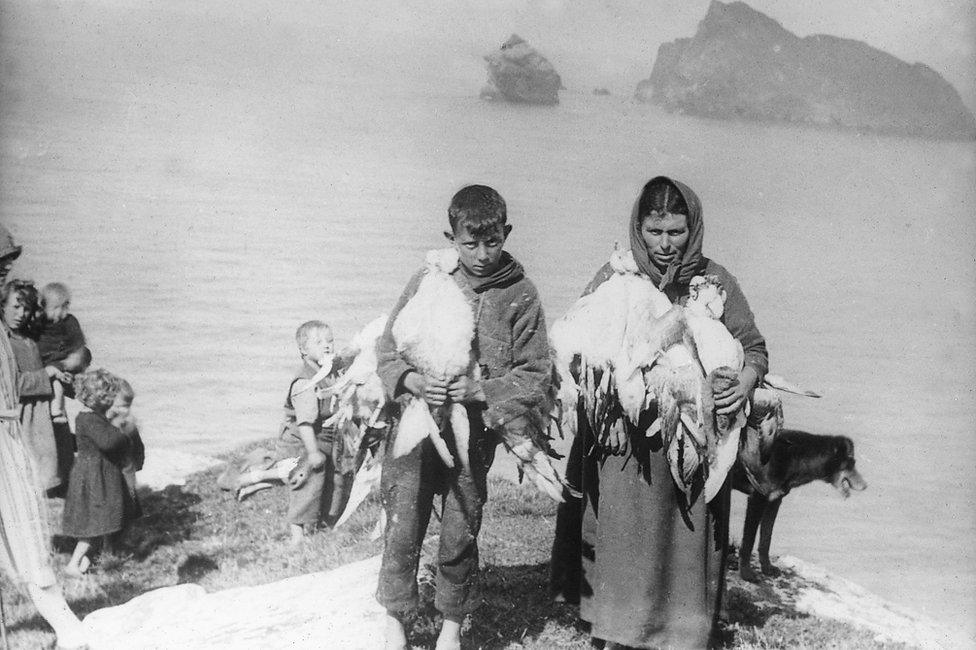
Nor was this a community untouched by commerce. In her recollections of a May 1930 visit, photographer and folklorist Margaret Fay Shaw described admiring a woman's headscarf and assuming it might be locally woven. Her host explained that it came from Glasgow. Shaw published the memory in 1980; the National Trust for Scotland reproduces it with material from the Canna Archives.[3] The anecdote is retrospective, but it usefully interrupts the picture of a sealed island world. Connections existed. Their reliability was another matter.
What consent establishes—and what it leaves open
In the Commons debate of 14 July 1930, ministers defended evacuation as a response to the inhabitants' wishes. Under-Secretary Thomas Johnston said he had visited every house and heard an earnest desire to avoid another winter. MP Thomas Ramsay challenged the policy, arguing that inadequate communications reflected neglect and that better transport should have been attempted.[4]
These arguments answer different questions. Johnston's account supports the urgency of the request under existing conditions. Ramsay asks whether those conditions should have been allowed to persist. His criticism need not erase the islanders' agency; their consent need not prove that every alternative had been exhausted.
The evidence here is strongest on the immediate decision. The petition and Johnston's reported interviews converge on a wish to leave before winter. Establishing that a viable alternative was available would require more than the suggestion of better communications: a workable service, dependable staffing and supplies, and evidence that residents wished to stay under those arrangements. The debate preserves that dispute without resolving the counterfactual.[1][4]
Turning departure into a livelihood
The government's first answers expose how much remained to be arranged. On 17 June 1930, Johnston told Parliament that the request had been accepted, but details of removal and placement were still being worked out. Asked about the sheep, he proposed selling them to help pay for evacuation, with any balance supporting the islanders afterward. He also promised attention to individual families' needs while ruling out resettlement as one body.[5]
Livestock therefore belonged to both sides of the journey: part of the island economy, then a possible resource for establishing life elsewhere. Agreeing to evacuate did not itself settle the practical questions of assets, employment, or household placement.
A contemporary Times dispatch, datelined 28 August 1930 and reproduced by the National Library of Scotland, records the work behind the departure. Sheep went out to the Dunara Castle in small boats. Loading continued late; personal possessions included chests, spinning wheels, querns, and furniture. Rough seas had already delayed the vessel.[6]
The report also describes visitors buying postcards and other souvenirs. That juxtaposition is revealing: while households sorted the things needed for a move, visitors sought objects to remember a disappearing way of life. The same shore served two very different purposes.
On 29 August, HMS Harebell carried the islanders away. Officials found forestry employment, and many evacuees settled near Lochaline, with others placed elsewhere in Scotland.[2] Those arrangements addressed the petition's demand for a future beyond arrival, though a placement record alone cannot measure how successfully each household adapted.
The letter's lasting force lies in how plainly it joins movement to subsistence. Its signatories had identified the labour their community was losing and the means they lacked to relocate. They asked government to help them carry a life across the water, with somewhere to put their furniture and work to begin afterward.
Sources
- St Kilda islanders, petition to Secretary of State William Adamson, 10 May 1930 — full transcription reproduced by the National Trust for Scotland in “90th anniversary of the evacuation of St Kilda” (8 May 2020).
- National Records of Scotland, “Stories from St Kilda” — archival context; petition AF57/26/3; Donald Gillies's exercise book GD1/817/1; and evacuation and resettlement records.
- Fiona J Mackenzie, Canna House Archivist, “St Kilda – the last summer” (14 May 2020), National Trust for Scotland — Margaret Fay Shaw's May 1930 visit, photographs, and recollections published in August 1980.
- House of Commons, “Department of Health for Scotland,” 14 July 1930, Hansard vol. 241 — especially columns 986–989 and 1010–1011, recording Ramsay's objections and Johnston's account of the islanders' wishes.
- House of Commons, “St. Kilda (Evacuation of Inhabitants),” 17 June 1930, Hansard vol. 240, columns 4–6 — acceptance of the petition, proposed sheep sales, and arrangements for individual families.
- National Library of Scotland, “1930 – Evacuation of St Kilda” — reproduction of a contemporary Times report datelined Lochmaddy, 28 August, describing loading, possessions, and souvenir purchases.
- BBC Scotland, photograph credit and identification.