The typewritten paper occupies the middle. Around it, animals and other painted forms extend across the bark; below the text sit signatures and official stamps. The two Yirrkala petitions presented to Australia's House of Representatives in August 1963 brought these elements into a single object. Parliament's reproduction lets us see how much would disappear if we read only the typed words.[1]
One small phrase in the English text nevertheless demands particular attention. The Yolngu petitioners asked Parliament to send a committee accompanied by “competent interpreters.” Hearing their case would require more than officials arriving to explain a decision already made. It would require a way for their own account to reach the people exercising power over their land.[5]
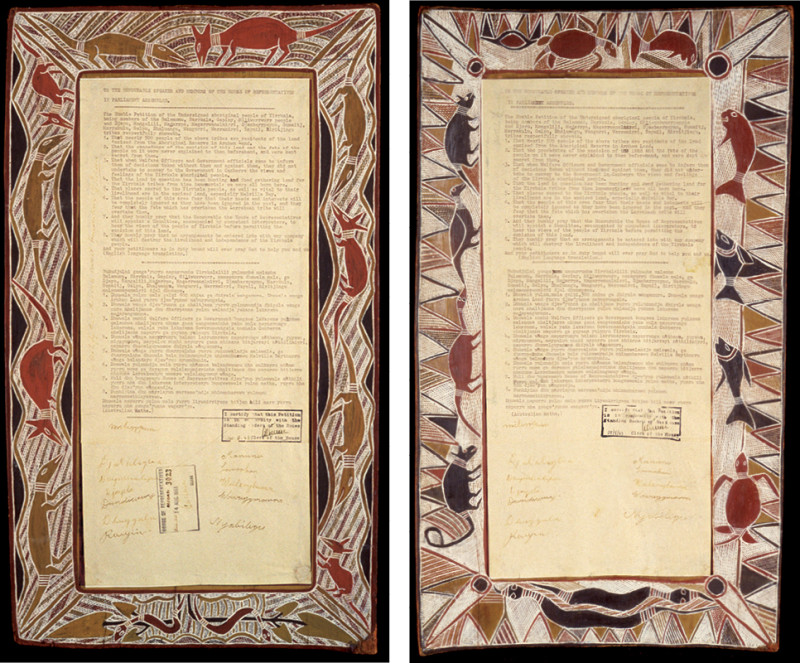
A document with more than one authority
On 13 March 1963, the Commonwealth removed more than 300 square kilometres from the Arnhem Land reserve to enable bauxite mining. Yolngu leaders objected to decisions taken without consulting them about their Country. The petitions reached Canberra after the excision, when the machinery they wanted to influence was already moving.[2]
Their material form mattered. As the Museum of Australian Democracy's Documenting Democracy account explains, the painted designs expressed Yolngu law and relationships to land. The paper followed Parliament's procedures for receiving a petition. Acceptance brought these forms together inside the House, but did not give them equal legal force.[2]
The clerk's stamp and the painting remain visible together. Looking at the whole object keeps its makers' presentation in view alongside the official act of receiving it.[1]
Historian Clare Wright reconstructs the collaboration behind that presentation. Visiting Yirrkala in July, MP Kim Beazley suggested a bark petition and supplied the parliamentary wording. Daymbalipu Mununggurr worked with Margaret Croxford on translation; Anne Wells typed the petitions. Clan leaders selected signatories, while senior artists supplied the paintings.[4]
Those connections help explain how the document could travel through Parliament's rules. They do not make its demands someone else's invention. Wright describes the paintings as gifts and a sharing of knowledge about land and ownership. The National Museum similarly explains that Yolngu understood Näku Dhäruk—the bark message—as a diplomatic offering between equal powers. The deferential English form therefore cannot, by itself, tell us how its makers understood their own standing.[3][4]
The sequence inside the request
Clauses two and three identify two failures: decisions were not explained beforehand, and officials did not undertake to carry the community's views back to Canberra. Information had travelled toward Yirrkala without a dependable return journey. Clause seven proposes a remedy: a hearing with interpreters before land is excised.[5]
The word before is crucial. Read against the March decision, it asks Parliament to interrupt a process already underway. Better explanation after the event would leave the petitioners in the same position. Their requested sequence makes listening part of deciding.
The final clause then sets a boundary around the outcome. Company arrangements must not destroy their “livelihood and independence.” The pairing matters: continued subsistence alone would not exhaust the request. This is a reading of the English text's argument, rather than a claim to translate the painted designs or every Yolngu understanding behind them.[5]
What the hearing changed
Parliament appointed a select committee on 12 September 1963. Its report, tabled on 29 October, confirmed that the administration had discussed excision with mission authorities rather than the Yolngu themselves. It also blamed inadequate language skills for confused communication afterward. On the separate allegation that officials had failed to relay local views, however, the committee said they had conveyed what they understood. Its agreement with the petition was substantial but qualified.[6]
The inquiry also acted on the request about language. Its September minutes sought interpreters whom witnesses trusted; the final report thanked five interpreters, three nominated by Aboriginal people and two by the mission. This was a concrete change in the conditions of the encounter.[6]
Yet the report's conclusion described the petition as an “appeal to the House of Representatives for protection.” That formulation placed Parliament in the role of guardian. Read beside the petition's demand for independence, it reveals how an institution could improve its listening while retaining its own account of the relationship.[5][6]
A hearing could leave ownership unanswered
The National Museum's history records the result plainly: the committee recommended protection for sacred sites, compensation for lost livelihood and continuing scrutiny, but did not recommend halting mining. The Yolngu took their claim to court in 1968 and lost the Gove land rights case in 1971. Their campaign became part of the longer struggle that produced the Aboriginal Land Rights (Northern Territory) Act in 1976.[3]
That later history should not turn the bark petitions into an easy story of inevitable progress. The Parliamentary Education Office distinguishes the committee's compensation response from the recognition of ownership the Yolngu sought. A response to injury could leave the underlying claim unanswered.[1]
Reading the petitions alongside the inquiry preserves both achievements and limits. The document brought Yolngu voices into a hearing conducted with interpreters. Its painted account of belonging entered Parliament together with its procedural demands. But receiving a claim, understanding it and accepting the authority it asserts remained different acts. The bark holds those acts together; the history shows the distance between them.[2][6]
Sources
- Parliamentary Education Office, “Yirrkala petitions” — archival image, object description, tabling dates and the distinction between compensation and ownership. Image credit: House of Representatives, Canberra.
- Museum of Australian Democracy, Documenting Democracy, “Yirrkala bark petitions 1963 (Cth)” — March excision, painted law, parliamentary form and the limits of recognition.
- National Museum of Australia, “Näku Dhäruk – Yirrkala bark petitions” — diplomatic meaning, committee recommendations and the subsequent land rights struggle.
- Clare Wright, “1963 – The Yirrkala Bark Petitions,” Australian Dictionary of Biography, The Quest for Indigenous Recognition — the petition's collaborative production and the paintings' significance.
- Yirrkala petitioners, bark petitions presented to the House of Representatives, August 1963 — English and Yolngu-language transcription, especially clauses 2–3 and 7–8; Documenting Democracy, pages 1–4.
- House of Representatives, Report from the Select Committee on Grievances of Yirrkala Aborigines, Arnhem Land Reserve, 29 October 1963, Parliamentary Paper 311 — paragraphs 4, 43–48, 77 and 88, and minutes of 19 September. The title retains the historical terminology.