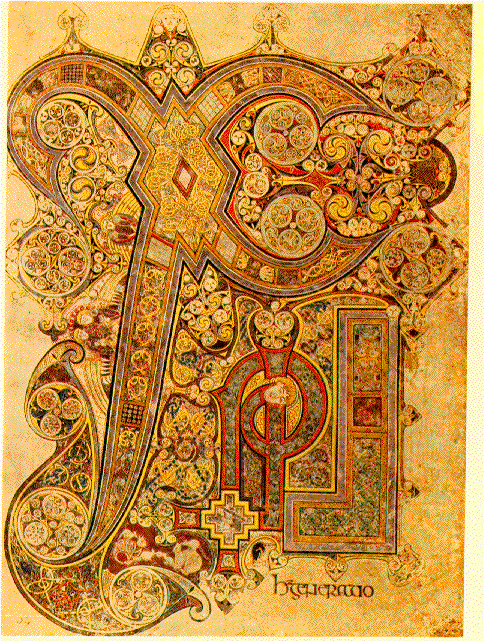
The Chi Rho page of the Book of Kells is often praised as beauty almost beyond explanation. That praise is not wrong, but it can make the page too harmless. Folio 34r is not only a dazzling manuscript image. It is a historical device for slowing the reader at a decisive threshold. At Matthew 1:18, where the narrative turns from genealogy to the birth of Christ, the first letters of Christ's name do not merely begin a sentence. They take over the page.[1][2]
That is the central clue. The Book of Kells was made close to the year 800, probably within the Columban monastic world associated with Iona and Kells, although Trinity College Dublin is careful to say the exact place of production remains contested.[2] It contains the four Gospels in Latin, written on vellum in insular majuscule, with prefatory apparatus and a level of decoration that Trinity describes as incomparable in extent and artistry.[2] The Chi Rho page is the manuscript's most famous act of that logic: writing becomes image, image becomes devotion, and devotion becomes public display.
Read closely, the page argues that a Gospel book could work by more than efficient reading. It could convert a name into a landscape dense enough to hold the viewer before the text moves on.
A page at the second beginning
The page marks a specific textual hinge. In Matthew, the genealogy has already traced descent. Then Matthew 1:18 begins the account of Christ's birth. The Greek letters Chi and Rho, joined with Iota in the Latin abbreviation for Christ, expand across folio 34r until the word is no longer only a word.[1][3] The page makes the first mention of Christ in the narrative visually unavoidable.
That matters because the manuscript's design does not treat all script alike. Trinity notes that the Book of Kells includes canon tables, evangelist symbols, Gospel openings, portraits, the Virgin and Child, Christ enthroned, and narrative scenes of Christ's arrest and temptation.[2] It is a book organized by moments of heightened arrival. Folio 34r belongs to that system, but it is also more radical. It does not illustrate a scene beside the text. It lets the first letters become the scene.
The result is a controlled delay. A reader cannot pass immediately from genealogy to nativity. The eye has to negotiate compartments, spirals, knots, animal forms, small figures, and the dominant sweep of the letter Chi.[1][3] This is not decoration added after meaning. It is meaning made by interruption. The page says: stop here; this name is not ordinary script.
Ornament as historical evidence
The manuscript page is also evidence for a particular kind of workshop intelligence. Trinity says three artists seem to have produced the major decorated pages, and the one responsible for the Chi Rho page was capable of ornament so fine that later observers compared the skill to a goldsmith's.[2] That comparison is useful because the page behaves like metalwork translated into vellum: intricate, compartmented, hard-edged, and minute enough to reward close inspection.
The page does not rely on gold leaf. Trinity's pigment summary names materials such as blue from indigo or woad, orpiment for a vibrant yellow, red lead or organic reds, and copper green, while also noting that recent research argues against the older idea that lapis lazuli was used.[2] That technical boundary keeps the page in a real economy of materials. Its splendor came from local and traded pigments, vellum preparation, scribal discipline, and labor, not from a vague miracle of medieval color.
The absence of gold is historically important. A later viewer might expect sacred luxury to declare itself through metallic shine. Kells does something subtler. It makes the page gleam through pattern, contrast, density, and the suggestion of precious surface. The "goldsmith" quality is not literal metal. It is a way of organizing attention so that ink and pigment behave like treasure.
That helps explain why the page still feels more active than many pictures with clearer figures. Its force is not only iconography. It is visual pressure. The letters hold the page; the ornament tests the boundary between letter and creature; the background refuses to become empty space. Even a reader who cannot parse the Latin would understand that this page is a threshold.
Hidden creatures and visible theology
Visit Trinity's guide to the Chi Rho page points readers toward animals, insects, snakes, angels, and other figures hidden inside the interlace and pattern.[3] These are not casual marginal amusements. They make the name-world feel inhabited. The page turns a monogram into a miniature creation, a sacred ecology where human, angelic, animal, and ornamental forms share the same surface.
The hiddenness matters. A large, simple icon would deliver meaning quickly. Folio 34r rewards duration. The viewer finds more by staying longer. This kind of looking fits a ceremonial Gospel book better than a daily working copy. Trinity's page on the manuscript states that the transcription can be careless, with omitted words and repeated text, and that this combination of textual carelessness with sumptuous display has led scholars to see it as designed for special liturgical occasions rather than ordinary service use.[2]
That observation should not be misunderstood as an insult to the scribes. It clarifies the book's function. Kells was not optimized like a portable reference Bible. It was a display object, a liturgical object, and eventually a relic-like object associated with St Colum Cille.[2][4] The Chi Rho page performs exactly that role. It does not help a hurried reader find a chapter. It helps a community see that the Gospel has entered sacred time.
The page's theology is therefore material. The Incarnation is not explained in a paragraph. It is staged as a transformation of letters into living ornament. The name of Christ becomes too large for ordinary script and too intricate for a single glance.
A book made for veneration, not only use
The later history of the manuscript confirms that people did not treat it as a neutral text carrier. The Annals of Ulster entry preserved through the Corpus of Electronic Texts says that the great Gospel of Colum Cille was stolen at Kells in 1006 or 1007, taken from the church, then found after two months and twenty nights with its gold removed and a sod over it.[4] Trinity also summarizes the episode, describing the book as stolen for its ornamental cumdach, or shrine.[2]
The theft is revealing. The thieves apparently wanted the valuable cover, not the manuscript as a readable book.[2][4] Yet the annalistic language makes clear that the Gospel itself was already a chief treasure, bound to place, saint, and community memory.[4] The Book of Kells was not simply stored at Kells. It mattered there.
That episode also changes how folio 34r should be read. The page survived not as a pristine museum image but as part of a vulnerable object: covered, stolen, stripped, recovered, handled, trimmed, rebound, displayed, and digitized. Trinity notes that around 30 folios went missing in the medieval and early modern periods, that the book was sent to Dublin around 1653 for safety, reached Trinity College in 1661, and has been bound in four volumes since 1953.[2] The page's beauty is inseparable from that custody chain.
A close reading therefore has to hold two scales together. On the folio, Christ's abbreviated name expands into a universe. In history, the physical book moves through monastic devotion, theft, church ruin, college custody, public exhibition, conservation, and modern image circulation. The page is both an early medieval threshold and a later heritage object.
The origin debate is part of the evidence
The Book of Kells is often claimed in national terms, but the manuscript itself resists a simple border. Trinity says the majority academic opinion tends to attribute it to Iona's scriptorium, while other claims have located it in Northumbria or Pictland; after the 806 Viking raid on Iona, Columban monks took refuge at Kells, and the two communities remained closely connected.[2] The safest statement is not that one modern nation owns the origin story. It is that the book belongs to a mobile Insular Christian world.
Folio 34r makes that mobility visible in style rather than itinerary. Its interlace, animal forms, script, pigment work, and Gospel structure belong to a culture of books moving through monastic networks across Ireland, Scotland, and northern Britain. The page's refusal to separate word, image, and ornament is not provincial excess. It is a sophisticated solution to a ceremonial problem: how to make sacred text visible as sacred before anyone has finished reading it.
This is why the Chi Rho page remains more than a famous image. It is a historical argument about attention. Around 800, a monastic workshop made a Gospel page in which the first letters of Christ's name became architecture, creature, ornament, and pause. In 1006/1007, the book's theft showed that it had become treasure as much as text. In 1661, its arrival at Trinity placed it inside a new custodial history. In the present, the same folio circulates as a photographed manuscript image, detached from the dim conditions in which the original must be protected, but still powerful enough to slow the eye.
The best reading of folio 34r does not choose between art and document. It is both. As art, the page overwhelms the normal boundary of lettering. As document, it records how an early medieval community made authority visible: through vellum, pigments, script, hidden creatures, ceremonial delay, and the public weight of a sacred name. The Book of Kells turns Christ's name into a whole landscape because ordinary writing was not enough for the moment it wanted the reader to enter.
Sources
- Wikimedia Commons, "File:Book of Kells ChiRho Folio 34R.png" - source page for the real photographic reproduction of folio 34r used as the article image.
- Trinity College Dublin Library, "The Book of Kells" - institutional overview of MS 58, contents, date and origin debate, decoration, pigments, use, theft, custody, display, and folio loss.
- Visit Trinity, "Symbolism in the Book of Kells: the Chi Rho page" - guide to the Chi Rho monogram, hidden animals, angels, and symbolic detail on folio 34r.
- Corpus of Electronic Texts, University College Cork, "The Irish Charters in the Book of Kells" - O'Donovan edition preserving the Annals of Ulster notice of the 1006/1007 theft and recovery.