The Concert for Bangladesh is easy to remember as a lineup: George Harrison, Ravi Shankar, Bob Dylan, Ringo Starr, Eric Clapton, Billy Preston, Leon Russell, Ali Akbar Khan, and other musicians under the lights at Madison Square Garden. That memory is not wrong, but it misses the mechanism. On August 1, 1971, the concert worked because it turned an enormous refugee emergency into a dated, ticketed, recordable public act. A crisis that many listeners could barely locate on a map became something they could attend, buy, replay, and explain to someone else.[2][3][4]
The emergency behind the stage had begun months earlier. The Bangladesh Liberation War followed the Pakistani military crackdown in East Pakistan in March 1971, after the West Pakistan-based government refused to honor the Awami League's electoral mandate. Britannica dates Operation Searchlight to March 25, 1971, and the declaration of Bangladesh's independence to March 26; it also places the war's military end on December 16, 1971, when Pakistani troops in East Pakistan surrendered.[1] In between came mass killing, sexual violence, village destruction, guerrilla war, Indian involvement, and civilian flight on a scale too large for ordinary charity language to hold.[1]
The United Nations in Bangladesh later summarized the refugee dimension with one hard figure: in March 1971, millions sought refuge in India, and UNHCR took the lead in coordinating assistance to 10 million Bengali refugees with the Indian government and UN agencies including UNICEF.[2] George Harrison's own concert-film page uses the same August 1971 horizon: by the time Harrison, Shankar, and friends took the Madison Square Garden stage, 10 million East Pakistani refugees had crossed into India with hunger and disease threatening survival.[4] The concert did not create the crisis. Its historical importance lies in how it made that crisis audible in a media environment where Cold War diplomacy, distance, and unfamiliar names could otherwise keep suffering abstract.
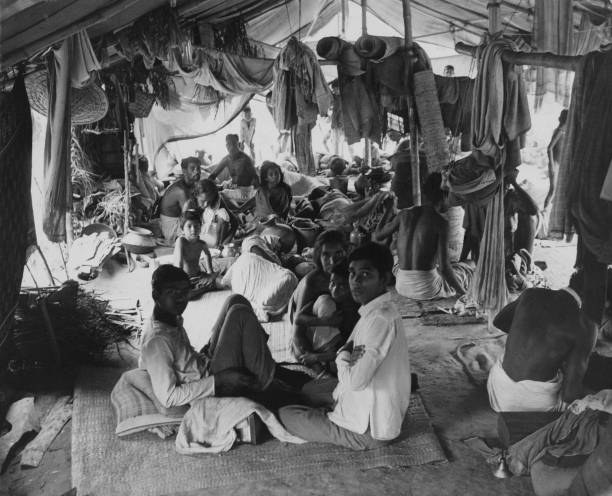
The crisis needed translation
East Pakistan's crisis was not invisible because nothing was happening. It was difficult to translate because too much was happening at once. The war grew out of a long political fracture between Pakistan's western and eastern wings after 1947, sharpened by language politics, economic imbalance, the Awami League's autonomy demands, the 1970 election, and the devastation left by the Bhola cyclone.[1][4] By spring 1971, the military crackdown and resistance had produced a conflict whose names and geography were unfamiliar to many Western listeners.
That is where Ravi Shankar's role matters. The George Harrison release page frames the beginning personally: Harrison heard Shankar's distress and helped organize the concert at Madison Square Garden.[3] UNICEF's later history of music-led giving makes the same originating move more explicitly institutional: Ravi Shankar teamed with Harrison to stage a major rock benefit in New York City, raising funds and support for the humanitarian crisis in East Pakistan, now Bangladesh.[5] The word "teamed" can sound small beside a refugee crisis, but historically it was the bridge. Shankar supplied urgency, cultural authority, and personal trust. Harrison supplied access to a rock audience, recording infrastructure, and a network of performers who could make news simply by agreeing to appear.
The translation was therefore not only musical. It was logistical and emotional. Shankar and Harrison had to convert "East Pakistan," "Bangladesh," "refugees in India," "UNICEF relief," and "civil war" into a form that a New York audience could understand without first studying South Asian political history. A concert could not explain every cause. It could, however, create a public question: if this mattered enough for these artists to assemble here today, what exactly is happening?
One day became an organizing machine
The event's most important design choice was compression. Rather than a diffuse appeal, the organizers created a single day at a single venue. George Harrison's album page says the Concert for Bangladesh was originally released in 1971 and identifies the Madison Square Garden event as an ambitious humanitarian effort in rock history that focused global attention on the Bangladesh crisis while raising awareness of UNICEF's role in the developing world.[3] UNICEF calls the August 1 event the first major rock benefit concert in New York City and says it galvanized global support for the humanitarian crisis.[5] The exact wording matters less than the structure: celebrity performance was being connected to humanitarian relief as a repeatable public format.
Madison Square Garden gave the appeal scale and credibility. It was not a private salon, a campus teach-in, or a small fundraiser. It was a major New York arena, the kind of room whose occupancy, press access, and technical machinery could make a distant emergency feel like a present-tense event. Harrison's concert-film page emphasizes that little public attention had been drawn to the crisis before then and that few people outside the region knew how the catastrophe had come about or what a concerned individual could do.[4] The concert answered that second problem with a simple act: buy a ticket, buy the record or film later, and let the proceeds and attention move through UNICEF-linked relief channels.[3][5]
The show also solved a credibility problem common to celebrity activism. It did not ask listeners to trust fame alone. Shankar's opening presence connected the appeal to South Asian artistic authority and to the people whose suffering was being named. Harrison's network brought Western audience reach. UNICEF and the wider UN relief system supplied an institutional path capable of absorbing money and translating public sympathy into assistance.[2][5] None of those pieces would have been sufficient by itself. Together they made a bridge between witness, performance, donation, and institutional delivery.
The recording turned an event into a memory system
The Concert for Bangladesh did not end when the house lights came up. Its album and film afterlife mattered because the event's audience could expand beyond the people physically present on August 1. The George Harrison release page lists the live album's track structure and presents the release as part of the continuing Concert for Bangladesh legacy.[3] The film page, released decades later in restored circulation, keeps the same historical frame: by August 1971, the stage had become a way to force attention onto a refugee emergency that otherwise remained under-recognized outside the region.[4]
That afterlife changed the relief appeal's time scale. A normal benefit night can raise money and then disappear into memory. A recorded benefit can keep recruiting witnesses. People who were not in New York could encounter the event in a shop, on television, through a film screening, or later through digital circulation. That meant the concert became both a fundraiser and an archive of the appeal. It preserved not only performances but a public posture: famous musicians publicly accepting that a humanitarian emergency required them to lend their audience.
This is also where the event's limitations become visible. A concert can concentrate attention, but it can simplify causes. It can make suffering legible through famous intermediaries while the people most affected remain represented rather than fully heard. It can raise awareness without resolving how money moves, how governments act, or how wars end. The careful historical claim is not that the Concert for Bangladesh saved Bangladesh. The war's outcome depended on Bengali resistance, Pakistani military decisions, Indian intervention, global diplomacy, and events far beyond Madison Square Garden.[1] The concert's achievement was narrower and still important: it made a vast emergency harder for distant publics to ignore.
Relief became a public culture
Seen from later decades, the concert looks like a template for Live Aid, Farm Aid, Amnesty-linked concerts, disaster telethons, and celebrity humanitarian campaigns. That retrospective view can flatten the 1971 event into a "first" and stop there. The better reconstruction keeps the specific historical pressure in view. The Concert for Bangladesh happened during an active war, before Bangladesh's formal victory in December 1971, while millions of refugees were still dependent on relief infrastructure in India.[1][2] It was not a commemorative charity evening after the fact. It was a live intervention in public attention while the disaster was still unfolding.
The UNICEF afterlife reinforces that point. UNICEF's 2025 account says music from the concert remains available on major streaming platforms and that net streaming proceeds still go to UNICEF programs in Bangladesh and elsewhere.[5] That continuity is not only a memorial to Harrison. It shows that the 1971 concert helped bind a style of public feeling to a relief institution. The audience was not just asked to feel sad about Bangladesh; it was asked to understand UNICEF as a channel through which concern could act.[3][5]
The phrase "made a refugee crisis audible" is therefore literal and structural. The concert used sound to carry news, but its deeper mechanism was organizational. Shankar's distress became Harrison's call. Harrison's call became a booked arena. The arena became a press event. The press event became an album and film. The album and film became continuing revenue and memory. UNICEF became the institutional route through which public attention could be attached to relief.[2][3][5]
That chain did not solve the moral problem of representation, and it did not replace political responsibility. It did something more specific: it created a usable form for emergency attention. In 1971, Bangladesh's refugees needed food, shelter, medical care, safety, and political resolution. A concert could not provide all of that. But on one August day in New York, it made the distance between a stage and a refugee camp feel less like an excuse. That was the historical innovation: not charity as sentiment, but performance as a machine for making distant obligation public.
Sources
- Roland Martin and Encyclopaedia Britannica editors, "Bangladesh Liberation War" - background on the 1971 war, Operation Searchlight, refugee displacement, Indian intervention, and the December 16 surrender.
- United Nations in Bangladesh, "The United Nations in Bangladesh" - institutional overview noting the 1971 refugee flight to India and UNHCR coordination of assistance to 10 million Bengali refugees.
- George Harrison official site, "The Concert for Bangladesh" - release page describing the 1971 album, Madison Square Garden benefit, refugee crisis framing, track listing, and UNICEF legacy.
- George Harrison official site, "Concert for Bangladesh" - film page summarizing the August 1971 refugee emergency, background to East Pakistan/Bangladesh, and the concert's public-attention purpose.
- UNICEF, "Greatest hits for humanity: A history of music and giving" - UNICEF account of Ravi Shankar and George Harrison's 1971 benefit concert, its UNICEF fundraising legacy, and later music-led humanitarian campaigns.
- Getty Images, "Refugees in a makeshift camp at Bongaon" - June 26, 1971 photograph of refugees fleeing fighting on the India-Pakistan border during the Bangladesh Liberation War, used as the article image.