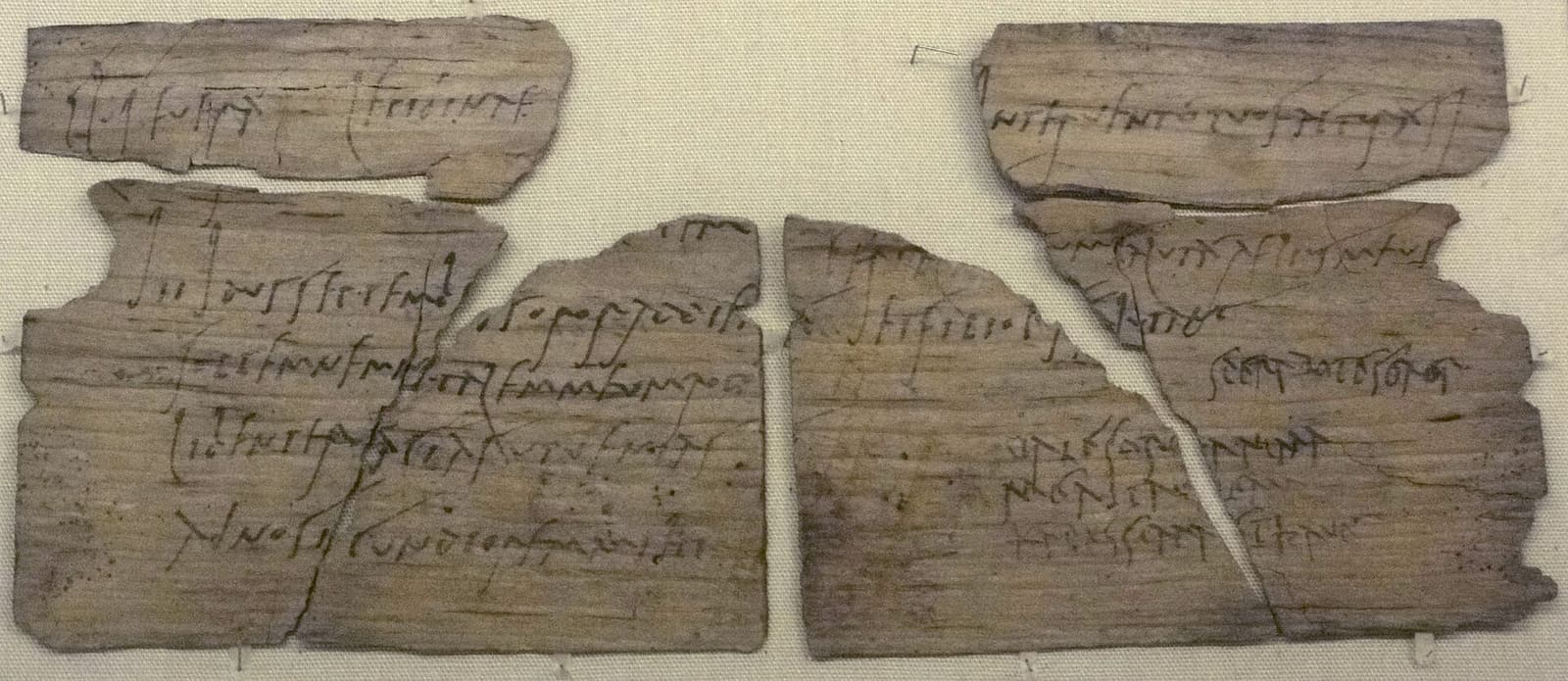
The Vindolanda tablets are easy to sentimentalize because one of the most famous pieces is a birthday invitation. Claudia Severa asks Sulpicia Lepidina to come on September 11, around AD 100, and the tablet is famous because it preserves a rare personal female hand from Roman Britain.[2][5] That intimacy matters. But the deeper historical question is mechanical: how did a damp military settlement near the northern edge of Roman Britain preserve hundreds of voices that were never meant to last?
The answer is not that Romans carefully archived their most charming letters for us. The tablets survived because a frontier fort produced routine paperwork, periodically cleared it out, failed to burn some of it, and buried it in wet, oxygen-poor ground. Later excavation, conservation, infrared photography, palaeography, and digital publication converted those scraps into evidence.[2][3][4] Vindolanda changes Roman frontier history because it catches administration at the moment it was still ordinary.
The cover image fixes the scale of that claim.[1] Tablet 291 is not a marble inscription, triumphal arch, imperial coin, or carved official dedication. It is a thin wooden writing tablet with ink lines, damaged edges, and a message moving between women attached to military households. The object is small enough to feel disposable. That is exactly why it matters.
Paperwork before stone
Vindolanda sat in present-day Northumberland, south of what would become Hadrian's Wall, the northern frontier work begun under Hadrian around AD 122.[6] Roman Inscriptions of Britain describes the Vindolanda corpus as nearly 780 texts on thin sheets of wood, composed across less than fifty years in the late first and early second centuries at the fort.[2] Oxford's Centre for the Study of Ancient Documents places the tablets in that same frontier period and notes their importance for military history, social history, and Latin language evidence.[3]
Those numbers matter because they move the evidence away from spectacle. Roman frontiers are often remembered through walls, forts, roads, altars, and tombstones. Vindolanda adds a different layer: leave requests, supply lists, strength reports, accounts, invitations, debts, names, deliveries, and complaints. Roman Inscriptions of Britain frames the corpus as a source for military and social history, not only as a curiosity of handwriting.[2] In other words, writing was not an occasional ceremonial act. It was part of the fort's daily operating system.
That operating system was social as well as military. The birthday invitation is famous because it draws women and families into the frontier picture, not as decorative background but as letter writers, hosts, guests, and correspondents.[2][5] The Vindolanda Trust notes that the closing lines were written in Severa's own hand, making the tablet important evidence for female literacy in Roman Britain.[5] Other tablets point toward unofficial households, debts, work roles, and contacts among soldiers from different regions of the empire.[5] The frontier becomes less like a bare military edge and more like a living administrative community.
Why the mud mattered
The preservation mechanism was accidental but not random. The British Museum explains that Vindolanda was rebuilt or remodelled several times; when documents were cleared out, some were dumped, and attempts to burn them seem to have failed because the ground was wet or rain intervened.[2] The Vindolanda Trust's account of the first discovery describes excavations in 1973 reaching anaerobic, oxygen-free levels that preserved wood, leather, and textiles.[4]
That is the hinge. In most Roman sites, ink on thin wood would vanish. At Vindolanda, damp anaerobic deposits slowed decay enough for carbon-based ink to remain recoverable.[4] The same wetness that made a northern fort uncomfortable for soldiers made its rubbish archaeologically legible. The archive was created by disposal, failed destruction, and burial conditions.
This changes how we should think about survival bias. The tablets are not a representative filing cabinet preserved whole. They are what escaped fire, rot, disturbance, and later excavation loss. That limitation is part of their value. They show the historian a slice of routine communication precisely because no one selected them as monumental memory. A strength report survived beside social correspondence because both belonged to the same world of temporary documents.
Discovery depended on seeing ink again
The modern recovery had its own mechanism. Patricia Birley's recollection for the Vindolanda Trust dates the first writing-tablet discovery to March 23, 1973, when a very thin dark fragment from a deep excavation seemed to carry marks.[4] The next stage was not instant translation. The fragment was kept wet, taken for expert inspection, and then sent toward infrared photography because ordinary viewing could not reliably reveal the carbon ink.[4]
That sequence is important because the tablets did not simply reappear as readable letters. They had to be recognized as a class of object. Birley's account says that once the first fragment was understood, excavators refined the process of finding more, and the first tablets went to the British Museum for conservation.[4] What looks inevitable in a museum case was, in the trench, a fragile habit of noticing: thin black wood, possible marks, waterlogged transport, photography, conservation, then specialist reading.
Oxford's digital publication work is the later continuation of the same chain. CSAD says the older Vindolanda Tablets Online project has been superseded by the full online edition at Roman Inscriptions of Britain, with published tablets digitized for wider access.[3] The historical mechanism therefore has two preservation stages. Wet ground preserved the physical writing; modern imaging, editing, and online publication preserved the reading environment.
What the tablets make visible
The tablets matter most when they make large frontier systems visible through small transactions. A fort needs food, animal products, building material, personnel records, reports, and social trust. A household needs visits, greetings, favors, and news. A soldier needs orders, credit, clothing, and connections. Vindolanda lets those needs show up in handwriting rather than in later summary.
That is why the birthday invitation should not be treated as cute marginalia. It is evidence that elite military households near the frontier exchanged written invitations, that women could participate in Latin correspondence, and that the social world around an auxiliary fort had rhythms of friendship, obligation, and ceremony.[2][5] The tablet is intimate because the frontier was administrative enough to make intimacy writable.
The same logic applies to the military documents. Reports and accounts may look drier than Severa's invitation, but they show the kind of information that wooden paperwork carried: personnel, supplies, credit, requests, deliveries, and responsibility moved through written records before some of those records entered the disposal stream.[2][3][5]
The causal chain is therefore compact but powerful. Roman frontier life produced routine writing. Fort maintenance produced rubbish deposits. Northumbrian wetness protected fragile organic material. Archaeologists learned to notice and conserve the pieces. Infrared photography and palaeographic work recovered ink. Digital editions made the corpus searchable and teachable.[2][3][4] At each stage, a weak survival path became stronger.
A frontier archive made by accident
Vindolanda's tablets have become famous because they feel immediate. That immediacy is earned, but it should not obscure the harder lesson. Most ancient lives do not vanish because they were uninteresting. They vanish because their media were perishable, their paperwork was discarded, their rubbish burned cleanly, or their sites dried, rotted, and were dug without recognition. Vindolanda is exceptional because a chain of ordinary failures worked in the historian's favor.
The fort's people did not intend to leave a democratic archive of Roman Britain. They wrote to run a unit, manage supplies, keep relationships alive, and move information across a frontier community. Then some of that writing was thrown away. The mud did what memory usually does not: it kept the temporary from disappearing.
That is why the Vindolanda tablets alter the scale of Roman history. They do not replace emperors, campaigns, walls, or official inscriptions. They force those structures to share the page with socks, invitations, strength figures, work roles, credit, names, and handwriting. The frontier becomes legible not only as a line on a map but as a place where people wrote because life had to be coordinated.
Sources
- Wikimedia Commons, "File:Vindolanda tablet 291.jpg" - source page for the photograph of the Claudia Severa birthday invitation tablet used as the article image.
- Roman Inscriptions of Britain, "Vindolanda Tablets - Home" - active online corpus page describing nearly 780 thin-wood texts from Vindolanda and their military, social, and linguistic importance.
- Centre for the Study of Ancient Documents, University of Oxford, "Vindolanda Tablets Online" - project page explaining the corpus, date range, published text count, and migration to Roman Inscriptions of Britain online editions.
- Patricia Birley, Vindolanda Trust, "Finding the first Vindolanda Writing Tablet" - first-person account of the March 23, 1973 discovery, anaerobic deposits, infrared photography, and early conservation chain.
- Vindolanda Trust, "Writing tablets" - educational fact file on stylus tablets, ink tablets, the scale of the collection, Claudia Severa's invitation, and other examples of fort life.
- North East Museums, "Hadrian's Wall" - museum overview of the wall as an AD 122 frontier work running from Wallsend to Bowness.