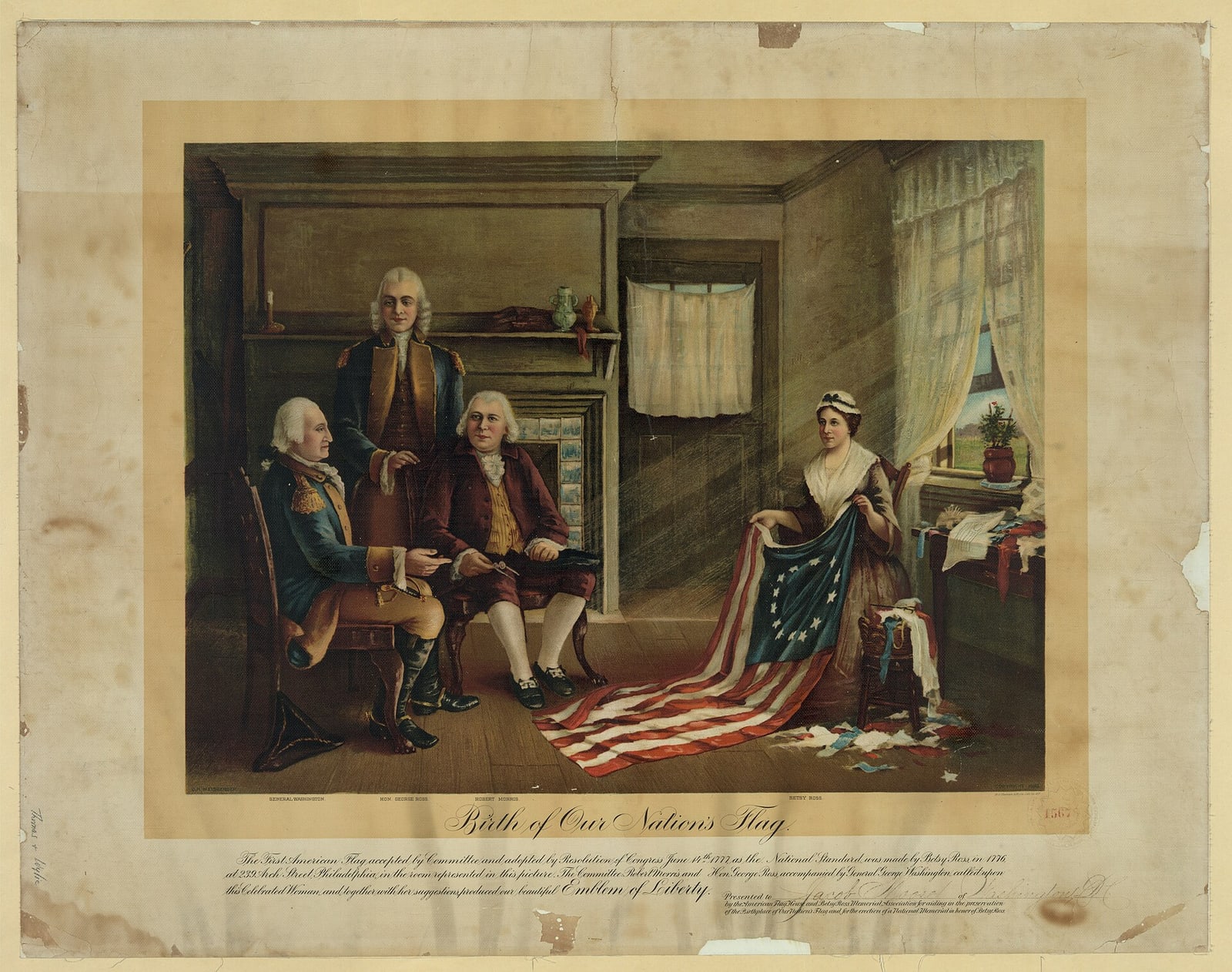
The room is almost too persuasive. George Washington leans toward a new flag. Robert Morris sits beside him. George Ross stands behind the chairs. Across the parlor, Betsy Ross holds the blue canton while thirteen stars curve in a neat white circle. Scraps of red, white, and blue cloth lie beside her worktable. Everyone necessary to the national origin story has arrived, and the evidence appears to be resting in their laps.
Except the picture was published in 1893, not painted from life in 1776. Charles H. Weisgerber’s Birth of Our Nation’s Flag gave a family account the visual grammar of an eyewitness scene more than a century after the supposed meeting. The image is genuine archival evidence—but evidence for how the legend became convincing, not for how the first United States flag was made.[6][7]
The careful verdict is neither “Betsy Ross invented the flag” nor “Betsy Ross had nothing to do with flags.” She was a real Philadelphia upholsterer with a substantial, documented flag-making career. What cannot be demonstrated is the most famous episode: that Washington and a congressional committee visited her shop, that she corrected their six-pointed stars with one fold and one cut, and that she made the first Stars and Stripes from their revised sketch.[2][3] The myth survives by turning a possible event into an exclusive act of creation—and by letting a late picture fill an early silence.
The official record begins with a specification, not a scene
On June 14, 1777, the Continental Congress resolved that the United States flag should have thirteen alternating red-and-white stripes and thirteen white stars in a blue field, representing a new constellation.[1] The resolution is striking for what it does not say. It names no designer or maker. It does not determine whether a star has five or six points. It does not prescribe a circle, rows, or any other arrangement. It does not record a committee visit to an upholstery shop.
That silence cannot, by itself, disprove the Ross account. Flags could be prototyped before Congress described them, and routine wartime craft did not always leave the paperwork historians would now want. The family story places the meeting in June 1776, roughly a year before the resolution. If the episode occurred informally, the congressional journal might never have carried it.
But silence changes the burden of proof. A later witness cannot point to the 1777 resolution as confirmation of the parlor meeting, because the resolution confirms only a spare design vocabulary. The familiar circle of stars is one compliant arrangement among several, not a pattern Congress specified. “First flag” therefore hides at least three separate questions: who helped devise the national specification, who drew a particular arrangement, and who sewed the first physical example. One person need not have done all three.
Ross belongs securely in the third world—the world of making—even if the superlative remains uncertain. The official Senate history Our Flag distinguishes the claims cleanly: records show that she produced colors for the Pennsylvania State Navy in 1777 and continued making flags, but they do not prove that she made the first Stars and Stripes.[2] Historian Marla Miller’s reconstruction goes wider. Ross and her family worked in upholstery for decades, supplying interiors, bedding, and flags; surviving receipts and ledgers place her among the important working flagmakers of Revolutionary and early-national Philadelphia.[3]
That is not a consolation prize. It is a different kind of history—one based on repeated labor rather than one miraculous commission.
What the family account can carry
The famous story entered public debate in 1870, when Ross’s grandson William J. Canby presented it to the Historical Society of Pennsylvania. Ross had died in 1836, when Canby was eleven. His evidence was family memory: he said he had heard the account from Ross, and other relatives supplied recollections and later affidavits.[2][3][4]
Those statements deserve more than a sneer. Oral testimony can preserve events that formal archives ignore, especially the work of women whose shop papers were not treated as national records. Several relatives recalled a common core: Washington, Robert Morris, and George Ross came to the shop; Ross suggested changes; she demonstrated a five-pointed star; and she made a specimen. The story also fits some circumstantial facts. Ross was in the right trade, in the right city, connected by marriage to George Ross, and demonstrably capable of government flag work.[2][3]
Yet the affidavits do not become independent contemporary witnesses merely because several people signed them. They record relatives remembering what Ross had reportedly told them, decades after the alleged meeting. Their agreement may preserve a real family tradition; it may also show a shared tradition becoming more detailed as it was repeated. Neither possibility can be resolved by counting affidavits alone.
The expanding detail is visible in a 1909 booklet assembled from the family case. It does not stop at a committee and a flag. It presents sworn accounts, locates furniture and rooms, describes Washington redrawing the design, and even opens with an affidavit authenticating a floorboard taken from the reputed flag house.[4] That floorboard may document the building. It cannot document the conversation. Material proximity gives the narrative texture without closing the evidentiary gap.
This is the strongest version of the pro-Ross reading: a working woman’s contribution survived because descendants preserved an oral account that official clerks never recorded. Its strongest objection is equally clear: the story surfaced publicly ninety-four years after the claimed event, with no known letter, diary, committee minute, shop account, or dated flag connecting Ross to that first national specimen.[2][3]
Hopkinson’s claim is stronger—and still incomplete
Francis Hopkinson offers a different paper trail. In 1780, he submitted an account for design work performed for the United States. The congressional record describes the “fancy work” and its editorial documentation identifies designs for the naval flag, official seals, and currency among the items. The Treasury Board rejected payment, citing missing vouchers, the involvement of other people in some designs, and the expectation that a salaried official would provide such public service without an extra fee.[5]
Hopkinson’s claim matters because it is contemporary and written in his own interest. It is harder evidence for design work than a family account first made public in 1870. The official Senate history accordingly identifies him as the person most likely to have designed the first Stars and Stripes.[2]
It still does not hand us one finished, indisputable first flag. The payment dispute does not preserve a signed drawing that can be matched to a surviving object. The Board’s answer also resists sole credit. Most importantly, Hopkinson’s design work and Ross’s sewing work are not mutually exclusive. A designer could prepare a device; a committee could alter it; several makers could turn loose instructions into different flags. The archive is warning against the very thing the legend supplies: a single clean room in which design, approval, manufacture, and national birth happen at once.
The reasonable comparison is therefore asymmetric. Hopkinson has a near-contemporary documentary claim to design work. Ross has strong documentary evidence of flag-making and a late oral claim to the first specimen. Neither record justifies treating the circle-of-stars flag as a standardized original produced entirely by one pair of hands.
The painting did what the archive could not
By 1893, the Ross story had something the 1770s record lacked: a complete scene. Weisgerber’s painting appeared at the World’s Columbian Exposition and then circulated through inexpensive prints. The Smithsonian connects its success to the late-nineteenth-century rise of “flag fever,” when the national banner acquired a newly intense place in civic ritual and patriotic education.[6]
The picture solved several narrative problems at once. It turned oral testimony into visible action. It placed three famous men in the room as guarantors. It made Ross’s craft legible through cloth, scissors, and scraps. It supplied the circular constellation that Congress never specified. It also compressed a messy production system—legislators, naval boards, designers, textile workers, multiple prototypes—into a domestic tableau with one heroine.
That compression was emotionally useful. The United States already had founders who declared, debated, commanded, and signed. Ross gave the flag a maker, and gave national origins a respectable working woman whose skill could be represented without disturbing the familiar hierarchy around her. She is active, but Washington still inspects; her suggestion improves the emblem, but the committee still authorizes it.
The image’s worn paper, printed caption, and visible edge damage now make it especially valuable. They keep us from confusing the artifact with the scene it depicts. This is a late-nineteenth-century object that tells us exactly how a possible workshop memory became public history: assertion below the picture, famous faces inside it, repetition after it.[6][7]
Two readings, one missing document
The strongest charitable reading says the family preserved the outline of a real meeting. Ross’s occupation, kinship connection, known government work, and the consistency of the core recollection make the episode possible. Archives are not neutral inventories of everything that happened, and the absence of a receipt is not proof that no needle touched cloth.[2][3][4]
The strongest skeptical reading says possibility hardened into certainty during the nation’s centennial era. A family tradition appeared after the principal actors were dead, acquired affidavits and architectural detail, then received a powerful painted scene at the moment Americans were investing the flag with new civic meaning.[2][4][6] On this reading, the legend’s precision is not accumulated confirmation. It is the product of retelling.
What would change the assessment? A dated 1776 letter naming the visit, a committee record commissioning Ross, a shop ledger tied to a national specimen, or an early flag with a documented chain back to her workshop would move the claim toward fact. Evidence that the core story was invented by a particular descendant would move it toward fabrication. None is presently part of the cited record.
The best verdict is narrower: Ross may have participated in making an early national flag, but the claim that she designed and sewed the first one is not established. The circle arrangement, the five-point-star demonstration, and the Washington meeting belong to a family tradition whose plausibility exceeds its proof.
The woman survives the superlative
Removing “first” does not remove Betsy Ross. It reveals a craftswoman whose historical importance does not depend on one unreceipted afternoon. She navigated war, widowhood, religious rupture, family responsibility, and a long working life. Her shop turned political symbols into durable objects because cutting, piecing, painting, contracting, and delivering were work—not because destiny briefly entered the parlor.[3]
The myth makes national creation look instantaneous. The evidence makes it distributed. Congress supplied a minimal specification. Designers and officials developed devices. Textile workers interpreted incomplete directions. Families remembered. Museums and publishers selected what later generations could see. The flag emerged from that chain, not from one frozen tableau.
Weisgerber’s image should stay at the top of the story, but with its date visible. It is not a counterfeit window onto 1776. It is an honest artifact of 1893: the moment a nation learned to picture uncertainty as memory.
Sources
- Library of Congress, Journals of the Continental Congress, 1774–1789, vol. 8 (1777), p. 464 — primary record of the June 14 flag resolution and its limited design specification.
- United States Senate, Our Flag, S. Doc. 105-13 (1998) — official history reproducing Canby’s account while separating Ross’s documented flag contracts from the unproven first-flag claim.
- Marla R. Miller, excerpt from Betsy Ross and the Making of America, via the Museum of the American Revolution (2017) — scholarly reconstruction of Ross’s working life, surviving evidence, family memory, and importance beyond the legend.
- Oliver Randolph Parry, Betsy Ross and the United States Flag (1909), digitized by the Internet Archive — an early compilation of the descendants’ case, affidavits, house claims, and material relics.
- Library of Congress, Journals of the Continental Congress, 1774–1789, vol. 18 (1780), pp. 983–985 — Treasury report on Francis Hopkinson’s design account and the editorial identification of his naval-flag work.
- Smithsonian National Museum of American History, “Resources: FAQs” — curatorial account of Weisgerber’s 1893 painting, its mass circulation, and the cultural conditions that fixed the Ross legend.
- Wikimedia Commons, “Birth of our nation’s flag — C. H. Weisgerber” — source page for the 1893 Library of Congress chromolithograph used as the article image.