In August 1858, Europe and North America appeared to have conquered the Atlantic. Two ships had met in mid-ocean, joined their cable, steamed in opposite directions and brought its ends ashore in Ireland and Newfoundland. Queen Victoria and President James Buchanan began exchanging congratulations on 16 August, and New York illuminated its City Hall during the public celebration. Then the signal deteriorated. Commercial traffic stopped, technicians kept trying, and on 20 October the cable went silent for good.[1][5][8]
Eight years later, the steamship Great Eastern entered Heart's Content with another cable behind it. The landing on 27 July 1866 is usually treated as the successful repetition of a heroic feat. That misses the more consequential difference. The 1858 expedition proved that a wire could cross the ocean and briefly carry words. The 1865–66 expeditions built a system in which faults could be detected while the cable was moving, damaged sections could be hauled back, a lost end could be found on the seabed, and a second working line could be added.[2][3][5]
This comparison does not produce one ingenious fix or one villain. The evidence points to a stack of changes: better manufacture, systemwide adoption of weak-current signaling, a ship large enough to unite transport and repair, more systematic testing and stronger recovery gear. The Atlantic cable became a maintainable system when its builders stopped defining success as arrival and began designing around what would happen when something went wrong.[9]
In 1858, reaching both shores was the governing problem
The 1858 cable was too large for one available vessel. HMS Agamemnon carried one portion and USS Niagara the other. After storms, broken cable and failed rendezvous, the ships finally made a mid-ocean splice and separated, one bound for Valentia and the other for Bull Arm at the head of Trinity Bay.[1][5] The method concentrated risk in the crossing itself: two ships had to meet, join their loads and preserve the cable while steaming away from one another.
Getting through this sequence was a genuine achievement. It was not, however, proof that the installed line had a safe operating margin. The Institution of Engineering and Technology's archival account identifies manufacturing faults, damage from laying machinery and inadequate insulation among the cable's weaknesses. It also describes electrician Wildman Whitehouse's use of high-voltage equipment as a final source of damage.[1][3]
That wording matters. A popular version turns the episode into a duel between Whitehouse, who drove the cable hard, and William Thomson, later Lord Kelvin, who favored sensitive receiving instruments. The institutional record supports the electrical conflict, but it does not make high voltage the cable's only defect. The line arrived already burdened by inconsistent manufacture and rough handling. Stronger impulses acted on a compromised object. Treating either bad cable or bad operation as a complete explanation hides the way they amplified one another.[1][3][9]
A decisive single-cause verdict would require a cleaner failure sequence than these sources provide: continuous measurements showing sound insulation until high-voltage operation would move the balance toward operating damage, while proof of a fatal defect before energizing would move it toward manufacture and laying. The surviving accounts establish both vulnerabilities, not an experiment that isolates one from the other.[1][8][9]
The first comparison, then, is between two definitions of completion. In 1858, completion meant that both shore ends had landed and an official message had passed. There was no long proving period between the ceremonial signal and public confidence. The celebration measured the crossing; the failure exposed the system that the crossing had not yet validated.
A submerged wire demanded a different idea of “strong signal”
Land telegraph intuition could be treacherous under an ocean. Over a very long submarine cable, an electrical pulse did not remain a crisp on-off event. The cable stored charge and released it gradually, smearing one pulse toward the next. Simply increasing the voltage could stress insulation without restoring the clean edges an operator wanted.[1][3]
Thomson's answer was to make reception more sensitive rather than transmission more violent. His mirror galvanometer used a tiny moving mirror and a reflected beam of light to make a weak current visible; he also developed signaling methods intended to counter the cable's delayed response. The point was not that the signal had become powerful. It was that a small, distorted signal could be recognized without punishing the cable to produce it.[3][8]
The mirror galvanometer was not invented after the first cable died. Thomson perfected it in 1858, took it aboard Agamemnon, and used it during that year's trials and laying expedition to establish the value of very small detectable currents.[8] The later change was institutional rather than a sudden flash of invention: low-current practice, sensitive reception, cable specification and testing were finally made to reinforce one another.[9]
This electrical change is easy to isolate as a laboratory triumph, but the comparison shows why that would be incomplete. A delicate receiver was useful only if the conductor and insulation remained within known limits. Conversely, a stronger cable was not enough if operators treated it like an unusually long land wire. By the mid-1860s, instrument, cable and operating practice were being designed as one circuit rather than as separable achievements.[3][8][9]
In 1865, a failed voyage demonstrated a better system
The Great Eastern changed the mechanical problem before it solved it. The former passenger ship was the only vessel with room for the immense cable load and its tanks; William Howard Russell's contemporary account records thousands of tons of cable, tank structure and coal aboard. One ship could now carry the working length instead of beginning with a mid-ocean splice between two cable ships.[2][3]
Size alone would only have made the ship an enormous delivery platform. What mattered was how the cable, test room, engines and paying-out machinery interacted. Henry Clifford supervised the paying-out machinery used during the expeditions.[4] After the break and failed recovery attempts, the picking-up and grappling equipment was strengthened for 1866.[2][8] Electrical tests ran during manufacture and continued aboard ship while the cable passed over the stern.[2][3][8]
Onboard continuity testing was not new: the 1858 expedition also tested while laying. The later system joined that electrical watch to stricter factory quality control, insulation tests that could expose a developing fault, and ship machinery able to stop, reverse and pick up cable for repair. The advance was not “continuous testing” by itself; it was the conversion of test results into controlled mechanical action.[3][8][9]
That monitoring repeatedly changed the voyage. Soon after departure in July 1865, a test indicated a fault. The ship reversed, the crew hauled the affected length back aboard, cut it out and resumed. Six days later, another fault was found and repaired. After more than 1,000 miles had been laid, a third suspect section was being recovered when the cable snapped and fell into deep water.[3]
Judged only by whether Newfoundland had been reached, 1865 was another failure. Judged against 1858, it revealed a different capability. Defects were being detected from the ship before a distant shore station discovered them as a dying service. Twice, ship and machinery converted those detections into local repairs. The third recovery failed catastrophically, but it failed inside an operating process that could identify what had happened and approximately where.
Russell's book is valuable here precisely because it preserves the expedition's contemporary confidence as well as its disappointment. He was an invited observer, and his volume reproduces company reports, so it should not be mistaken for a disinterested verdict. Yet it records a concrete result: the crew grappled the lost cable three times at a depth of roughly two nautical miles and lifted it partway before gear failed. The company's September 1865 report argued that stronger, more convenient equipment could complete the recovery.[2] That claim was promotional; the next voyage made it testable.
In 1866, recovery turned a lost cable into a second line
The 1866 expedition did not merely try the same crossing once more. It carried a new cable to Heart's Content while preparing to return for the one abandoned in 1865. The fresh line landed on 27 July 1866. On 9 August, after recoaling, the Great Eastern headed back toward the marked loss area with support ships and grappling equipment.[3][5][8]
Finding a slender object on a deep seabed was not a tidy operation. Grapnels had to be dragged across an estimated route; the suspended bight imposed immense loads on cable and recovery gear; every failed lift consumed rope, hardware, coal and time. On 2 September, the expedition recovered the old end. The crew spliced new cable to it, and on 8 September brought the completed second line into Heart's Content.[2][5][8]
The sequence changed the meaning of the previous year's loss. The 1865 cable had not become waste merely because its end lay beyond reach during the first attempt. Its position had been observed, its electrical condition had been tested, and its retrieval had become a specified task for better machinery. Recovery converted a sunk asset into a working route; completing two lines also reduced dependence on a single strand.[2][3][5]
There is a limit to the word “permanent.” Individual cables still aged, failed and were repaired or replaced; the two Heart's Content lines did not provide uninterrupted service.[8] The achievement was not an immortal 1866 object. It was maintainability at the level of the system: an industry now had a repeatable way to manufacture, lay, monitor, retrieve, splice and supplement long submarine lines.[3][8][9] Parks Canada's description of Heart's Content as a monument to the first successful trans-oceanic cable captures the public milestone, while the surviving cable station captures the less theatrical fact that a landing had become an operation.[7]
The photograph records a system, not just a ship
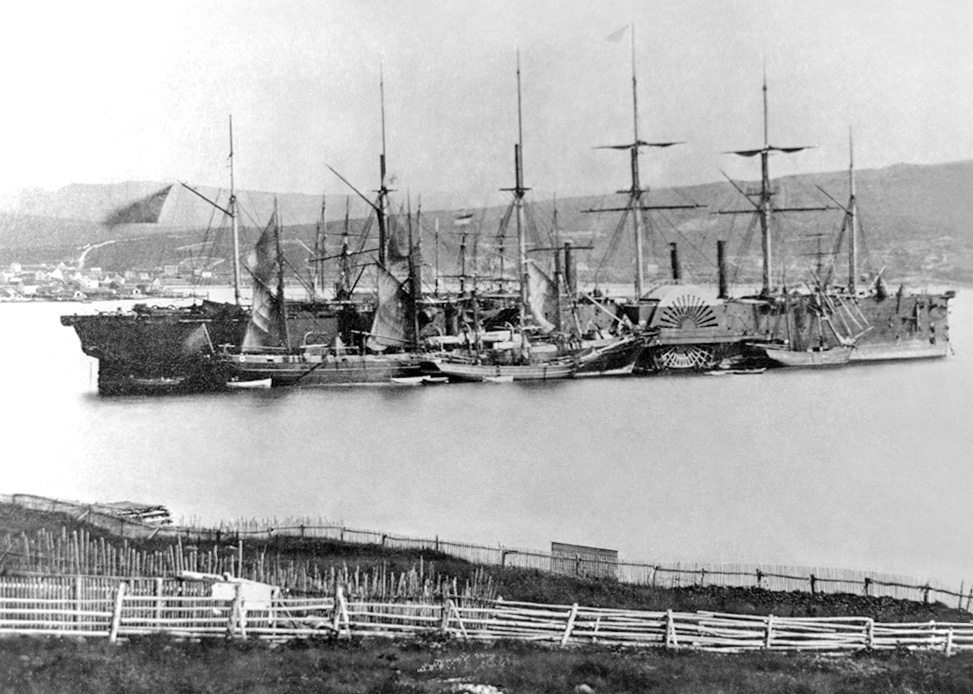
The archival photograph of the Great Eastern at Heart's Content shows an immense dark hull surrounded by small boats.[6] It is tempting to read scale as the whole explanation: Brunel's commercial misfit finally found the job only it could do. The ship was indispensable, but the comparison with 1858 makes a stronger claim. Capacity mattered because it brought the whole working process together. Cable tanks, test instruments, brakes, engines, repair crews, grappling gear and spare cable could act on the same object while it crossed from factory to seabed.[2][3][4]
The difference between 1858 and 1866 was therefore not courage. Both expeditions had plenty of that. Nor was it a clean substitution of science for error: the 1865 cable still broke after improved theory and manufacture. What changed was the treatment of failure. A weak signal became something to detect rather than overpower. A flaw became something to locate and haul back. A break became a recorded position and a future recovery job. One successful line became the platform for retrieving a second.
In 1858, the first official message proved that the Atlantic could be crossed. In 1866, the return to the lost cable proved that crossing was no longer the only test that mattered. The lasting invention was not simply the wire beneath the ocean. It was the ability to diagnose, recover and restore the link after the voyage stopped going according to plan.
Sources
- Institution of Engineering and Technology Archives, “The first transatlantic telegraph cable 1858” — voyage sequence, manufacturing and handling problems, official messages and the cable's failure.
- William Howard Russell, The Atlantic Telegraph (1865), Project Gutenberg — eyewitness narrative, technical appendices and company reports from the Great Eastern's 1865 expedition.
- Institution of Engineering and Technology Archives, “The Transatlantic Telegraph Cables 1865–1866” — electrical behavior, cable testing, onboard repairs, the 1865 break and the two completed links of 1866.
- Royal Museums Greenwich, “Clifford, Henry, Chief Engineer, 1821–1905” — archive record on Clifford's cable machinery, the 1865 failure and the successful 1866 expedition.
- Newfoundland and Labrador Provincial Archaeology Office, 2017 Archaeology Review, pp. 88–90 — official history and field record of the 1858 landing at Bull Arm and the 1865–66 cables at Heart's Content.
- Wikimedia Commons, “Great Eastern 1866.jpg” — archival photograph metadata, source record, date, dimensions and public-domain status.
- Parks Canada, “Heart's Content Cable Station Provincial Historic Site, Newfoundland and Labrador” — historical significance and surviving-site context.
- Charles Bright, The Story of the Atlantic Cable (1903), Project Gutenberg — technical history of Thomson's 1858 mirror instrument, the later cable systems and recovery machinery.
- Bruce J. Hunt, “Wildman Whitehouse, William Thomson, and the First Atlantic Cable,” in Imperial Science (Cambridge University Press, 2021), pp. 37–96 — multicausal failure, electrical measurement, quality control and the mid-1860s cable system.