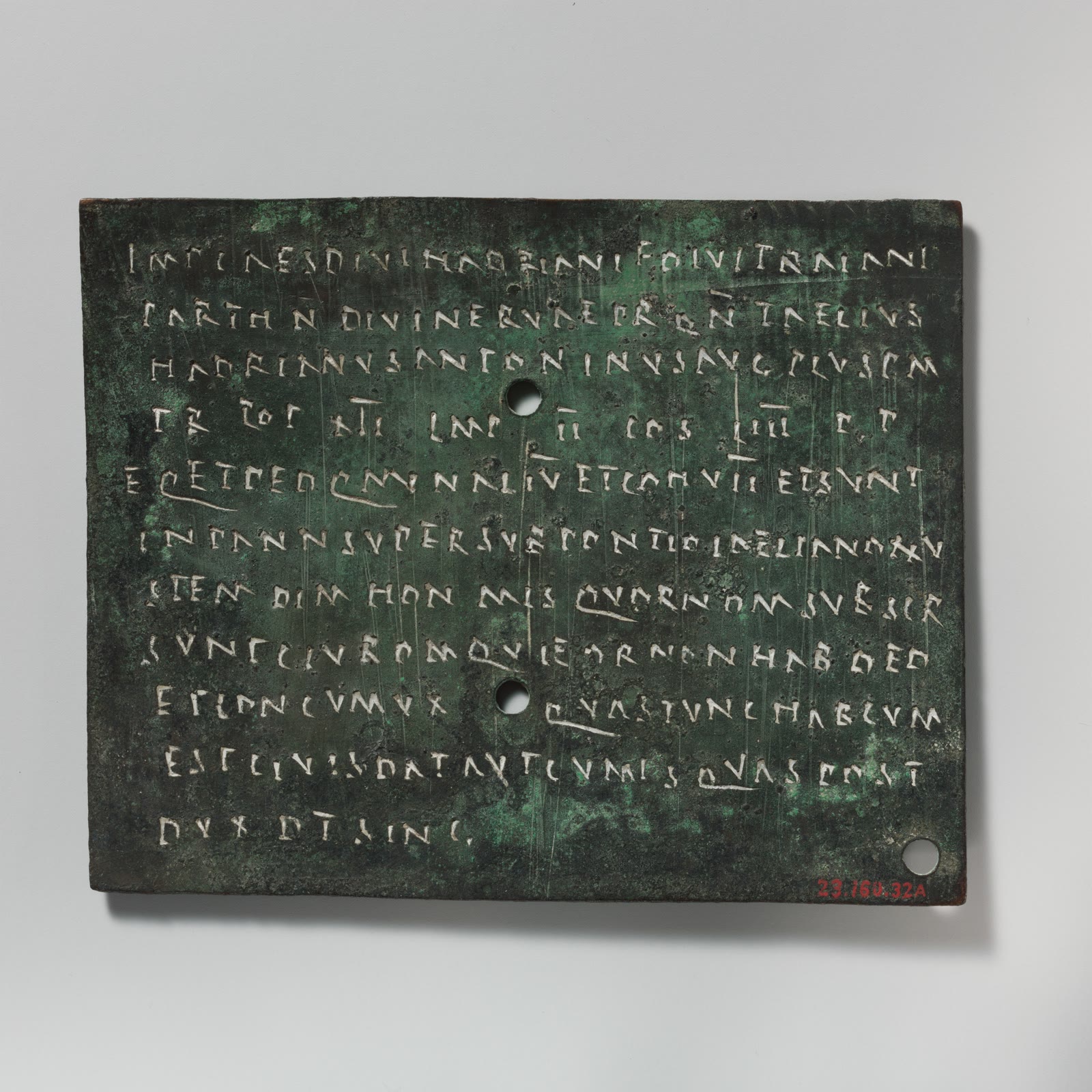
The photographed plate is small enough to hold in one hand. It is only 13.2 by 10.5 centimetres, yet its surface is crowded with lines of Latin. This was not a ceremonial plaque meant to stay on a barracks wall. It was one half of a bronze booklet made around 149 CE for Dasmenus, son of Festus, of the Azali, an infantry veteran who had completed twenty-five years in Rome’s auxiliary forces. The emperor’s grant gave him Roman citizenship and the right to contract a legally recognized marriage.[1]
The object answers a practical question hidden inside the grand language of empire: how could a man discharged on one frontier prove that a legal act made at Rome applied to him personally?
Rome’s answer was a chain of verification. An imperial constitution created the grant. An official copy connected that public law to a named recipient. The text was written twice across two bronze tablets, one version available to read and another protected behind seals. Witnesses authenticated the copy. The veteran could then carry the result away from the capital.[2][3][6]
The diploma did not make citizenship portable because bronze was magically authoritative. It worked because material, text, names, and witnesses locked together. Remove any link and the promise became harder to enforce.
The grant began as a public act, not a private certificate
Military diplomas appeared under Emperor Claudius. The earliest surviving example dates to 52 CE, although historian Myles Lavan notes that the practice may have begun a few years earlier. Grants of citizenship for service were older, but Claudius introduced the small bronze diptychs that documented the privileges of individual beneficiaries.[4][7]
The legal act itself was collective. An imperial constitution named the formations whose qualifying soldiers received privileges: cavalry wings, infantry cohorts, fleets, or particular guards. It identified the province and commander, stated the service condition, and listed the beneficiaries. The constitution was displayed publicly in Rome. What the veteran received was not a separate law but a certified individual extract from it.[2][3][6][7]
That distinction solved a scale problem. The empire did not need to draft a wholly new act for every retiring auxiliary. It could issue one constitution for a group, preserve a public version at the centre, and produce personalized copies for the men named under the grant. The Met diploma is one such copy. Its text places Dasmenus inside a wider award made by Antoninus Pius to veterans of several units in Pannonia Superior.[1]
The mechanism moved in two directions. The constitution let officials treat many cases together; the diploma let one veteran detach his case from the group and take it home. Central law became local proof.
Two texts made tampering visible
A Roman military diploma was a little bronze book. Its two pierced plates were joined by wire. The same legal substance appeared on the inner and outer faces, but the two versions served different purposes. The exterior could be consulted without disturbing the document. The fuller interior text sat behind the closed plates, with the fastening protected by the seals of seven witnesses.[2][3][6][7]
This was not encryption. Anyone able to read the exterior could know what the document claimed. The security came from duplication and controlled access. Altering the visible text would not alter the sealed version inside; breaking the seals made comparison possible.
The surviving evidence does not supply one routine inspection script for every province. The Grand Curtius museum reconstructs a plausible handoff for its diploma issued in 98 CE: a veteran presented the booklet where he intended to settle, and local authorities opened it to recognize the privileges in the official copy.[3] That interpretation shows how the format could work without proving that every diploma was checked through the same ceremony.
The witnesses did not testify that the veteran had personally fought well for twenty-five years. They authenticated the conformity of his extract to the public constitution. Pierre Cosme’s study of early Flavian diplomas shows that witness practice itself changed: under Vespasian, men linked to recipients’ places of origin appear to have given way to more regularized authenticators in Rome. The personnel evolved, but the function remained the same—bridge the distance between an authoritative text in the capital and a copy leaving it.[6]
That makes the diploma more than durable paperwork. It is a compact verification protocol made from engraving, redundancy, restricted access, and social trust.
A formula turned a soldier into a beneficiary
The copy still had to prove that this man belonged to that grant. Diplomas therefore carried a dense chain of identifying context: emperor, date, province, commander, units, qualifying service, recipient, father, and place or people of origin; wives and children could also appear when the grant covered them.[4][6][7]
This was identification by relationships rather than by portrait or serial number. Dasmenus was not isolated as a modern cardholder. He was fixed inside a military and administrative web: a named son from a named origin, serving in a named unit under a named command, included in a dated imperial act.[1][4]
Formulaic language made the chain repeatable. It also makes fragments useful to historians. A broken tablet may preserve only part of a unit list or date, but the stable order of clauses can reveal what has been lost around it. The standardized document that once helped an official verify one veteran now lets an epigrapher reconstruct troop movements, commands, recruitment, and family claims.[3][4]
The formula should not be mistaken for automaticity. Twenty-five years was a qualifying minimum, not always the actual moment of reward. Lavan finds that some men served longer, especially earlier in the system, and that grants shifted gradually from men still serving toward discharged veterans; only from about 110 CE did veteran grants become the norm.[4] A diploma recorded a successful legal outcome. It did not prove that every eligible soldier reached it on schedule.
Citizenship and marriage were two different levers
The diploma’s reward is often shortened to “citizenship,” but the grant normally joined civitas to conubium. The first changed the veteran’s civic status. The second authorized a legally recognized Roman marriage with the current or a future wife—restricted in the formula to one woman—and allowed children of that union to inherit citizen status under Roman law.[2][4]
That pairing mattered because soldiers formed households during long service even when their unions did not fit Roman marriage law. A grant at discharge could therefore reorganize more than the veteran’s public identity. It could change the legal future of a family.
But the family benefit was neither timeless nor uniform. Before 140 CE, auxiliary grants normally extended citizenship to the recipient’s living children and descendants named in the act. In 140, Antoninus Pius sharply narrowed the ordinary auxiliary formula: citizenship and conubium went to the veteran, while broad grants to children ended. Later diplomas preserve limited exceptions, and fleet practice followed a different path.[4][5]
The Met diploma dates to 149, on the far side of that change. Its physical form looks like earlier diplomas, but the legal payload had contracted. That is the advantage of reading the object as a mechanism rather than a symbol. A bronze booklet can remain stable while the rule moving through it changes.
The system was powerful because it was bounded
It is tempting to call the diploma a Roman passport. The analogy catches portability and misses almost everything else. It was not a universal identity document, a travel permit, a land deed, or a routine certificate for every soldier. Legionaries were already citizens and did not receive these citizenship diplomas; auxiliary soldiers, sailors, members of the praetorian and urban cohorts, and imperial horse guards entered the record under different rules.[4][7]
Nor should survival be confused with equal distribution. Lavan’s corpus shows a strong Danubian bias: 69 percent of 623 auxiliary recipients whose service region was known came from Danubian provinces, although those provinces held an estimated 38 percent of auxiliary forces in the second century. Finds, collecting, publication, and the ancient geography of disposal all shape the archive.[4] The heavy presence of Pannonian and Danubian diplomas may describe both Roman deployment and modern survival.
The system’s demographic effect also needs a boundary. Lavan estimates that army-mediated grants enfranchised roughly 0.9 to 1.6 million soldiers and family members between 14 and 212 CE, a range that includes grants before the first surviving diplomas and routes beyond auxiliaries alone.[4] That is substantial, but it is not evidence that military service mechanically Romanized every frontier household.
In 212, the scarce reward changed
The diploma worked because citizenship was valuable, differentiated, and capable of being granted to selected people. In 212 CE, Caracalla’s empire-wide extension of citizenship to almost all free inhabitants changed that landscape. Service did not cease, veterans did not cease needing legal records, and bronze diplomas did not vanish overnight. But citizenship could no longer perform the same recruiting and integration work when the pool of non-citizen free provincials had been transformed.[4][7]
The deeper history is therefore not that Rome rewarded loyal foreigners with a prestigious metal keepsake. It is that the state engineered a route from service to status and gave the beneficiary a way to make distant law answer locally.
One public constitution gathered the grant. One named extract separated the veteran from the group. Two copies exposed alteration. Seven seals authenticated the correspondence. Bronze let the result survive the road. The empire became tangible not when an emperor declared a privilege, but when Dasmenus could place that privilege in another official’s hands.
Sources
- The Metropolitan Museum of Art, “Bronze military diploma” (ca. 149 CE) — object record, dimensions, public-domain photographs, recipient Dasmenus Azalus, twenty-five-year service, citizenship, marriage right, and sealed two-tablet construction.
- Vatican Museums, “Military diploma of a sailor of the Roman fleet in Egypt” — museum account of the diploma issued to C. Gemellus Coptita on February 17, 86 CE, including the public original, interior and exterior texts, wire, privileges, and seven witnesses.
- Grand Curtius Museum, “Fragments of a military diploma” — object record for a 98 CE diploma explaining its booklet form, readable duplicate, sealed interior, local presentation, standard formula, and reconstruction from fragments.
- Myles Lavan, “The army and the spread of Roman citizenship,” Journal of Roman Studies 109 (2019), author-final manuscript — chronology, eligibility, service length, family provisions, documentary limits, corpus bias, and quantitative estimate of army-mediated enfranchisement.
- Sofie Waebens, “Imperial Policy and Changed Composition of the Auxilia: The ‘Change in A.D. 140’ Revisited,” Chiron 42 (2012) — scholarly analysis of the 140 reduction in auxiliary veterans’ family privileges and its exceptions.
- Pierre Cosme, “L’authentification des diplômes militaires au début du principat de Vespasien,” in Figures d’empire, fragments de mémoire (2011) — study of the diploma as a certified extract and of its formula, duplicate texts, wires, seals, and changing witness practice.
- Roman Inscriptions of Britain Online, “2401. The Diplomata” — scholarly corpus overview of the certified-copy formula, recipient fields, service categories, inner and outer texts, fastenings, family rules, and the continuation of some diplomas after 212.