On March 14, 1899, Belgica finally cleared the Antarctic pack and pointed toward South America. The shortest version of the story says that the ice released the ship after thirteen months. That verb makes the ending sound passive: winter loosens, a vessel floats away.
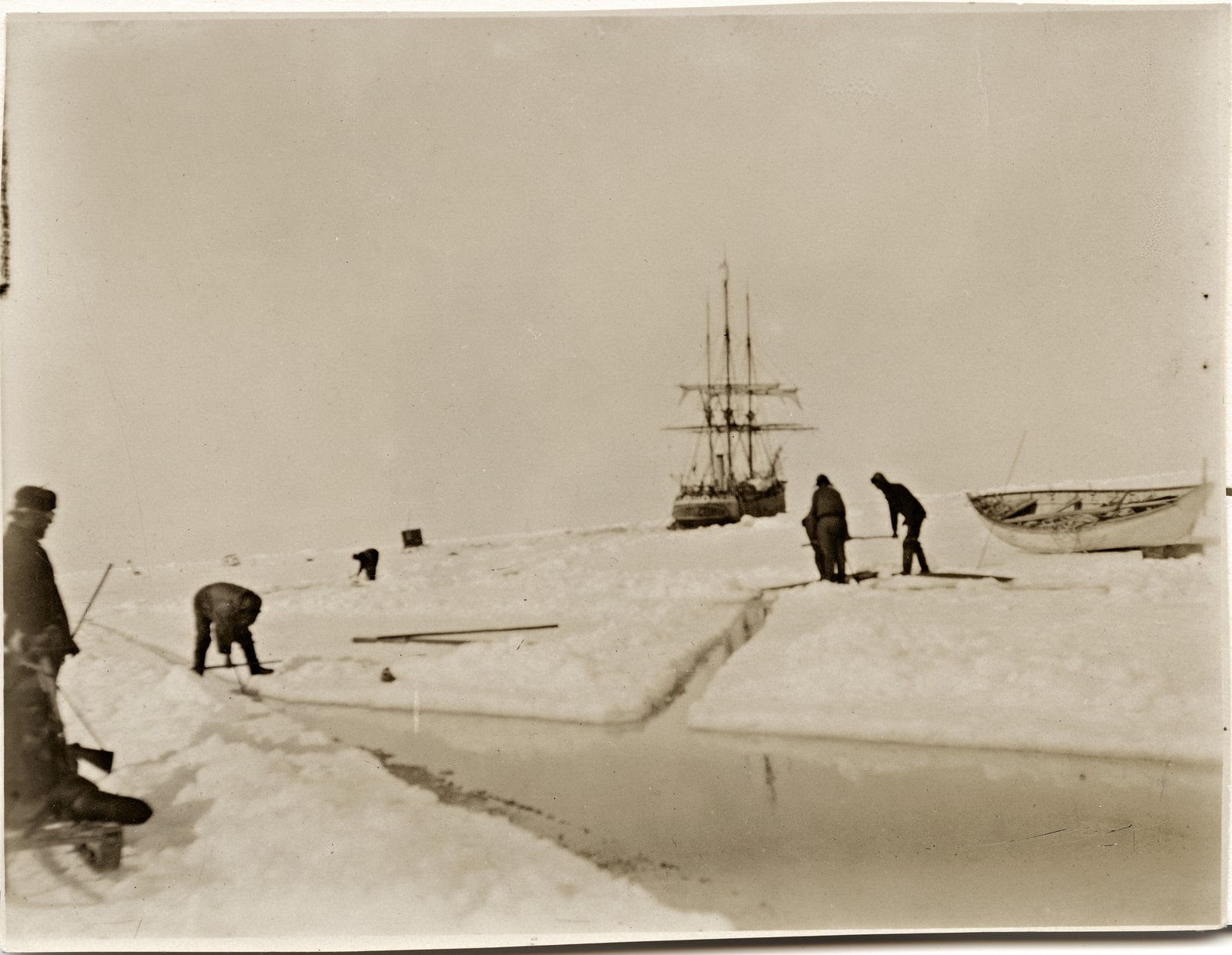
The fuller sequence is more interesting. Sixteen men had spent weeks shifting snow, driving long saws through several feet of sea ice, and levering blocks out of a channel more than 2,000 feet long. That work created a viable route across most of the particular floe holding Belgica; pressure and wind still had to open the last obstruction. It did not free the ship from the pack. Moving ice trapped the vessel again within sight of open ocean, and only a later weather change completed the escape.[1][2]
This distinction matters because the expedition was neither a clean triumph of human will nor a simple rescue by nature. The crew could choose a route, ration its strength, and cut. It could not command the pack to keep the route open. The last year of the voyage became a running negotiation between labor and weather, with survival, science, and a second winter all hanging on which one moved faster.
February 28–March 5, 1898: an open route north became a trap south
Belgica had sailed from Antwerp on August 16, 1897, under the command of Belgian naval officer Adrien de Gerlache. Its multinational staff included the Romanian zoologist Emil Racoviță, Polish geologist Henryk Arctowski, Belgian hydrographer Georges Lecointe, American physician Frederick Cook, and Roald Amundsen, then a young Norwegian mate. The plan contemplated Antarctic fieldwork and a wintering party on land; it did not require the entire ship to vanish into the pack for a year.[1][2]
The margin for error was already narrowing. Sailor Carl Wiencke had been swept overboard and drowned on January 22, 1898. During February the ship repeatedly probed the ice west of the Antarctic Peninsula, became briefly held, and fought back to open water. The official expedition report says that after another failed attempt on February 23, the advanced season made a northward retreat necessary.[2]
Then a storm broke the pack apart on February 28. Water lay open to the north and west. De Gerlache instead turned south, and Belgica drove roughly ninety miles deeper into the ice.[2]
The surviving accounts do not frame that decision in quite the same way. The expedition's 1904 summary calls the storm opening an opportunity and moves directly into the southward advance. Cook's 1900 narrative says the scientific staff thought the season too late and depicts de Gerlache as determined to press farther south. Cook wrote with hindsight and a taste for drama; the official report spoke for the expedition as an institution. Together they establish the action, but they do not settle every private motive behind it.[1][2]
On March 2, the ice closed. A northward attempt failed the next day. By March 5, the official report says, Belgica had to accept that it was a prisoner. The ship was near 71° south, hundreds of miles from the nearest known land. No relief vessel knew where to look. Cook understood the dependency without romance: if the hull survived, they had a home; if pressure destroyed it, their route back across the Southern Ocean was effectively gone.[1][2]
March–May: a drifting ship became an observatory
Imprisonment did not stop the expedition's stated work. It changed the platform. With the boiler shut down, the party erected magnetic and astronomical stations on the ice. A telegraph wire connected the astronomical hut to chronometers kept safely aboard. The scientists lowered instruments through holes, recorded weather and magnetism, took ocean soundings, and collected organisms beneath a sea no expedition had sampled through an Antarctic winter.[2]
That continuity is easy to lose in a survival story. Belgica was moving even when it looked fixed: ship, floe, observatories, and horizon drifted together. A later Nature assessment called the voyage a landmark because it made the first deep-sea collections inside the Antarctic Circle. The Institute of Natural Sciences in Brussels says the specimens included so many newly encountered species that studying them took nearly fifty years.[4][5]
The research schedule also provided structure as daylight contracted. On May 17, 1898, the sun disappeared below the horizon. The official report counted more than 1,600 hours before its return on July 22. Darkness was not merely the absence of a view. It folded work, sleep, recreation, and anxiety into the same dim interior while storms and grinding floes remained audible outside.[1][2]
June–July: the men had symptoms before they had a diagnosis
On June 5, magnetician Emile Danco died of cardiac failure. Two days later the crew cut through young ice and committed his weighted, sailcloth-wrapped body to the sea. Cook believed that an underlying heart defect had worsened with the loss of sunlight. That was the ship doctor's interpretation; the surviving evidence cannot now establish the lesion or make darkness its cause.[1][2][3]
Other men developed swollen ankles, irregular or racing pulses, pallor, weakness, despondency, and signs that contemporaries associated with scurvy. Cook called the broader syndrome “polar anaemia,” although he recorded no hemoglobin measurements. Medical historian Harry Guly argues that its cardiac pattern was almost certainly wet beriberi caused by thiamine deficiency, often overlapping with vitamin C deficiency and scurvy. That explanation is stronger than Cook's darkness-centered theory without requiring every symptom—or every patient—to have had the same illness.[3]
Cook's response was practical even where his theory was uncertain. He reduced reliance on preserved food, pushed fresh penguin and seal meat, dried bedding and clothing, prescribed warmth and limited exertion, and treated morale as part of care. Fresh meat could supply some vitamin C; the fire treatment also offered attention, warmth, and dryness, even if later claims that it was modern light therapy outrun what a coal stove could demonstrate.[1][3]
When a sliver of sun returned on July 22, it found a crew still physically weak but scientifically active. The sunrise ended the polar night, not the imprisonment. Spring and then summer altered the light and surface melt, yet the large floe around Belgica remained intact. Waiting for a convenient fracture was beginning to look like a plan for spending another winter in the same place.[1]
January–February 1899: explosives failed, so the crew measured the ice
By January 9, 1899, Cook judged the main provisions sufficient for only about three more months. Open leads could be seen in the distance, but the ship's floe—roughly two miles across in his account—had not broken apart. His first January plan used trenches cleared of snow and surface ice. The hope was that darker exposed water would absorb more solar heat and weaken a line toward open water. Nightly freezing erased the day's gain.[1]
The expedition also carried tonite, an explosive tested about two months earlier and tried again after the trenches failed. It produced flame, smoke, and shallow craters rather than an exit. The official report says even a hundredweight failed to breach the floe. Cook's dry verdict was that it would “cut no ice.” The phrase is memorable; the failed experiments behind it were useful. They forced the party to stop imagining one dramatic blast and start measuring a workable route.[1][2]
The first line from the bow crossed submerged ice projections fifteen to twenty-five feet thick—far beyond the reach of the saws. Soundings revealed a longer but thinner route astern. Contemporary totals differ: Cook put the channel at about 2,200 feet, while the official summary gave 2,500 feet. Both describe the same method. Crews stripped away the upper snow and soft ice, cut parallel sides through roughly three to five feet of solid ice, divided the lane into sections, and hauled the blocks clear.[1][2]
Rank temporarily flattened into shifts. Cook counted sixteen workers, from the expedition's leaders to the cabin boy, with officers and sailors on the same saws. Each man worked about eight hours a day; the cook covered the galley work. The labor also changed the health equation. Fresh seal and penguin entered the new water lane, while regular exertion, a visible objective, and exhaustion replaced part of the listlessness of the winter.[1]
By February 1, the cut had reached to within about one hundred feet of the ship, where harder ice slowed progress to inches. Then pressure shifted the floes, fractured the remaining barrier—and partly crushed the channel shut. The same mobile pack that offered help also erased labor. After another wind change, the canal widened enough for Belgica to steam out of its original berth in mid-February.[1][2]
That was not the ending. The ship worked north for roughly twenty miles and became trapped again near the pack's outer edge. Open ocean darkened the sky beyond the icebergs, close enough to recognize but impossible to reach. For about thirty more days, swells drove floes against the hull while the party prepared for the possibility that its hard-won canal had only moved the site of a second winter.[1][2]
March 14: the escape was finished by a change no one could order
On March 14, 1899, the ice yielded. Cook credited a gentle southerly wind with carrying the surrounding sea ice beyond the barrier of icebergs; the official summary says Belgica threaded between floes and cleared the last impediment that evening. After thirteen months inside the moving pack, the ship turned toward Cape Horn.[1][2]
The channel therefore deserves neither dismissal nor legend. It did not slice a continuous road all the way to the Pacific, and the men did not conquer the pack by muscle. They made escape from the original floe possible because they sounded for thinner ice, abandoned methods that failed, and concentrated limited strength on a route their tools could cut; pressure and wind still had to fracture the last barrier and reopen the lane. They escaped the larger pack because later ice movement made the route onward navigable.
That sequence is the voyage's sharpest lesson. Contingency is not the opposite of agency. Weather set the outer limits, but human choices determined whether Belgica would be ready when those limits briefly moved. The ship's winter in the pack—absent from the published expedition plan, whatever de Gerlache privately intended—produced an unprecedented annual scientific record. The deliberately cut channel helped prevent that record, and the people who made it, from being wagered on one more Antarctic night.[2][4][5]
Sources
- Frederick A. Cook, Through the First Antarctic Night, 1898–1899 (1900) — the expedition physician's contemporary narrative, used for the daily chronology, medical response, canal measurements, labor, and final escape.
- Commission de la Belgica, The Belgian Antarctic Expedition under the Command of A. de Gerlache de Gomery: Summary Report of the Voyage of the “Belgica” in 1897–1898–1899 (1904) — official expedition plan, chronology, scientific work, winter illness, canal account, and release.
- Harry R. Guly, “'Polar anaemia': cardiac failure during the heroic age of Antarctic exploration,” Polar Record 48, no. 2 (2012) — medical reassessment identifying probable wet beriberi, concurrent scurvy risk, and the limits of Cook's terminology.
- Institute of Natural Sciences, Brussels, “The Belgica” — institutional overview of the expedition's oceanographic, meteorological, mapping, and biological legacy.
- J. W. G., “Some Results of the 'Belgica' Expedition,” Nature 74 (July 26, 1906) — contemporary assessment of the voyage's deep-sea collections and published scientific results.
- National Library of Norway via Wikimedia Commons, “Unidentified persons cutting ice around 'Belgica'” (January 1899) — catalog record and high-resolution scan for Frederick A. Cook's archival photograph used as the article image.