
The most consequential thing lost in the National Personnel Records Center fire was not “history” in the abstract. It was proof. An Official Military Personnel File could establish when someone served, where that person was assigned, what training and awards followed, and the circumstances of separation. Veterans and families needed those facts for benefits, burials, corrections, research, and private memory. When fire was reported on the sixth floor of the center outside St. Louis shortly after midnight on July 12, 1973, it attacked both a national archive and millions of individual claims on the state.[2][3]
The scale remains difficult to hold in mind. The fire destroyed an estimated 16 million to 18 million files, mostly for former Army, Army Air Forces, and Air Force personnel. There were no duplicate sets or microfilm backups, and the destroyed blocks had not been indexed file by file. That means there is no definitive roll of everything that disappeared. The loss itself cannot be completely listed.[2]
The U.S. National Archives video embedded below lasts only one minute. It cannot narrate fifty years of recovery, but its compression is useful. Aerial images turn the building into a smoking geometric mass; lines of water appear thin against an immense roof; surviving records are invisible at that distance. The soundtrack restores urgency through audio recorded by the North Central County Fire Alarm System. The film makes the disaster visible and audible, then leaves the viewer with the harder question: what does an archive do after the evidence it was built to supply has partly vanished?[1]
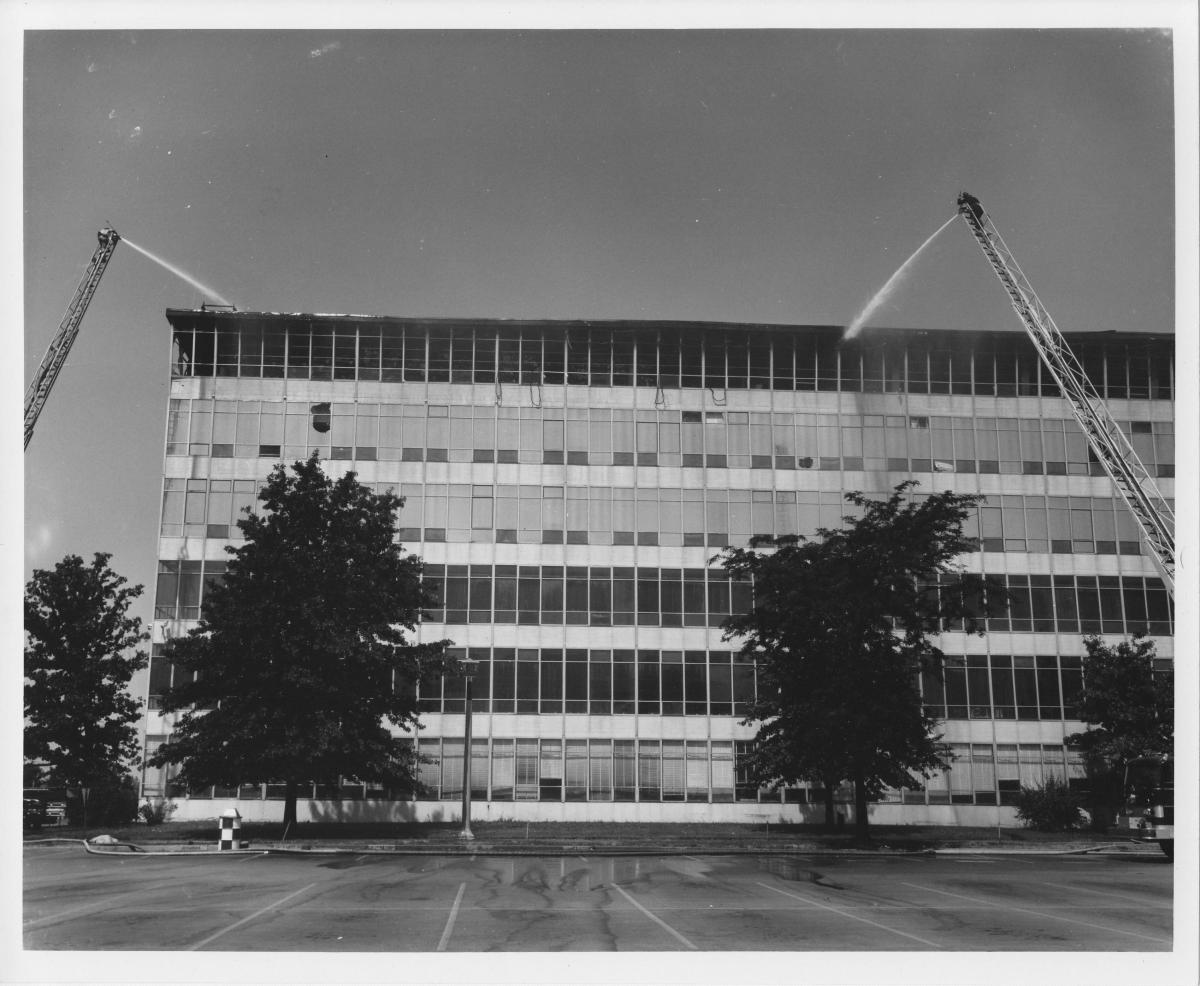
Image context: the cover is a genuine National Archives photograph made during the fire, not a frame taken from YouTube. Firefighters are working at the building's southeast corner on July 13, 1973. From across the parking lot, two elevated water streams enter blackened sixth-floor openings. The visible operation is containment; the condition of the records remains hidden behind the repetitive facade.[5]
Before the fire: storage without compartments
The records center opened in the mid-1950s as a monument to centralization. About 22 million personnel files eventually occupied its sixth floor. Each floor offered more than 200,000 square feet of largely open storage, and the building gathered records that had previously been dispersed. Efficiency came from scale: shelving, staff, and requests could be concentrated in one enormous facility.[3]
That same scale created the disaster's mechanism. The sixth floor held about 205,000 square feet of open records storage without fire partitions. Some areas on the first two floors had sprinklers, and smoke detectors served an office-only air-circulation system; the sixth-floor records area had no effective automatic sprinkler or detection coverage. Its designers had confronted a genuine preservation dilemma. One model of records protection feared fire and installed sprinklers; another feared leaks and accidental water damage. St. Louis followed the second model.[3][4][7]
That original debate explains the choice; it does not excuse the long failure to correct it. By 1956, the National Archives and Records Service had decided that future records centers should have sprinklers and smoke detectors. GSA's regional office proposed protection for the rest of the St. Louis building in fiscal 1963; Congress approved the project in fiscal 1964 for installation in 1965; GSA did not fund it, and later requests lost out to projects judged more urgent. After another fire-safety study in October 1972, full sprinkler protection was recommended again, but it was still absent in July 1973. Centralization multiplied both convenience and exposure while a recognized risk remained unresolved. The building stored millions of separate biographies as one physical risk.[4][7]
The first alarm was recorded at 12:16:15 a.m. Firefighters arrived within minutes and initially entered the building, but heat and smoke forced them out by 3:15 a.m. The blaze then had to be fought largely from outside. It burned uncontrolled for more than 22 hours; 42 fire districts participated; officials did not declare it out until July 16. Even then, hot spots and continued spraying extended the emergency. Investigators could establish neither a definitive cause nor a precise point of origin because the sixth floor had been so thoroughly destroyed.[2][3]
The archival minute and its provenance
The embedded item is “Remembering the 1973 fire at the National Personnel Records Center,” published by the verified U.S. National Archives channel on July 13, 2023, for the fire's fiftieth anniversary. The archive's description credits the North Central County Fire Alarm System for the emergency audio. The anniversary collection identifies the underlying aerial footage in Record Group 330 as National Archives Catalog NAID 140105052. These pictures are not neutral surveillance: the National Archives edited archival views and aftermath images into a new vertical film, added captions, and republished them for a contemporary audience. Its provenance therefore has two dates—the emergency recorded in 1973 and the commemorative edit assembled in 2023.[1][6]
Listen for procedure; look for scale
The alarm-system recording is the film's most important choice. Fire is usually remembered through spectacle—flame, smoke, collapse—but dispatch audio belongs to procedure. A report enters a system; a location is named; equipment and people are sent. The voices cannot know the final count of missing files or the decades of reconstruction ahead. They inhabit the brief interval when this is still an incident to which emergency services can respond.[1]
Against that urgent sound, the aerial images create distance. The long horizontal bands of the building repeat across the frame. Water streams reach upward like narrow white lines. Smoke moves across a footprint so large that trucks and firefighters lose human scale. The edit adds compact text panels because the footage alone cannot reveal what the structure contains. From the air, a personnel file has no visible size. The captions must reconnect the giant building to the military careers stored inside it.[1][2]
The final overhead views replace smoke with a torn roof and blackened interior. They make destruction legible as a change in architecture: an orderly rectangle has opened into debris. Yet even this image understates the archival loss. A collapsed roof can be photographed; an absent discharge paper cannot. Nor can the camera show the later moment when a veteran asks for proof and an archivist finds that the expected folder is not there.
That boundary is why the minute works best as an opening, not a complete account. It preserves the scale of the emergency and the texture of its official response. It does not turn loss into a self-explanatory image. The history begins where the visible fire ends.
The catastrophe moved from flame to water
Millions of gallons of water kept the fire from descending through the building. The same water soaked records on lower floors, while broken pipes continued flooding parts of the structure. St. Louis summer heat and humidity then created a second race, this time against mold. What survived the fire could still be lost through saturation, biological growth, or rough handling.[2][3]
Recovery required improvisation at industrial scale. Staff and contractors removed damaged material from the building and sorted it in a temporary “tent city.” Plastic milk crates proved more useful than closed cardboard boxes for holding wet files. Nearly 90,000 cubic feet of waterlogged records needed drying. A nearby McDonnell Douglas facility supplied vacuum chambers that had been used in the space program; technicians adapted them to pull water from batches of soaked paper. A machine associated with simulated space conditions became emergency infrastructure for damaged bureaucracy.[2][3]
About 6.5 million burned or water-damaged files were recovered. Calling them “saved” can sound final, but survival created a new kind of work. Charred pages might be fused together, stained, brittle, or mold-damaged. The National Archives created a temperature-controlled B-file, or burned-file, area and a registry for the survivors. A file could remain present while becoming too fragile for ordinary handling. Preservation had to happen when someone requested it, page by page and case by case.[2][3]
The distinction between destroyed and damaged was therefore not clean. Fire made ash; water preserved some paper while endangering other paper; drying stabilized records without restoring what heat had removed. The archive that emerged was not the archive that existed on July 11. It was a mixed body of missing files, burned survivors, auxiliary evidence, and newly constructed records.
Reconstruction made absence operational
On July 23, 1973, the federal government told agencies to stop disposing of records that might help document military service. The order reversed the ordinary logic of records schedules. Documents previously treated as secondary could now substitute for a lost personnel file. Morning reports, payroll material, Veterans Administration claims, Selective Service registrations, hospital records, state records, and unit-level files became pieces from which basic service could be rebuilt.[2]
The National Personnel Records Center established an R registry for reconstructed files in April 1974. This was more than a cataloging measure. It formalized a new evidentiary practice: no surviving folder meant no single authoritative narrative, so staff had to assemble a service history across agencies and record series. Reconstruction could establish enough information to issue a Certification of Military Service in place of a missing separation document, even though it could not recreate every evaluation, order, medical note, or personal detail once held in the original file.[2][5]
That difference is essential. “Reconstructed” does not mean “recovered whole.” It means that the archive can often answer a defined question from surviving traces. A payroll can place a person in service; a morning report can connect a name to a unit; a hospital record can document treatment. Each alternate source proves something bounded. The reconstruction technician's task is to join those bounded facts without pretending that the lost folder has returned.
By the fiftieth anniversary, the National Archives reported 5.5 million successful reconstructions of service details. The agency's preservation staff still triaged tens of thousands of fire-affected records each year, with urgent requests for health care or funeral benefits receiving priority. In other words, the 1973 disaster persisted as a daily workflow in 2023. Its duration was measured not only by the four days of firefighting but by every later request routed through burned and missing evidence.[5]
Legacy: design for a failure that has not happened yet
The fire forced records institutions to reconsider what “safe storage” meant. A warehouse could be made of concrete and still be vulnerable if one open floor allowed fire to travel. Water could harm paper and still be indispensable. The lesson was not merely “add sprinklers.” It was to combine early detection, suppression, compartmentalized storage, disaster planning, and alternate copies so that one failure would not become an indivisible national loss.[3][4]
The National Archives established a dedicated St. Louis preservation program in 1999. Fire-affected military records became permanent National Archives holdings in 2004. A new personnel records facility completed in 2011 uses separated storage bays, detectors, and fire suppression as part of a design built around containment rather than confidence in one enormous open room.[3][5]
The one-minute film ends, but its subject does not. Its aerial view shows the paradox clearly: centralization made public service efficient until it concentrated too much irreplaceable evidence under one roof. The response did not restore the old archive. It built a different one—an archive that treats fragments as evidence, absence as a condition to document, and reconstruction as public service. The flames went out in July 1973. The fire's administrative afterlife continues each time a damaged page is opened or military service has to be proved without the missing file.
Sources
- U.S. National Archives, “Remembering the 1973 fire at the National Personnel Records Center” — official one-minute YouTube publication using archival aerial images and audio recorded by the North Central County Fire Alarm System (July 13, 2023).
- National Personnel Records Center, “The 1973 Fire” — official chronology of the fire, losses, salvage, B- and R-file registries, and auxiliary-record reconstruction.
- Marta G. O’Neill and William Seibert, “Burnt in Memory: Looking Back, Looking Forward at the 1973 St. Louis Fire,” Prologue 45, no. 1 (2013) — building design, firefighting, vacuum drying, preservation, and long-term fire-safety lessons.
- Walter W. Stender and Evans Walker, “The National Personnel Records Center Fire: A Study in Disaster,” The American Archivist 37, no. 4 (1974), 521–549 — contemporary account of the building, firefighting, loss, recovery, and fire-safety questions, hosted by the National Archives.
- Victoria Macchi, “Remembering the 1973 NPRC Fire,” National Archives News (July 10, 2023) — fiftieth-anniversary account of ongoing reconstruction, preservation work, facility changes, and the July 13, 1973 cover photograph, NAID 293518048.
- U.S. National Archives, “1973 National Personnel Records Center (NPRC) Fire” — fiftieth-anniversary collection identifying the surviving photographs, videos, oral histories, and Record Group 330 aerial footage, NAID 140105052.
- U.S. General Accounting Office, Fire Damage at the Military Personnel Records Center, St. Louis, Missouri, and Fire Protection at Other GSA Records Centers, B-125617 (October 9, 1974) — independent congressional review of the limited fire protection and repeatedly deferred sprinkler project.