The Bandung Conference is often remembered in one compressed phrase: the moment the postcolonial world announced that it would not line up obediently behind either Washington or Moscow.[2][4] That memory is not wrong, but it is too small for the document the delegates actually produced on 24 April 1955.[1] The final communique does contain the seed of nonalignment. What it really offers, though, is something broader and more durable: a diplomatic language for newly independent states that wanted sovereignty without isolation, anti-colonial solidarity without a formal bloc, and economic cooperation without simply returning to dependency under a different name.[1][2]
That sharper claim becomes visible only when the communique is read as a whole rather than mined for the later-famous "Ten Principles" alone.[1] The text moves across economic cooperation, cultural cooperation, human rights and self-determination, dependent peoples, and finally world peace and cooperation.[1] In other words, Bandung did not frame the new Asian and African states as governments whose only common interest was saying no to the Cold War. It treated them as governments that had to govern, trade, educate, develop, and survive in a world still structured by empire and nuclear rivalry.
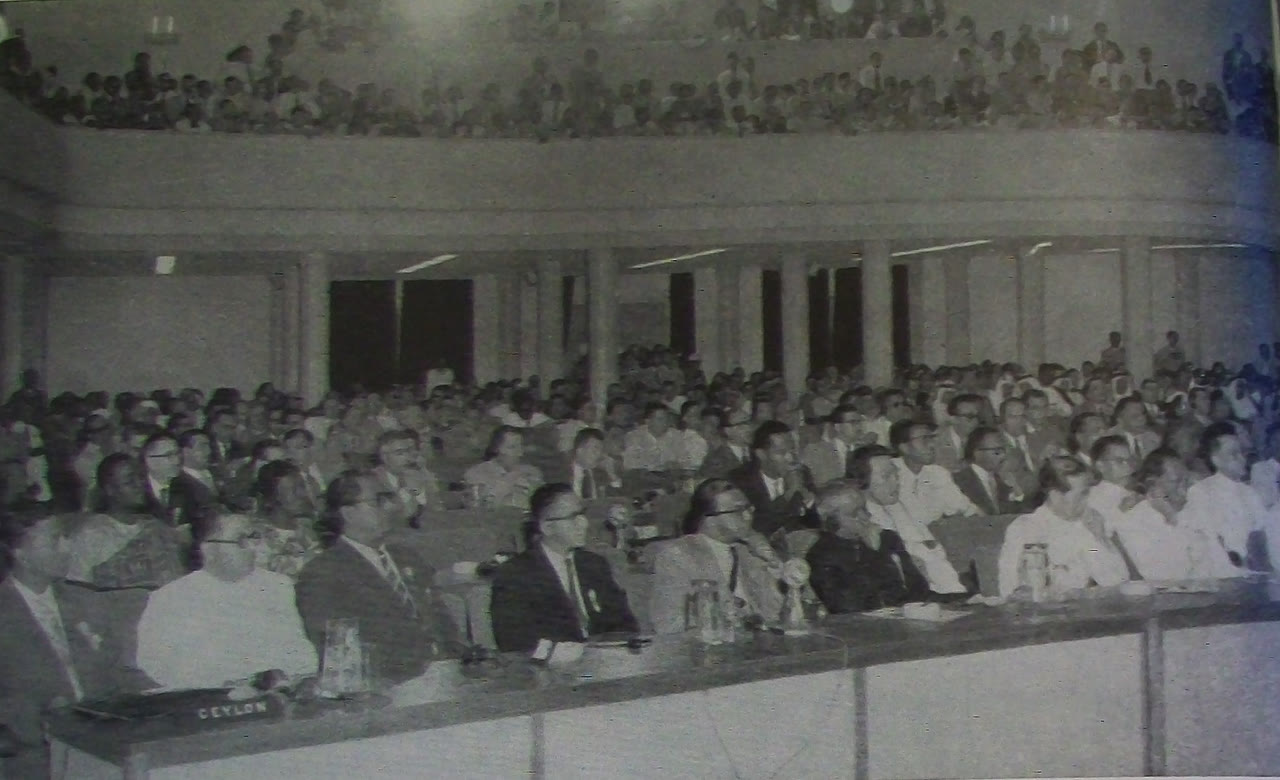
Image context: the cover uses an archival photograph of delegates at the conference's opening meeting in Bandung.[5] It is the right image for this piece because the historical question here is textual and institutional. Bandung mattered not simply because leaders gathered in one hall, but because that gathering turned into a negotiated written program. The tables, microphones, and dense conference room keep the event at the level where politics becomes wording.
The communique wrote a program, not just a mood
The first surprise in the document is how much of it is economic.[1] Popular memory often jumps straight from Sukarno's opening atmosphere to the anti-colonial and nonaligned afterlife.[2][3][4] The communique itself starts elsewhere. It declares the urgency of economic development across Asia and Africa, calls for technical assistance among participating countries, asks for more development financing through international institutions, recommends commodity-price stabilization, worries about shipping rates, encourages regional banks and insurance companies, and even notes the value of information exchange on oil profits and taxation.[1]
That structure matters. It shows that Bandung was not conceived as a purely moral congress of recently liberated nations. It was also a forum for states whose independence would remain fragile if they continued exporting raw materials through shipping and credit systems they did not shape.[1][4] My inference from the order of the communique is straightforward: the delegates understood sovereignty as something that had to be materially supported. Political dignity without development capacity would remain vulnerable to renewed dependence.
The official Indonesian museum history reinforces that practical reading.[3] Its account of the 1954 Colombo and Bogor preparatory meetings stresses that the sponsors were not improvising a symbolic summit at the last minute. They spent months deciding agenda, invitees, procedures, logistics, and committee structure.[3] Even the opening day in Bandung on 18 April 1955 is described not only as spectacle but as preparation for committees on politics, economics, and culture.[3] The conference was designed to produce a usable communique, and the communique reads like it.
Sovereignty at Bandung did not mean withdrawal from the world
The most cited part of Bandung is the declaration on peace and cooperation, especially the principles later called the Dasasila Bandung.[1][3] Read in isolation, those clauses can look like a soft statement of neutralism. Read closely, they are more exact than that. Principle 5 respects the right of each nation to defend itself "singly or collectively" in conformity with the UN Charter.[1] Principle 6 then narrows the warning: states should abstain from using collective-defense arrangements to serve the particular interests of the big powers, and they should not exert pressure on other countries.[1]
That pairing is the document's hinge. Bandung does not reject security cooperation as such.[1] It rejects the conversion of security cooperation into hierarchy. This is a crucial distinction. The communique does not demand that newly independent states become pacifist, unarmed, or diplomatically solitary. It tries to preserve room for security choices while blocking the pattern in which those choices become pipelines of external command.[1][2]
That is why the communique reads more like a document about political space than a document about purity. The delegates were operating in a world shaped by the Korean War, the deepening Cold War, and mounting nuclear fear.[2][3] The text therefore seeks a middle position that is stronger than simple fence-sitting. It says, in effect, that states of Asia and Africa can cooperate internationally, can defend themselves, and can use outside capital or institutions, but should not allow those channels to dissolve sovereign judgment.[1]
Anti-colonialism was stated as a present emergency, not a background value
The second reason Bandung matters is that the communique refuses to treat colonialism as yesterday's problem.[1] Section D does not speak in vague civilizational terms. It declares that "colonialism in all its manifestations is an evil," describes alien domination and exploitation as denials of fundamental human rights, supports freedom and independence for dependent peoples, and calls on the powers concerned to grant that freedom.[1] The phrasing is general, but the document immediately becomes concrete: it supports self-determination and independence in Algeria, Morocco, and Tunisia, addresses Palestine, backs Indonesia's position on West Irian, and supports Yemen's case regarding Aden and the southern protectorates.[1]
That breadth is important because it prevents Bandung from shrinking into an Asian conference with African ornament.[1][3][4] The museum's historical page makes the same point in narrative form when it describes the pre-conference world as one in which some Asian states had gained independence after 1945 while many African territories remained under colonial control or were still fighting for it.[3] The communique translates that uneven map into shared language. It lets already independent states speak politically for territories not yet free without pretending that the decolonization process was complete.[1][2][3]
The human-rights section sharpens the argument further.[1] The delegates affirm support for the UN Charter, note the Universal Declaration of Human Rights, endorse self-determination as a prerequisite for the full enjoyment of rights, and condemn racial discrimination, with explicit sympathy for those suffering under racial rule in South Africa.[1] This is not a side note. It shows that Bandung linked sovereignty to personhood. The state claim and the human claim were drafted together.
The communique refused bloc status even while asking for coordination
One of the most revealing lines in the economic section comes after repeated recommendations for consultation, technical exchange, commodity coordination, and intra-regional trade. The communique says plainly that these efforts are not intended to form a regional bloc.[1] That sentence can look defensive at first glance. In practice it reveals the conference's underlying design.
Bandung wanted coordination without enclosure.[1] It encouraged prior consultation in international forums, but it did not build a binding alliance. It welcomed cooperation with countries outside the region, including foreign capital, but insisted on mutual interest and respect for sovereignty.[1] It wanted joint leverage on trade and development questions, while avoiding the appearance that Asia and Africa were merely building a third camp to mirror the first two.[1][2][4]
That is why the communique survives as more than a relic of 1955. The afterlife described by the U.S. State Department and Britannica, which connects Bandung to the later Non-Aligned Movement, is real.[2][4] But the text itself shows that the conference's imagination was somewhat different from the later label. "Nonalignment" can sound passive, as though the achievement were simply not joining someone else's side. The communique is more active. It builds a vocabulary for choosing, coordinating, and bargaining without surrendering the right to judge case by case.[1]
Why the wording still matters
Bandung remains historically powerful because the final communique solved a drafting problem that decolonization kept creating.[1][2][3][4] Newly independent states needed a common language large enough to cover anti-colonial legitimacy, development needs, racial equality, nuclear danger, and sovereign dignity, yet narrow enough to keep governments with very different regimes and interests in the same room.[1][3] The document found that language by refusing a false choice. It did not ask the postcolonial world to pick between abstract moralism and raw state interest. It wrote the two together.
That is the strongest conclusion a close reading supports. Bandung did not matter only because it announced a mood of awakening or because it foreshadowed a later diplomatic movement.[2][4] It mattered because the delegates wrote a practical grammar for states trying to stay newly free in a world eager to classify them. Sovereignty, at Bandung, was never just a flag. It was a claim to political judgment, economic room, and anti-colonial solidarity without compulsory bloc discipline.[1][2][3][4]
Sources
- Economic Cooperation Foundation, Bandung Conference - Final Communique - English (1955) - full text of the communique used for the close reading.
- U.S. Department of State, Office of the Historian, "Bandung Conference (Asian-African Conference), 1955" - background on the conference, its principles, and its relation to the later nonaligned movement.
- Museum Konperensi Asia Afrika, "KAA 1955" - official Indonesian museum history covering the pre-conference context, the Colombo and Bogor preparations, the opening in Bandung, and the Dasasila Bandung.
- Encyclopaedia Britannica, "Bandung Conference" - overview of participants, goals, and Cold War/decolonization significance.
- Wikimedia Commons, "File:Delegates at the opening meeting of the Bandung Conference.png" - source page for the archival conference photograph used as the article image.