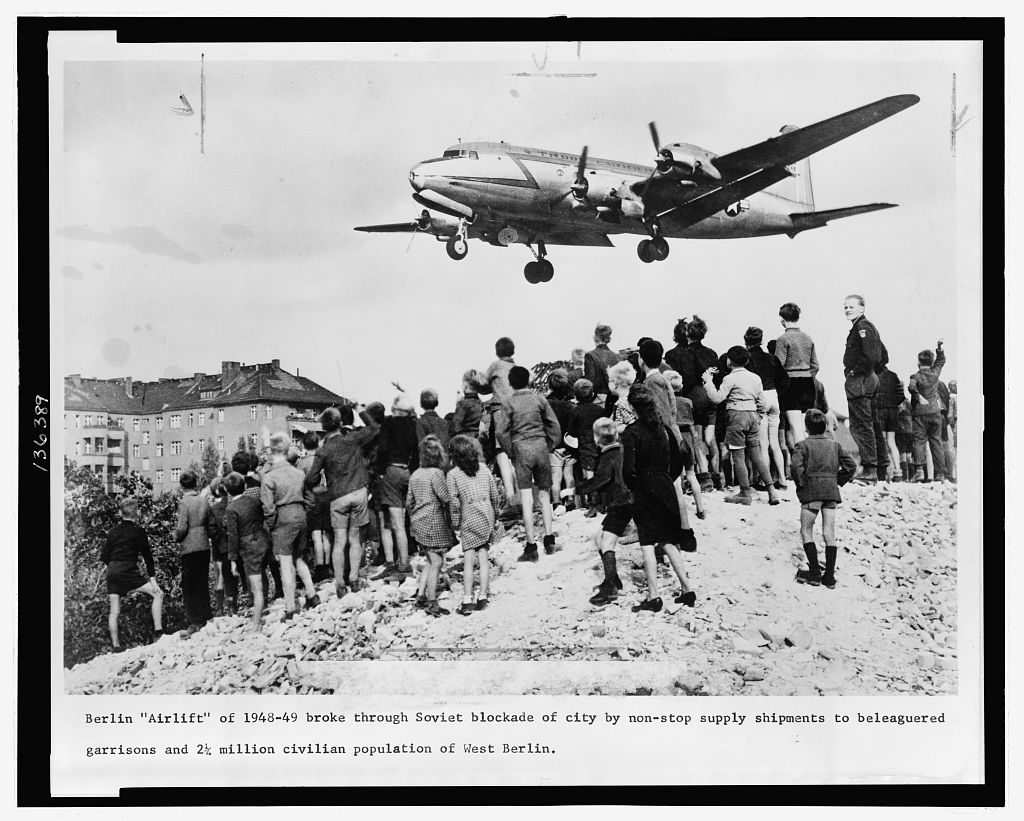
The Berlin Airlift is often remembered as a feat of endurance: pilots flew through fog, Berliners waited through shortages, and the Western Allies simply refused to blink.[1][3] That memory is true as far as it goes, but it leaves out the mechanism that made refusal workable. In June 1948, the United States, the United Kingdom, and France did not have the ground strength to smash the Soviet blockade around West Berlin without risking a much larger war.[1][2][4] What they did have was something narrower and, in the end, more durable: recognized air access, enough transport capacity to scale, and a political strategy that converted a local access crisis into a test of whether Moscow was willing to shoot down a visible humanitarian supply line.[1][2][3]
That is why the airlift mattered. It was not a romantic improvisation hovering above geopolitics. It was a system built around a hard fact: Berlin could not be held by force on the ground at acceptable cost, so it had to be held by tempo in the air.[1][2][4] Once that redesign happened, the crisis stopped being a simple question of who had the bigger army outside the city. It became a contest over endurance, logistics, and blame.
The crisis began as an economic struggle over who would control Berlin
The road to the blockade ran through postwar occupation policy, not through aviation. After 1945, Berlin sat far inside the Soviet zone of occupied Germany even though the city itself was split among four powers.[1][3] By 1947, the Western zones were already moving toward closer integration, including the creation of Bizonia on January 1, 1947.[1] In March 1948, the Soviets withdrew from the Allied Control Council after discovering that the Western powers were planning a separate West German state.[1] Then came the sharper trigger: in June 1948, the Americans and British introduced the Deutsche Mark into Bizonia and then into West Berlin without Soviet agreement.[1]
That currency move mattered because it was not just a technical monetary reform. It was a bid to pull Berlin's economy out of black-market paralysis and align West Berlin with the Marshall Plan order taking shape in Western Europe.[1] Soviet leaders answered with a blockade of the city's road, rail, and canal connections on June 24, 1948.[1][3] The immediate effect was practical: food, coal, electricity, and industrial supplies were suddenly in jeopardy. But the larger point was political. If the Western powers accepted the closure of surface routes and backed out, Berlin would become proof that the postwar balance in Europe could be revised by pressure alone.[1][4]
The key decision was to reject both withdrawal and a convoy showdown
From the outside, the menu of options looked broad. In reality it was brutally narrow. One path was withdrawal: write off West Berlin as an exposed enclave, move responsibility westward, and avoid military confrontation. Another was to force a land route with armed convoys and dare the Soviets to stop them. A third was the airlift.[2][4]
The reason the third option won is the heart of the story. A withdrawal would have saved resources in the short run, but internal U.S. policy debate treated it as a prestige disaster that would unsettle Western Europe.[1][4] A forced land probe looked firmer, yet U.S. planners concluded it risked a humiliating failure or immediate hostilities under conditions chosen by the Soviets.[2] The June 1, 1949 National Security Council report preserved in Foreign Relations of the United States is striking on this point: if the blockade returned, Washington recommended keeping the airlift at full capacity, rebuilding reserve stocks, and explicitly avoiding armed convoy attempts or symbolic "probes" that could produce a loss of prestige and entanglement in war on bad terms.[2]
That logic had already been visible from the start. The Western position in Berlin was politically vital but tactically weak. The answer, then, was to choose the one route whose legal basis still existed and whose interruption would require the Soviets to make themselves unmistakably responsible for escalation. The three air corridors into Berlin were narrow, but they were real.[1][3] So the crisis was redesigned around them.
Air corridors changed Berlin from a garrison problem into a throughput problem
This is the part of the airlift that is easiest to sentimentalize and easiest to misunderstand. Aircraft alone were not enough. The operation worked when the Allies turned flying into an industrial rhythm. The first American flights of Operation Vittles arrived on June 26, 1948, using C-47s that could carry only about three tons apiece; the British followed with Operation Plainfare two days later.[1][3] Very quickly, that initial scale looked inadequate. Berlin did not need symbolic deliveries. It needed food every day and coal before winter.[3]
So the system changed. Larger C-54s took a greater share of the burden. Aircraft were grouped by type into blocks so radar controllers could manage strings of planes with similar speed and handling. Pilots entered the corridor at assigned times and altitudes, made one landing attempt, and, if they could not get down, returned to base rather than clogging the queue.[3] When William H. Tunner took command in late July 1948, he accelerated exactly this discipline. The point was not aerial heroics in the singular. It was removing improvisation from a mission that could only survive as repetition.[3]
That is why the famous image of planes arriving at Tempelhof matters. The airlift succeeded not because every flight was dramatic, but because drama was replaced by cadence. By the spring of 1949, aircraft were moving through the corridors on a strict three-minute pattern, and during the mid-April 1949 "Easter Parade" a plane was landing nearly every minute across Gatow, Tegel, and Tempelhof while more than 12,000 tons of food and coal were delivered in a 24-hour push.[3] At that point the operation was proving something larger than technical competence. It was demonstrating that the Western allies could sustain the city long enough to make the blockade self-defeating.
Political design mattered as much as tonnage
The airlift did more than move cargo. It arranged responsibility. If the Soviets tolerated the flights, the Western position in Berlin endured. If they attacked the flights directly, they would own the transition from pressure to open aggression against aircraft carrying food and fuel into a civilian city.[1] That asymmetry did not solve every danger; Soviet forces harassed the corridors, and accidents remained a constant risk.[3] But it changed the moral and diplomatic geometry of the crisis.
The people inside Berlin mattered too. In September 1948, after Communist pressure disrupted the city council, some 300,000 West Berliners gathered near the Reichstag to reject Soviet domination and show that the city did not want to be bargained away.[1] This was not a side scene. It helped convince Western policymakers that the airlift was politically legible on the ground, not just defensible in memoranda.[1] Berliners were not merely passive recipients of supply. Their public resolve made abandonment more costly and continuation more credible.
By May 1949, the Soviet calculation had worsened. The blockade had not broken the Western position. The airlift had become more efficient instead of less. Meanwhile, the Western counter-blockade was inflicting shortages in the East.[1][2] On May 12, 1949, Moscow lifted the blockade.[1] The flights continued until September 30, 1949 anyway, because the Allies wanted reserve stocks in place in case the crisis restarted.[2][3] That detail is important. It shows the operation's governing logic in pure form: not theatrical victory, but system resilience.
The airlift worked because it chose the contest the Soviets least wanted
The Berlin Airlift is often folded into a broader Cold War morality play in which free societies simply showed more courage than dictatorships.[1] Courage was part of it. But the more exact historical lesson is colder and more useful. The West won this crisis because it refused the two contests the Soviets were best positioned to exploit: panic and ground confrontation. Instead it chose a third contest, one organized around air access, cargo tempo, reserve accumulation, and political optics.[1][2][3][4]
That is why the airlift became foundational in Cold War memory. It was not a mere substitute for military force. It was a demonstration that infrastructure could become strategy. A blockade designed to expose Western weakness ended by advertising Western staying power, because the answer to the blockade was not to break it head-on. It was to make it look futile day after day, landing after landing, until the side that had closed the roads found itself reopening them.[1][2][3]
Sources
- U.S. Department of State, Office of the Historian, "The Berlin Airlift, 1948-1949" - overview of the blockade's trigger, the June 24 closure, the September 1948 Berlin rally, and the May 12, 1949 Soviet reversal.
- U.S. Department of State, Office of the Historian, Foreign Relations of the United States, 1949, Council of Foreign Ministers; Germany and Austria, Volume III, Document 408 - NSC guidance to continue the airlift, rebuild stocks, and avoid armed convoy probes if the blockade returned.
- U.S. Army Transportation Corps, "Berlin Airlift" study page - operational detail on the 20-mile air corridor, the three-minute landing pattern, and the Easter Parade's 24-hour tonnage surge.
- U.S. Department of State, Office of the Historian, Foreign Relations of the United States, 1949, Council of Foreign Ministers; Germany and Austria, Volume III, Document 360 - contemporaneous policy framing of withdrawal, prestige, and the risks of trying to force Berlin by surface route.
- Library of Congress, "Berlin 'Airlift' of 1948-1949 broke through Soviet blockade of the city by non-stop supply shipments to beleaguered garrisons and 2 1/4 million civilian population of West Berlin" - archival photograph source page for the lead image.