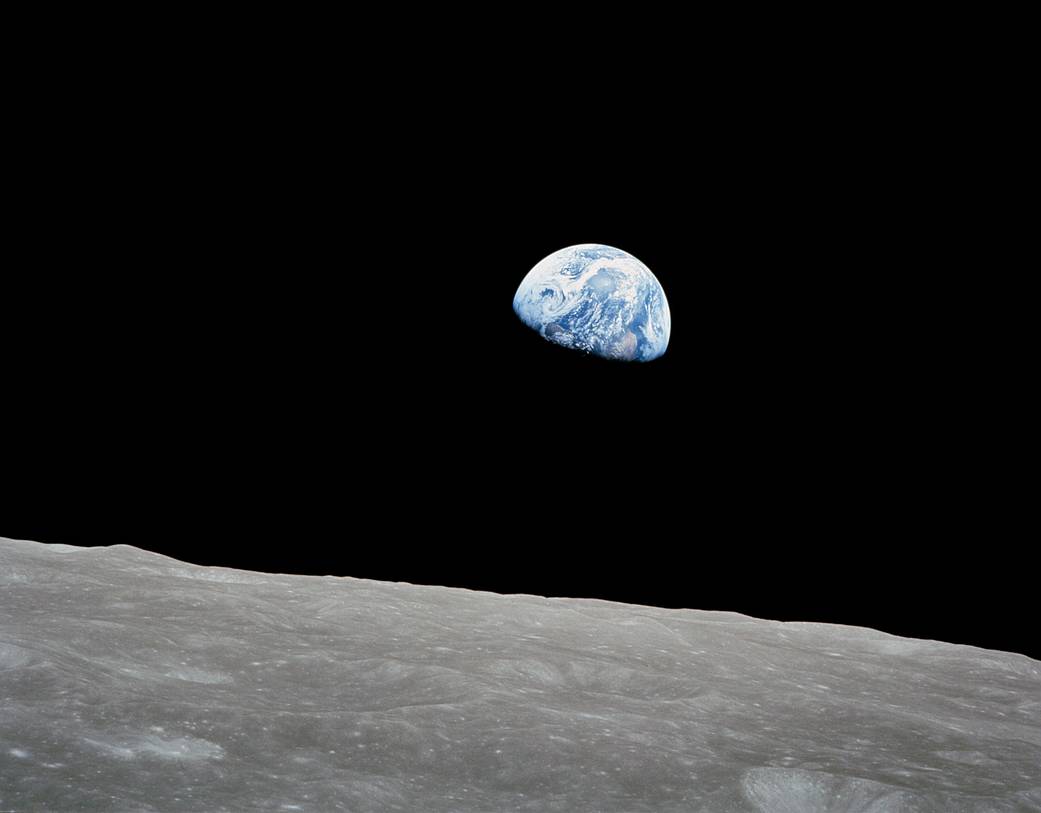

On December 24, 1968, Apollo 8 became the first crewed spacecraft to orbit the Moon.[2][3] That fact alone secures the mission's place in the history of exploration. The archival footage embedded below matters for a more specific reason. In a live Christmas Eve television message from lunar orbit, Frank Borman, Jim Lovell, and William Anders did not give viewers a triumphal preview of a landing. They offered pictures of the Moon and Earth, then read from Genesis, and in doing so turned a technical test flight into one of the twentieth century's most durable public images of the planet.[1][4][5]
The usual shorthand for Apollo 8 runs through firsts: first humans to leave low-Earth orbit, first crewed trip to the Moon, first humans to see the lunar far side with their own eyes.[2][3] Those achievements are real, but the broadcast preserves the mission's emotional and political hinge. This was still a Cold War program, still a vehicle test, still a race under deadline pressure. Yet the television signal coming back from lunar orbit gave the mission another register. The Moon became the platform from which Earth could be newly seen.
That is why the footage still deserves close attention. Apollo 8 is often remembered through the still photograph Earthrise, taken by Anders during lunar orbit on the same day.[2][5] The photo is indispensable. The moving image shows the transition into that way of seeing. It preserves the moment when the mission's meaning widened from getting there first to realizing what "there" made visible.
Historical context: a mission rewritten by schedule pressure became a new human vantage point
Apollo 8 did not begin as the mission history now remembers. NASA's broader Apollo sequence had to be reorganized in 1968 after delays in the lunar module program, and Apollo 8 was reassigned from an Earth-orbit test toward a bold circumlunar and then lunar-orbit mission.[3][4] The wager was operational as much as symbolic. If the Saturn V, the command-and-service module, navigation, communications, and mission control could all work together at lunar distance before the end of the year, the United States would prove that the Moon program had moved from promise into integrated capability.[2][3]
The dates matter because the pace was part of the drama. Apollo 8 launched on December 21, 1968.[2] Roughly 69 hours later, on December 24, the crew fired the engine for lunar orbit insertion while out of radio contact behind the Moon, becoming the first human beings to orbit another world.[4] On that same Christmas Eve, the astronauts sent a live television broadcast home. Three days later, on December 27, the spacecraft splashed down safely in the Pacific.[2] In less than a week, a mission created under schedule pressure had redrawn the visual scale of human travel.
NASA's own mission material makes clear how new the vantage point was. The crew watched Earth shrink as they traveled outward and then saw the Moon's far side directly, a sight no human being had ever observed with the naked eye.[3][4] Yet the archival force of Apollo 8 lies in the fact that the mission did not keep that perspective private. Television carried it outward. Millions were invited into a point of view that, until then, had belonged to no one.
Image context: the lead image uses NASA's Apollo 8 Earthrise photograph, taken by William Anders in lunar orbit on December 24, 1968. It belongs here because the article's central claim is about sequence: the Christmas Eve broadcast and the Earthrise image together transformed a lunar-orbit mission into a planetary event for viewers back on Earth.[5]
Video provenance
The embedded video is NASA Video's official YouTube upload, titled "Apollo 8's Christmas Eve 1968 Message."[1] The description identifies it as footage from the first manned mission to enter lunar orbit, notes that the astronauts showed views of the Earth and Moon from their spacecraft, and records that they ended with a reading from Genesis.[1] This provenance matters. The clip is not a later documentary montage with retrospective music and interpretation layered over it. It is the broadcast moment itself, preserved in the form by which most people first encountered it: as a mediated transmission from lunar orbit.
Close reading: what the broadcast shows that the still image alone cannot
The first thing the footage establishes is mediation. Apollo 8 reaches viewers as a live, grainy, black-and-white television event, with all the fragility that implies.[1] The image does not arrive polished. It arrives as signal. That matters historically because it preserves the mission not only as achievement but as transmission. The audience is not asked to admire a finished commemorative object. It is asked to watch a distant crew build a shared scene in real time.
The clip also reveals how carefully the astronauts organize scale. They do not speak as if the Moon were merely a trophy at the end of a race. They use the camera to show surfaces, horizons, and the relation between the spacecraft's view and the world listening below.[1] In written memory, Apollo 8 can flatten into prelude: the mission before Apollo 11, the rehearsal before the landing. The broadcast resists that flattening. It has its own completed historical form. A human crew has reached lunar orbit and is now sending home a picture of perspective itself.
That is where the broadcast and Earthrise lock together. The still photograph gives posterity a single unforgettable composition: blue Earth above the Moon's gray horizon.[5] The video preserves the conditions around that composition. It reminds the viewer that Earth did not enter history here only as an image taken by one astronaut. It entered as a narrated object, a thing shown back to its inhabitants through television and voice. The mission became memorable because it joined visual discovery to collective address.
The Genesis reading is often what later audiences remember first, and it does deserve attention.[1][4] On one level it reflects the ceremonial instincts of the period: a crew told to do something appropriate for what Borman later described as the largest audience yet to hear a human voice.[4] On another level, the reading works structurally. It slows the moment down. Instead of framing the Moon as a military frontier or a purely technical benchmark, the broadcast gives viewers cadence, sequence, and a language of beginnings. In archival terms, that choice explains some of the clip's afterlife. The footage survives not only because it was first, but because it gave firstness a script.
Yet the video is stronger than nostalgia. It captures a mission suspended between engineering and interpretation. Apollo 8 existed because NASA needed to prove an integrated deep-space capability in 1968.[2][3] The crew on screen are products of that system: trained, procedural, precise. But the camera record shows something that planning documents could not. Once the spacecraft reached lunar orbit, the mission's most durable public meaning shifted toward relation rather than conquest. The Moon stayed gray, cratered, severe.[3] Earth became luminous by comparison. That reversal is the real historical surprise.
The footage also shows why moving images matter alongside transcripts and stills. Duration changes meaning. The viewer watches the astronauts sustain attention, alternate voices, and hold the audience inside a remote scene long enough for the perspective to settle.[1] A single frame can symbolize fragility; a live broadcast makes fragility experiential. You feel the delay, the grain, the improbability of the connection itself. History appears not as a slogan but as a link that might have failed and did not.
Why this archival moment still matters
Apollo 8 remains one of the clearest examples of a mission whose technical objective and cultural consequence diverged in productive ways. The mission was built to reduce risk and advance the lunar program.[2][3] The footage it left behind helped create a planetary consciousness that extended far beyond mission planning. NASA's Earthrise materials still describe the image as one that speaks to the fragility and loneliness of Earth in space.[5] That reading did not come from commentary added decades later. The Christmas Eve broadcast already contains the emotional precondition for it.
Seen now, the clip preserves a threshold rather than a climax. Humans had not landed yet. The famous bootprints, flag, and descent images were still in the future. What Apollo 8 offered instead was orientation. The mission made the Moon reachable, and in the same gesture made Earth newly visible. That is why the archival footage belongs at the center of the story rather than at its edge. It records the exact moment when a race to the Moon turned, in public view, into a picture of home.
Sources
- NASA Video, "Apollo 8's Christmas Eve 1968 Message," official YouTube upload of the lunar-orbit broadcast.
- NASA, "Apollo 8" mission page - launch date, mission profile, crew, and return timeline.
- NASA, "Part 3: Apollo 8 - The Far Side" - lunar-orbit insertion timing, far-side context, and onboard observations.
- NASA, "Apollo 8: Christmas at the Moon" - historical context for the Christmas Eve broadcast, audience scale, and the Genesis reading.
- NASA Science, "Image: Earthrise" - historical note on Anders's photograph and the Christmas Eve broadcast context.