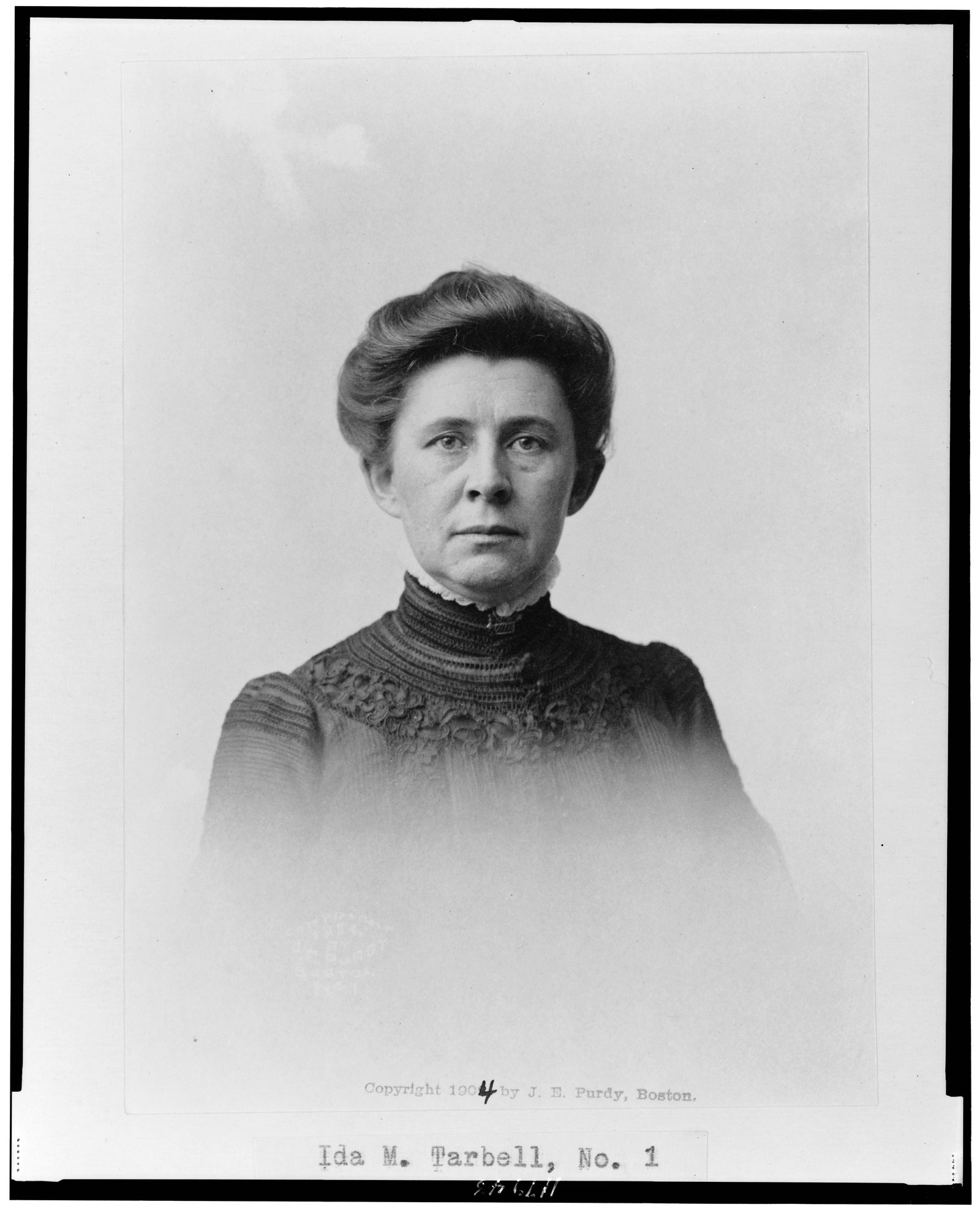
Ida Tarbell is often remembered as one of the great muckrakers of the Progressive Era. That label is not wrong, but it can flatten the mechanism that made her historically important. Tarbell did not topple Standard Oil by discovering one hidden memo or by writing a single denunciation so powerful that the state had to act. Her real achievement was slower and harder. She took a monopolistic system that many Americans already distrusted and turned it into an evidence problem that ordinary readers, legislators, and lawyers could follow in sequence.[1][2][3]
That distinction matters because Standard Oil had lived for decades inside a fog of scale. People knew John D. Rockefeller's empire was vast. They knew independent refiners had been crushed and rail rebates had tilted the field. What Tarbell gave the country between November 1902 and October 1904 was not outrage alone but legibility: dates, committees, contracts, courtroom testimony, pipeline arrangements, railroad favors, and named actors moving through a traceable chronology.[1][2] Her biography becomes historically useful at precisely that point, where private memory and public documentation begin to lock together.
Image context: the cover image is J. E. Purdy's 1904 portrait of Ida Tarbell, preserved by the Library of Congress. It suits this essay because the photograph belongs to the exact period when Tarbell's Standard Oil series was reshaping how monopoly could be described in public, in print, and eventually in law.[5]
Timeline anchors: when the Tarbell story becomes more than a profile
- 1872: the South Improvement scheme in Pennsylvania's oil country teaches Tarbell's family what railroad favoritism and refinery consolidation can do to a local economy.[2][3]
- 1894: Tarbell joins McClure's Magazine after her Abraham Lincoln series establishes her as a major long-form magazine writer.[2]
- 1901-1902: McClure's decides to tackle the trust question concretely, and Tarbell begins assembling the documentary record behind Standard Oil's rise.[1]
- November 1902 to October 1904: The History of the Standard Oil Company runs as a 19-part series.[2]
- 1904: the series is collected in book form, making Tarbell's reconstruction easier to circulate beyond the magazine audience.[1]
- May 15, 1911: the Supreme Court rules against Standard Oil under the Sherman Act; the company is later split into 34 companies.[3][4]
Those dates show why this is best read as a biography / microhistory rather than a generic reform-era profile. Tarbell's importance sits in a chain: remembered regional injury, disciplined archival work, a mass readership trained to read monopoly as a sequence of acts, and only later the formal antitrust judgment. The woman matters because the method mattered.
Oil country gave Tarbell her question before journalism gave her the tools
Tarbell did not approach Standard Oil as a detached puzzle chosen at random from a list of corporate giants. She grew up in northwestern Pennsylvania, in the region where the modern American oil business first took shape, and her family experienced directly what Rockefeller's rise meant for smaller operators.[2][3] The Library of Congress's account of her later recollections is especially useful here because it preserves the emotional starting point without turning it into myth. Tarbell wrote that the completion of Standard Oil's monopoly had filled her community with "hate and suspicion and fear."[3] PBS's biography places the wound earlier, in the 1872 South Improvement crisis, when a hidden arrangement between railroads and refiners threatened the position of independent producers and left strong memories in the Tarbell household.[2]
This origin point is important, but it should be handled carefully. Tarbell was not simply writing revenge literature on behalf of her father. If that had been all, the work would have stayed local and polemical. What matters historically is that she did not stop at memory. She treated regional grievance as a prompt for investigation. That shift from remembered injury to documentary reconstruction is what allowed her work to travel from Titusville and the Oil Regions into the national conversation about trusts.[1][2][3]
The move also helps explain Tarbell's tone. PBS notes that she did not condemn capitalism in the abstract, and she did not write Rockefeller as a cartoon villain.[2] She acknowledged his brilliance and the coherence of the business structure he had built. Her sharper claim was that the structure had grown through tactics that could be described, sourced, and judged. In other words, she was less interested in denouncing size than in reconstructing the route by which size had been achieved.
McClure's did not just give Tarbell a platform; it gave her a method
Tarbell's preface to the 1904 book version of The History of the Standard Oil Company is one of the most revealing source documents in her own voice.[1] She explains that the project began because the editors of McClure's wanted to deal "concretely" with the trust question. Standard Oil was chosen, she wrote, because it was the first great trust, the most fully developed one, and the case whose growth could actually be reconstructed from trustworthy documents.[1]
That claim is the hinge of the whole story. Tarbell did not build her series around rumor, leaked gossip, or one star witness. She emphasized the existence of a dense evidentiary trail: congressional investigations dating back to the 1870s, state legislative inquiries, Interstate Commerce Commission examinations, court fights in Ohio, testimony taken under oath, pamphlet literature, newspaper archives, and manuscript evidence from civil suits.[1] She even highlighted the "nineteen volumes" of the U.S. Industrial Commission reports in which Standard Oil repeatedly appeared.[1] The point was methodological. Standard Oil had become so large, and had collided with regulators so often, that it had accidentally generated the record of its own ascent.
Tarbell then added another layer. In the same preface, she describes examining court files on the ground, consulting private correspondence, and interviewing participants across the oil centers.[1] This is where the article becomes more than advocacy. She was doing what modern investigative reporting still tries to do at its best: not treating narrative and documentation as opposites, but using narrative to organize a massive documentary archive into causal order.
That is why the Tarbell story should not be reduced to the phrase "muckraking exposé." The important word is not exposé but history. She meant to write the growth of Standard Oil as a historical sequence with evidence attached to each stage. The result could be read by magazine readers, but it was constructed more like a public brief.
Why the series hit so hard
PBS's biography captures the publication fact that made the project politically potent: Tarbell's investigation became a 19-part series running from November 1902 through October 1904.[2] Serial publication mattered. It meant readers did not receive one abstract lesson about monopoly. They received repeated demonstrations of how Standard Oil had worked: rebates here, pipelines there, local pressure elsewhere, and all of it attached to names, dates, and institutions.[1][2]
This slow release schedule also changed the emotional texture of the work. A one-off article can shock and vanish. A long sequence builds memory. Tarbell kept Standard Oil in front of readers month after month, long enough for the trust to stop appearing as an inevitability of modern business and start appearing as a chain of choices that could have been made differently.[1][2] That is one reason the series matters even if one refuses the simplistic claim that Tarbell "single-handedly broke up Standard Oil." She did something more durable: she trained a mass audience to read monopoly as a historical construction rather than a natural fact.
The texture of the writing mattered too. Tarbell was sympathetic to the independent oil workers and producers who had been rolled over by Standard Oil's tactics, but she did not write in a purely prosecutorial register.[2] That balance gave the work credibility. She could show Rockefeller's organizational skill and still argue that his route to dominance had depended on methods that violated public norms of fair competition. In a media environment saturated with boosterism and partisan attack, that combination of respect for the subject's power and precision about his methods gave the series unusual force.
The 1911 breakup belongs in the story, but not as a fairy-tale ending
The temptation in Tarbell's biography is to jump directly from the magazine series to the Supreme Court's 1911 Standard Oil decision and narrate a clean triumph.[4] The chronology does not support such neatness. Tarbell was one force among many: state litigation, federal antitrust enforcement, changing political attitudes toward corporate combination, and long-running documentary disputes over rail discrimination and market control all mattered.[1][3][4]
Still, it would be equally wrong to sever her work from the later legal outcome. The Library of Congress summary ties the connection together cleanly: after the publication fight, Standard Oil was found to have violated the Sherman Act and was split into 34 companies.[3] The Supreme Court decision on Justia shows the case as the state finally converting a long historical argument into a formal judgment.[4] Tarbell did not write the opinion, but she helped shape the public file from which monopoly could be understood before the Court gave it doctrinal form.
This is the point where biography becomes microhistory in the strongest sense. A single writer's workflow tells us something larger about American governance. Tarbell's career shows that modern corporate power often becomes actionable only after someone reorganizes scattered evidence into a readable pattern. Institutions may possess pieces of the record for years. The political threshold is crossed only when those pieces start to cohere for a wider public.
What Tarbell's career reveals about the history of monopoly
Tarbell's lasting importance lies in the distance she covered between local memory and national argument. She began with the Oil Regions' lived knowledge that Standard Oil's rise had not felt clean.[2][3] She then passed through archives, investigations, testimony, and interviews until that knowledge could be expressed in a form broad enough for the country to absorb.[1] That movement is why her work endured. She neither abandoned the local wound nor allowed it to remain anecdotal.
Seen from that angle, Tarbell was not just an investigative journalist and not just a reform icon. She was a builder of public intelligibility. She made it harder for Americans to talk about monopoly as if it were only the reward for efficiency. She showed that the trust question had a paperwork trail, and that the paperwork trail had a human geography: towns, refiners, shippers, pipelines, legislatures, and courts.[1][2][3]
That is why the most revealing unit of Tarbell's life is not the heroic portrait of the lone crusader. It is the file box. Her historical significance rests on the conversion of scattered records into a narrative structure strong enough to survive magazine publication, strong enough to shape civic memory, and strong enough to sit in the background when the state finally moved against Standard Oil in 1911.[1][3][4] Read that way, Tarbell's career is not only a story about one corporation. It is a story about how evidence has to be arranged before power becomes visible.
Sources
- Ida M. Tarbell, The History of the Standard Oil Company (Project Gutenberg edition of the 1904 book; Tarbell's own preface on method, documentary sources, and the trust question).
- PBS, American Experience: "Ida Tarbell" (biographical overview, Oil Region background, and publication history of the Standard Oil series).
- Library of Congress, "Standard Oil, Tariffs, and Ida Tarbell" (Inside Adams blog post on Tarbell's memory of the Oil Regions, her Standard Oil work, and the 1911 breakup).
- Standard Oil Co. of New Jersey v. United States, 221 U.S. 1 (1911), Justia U.S. Supreme Court Center.
- Library of Congress Prints and Photographs Division, "Ida Tarbell, no. 1 / J. E. Purdy, 1904" (image provenance and catalog record).