
On October 15, 1964, Radio Moscow and Western broadcasters were carrying the same basic fact: Nikita Khrushchev was out.[2] What no outside audience could yet see was the room in which the decision had been made, the coalition that had formed against him, or the bargaining that turned a Soviet leader who had dominated the post-Stalin decade into yesterday's problem. That gap is what makes the 130-second Universal News reel embedded below historically useful.[1]
The reel does not uncover the coup. It does something more revealing about Cold War media. It takes an opaque internal Party removal and turns it into a consumable public event for Western viewers. First comes the clean announcement. Then comes a search for a single reason. Then comes the familiar Khrushchev montage: volatility, theater, the United Nations, the world stage. Only at the end does the newsreel return to the harder fact that actually mattered in October 1964, which was succession.[1][3][4]
That sequence is worth watching closely because the official Soviet line and the Western explanation were both trying to calm uncertainty at high speed. Soviet diplomats told Washington that foreign policy continuity and peaceful coexistence remained intact.[3] Embassy analysts in Moscow read the first post-coup signals as an effort to manufacture legitimacy and continuity around a collective leadership.[4] Lyndon Johnson told Americans that Khrushchev had been forced out, but also that many of the men now in charge were the same figures he had already elevated.[6] The reel lives inside that same scramble for legibility.
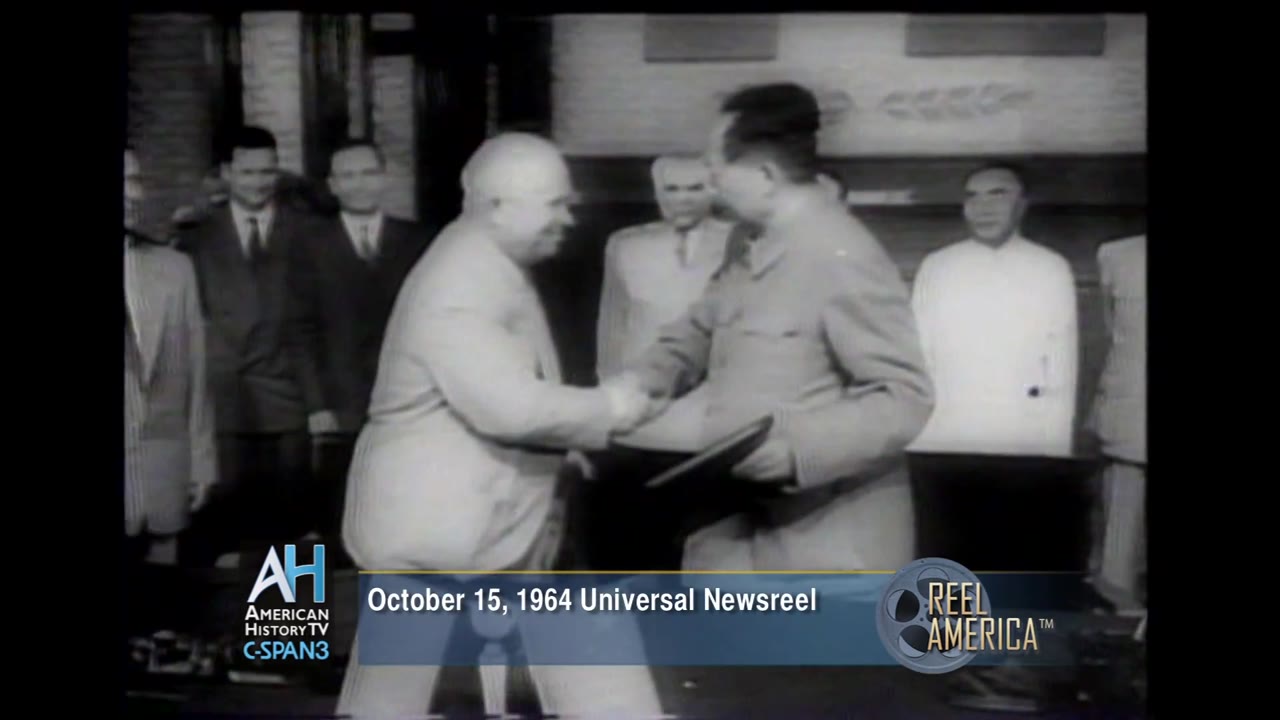
Image context: the lead image is a frame extracted from the embedded Universal News reel itself. It belongs here because the article's subject is mediation as much as politics: Khrushchev's removal reached most foreign audiences as edited moving images and narration, not as direct access to the Central Committee's closed proceedings.[1]
By 0:14, the reel turns secrecy into a finished fact
The first striking move is how quickly the narration collapses uncertainty into certainty. Within seconds, the viewer is told that an official Russian announcement said Khrushchev had resigned and that Western diplomats were taking measure of the event.[1] In formal terms that is true enough. There had been an announcement. Diplomats were reacting. But the compression matters. The viewer is delivered the outcome before being allowed to feel how little was actually known outside the Soviet system on that first day.
That flattening was part of the event, not a distortion added later. The Wilson Center's preserved Radio Moscow announcement is itself terse and ceremonial, the sort of statement designed to establish finality before explanation.[2] Dobrynin's first message to Johnson did much the same work in diplomatic language, assuring the White House that the broad line of Soviet foreign policy remained unchanged.[3] The newsreel sits between those two forms. It has to sound definitive enough for television while leaning on information channels that were still being tightly managed.
By 0:24, the health story is discarded and replaced with a simpler one
The narration then moves to the standard problem: if ill health was only the official cover, what was the real cause? Universal News reaches quickly for a single answer, suggesting that Khrushchev's feud with China was the decisive reason for his fall.[1] That claim is intelligible as television because it gives viewers one dramatic line of explanation. It is also too neat.
The CIA memorandum published in Foreign Relations of the United States presents a much denser picture. Khrushchev's style of rule had irritated or damaged nearly every important group in Soviet politics, and the immediate trigger appears to have involved contested economic priorities as much as foreign-policy embarrassment.[5] The point is not that the Sino-Soviet split was irrelevant. It mattered. The point is that the coup succeeded because grievances had accumulated across party, state, and economic elites. A single-cause explanation made good copy; it did not capture the coalition that removed him.[5]
This is one reason the reel remains interesting instead of merely dated. It shows how television news translated a collective bureaucratic revolt into a plot line. Viewers were not given a layered account of policy fatigue, agricultural disappointment, administrative disorder, and leadership resentment. They were given a comprehensible trigger.
Around 0:40, personality takes over because mechanism stays hidden
Once the reel has named a cause, it shifts into the archive of Khrushchev's public persona. The footage returns to his most internationally legible self: the loud visitor to the United Nations, the leader associated with interruption, spectacle, and shock.[1] In narrative terms this is efficient. A viewer who cannot see the Presidium can still be reminded what kind of man Khrushchev seemed to be.
That move does historical work, but not the same work as explanation. Khrushchev really was a leader whose public style unsettled allies, opponents, and colleagues. Johnson's October 18 address acknowledged both his dominance and his taste for dangerous adventure while stressing that the broader Soviet leadership was still there after him.[6] The reel, by contrast, uses personality montage to solve an analytical problem. Since the internal mechanics of removal were closed, the film falls back on character. The man becomes the reason.
Watch what that accomplishes rhetorically. The coup begins to feel less like a decision by a nervous collective and more like the inevitable end of one overbearing individual. That framing was comforting for Western audiences because it made succession appear orderly and almost moral: excess style invites removal, institutions restore balance. FRUS reporting from Moscow was more cautious. Embassy analysts saw the new regime struggling to construct legitimacy and continuity in the first place.[4] The stability had to be asserted because it was not yet self-evident.
In the final half-minute, the reel becomes most honest when it admits darkness
The most revealing sentence comes late, when the narration concedes that outsiders were left in the dark about what happened when the Central Committee met and then moves directly to the naming of Leonid Brezhnev and Alexei Kosygin.[1] This is the point where the film's simplifications briefly run out. It cannot show the decisive meeting. It cannot show a vote the public never saw. It can only acknowledge opacity and then list offices.
That is exactly where the historical substance lies. Khrushchev's removal mattered not because one colorful Cold War personality disappeared from the screen, but because the Soviet system redistributed authority. Brezhnev took the leading Party role, Kosygin the premiership, and the post-Khrushchev order announced itself through collective vocabulary rather than one-man dominance.[1][4][6] Even the first American assessments emphasized process over drama: continuity in foreign policy, uncertainty about internal balance, and strong incentives for the new leadership to avoid further shock.[3][4]
The newsreel cannot fully teach that structure, but it does preserve the moment when television tried to compress it. That is why this short film is still worth the time. It captures three layers at once: the Soviet state's managed announcement, the Western media's hunger for a simple causal story, and the deeper fact that modern power transitions are often experienced first as edited shorthand. The coup itself happened off camera. The history of how people learned about it did not.[1][2][3][4][5][6]
Sources
- C-SPAN, "Khrushchev Resigns - Oct. 15, 1964 Universal News - Reel America," YouTube upload of the 1964 newsreel.
- Wilson Center, "Khrushchev Ousted. Radio Moscow, 10/15/1964 (0:49)" - surviving Soviet broadcast announcement of the leadership change.
- Office of the Historian, Foreign Relations of the United States, 1964-1968, Volume XIV, Document 55 - Dobrynin's assurance that Soviet foreign policy continuity and peaceful coexistence remained in place after Khrushchev's removal.
- Office of the Historian, Foreign Relations of the United States, 1964-1968, Volume XIV, Document 57 - U.S. Embassy Moscow analysis of the new leadership's effort to stage legitimacy and continuity after the coup.
- Office of the Historian, Foreign Relations of the United States, 1964-1968, Volume XIV, Document 62, "Khrushchev's Fall and Its Consequences" - CIA analysis of the coalition of grievances behind the October 1964 ouster.
- Miller Center, "October 18, 1964: Report to the Nation on Events in China and the USSR" - Lyndon Johnson's public framing of what Khrushchev's fall did and did not mean.