The Anglo-Zanzibar War is usually served as history’s quickest fact: Britain and Zanzibar fought for exactly 38 minutes on August 27, 1896, making theirs the shortest war on record. It is memorable, compact, and almost right.
The fighting was extraordinarily brief. The exact number is not nearly so secure. Rear-Admiral Harry Rawson’s telegram from Zanzibar that afternoon says, “At nine I opened fire” and “At 9.40 I ceased firing”—a forty-minute interval.[1] Guinness World Records currently gives 9:00 to 9:45, or forty-five minutes.[2] A recent scholarly reassessment uses the familiar thirty-eight.[4]
That disagreement does not turn a short war into a long one. It changes what can honestly be claimed. “About forty minutes” is evidence; “exactly thirty-eight” is a convention built by choosing particular start and stop signals. More importantly, the stopwatch begins only after six years of treaty-making, protectorate rule, and intervention in Zanzibar’s succession. The neat record makes an imperial takeover look like a sporting curiosity. The surviving documents tell a harder story.
The myth: a war with perfect edges
The popular version has the satisfying geometry of a timed event. An ultimatum expires. British ships fire. The palace flag falls. Thirty-eight minutes have passed. The record closes.
But a battle offers several plausible clocks. One can start when the ultimatum expires, when Rawson orders fire, or when the first ship’s gun actually discharges. One can stop when Khalid bin Barghash leaves the palace, when its flag comes down, when resistance becomes ineffective, or when the British cease firing. Even a small delay between an order and a first shot, or between a collapsed defense and a final cease-fire, is enough to produce the competing totals preserved today.[1][2][4]
Rawson’s same-day message is the firmest compact chronology. He reported issuing a morning ultimatum that required Khalid to lower his flag, surrender, and have his followers leave the palace before nine. When Khalid instead strengthened the position and trained the royal yacht’s guns toward the squadron, Rawson opened fire at nine. He reported ceasing at 9:40, after the yacht had sunk and the shore guns had been silenced.[1] The admiral was summarizing an operation, not certifying a record attempt; his times are rounded to the minute and his chosen end is the end of British firing.
The famous thirty-eight can still describe one defensible slice of the action. It should not be mistaken for a universally observed duration. Even the institution that labels the conflict the shortest war uses a forty-five-minute interval.[2] The safest verdict is therefore narrower: the armed exchange lasted no more than about three quarters of an hour and is conventionally treated as the shortest recorded war. The zeroes and eights are less important than the choices that put them there.
Before the first shell: a sovereignty already narrowed
Starting the story at 9:00 a.m. also accepts the victors’ preferred frame. Zanzibar’s political room had been shrinking well before the guns arrived.
On July 1, 1890, Britain and Germany signed the agreement often called the Heligoland-Zanzibar Treaty. Article XI recorded Germany’s recognition of a British protectorate over the sultan’s remaining territories, including Zanzibar and Pemba; in the same bargain, Britain undertook to press the sultan to cede other possessions to Germany. The negotiators named in the text are British and German. No Zanzibari signed the document that sorted Zanzibari territory into European spheres.[5]
Four months later, a British notice declared the sultan’s dominions under Queen Victoria’s protection. The declaration was communicated to other powers and reproduced in U.S. diplomatic papers; it described the protectorate as following an agreement with the sultan, but defined its territory through earlier British-German arrangements.[6] Zanzibar remained formally a sultanate. In practice, Britain increasingly decided which exercises of sovereignty it would recognize.
That distinction became explosive on August 25, 1896, when Sultan Hamad bin Thuwaini died. Khalid, a son of the former sultan Barghash, occupied the palace, gathered supporters, raised the red flag, and proclaimed himself ruler. There was no settled automatic law of succession within the dynasty, and Khalid had attempted to claim the throne before. His case also carried political meaning: scholars working from British Foreign Office records and Omani and Zanzibari accounts describe support for him among people who wanted to resist British control.[3]
British consul Basil Cave refused to recognize the accession. Khalid tried to communicate his claim—including an attempted telegram to Queen Victoria—but the telegraph company declined it at Cave’s request. Cave sought authority from London to use naval force; permission arrived on August 26. British warships concentrated in the harbor, while British-led Zanzibari government troops held the customs house. The famous final ultimatum came after the coercive machinery and preferred successor were already in place.[3]
This is why the stopwatch is not neutral. It begins when Britain had converted a dispute over who could rule into a target awaiting fire. It excludes the diplomatic partition that made British approval decisive and the two-day crisis during which one claimant’s messages were blocked while the other side assembled ships.
What forty minutes could contain
At nine on August 27, the imbalance became physical. The British squadron included modern cruisers and gunboats positioned within close range. Khalid’s defenders had old cannon, some machine guns, rifles, and the palace complex; the royal yacht Glasgow could fire, but it could not contest a Royal Navy squadron.[1][3]
Shells quickly disabled the palace guns, wrecked and burned buildings, and sank the Glasgow. The force disparity explains the brevity, not an absence of violence. Contemporary British reporting called the opposing loss “heavy.” Later accounts based on the diplomatic archive give roughly 500 Zanzibaris killed or wounded, compared with one seriously wounded British sailor.[1][3][4] The exact casualty total, like the exact duration, should be treated as an estimate. Its scale is enough to defeat the idea that a short war was a harmless one.
Khalid escaped the burning complex and entered the German consulate. Hamoud bin Mohammed, Britain’s preferred candidate, was brought to the customs house and accepted terms before being proclaimed sultan. In the following weeks, British authorities disarmed Khalid’s supporters, contemplated or imposed exile and property confiscation on prominent backers, and tried unsuccessfully to obtain Khalid from the Germans.[3][4]
On October 2, a German warship removed Khalid to German East Africa. He did not simply vanish when the palace flag fell: his exile, later capture during the First World War, and eventual return to East Africa extended the succession struggle’s human consequences for decades.[3] The shooting stopped before breakfast was late. The political work of the bombardment did not.
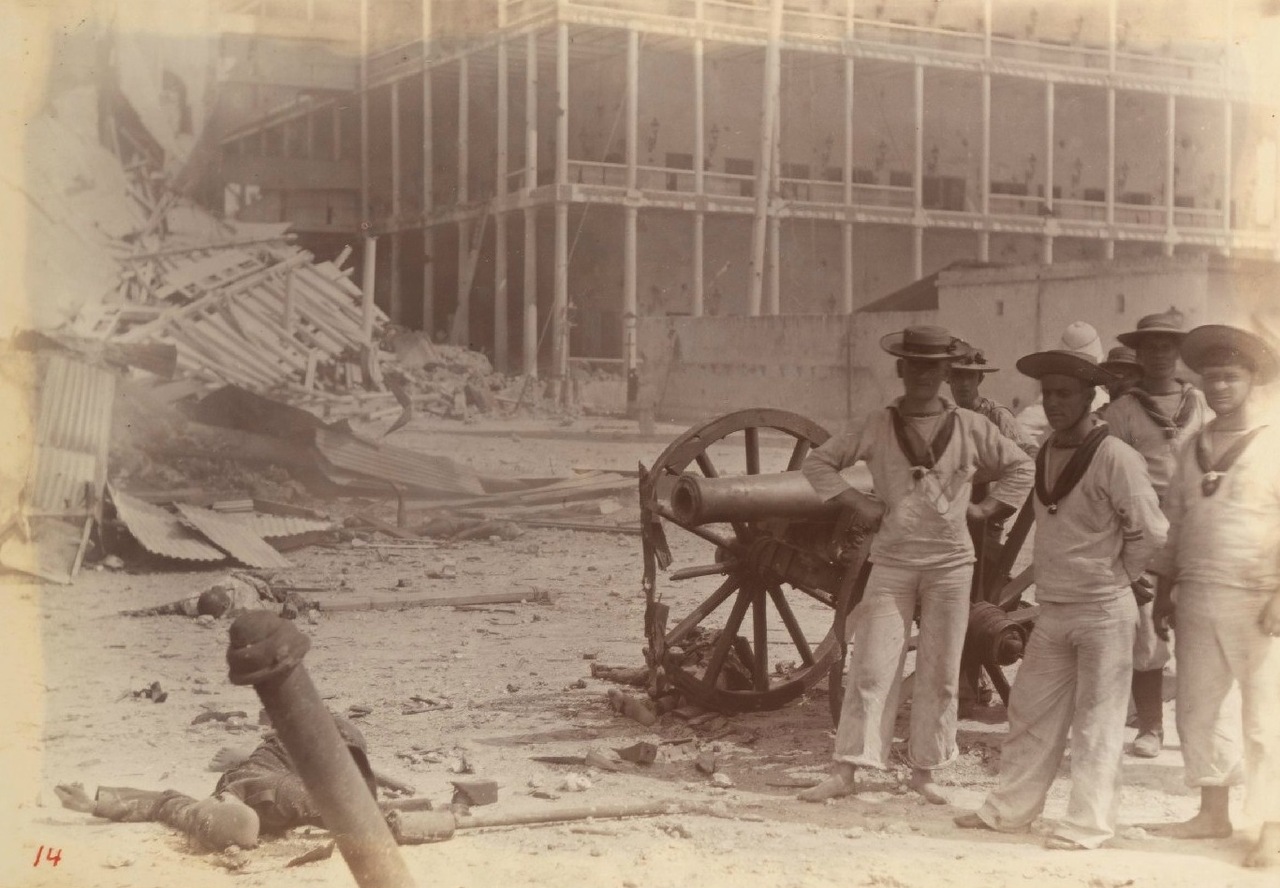
The photograph above belongs to that work of closure. British marines pose around a captured Zanzibari cannon, hands resting on the defeated weapon; two motionless bodies lie among the wreckage at lower left.[7] It is a real record of the aftermath, but not an unmediated view of the battle. The marines are posed and identified, while the fallen are unnamed; most of Khalid’s supporters and the installed ruler remain outside the picture. Like the duration, the photograph tells the truth from a position selected by the victors.
The evidence: short war, long seizure
Two corrections are possible, and only one is useful. The weak correction merely replaces thirty-eight with forty—or forty-five—and continues treating the episode as a stopwatch puzzle. The stronger correction asks why later retellings desire a precise number in the first place.
Precision turns asymmetry into novelty. “The shortest war” invites surprise at efficiency; it directs attention toward naval speed and away from the prior arrangement that let two European powers recognize a protectorate over someone else’s state. It also suggests clean boundaries: peace before nine, war for thirty-eight minutes, peace again. Yet the sequence was a continuum of constrained sovereignty. Britain had already acquired the power to approve a ruler, control external communications, assemble local and naval force, and install its candidate. Gunfire enforced that structure.[3][4][5][6]
This does not require turning Khalid into a simple nationalist hero. His coalition included dynastic loyalists, palace soldiers, slaveholders worried about British abolition policy, and people resisting foreign domination; those motives did not point in one direction.[3] Nor does acknowledging British imperial coercion settle every dispute over Khalid’s legitimacy. The evidence supports a more exact boundary: his claim had local backing, Britain rejected it according to a political order Britain had helped impose, and overwhelming firepower decided which claimant would rule.
Nicolini’s recent reassessment argues that the familiar record-book version has minimized both Zanzibari casualties and the loss of Omani-Zanzibari autonomy.[4] That is the historiographical cost of the myth. Thirty-eight minutes is not wholly fabricated; it is simply too small a container for the event it names.
Verdict
The Anglo-Zanzibar War probably deserves its superlative. No better-documented war between political authorities is generally accepted as having begun and ended more quickly. But “exactly 38 minutes” is false precision. A same-day operational report gives forty minutes, Guinness gives forty-five, and a recent scholarly reassessment repeats thirty-eight.[1][2][4]
The better historical sentence is less dazzling and more revealing: on August 27, 1896, British naval fire defeated Khalid’s palace forces in about forty minutes, completing an intervention prepared by years of imperial agreements and two days of succession crisis. The guns were brief because the inequality behind them was already mature.
Sources
- Rear-Admiral Harry Rawson, telegram to the Admiralty (August 27, 1896), reproduced from the Western Times in Reporting History — ultimatum, opening and cease-fire times, naval outcome, and British casualty report.
- Guinness World Records, “Shortest war” — current record entry identifying the Anglo-Zanzibar War and giving a 9:00–9:45 a.m. interval.
- Benyan Saud Turki, “Sayyid Khalid Bin Barghash, Britain and the Throne of Zanzibar,” Anaquel de Estudios Árabes 21 (2010), pp. 35–53 — source-based reconstruction of the succession, bombardment, losses, installed government, and Khalid’s exile.
- Beatrice Nicolini, “The 1896 War against Zanzibar: New Reflections about Imperial Military Power,” Africana 30 (2024), pp. 207–238 — reassessment of the conflict’s casualties, imperial asymmetry, and political consequences.
- German History in Documents and Images, “Anglo-German Treaty [Heligoland-Zanzibar Treaty]” (July 1, 1890) — translated treaty text, especially Article XI on Zanzibar and the British protectorate.
- U.S. Department of State, Office of the Historian, Foreign Relations of the United States, 1890, document 292 — British diplomatic notification and the November 4 protectorate declaration.
- Richard Dorsey Mohun, “British marines with a captured Zanzibari gun” (August 27, 1896), Wikimedia Commons — source page for the archival photograph used as the article image.