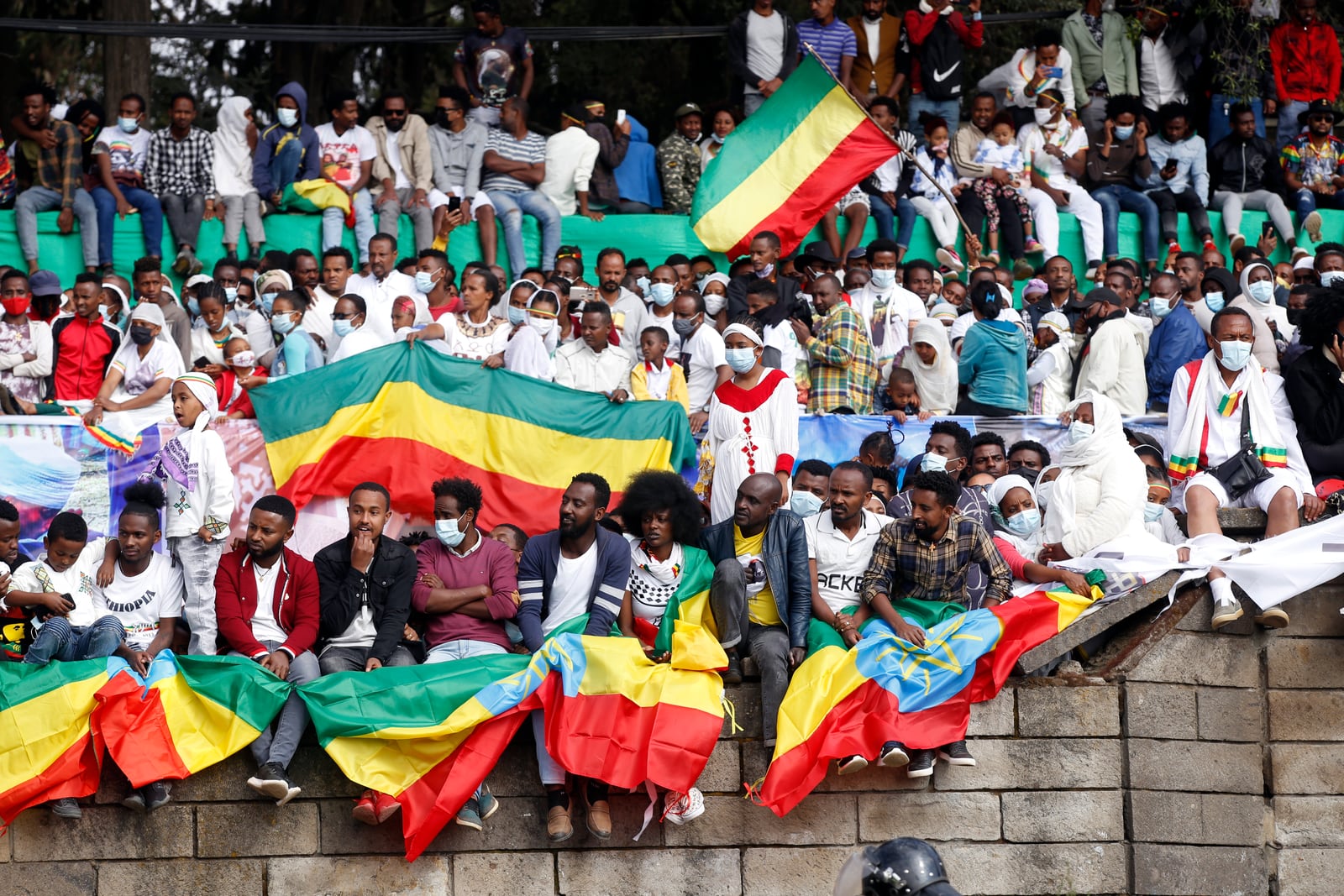
On 2 March 2021, thousands of people gathered around the equestrian statue of Emperor Menelik II in Addis Ababa. Ethiopian flags rose above the crowd; President Sahle-Work Zewde and members of the Ancient Ethiopian Patriots' Association attended. The occasion was the 125th anniversary of the victory at Adwa, won on 1 March 1896 against an invading Italian army.[6]
The photograph of that anniversary looks, at first, like a settled national icon: one victory, one flag, one crowd, one square. Its history says otherwise. Adwa's commemoration has moved among cathedral, monument, revolutionary plaza, battlefield route and museum project. Governments have changed its religious language, reassigned its heroes and redirected its crowds. Citizens have answered by defending an old gathering place, claiming a different one or walking more than 1,000 kilometres to the battlefield.[2][4]
The changing ritual does not mean that the battle's outcome is in doubt. Ethiopia defeated a European colonial invasion and preserved its sovereignty. The dispute is over what that victory authorizes in the present: a story of imperial continuity, a collective achievement wider than any emperor, a Pan-African inheritance, or some combination that also acknowledges the violence within Ethiopia's state-building. Adwa endures not because every generation has remembered it in the same way, but because each has had to decide where—and around whom—to assemble.
1889–1896: the victory supplied a durable claim
Adwa's commemorative power begins with an unusually clear political result. Article XVII of the 1889 Treaty of Wichale did not say the same thing in Amharic and Italian. Italy treated its version as making Ethiopia conduct foreign relations through Italian channels and claimed a protectorate. Menelik rejected that reading. After diplomacy failed, war followed; victory at Adwa forced recognition of Ethiopia's independence.[1]
Historian Sven Rubenson went further than the familiar story that Adwa ended a protectorate supposedly in force from 1889 to 1896. Because the discrepant Amharic text had equal authority, he argued, Italy's supposed protectorate had never been valid in the first place.[1] That is an interpretation of the treaty's legal history, not a dispute about the battle's consequence. In either account, Adwa made sovereignty visible in a form that could be repeatedly staged: foreign aggression met by a mobilized Ethiopian army and decisively defeated.
This portable meaning helps explain why the anniversary could survive governments that disagreed about almost everything else. A religious monarchy, a Marxist military regime and an ethno-federal coalition could all use anti-colonial victory. They did not have to preserve the same ritual—or identify the same principal owner of it.
Menelik's commemoration joined saint, army and state
The surviving record is clearest for the documented 1903 seventh-anniversary commemoration. Menelik ordered homage to Saint George, whom believers credited with assisting the Ethiopian forces, and the festivities centered on Saint George's Cathedral. Yet the ceremony also had a diplomatic audience. Weldegebreil interprets the parade before European consuls as a display of the country's military capacity to the colonial powers surrounding it.[2]
Those two registers reinforced one another. Liturgy placed the victory inside a sacred history; parade converted memory into a warning. The event Menelik declared annual was therefore never only backward-looking. It honored divine assistance and fallen patriots while broadcasting that the sovereignty won at Adwa remained defensible.
The emperor at the center of this ritual was also not the whole army. Adwa drew forces and support from across Ethiopia, including commanders and fighters whose descendants would later challenge a memory concentrated on Menelik. Empress Taytu's role, the work of women maintaining supply lines, regional leaders and the mass of mobilized participants all make the event larger than the mounted figure that came to symbolize it.[4][6] The tension between a convenient central icon and a dispersed collective achievement was present even if later politics made it more visible.
1930–1974: taking down and restoring a monument changed its charge
The Menelik II monument was built under Empress Zewditu in 1928 and unveiled in 1930. The bronze rider holds a sword and Ethiopian flag. Rituals around it helped turn an urban object into a memorial site.[4]
Italian occupation then altered what restoration could mean. After Ethiopian and Allied forces ended the occupation in 1941, Haile Selassie's government re-erected the Menelik monument the Italians had taken down and unveiled it on 5 May 1942. The act linked the emperor's restored state to Menelik's victory and treated the removal itself as evidence of what the occupiers wished to erase.[2][4] A statue erected for one political order became, after violation and return, a sign of recovered sovereignty.
Adwa's memory had also done work before liberation. Weldegebreil's study finds it useful in mobilizing patriotism before and during resistance to the renewed Italian invasion. Afterward, the imperial government used the victory to rebuild state symbols and national continuity.[2] This is a source-based claim about official practice; it should not be mistaken for evidence that every Ethiopian experienced imperial rule or its historical narrative in the same way.
The distinction matters because monuments compress. The rider can stand for victory, independence and resistance. He can also make a many-sided campaign look like the achievement of a single sovereign. What the monument gathered into one image, later commemorations would pull apart.
1974–1991: the revolution kept the anniversary and changed its grammar
The Derg overthrew Haile Selassie in 1974 and attacked the old order as exploitative. It did not discard Adwa. Instead, the Marxist military regime separated the state ceremony from its church-centered form, emphasized a secular anti-imperial meaning, renamed roads after Adwa and one of its heroes, and held celebrations at Menelik II Square and Revolution Square.[2][4]
That shift reveals a useful rule of public memory: survival does not require ideological continuity. The Derg could denounce monarchy while preserving a victory previously narrated through emperor and saint. Moving the ceremony outside the cathedral changed who appeared to authorize it. The revolution, the people and the anti-fascist state could replace divine patronage without surrendering the anniversary's mobilizing force.
The regime's reuse was selective too. It made Adwa serve a new government's policy and its calls for unity against internal and external enemies.[2] The content changed, but the ritual technology remained recognizable: designate a day, arrange a procession, choose a stage, name exemplary actors and translate a past coalition into a present political community.
After 1991: rival gatherings exposed rival ownership
The Ethiopian People's Revolutionary Democratic Front, which replaced the Derg in 1991, was initially ambivalent. Weldegebreil argues that the EPRDF's top leadership did not preside as earlier heads of government had, although other senior officials attended; the 1996 centenary became highly politicized.[2] This distance did not depoliticize Adwa. It created room for competing groups to fight over the memorial grammar the state seemed unwilling to settle.
One confrontation concerned the Menelik statue itself. An Oromo party within the governing coalition demanded its removal, regarding the emperor as an oppressor connected to the conquest and subjugation of Oromo and southern peoples. Patriots' and Menelik memorial organizations counter-demonstrated, arguing that he was a nation-builder and that removal would erase history. The statue remained.[4]
These are not simply pro-Adwa and anti-Adwa positions. Their strongest versions share more ground than that binary allows. The national-unity interpretation rests on well-supported facts: Ethiopian forces defeated Italian imperialism, and the victory became a powerful resource against later colonial rule. The critical interpretation does not need to deny that victory; it asks whether centering Menelik sidelines an army drawn from many communities and memories of his empire's expansion. The disagreement concerns the political community represented by the monument and the terms on which people enter its story.[4][5] Better battlefield and provisioning records could redistribute credit among the victory's participants. They could not, by themselves, decide the later normative question of who should own its public memory.
On 2 March 2019, the disagreement acquired a spatial form. Oromo equestrians and young people celebrated at Meskel Square, honoring Oromo participants in the battle and emphasizing commanders below the imperial summit. At the same time, the traditional gathering continued at Menelik II Square, foregrounding Menelik and Taytu. One anniversary produced two civic stages, each arranging the victory's scale differently.[4]
The split did not prove that Adwa had ceased to unite. It showed that “unity” itself requires an account of recognition. Who is named? Who leads the parade? Which monument supplies the background? A crowd's location became an argument before anyone spoke.
The road to Adwa made memory bodily
Not every commemorative claim stayed inside Addis Ababa. Guzo Adwa—“journey to Adwa”—re-enacted the historic march by walking from the capital to the northern battlefield, a route of more than 1,000 kilometres that took over a month. The annual pilgrimage replaced the static viewer before a monument with a body tested by distance.[4]
That form offered a different relation to the past. It did not merely represent mobilization; it made participants coordinate, endure and move together. The road became a temporary memorial, and arrival mattered because it had been earned step by step.
Yet re-enactment also met the present. The eighth journey, in 2021, took place amid war between Ethiopia's federal government and the Tigray regional government. Warned of the danger of continuing past Alamata, the organizers stopped there rather than reaching Adwa.[4] The interruption is historically revealing. Commemoration can borrow an old road, but it cannot walk outside current power and conflict.
The Adwa Zero KM project in Addis Ababa was designed as an institutional answer, bringing a memorial museum, amphitheatre, libraries and other public facilities into one complex. Its plan for monuments to multiple battle figures sought to widen ownership beyond one rider.[4] A museum can add names and rooms that a single statue cannot hold. It still cannot make interpretation final. Any roster includes and excludes; any central site competes with the battlefield, cathedral, street and memories carried by families and communities.
Pan-African memory broadens Adwa without dissolving the dispute
Adwa has another public far beyond Ethiopia. In 2018, the chairperson of the African Union Commission called it an Ethiopian and African victory, and one for peoples worldwide then subjected to colonial domination and discrimination; he said it gave them courage in their struggle for independence and dignity.[3] That Pan-African framing is not merely a later slogan pasted onto a national event. Ethiopia's preservation of sovereignty offered a material counterexample to the colonial claim that European conquest was inevitable.
But a continental meaning cannot act as a solvent on Ethiopia's internal history. Saying that Adwa belongs to Africa answers one question—why the defeat of an Italian invasion mattered beyond the battlefield. It does not answer another—how Menelik's state incorporated peoples, or how credit for victory should be distributed. External anti-colonial significance and internal historical injury can coexist. Treating one as proof that the other is imaginary makes the commemoration smaller, not larger.
The most capacious Adwa anniversary therefore does not need to choose between pride and argument. It can affirm the defeat of colonial invasion, recognize a coalition wider than its sovereign, and leave room to examine the state that victory strengthened. The cathedral, imperial monument, revolutionary square, Oromo horse parade, long-distance walk and Pan-African institution are not failed attempts to locate one authentic memory. Together, they are the history of the memory.
Adwa has never belonged to one square because its meaning has never belonged to one regime. The enduring ritual is not consensus around a statue. It is the repeated public act of assembling the victory—and disputing who stands within its frame.
Sources
- Sven Rubenson, “The Protectorate Paragraph of the Wichale Treaty,” The Journal of African History 5, no. 2 (1964) — African Union Library record and abstract on the discrepant treaty texts, Italy's protectorate claim and Ethiopia's recognized independence.
- Biniam Weldegebreil, Memories of the Victory of Adwa: A Focus on Its Commemoration (1941–1999), Addis Ababa University MA thesis (2004) — study of the anniversary under Menelik, Haile Selassie, the Derg and the early EPRDF.
- African Union Commission, “Statement of the African Union Commission Chairperson, Moussa Faki Mahamat, on the Celebration of the Adwa Victory Day” (2018) — official articulation of Adwa's Ethiopian, African and global anti-colonial meaning.
- Dalaya Ashenafi Esayiyas, Politicizing Public Events in Addis Ababa, Rift Valley Institute (2025) — research report on the Menelik monument, changing official venues, competing Adwa narratives, Guzo Adwa and the Adwa Zero KM project.
- Joseph A. Steward, The Battle for the Battle of Adwa: Collective Identity and Nation-Building, CUNY City College thesis (2020) — analysis of successive state uses of Adwa and resistance to the national narrative.
- Addis Getachew, “Ethiopians celebrate 125th anniversary of Adwa Victory,” Anadolu Agency (2 March 2021) — report and photographic source documenting the gathering at Menelik II Square.