
In the summer of 1919, the Lincoln Highway was a transcontinental route in the promotional sense before it was one in the material sense. Its name and line could join the Atlantic and Pacific on paper, but a heavy vehicle following that line still met a succession of concrete, macadam, dirt, wheel ruts, sand, mountain trail, culvert, and wooden bridge. The U.S. Army's first transcontinental motor convoy made that gap visible. It did not merely test trucks on a road. It tested whether “the road” existed as a continuous system at all.[2][4]
The convoy left Washington, D.C., on July 7, 1919, and reached San Francisco on September 6, after 3,251 miles and 62 days. The Eisenhower Presidential Library describes 81 motorized Army vehicles carrying 24 expeditionary officers and 258 enlisted men; 15 War Department observers accompanied them. Among those observers was 28-year-old Lieutenant Colonel Dwight D. Eisenhower, whose later association with the Interstate Highway System would become the expedition's most familiar afterlife.[2][5]
That retrospective fame can shrink the original undertaking into a presidential origin anecdote: bad roads taught young Eisenhower to build good ones. The 1919 documents describe a stranger and more revealing experiment. The Army wanted to service-test vehicles developed during World War I and examine whether a self-sustaining force could cross the continent if rail facilities and bridges had been disabled. The scenario was military, the machinery was experimental, and the route was also a rolling demonstration for the Good Roads movement.[2][5] Mobility, publicity, and national defense traveled in the same column.
The film preserved by the National Archives is valuable because it returns resistance to this polished story. A route on a map is frictionless. On film, a truck has weight; a ditch has depth; a grade changes engine temperature; and a convoy advances only when repair crews, scouts, cooks, engineers, and drivers keep its unequal machines together. The camera turns infrastructure from background into the event.
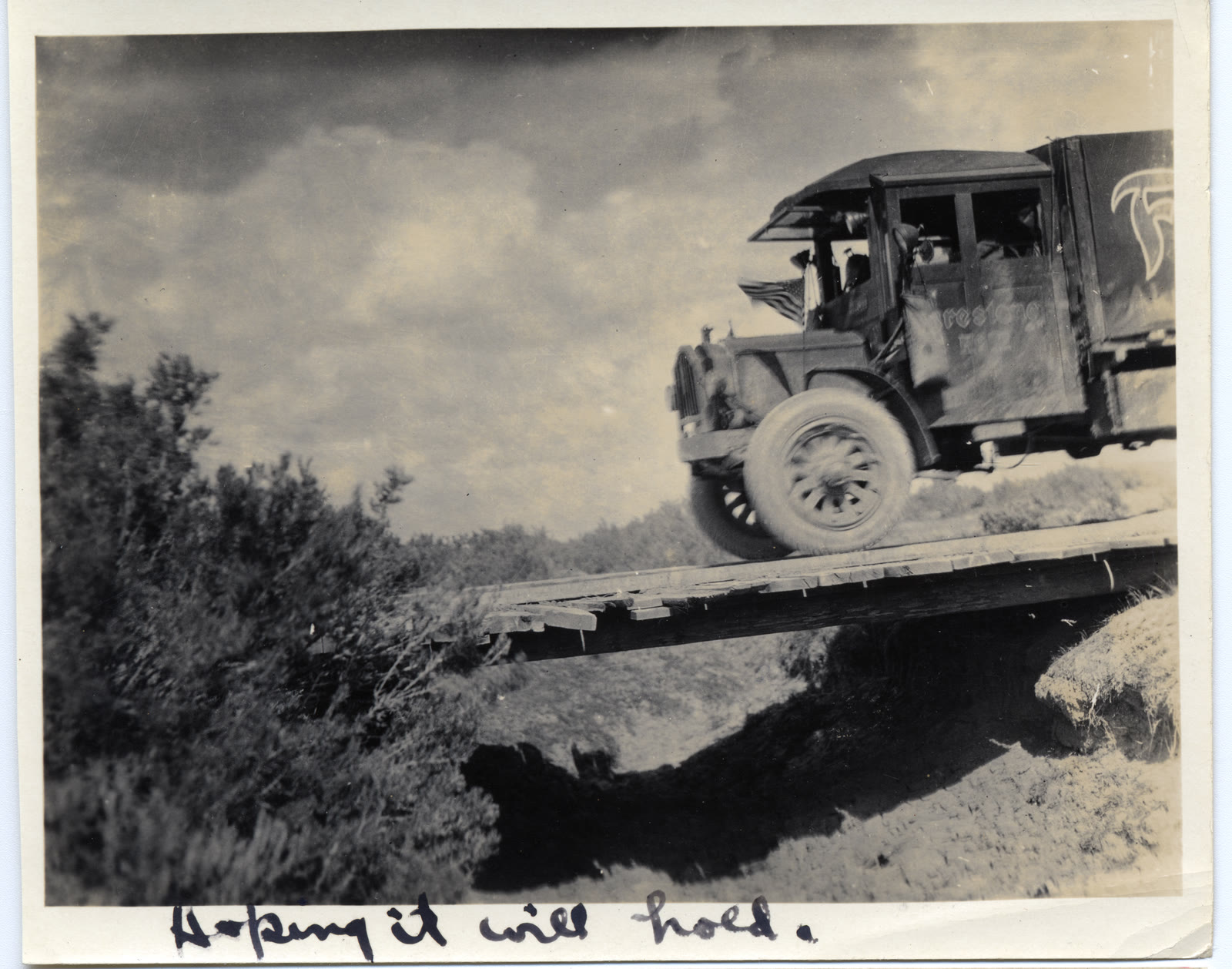
Image context: the hero photograph is part of the Eisenhower Library's convoy collection. Its handwritten caption, “Hoping it will hold,” is attached to a view of a truck edging across a makeshift-looking wooden span.[2] The image is not a generic illustration of early motoring. It records the exact question the expedition repeatedly posed: what happens when military weight reaches a local bridge?
A Highway Made Out of Local Surfaces
The expedition's official “Principal Facts” summary, preserved in the Eisenhower Library collection, says that 1,778 miles—54.7 percent of the journey—ran over dirt roads, wheel paths, mountain trails, desert sand, and alkali flats. More than 800 miles were judged practically impassable to the convoy's heavy vehicles. Men built traction from timber, canvas, sagebrush, and grass; on the worst days, the scheduled advance required 15 to 24 hours of labor.[2]
Bridges were not passive scenery. The same summary counted 88 mostly wooden bridges and culverts damaged or destroyed, then repaired or rebuilt before the column could continue.[2] Eisenhower's November 3, 1919, report explains why a pre-trip inspection could not solve every problem. Vehicle types had different efficient speeds; heavy trucks struggled in sand and on steep grades; narrow pavement forced wheels onto soft shoulders; and road quality changed sharply by state and region.[4] The convoy was therefore a moving compatibility test among machines, surfaces, bridge loads, drivers, and maintenance practices.
It was also a test conducted in public. The National Archives estimates that the column passed through roughly 350 communities and was seen by about 3.25 million people. Town stops, speeches, equipment displays, and local hospitality converted breakdown-prone movement into a national roadshow.[5] That dual character matters. A damaged bridge was an operational failure, but the sight of soldiers repairing it could also become an argument for road investment. The expedition generated evidence and staged persuasion at the same time.
The Film in the Archive
The embedded film was recorded by the U.S. Army Signal Corps during the 1919 journey. The National Archives preserves it in Record Group 111, Records of the Office of the Chief Signal Officer, as 111-H-1189, NAID 24694, together with an original shot list; the archive's Special Media staff has matched moments in the footage to the convoy's daily log.[3] The U.S. National Archives uploaded the surviving film to its official YouTube channel for the convoy's centennial in 2019.[1][6]
Close Reading: Failure Becomes Repeated Labor
The first thing to resist is the temptation to watch only for old vehicles. The machinery is fascinating, but the film's historical force lies in the changing relationship between vehicle and ground. At about 3:35, the National Archives' shot-list guide identifies a Riker truck that “turned turtle” in a ditch on July 22.[3] The overturned body is not simply comic mishap. It makes convoy geometry visible: one disabled truck consumes time, blocks sequence, demands equipment and bodies, and can separate the repair unit from the moving column.
The still photograph used above supplies the same lesson in a single frame. A truck crossing a narrow wooden bridge is not yet a truck that has arrived. Its success depends on a structure built for some earlier pattern of traffic accepting a new axle load.[2] My inference from the film and reports is that the convoy's real unit of performance was never the individual vehicle. It was the chain linking reconnaissance, road repair, bridge reinforcement, recovery gear, fuel, water, food, discipline, and the next passable mile. The machine could be mechanically sound and the movement could still fail.
Around 10:45, the film reaches the Continental Divide near the Ames Monument in Wyoming, which commemorated Union Pacific Railroad financiers Oakes and Oliver Ames. The archival shot list places the convoy there on August 11, at a reported elevation of 8,020 feet.[3] The juxtaposition is almost too neat: a motor column claiming a new mobility future pauses beside a monument to the railroad system that already crossed the continent. The convoy's own planning assumed that rail infrastructure might be unavailable, yet its western route repeatedly remained close to the older transportation geography. Motor mobility was not born outside the rail network; it was measured against it.
At roughly 16:39, a Trailmobile kitchen appears. The daily record notes that it later overturned and was lost on a Nevada hillside.[3] This brief appearance widens the viewing frame. A self-sustaining convoy is not only cargo trucks and command cars. It is hot food, water, medical care, spare parts, machine tools, sleep, and the trailers that carry those services. The kitchen's loss is a reminder that support equipment can be both essential and more fragile than the headline machines it sustains.
The final approach contains one last complication. At about 23:56, trucks board the ferry from Oakland to San Francisco.[3] The transcontinental road expedition finishes on water because no Bay Bridge yet connects those cities. That is not a contradiction in the convoy's achievement; it is the clearest possible ending. Networks are assembled from modes and crossings. “Coast to coast” was a successful claim, but the camera preserves the transfer point hidden inside it.
More Than an Interstate Origin Story
Eisenhower did remember the convoy when advocating better highways, and the National Archives traces that experience alongside his later view of German autobahns and the legislation signed in 1956.[5] But treating the 1919 trip as a direct blueprint for the Interstate System gives hindsight too much power. Eisenhower's immediate report was narrower: it compared vehicle types, criticized training and convoy discipline, catalogued regional road conditions, favored lighter trucks for long hauls, and argued that extended truck movement through the middle West was impractical until roads improved.[4]
The policy path was not automatic either. Federal-road advocates and state-highway officials disagreed about who should build and maintain a connected network. The Federal Highway Act of 1921 strengthened state control; later traffic growth, Depression-era planning, wartime logistics, federal studies, financing fights, and design standards all stood between the mud of 1919 and the controlled-access system of 1956.[5] The convoy belongs in that history as an unusually vivid diagnostic and political spectacle, not as a fully formed master plan.
Two interpretations can therefore coexist. As an Army experiment, the trip exposed weaknesses in vehicles, personnel, bridges, and roads under a simulated emergency. As a Good Roads performance, it made those weaknesses legible to millions of spectators and later to a president.[2][4][5] The evidence supports both readings. What it does not support is the simpler legend in which one unpleasant road trip, by itself, created the Interstate Highway System.
The footage's lasting value is more exact. It shows that infrastructure is not the line between two cities. It is the weakest bridge, the soft shoulder, the recovery winch, the water stop, the kitchen trailer, the maintenance decision, and the ferry at the end. The 1919 convoy succeeded because people repeatedly repaired the route beneath it. On camera, a highway becomes not a noun but a continuous act of making passage possible.
Sources
- U.S. National Archives, “1919 Transcontinental Motor Convoy” — official YouTube upload of the surviving Army Signal Corps footage.
- Dwight D. Eisenhower Presidential Library, “1919 Transcontinental Motor Convoy” — official overview with primary reports, daily log, photographs, and the archival source of the hero image.
- U.S. National Archives, The Unwritten Record, “Summer Road Trip: Across the Great Divide and into the Badlands” — Record Group and item provenance, shot-list identifications, daily-log matches, and film timestamps.
- Federal Highway Administration, “Eisenhower's Army Convoy Notes 11-3-1919” — transcription of Eisenhower's report on vehicles, personnel, roads, and operational lessons.
- David A. Pfeiffer, U.S. National Archives, “Ike's Interstates at 50” — archival synthesis of the convoy, Good Roads politics, federal-state debate, and the longer route to the Interstate System.
- Mary Ryan, U.S. National Archives News, “Eisenhower Library Exhibit Showcases 1919 Transcontinental Convoy” — centennial account and link to the full historic footage on the National Archives channel.