On May 4, 1912, the teenage Mabel Ping-Hua Lee rode on horseback among the mounted opening group of a New York City suffrage parade. An advance profile in the New-York Tribune had specified the visual effect: a black riding habit, a three-cornered hat, and the green, purple, and white colors of the Women's Political Union. Its headline compressed her into a paradox that would outlast the procession: “Chinese Girl Wants Vote.” A next-day report confirms that Lee was among the horsewomen as thousands marched behind them.[2][3][9]
The law supplied the other half of that paradox. Lee had been born in Guangzhou and came to the United States as a child during the exclusion era. Sources disagree about her precise birth and arrival years, but not about the fact that governed her political position: she was a foreign-born Chinese immigrant, not a United States citizen. The exclusion regime did more than restrict immigration. The Chinese Exclusion Act barred state and federal courts from admitting Chinese immigrants to citizenship. A victory against sex discrimination in voting could therefore leave Lee outside the electorate: first New York's state suffrage amendment in 1917, then the Nineteenth Amendment in 1920, changed one legal boundary without opening the citizenship boundary that enclosed it.[2][4][5][6][8]
That does not make Lee's activism a sentimental story about fighting only for someone else's rights. It makes her a guide to the movement's larger geography. Lee used suffrage to connect New York politics, the new Chinese republic, women's education, economic independence, and the public standing of Chinese communities in the United States. The parade displayed that connection. Her own writing explained it.
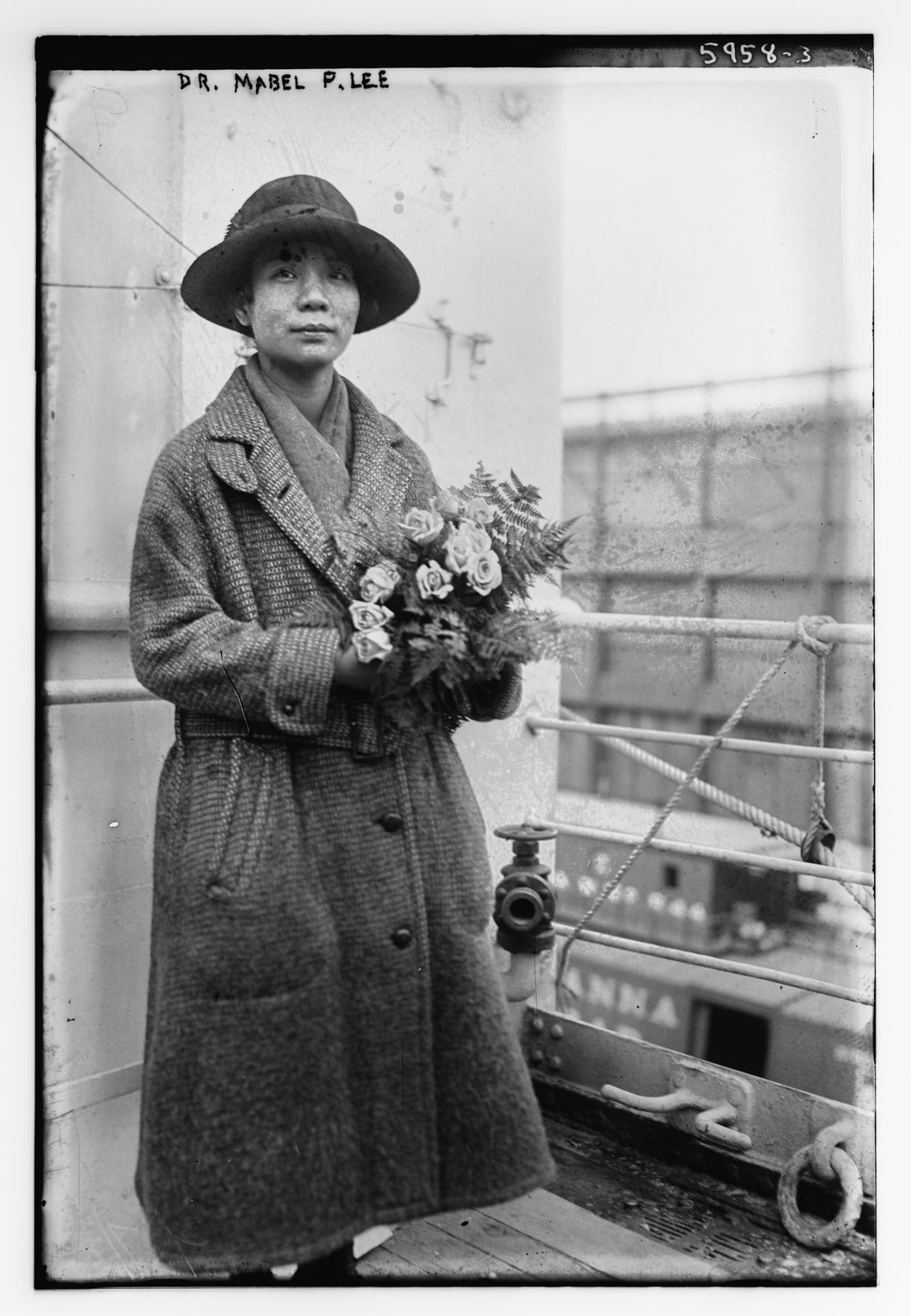
The cover portrait comes from a later moment. The Library of Congress catalog dates the Bain News Service glass negative to sometime between about 1920 and 1925. It is a real archival photograph rather than a reenactment or generated likeness. That date range spans the constitutional suffrage victory and Lee's completion of doctoral work, while the question raised by her 1912 ride remained unresolved: what did political equality mean when citizenship itself was distributed by race?[6][7]
The parade needed a Chinese future
Lee's appearance in the mounted guard was not an exotic footnote to an entirely domestic American campaign. The Chinese Revolution of 1911 had ended Qing imperial rule, and the Republic of China was proclaimed at the beginning of 1912. Reports of Chinese women's political participation—and overconfident reports that women had already secured the vote—gave American suffragists a useful reversal. A country many white Americans described as backward could be presented as moving ahead of the United States.[3]
The reality in China was unsettled. Provincial experiments and revolutionary promises did not amount to a secure national franchise for women. But the comparison became political theater in New York. Anna Howard Shaw marched with a banner declaring that the National American Woman Suffrage Association was “catching up with China.” Women from Chinatown carried the new republic's striped flag and a sign reading “Light from China.” These slogans tried to shame American men, but Chinese participants could use the same stage to challenge the stereotypes and immigration restrictions imposed on their own communities.[3]
That exchange had been prepared before the parade. At a meeting in the Peking Restaurant, Lee and her parents joined Chinese women including Grace Yip Typond and Pearl Mark Loo in conversation with prominent suffragists such as Shaw, Harriet Laidlaw, and Alva Belmont. According to historian Cathleen D. Cahill's National Park Service account, Lee drew attention to the double pressure of sexism and anti-Chinese prejudice and argued for better educational opportunities for Chinese girls and boys. Loo pressed the citizenship question directly. The Chinese women were not merely illustrations in a white suffrage argument; they brought demands of their own.[3]
The parade therefore held two different uses of China in the same street. White organizers used an imagined Chinese lead to expose American inconsistency. Chinese participants used the organizers' platform to claim modernity, education, and civic authority in a country whose law treated them as permanent aliens. Neither use was politically pure, but the overlap gave Lee room to act.
A newspaper made her a symbol
The Tribune profile is valuable precisely because it is not an unfiltered transcript of Lee's mind. It shows how a major newspaper made a Chinese teenager legible to its readers. The article called her a “symbol of the new era,” praised her preparation for Barnard College, inspected the clothing worn at her Bayard Street home, and contrasted her schooling with her mother's bound feet. It presented the Lee household as a passage between an “old” China and an American future.[2]
The reporter did record a political judgment: Lee admired American institutions but saw in them “one defect”—the limited franchise. Yet the story repeatedly routed her education through marriage and uplift. Its title made her desire individual and immediate, even though the legal system offered her no direct route from parade participation to registration. It also turned “Chinese girl” into the newsworthy category before readers reached her name.[2]
That distinction matters for a microhistory. The article proves how the Tribune framed Lee on April 13, 1912; it does not by itself settle everything Lee believed. A self-authored text survives from two years later, written for a different audience and with a much wider definition of the problem.
Lee changed the argument in her own pages
On May 12, 1914, The Chinese Students' Monthly published Lee's six-page essay “The Meaning of Woman Suffrage.” The journal belonged to a network of Chinese students in the United States, and Lee wrote as a Barnard student addressing people who expected their American education to matter in China. Her question was not simply whether American women should receive a ballot. It was what kind of republic educated Chinese citizens would build.[1]
Lee began by rejecting the idea that suffrage was an amusing abnormality. She described democracy as equality of opportunity and called the feminist movement the “application of democracy to women.” She then divided that movement into spiritual, legal, political, and economic dimensions. Voting occupied only one part of the scheme. Equal access to education and professions, and the economic independence of married as well as unmarried women, were necessary if political equality was to become more than a paper declaration.[1]
The essay is a historical document, not a timeless manifesto. Some of its reasoning belongs recognizably to the Progressive Era: Lee invoked eugenics, accepted several domestic assumptions she was trying to stretch, and treated social development as a sequence of stages. Reading those limits is more useful than polishing them away. They show a young writer working with the reform vocabularies available to her, then turning those vocabularies toward a transnational audience.[1]
Her closing moved decisively to China. Western societies, she argued, had built an unstable structure by leaving “every other beam loose” when they excluded women. Chinese students now had the chance not to repeat that construction error. The point of feminism was not to confer decorative privileges but to enable women to become capable public contributors. Lee's “citizen” in this passage was therefore more than a person holding a passport or ballot. It named a participant in national reconstruction.[1]
This does not erase the harder legal meaning of citizenship. It explains why Lee could campaign under conditions that denied it to her. Suffrage was simultaneously a concrete vote she could not cast in New York and a democratic method she believed China could not afford to omit.
One victory met another locked door
When New York voters approved woman suffrage in November 1917, Lee remained ineligible to vote because she remained outside U.S. citizenship. The Nineteenth Amendment created the same boundary at the national level. Its text forbade the United States or any state from denying the voting rights of citizens on account of sex. It did not turn noncitizens into citizens, and it did not cancel the racial restrictions governing naturalization.[4][5][6]
The Chinese Exclusion Act of May 6, 1882 had explicitly removed naturalization authority from the courts for Chinese applicants. Congress extended and hardened the exclusion system in later laws. Only in 1943, during the Second World War, did repeal permit foreign-born Chinese people to seek naturalization; even then, the change imposed a small immigration quota and offered eligibility, not automatic citizenship.[4]
Lee's federal immigration file makes the boundary visible long after the parade. On June 18, 1937, the Immigration and Naturalization Service interviewed her in connection with permission to travel abroad and return. The record remained part of a Chinese Exclusion Act case file: constitutional woman suffrage had not converted her immigration status into citizenship.[8]
The surviving record does not support a neat final scene in which Lee eventually enters a polling place. The National Park Service notes that it is unknown whether she ever became a U.S. citizen or voted. A responsible biography has to preserve that blank. Saying that she “could vote after 1943” would confuse a newly available legal process with evidence that she completed it.[6][8]
The two strongest ways to read her 1912 ride therefore differ in emphasis rather than fact. One interpretation treats it as principled solidarity with women who could directly benefit from suffrage. Another sees a transnational strategy through which Chinese women claimed a public voice, rebutted racial caricature, and argued for change in both countries. Lee's 1914 essay and the Chinatown contingent's own banners make the second reading indispensable; the first remains true but incomplete.[1][3]
Her public life did not end at the amendment
Lee's career after the parade further resists a ballot-only account of politics. She studied at Barnard and Columbia, became the first Chinese woman to earn a doctorate in economics from Columbia, and published her research in 1921 as The Economic History of China. Her scholarship examined agriculture and economic organization—the material structure of the nation whose reconstruction she had addressed in her suffrage essay.[6]
After her father died in 1924, Lee assumed leadership at the First Chinese Baptist Church in New York's Chinatown rather than returning to China as she had once planned. She later developed the Chinese Christian Center, which offered English and vocational classes, a health clinic, and a kindergarten. These institutions did not substitute for equal political rights, and they should not be romanticized as compensation for exclusion. They show that Lee's idea of civic work had always exceeded election day.[6]
The link between the essay and the community center is an interpretation, not a statement Lee left behind in those terms. But it is a bounded inference. In 1914, she defined democracy through opportunity, education, economic capacity, and useful participation. In the decades after 1924, she built an institution around education, health, and practical support for a community constrained by immigration and citizenship law.[1][6]
Mabel Lee's ride matters because it refuses the clean finish often assigned to suffrage history. On Fifth Avenue, she was visible enough to symbolize a modern future. In law, she remained outside the electorate that the parade sought to enlarge. In her own pages, she made that contradiction bigger than personal disappointment: a democracy could loosen one beam and still leave the structure unsound.
The Nineteenth Amendment was a constitutional achievement. Lee's microhistory does not diminish it; it identifies its edge. Sex and citizenship were not two doors opened in orderly sequence. They were overlapping systems, and Lee stood where they crossed—on horseback, in print, and then in the long institutional work that followed the parade.
Sources
- Mabel Lee, “The Meaning of Woman Suffrage,” The Chinese Students' Monthly, vol. 9, no. 7 (May 12, 1914), pp. 526–531 — digitized full-volume scan held by the University of Illinois Urbana-Champaign and hosted by Internet Archive.
- New-York Tribune, “Chinese Girl Wants Vote” (April 13, 1912), p. 3 — Library of Congress page image and newspaper metadata.
- Cathleen D. Cahill, National Park Service, “Mabel Ping-Hua Lee: How Chinese-American Women Helped Shape the Suffrage Movement” — transnational context, Peking Restaurant meeting, parade banners, and Chinese participants' aims.
- U.S. National Archives, “Chinese Exclusion Act (1882)” — archival citation, transcript, naturalization restriction, later extensions, and the 1943 repeal.
- U.S. National Archives, “19th Amendment to the U.S. Constitution: Women's Right to Vote (1920)” — official document page, transcript, and ratification history.
- National Park Service, “Dr. Mabel Ping-Hua Lee” — institutional biography covering education, suffrage work, church and community leadership, and the unresolved citizenship and voting record.
- Library of Congress Prints and Photographs Division, “Dr. Mabel P. Lee,” Bain News Service glass negative, ca. 1920–1925 — catalog record and source for the article image.
- U.S. National Archives, “Transcript of an Immigration Interview with Mabel Lee” (June 18, 1937), Chinese Exclusion Act case file — digitized primary record hosted by DocsTeach.
- New York Times, “Suffrage Army Out on Parade” (May 5, 1912) — post-parade report confirming Lee among the mounted opening group; licensed historical scan hosted by Arlington Public Library.