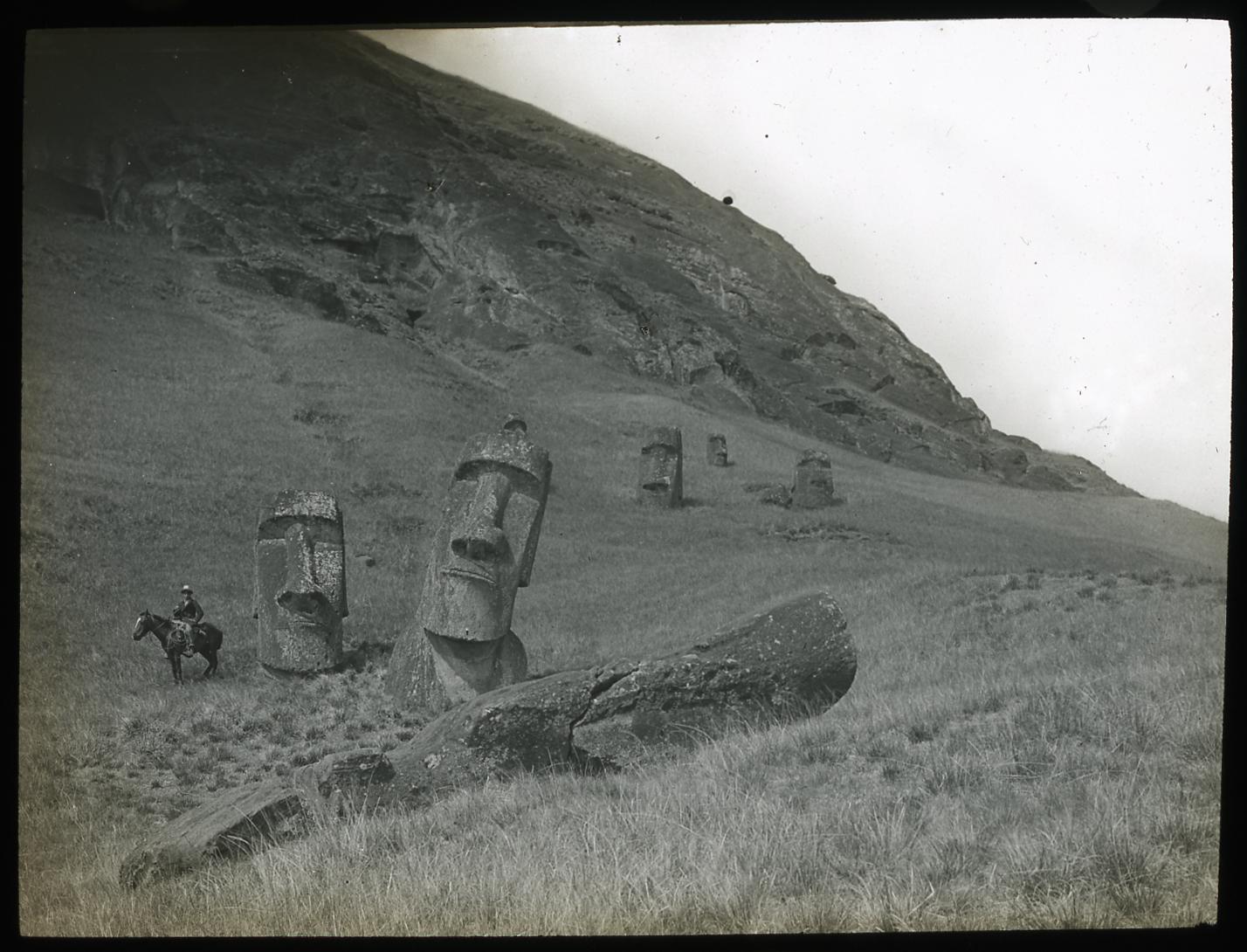
Rano Raraku seems built to make a parable. Hundreds of moai were cut from its volcanic tuff; some left the quarry, others remain upright in the slopes or unfinished in the rock. In a 1914–1915 lantern slide from the Mana Expedition, one figure lies in the grass while five heads rise behind it and a rider supplies scale. The scene is astonishing. So is the temptation to treat it as the graveyard of a society that exhausted itself.[8]
That story has a hard fact at its center: the palm-dominated forest that once covered Rapa Nui disappeared. The dispute is not whether people transformed the island. It is whether ecological transformation caused a large demographic crash before the first recorded European arrival in 1722—and whether changes in monument building, ritual, settlement, and population have been compressed into one misleading word: collapse.
The distinction matters beyond archaeology. Jared Diamond's Collapse made Rapa Nui a global warning about environmental damage, rapid population growth, and destructive political choices.[1] A moral lesson this portable can outrun its evidence. If every broken sequence becomes proof of self-destruction, the Rapanui appear as the authors of their own disappearance, while slave raiding, introduced disease, and colonial confinement arrive as an epilogue rather than the only securely documented demographic catastrophe.
One island, four different endings
The chronology begins much later than older histories assumed. Current archaeological models place Polynesian settlement around 1200–1280. Ahu platforms and moai construction accelerated over the following centuries. By roughly 1550, the island was entering a long dry interval, monument building was slowing, activity was shifting among places, and new ritual forms were gaining importance. Europeans arrived in 1722. Peruvian slavers struck in 1862, and by 1877 an international heritage assessment records only 111 inhabitants.[3][6][7]
Those dates describe at least four possible processes. A forest can collapse when palms no longer regenerate. A monument tradition can decline when communities redirect labor and authority. A political or ritual order can reorganize without its population disappearing. A population can fall through death or departure. Evidence for one process is not automatically evidence for all four.
Even the 1914–1915 photograph makes this problem visible. It records old statues, a modern horse, a rider identified in the museum record as South American, a European-led expedition, and an image later circulated through a British collection. It is not a view outside history. It is a layered colonial archive, made long after the moai-building era and only decades after the nineteenth-century population nadir.[8]
Reading one: contraction before European contact
The strongest modern case for pre-contact decline is more careful than the familiar tale of people recklessly cutting a final tree. A 2020 study by Mauricio Lima and colleagues assembled 244 radiocarbon dates from 95 archaeological sites, treated their summed probability distribution as a proxy for human activity, and compared that pattern with palm cover and climate variability. Its models identify two pre-contact downturns, around 1430–1550 and 1640–1700, and link them to changes in environmental carrying capacity.[2]
This interpretation has real explanatory power. On a small island with limited surface freshwater, forest clearance, soil pressure, and hydroclimate could affect food production together. A multi-generational contraction need not look like one cinematic famine. It could appear as fields used less often, fewer datable fires and meals, delayed construction, movement toward more dependable water, or a population growing slowly after earlier expansion.
The 2020 model also resists one common simplification: it treats deforestation as a result of agricultural pressure, not as a magic switch that by itself caused demographic collapse.[2] The mechanism is feedback. More cultivation alters vegetation; a changed landscape and variable rainfall narrow the margin for cultivation; human activity then adjusts or contracts.
But the population curve is not a census. Radiocarbon dates measure surviving, sampled, datable activity. Their frequency can change because people moved, burned different fuel, built in different materials, or because archaeologists excavated some periods and places more intensely than others. Calibration itself can turn a smooth underlying process into apparent peaks and troughs. The contraction reading is therefore a model-dependent inference from an archaeological proxy, not a head count recovered from the soil.[2][3]
Reading two: a smaller society that kept adapting
A 2021 study led by Robert DiNapoli began with nearly the same kind of evidence and reached a different result. It restricted its dataset to 201 radiocarbon dates from 47 locations with clear links to residence or subsistence, then used approximate Bayesian computation to simulate how demographic models would look after radiocarbon calibration and sampling error. In all four fitted models, population rose steadily from settlement to European contact; the apparent wiggles in the observed record fell within the simulations' uncertainty.[3]
This is the resilience reading. It does not require an untouched forest or an unchanging society. It argues that profound ecological and cultural change can occur without a large island-wide population crash. Rapanui communities could clear land while also engineering it: placing and breaking stone to reduce evaporation, moderate temperature, and release nutrients into heavily weathered soil.
The scale of that agricultural system was revised again in 2024. Dylan Davis and colleagues combined ground observations with shortwave-infrared satellite data to distinguish rock gardens from roads, lava flows, and other stony surfaces. They mapped about 0.76 square kilometers of rock gardening—far below an earlier range of 4.9 to 21.1 square kilometers. Under the study's most productive continuous-cultivation scenario, that footprint could support about 3,900 people. The result makes a modest population, broadly consistent with early European observations, easier to sustain than a rise to 15,000 followed by a vast unseen crash.[4]
That estimate has boundaries too. Satellite classification can miss gardens erased by later building or cultivation. Rock gardens were not the whole food system, and calorie models depend on assumptions about crop yields, fallow cycles, marine foods, and how much of the harvest people could actually use. The important result is not a perfect population number. It is that a large pre-contact population can no longer be smuggled into the argument through an inflated map of cultivation.
A separate line of evidence now points the same way. In 2024, J. Víctor Moreno-Mayar and colleagues analyzed genomes from 15 Rapanui individuals whose remains date between roughly 1670 and 1950. Their effective-population models and simulations did not support a strong or intermediate bottleneck in the 1600s. Instead, the results fit a small population whose effective size increased after settlement until the nineteenth-century catastrophe.[5]
Genomes are not a census either. Effective population size reflects reproduction and ancestry, not everyone alive at a given moment, and 15 museum-held individuals cannot represent every community history. Yet this evidence is valuable precisely because it fails in a different way from radiocarbon dates. A sampling artifact in excavated hearths does not automatically create the same signal in inherited DNA. Agreement between independent archives weighs against a severe pre-contact crash more strongly than either archive could alone.[3][5]
The drought was real; its meaning is the argument
The newest climate evidence makes the story less comfortable without restoring the old morality play. A 2025 study measured hydrogen isotopes in leaf waxes preserved at Rano Aroi and Rano Kao. It reconstructs a persistent drought beginning around 1550 and lasting to about 1720, with annual precipitation roughly 600–800 millimeters below the earlier interval. That is a formidable shock on an island whose porous basalt quickly drains rainfall and whose few crater wetlands could dry out.[6]
The timing overlaps with slower ahu construction, increased activity around Rano Kao and Orongo, and changes in political and ritual geography. The study proposes a plausible sequence: Rano Raraku and Rano Aroi dried; communities initially leaned more heavily on coastal groundwater; as prolonged drought may have reduced the flow or potability of those seeps, comparatively stable Rano Kao gained importance. Communities reorganized around the places and practices that still worked.[6]
This is environmental causation without demographic determinism. Drought can change where people live, how they farm, which authorities coordinate water, and which rituals carry prestige. None of those effects requires mass death. The investigators explicitly frame their scenario as one that does not need intensified clan warfare or population collapse.[6] Climate stress is not a verdict; it is a constraint whose consequences depend on institutions, technology, mobility, and time.
Put the documented catastrophe back in the center
The post-contact chronology has a different evidentiary character. It is not inferred only from pollen, radiocarbon density, or genetic models. Ships, missionaries, colonial authorities, and survivors left records. The ICOMOS evaluation prepared for Rapa Nui's World Heritage inscription describes Peruvian slavers carrying islanders away in 1862, including political and religious leaders. A small group sent back later brought smallpox into an already damaged community. By 1877, only 111 inhabitants remained.[7]
That 1995 evaluation is itself a useful historiographical artifact. Its pre-contact section repeats an older story of sixteenth-century overpopulation, warfare, and ecological crisis with more confidence than current evidence permits. Its nineteenth-century chronology, however, identifies named outside mechanisms and documented dates. One source can preserve a strong colonial record while carrying an outdated archaeological synthesis.[7]
Rejecting a pre-contact ecocide does not mean imagining an ecological paradise. Forest loss was real. Drought was real. Agricultural intensification, local contraction, conflict, inequality, and cultural change remain possible, sometimes likely. Nor does it mean denying Rapanui agency by replacing a story of self-destruction with one of passive victimhood. Rock gardens, water harvesting, settlement shifts, ritual change, and continued community life are agency too.[3][4][6]
Where the evidence now stands
The balance of current evidence does not require a large demographic collapse before 1722. The radiocarbon model that finds pre-contact contractions remains a serious counterargument, especially because it tries to connect population pressure with climate and vegetation rather than relying on a cartoon of the last tree.[2] But its demographic signal depends on treating dated activity as population. Against it stand an uncertainty-aware reanalysis of radiocarbon dates, a much smaller mapped agricultural footprint, ancient-genome models that reject a severe seventeenth-century bottleneck, and a drought record whose authors explain reorganization without mass mortality.[3][4][5][6]
Future evidence could move the balance. More securely dated residential sequences might reveal a synchronized decline that present radiocarbon samples miss. Wider genomic sampling could expose a bottleneck hidden by 15 individuals. Conversely, more field-checked mapping, settlement dates, and human remains may further strengthen the small-and-resilient model. Any new claim should specify its scale: one district or the whole island, a ritual tradition or a population, a temporary contraction or a terminal break.
The most defensible history is therefore not “nothing happened” and not “the islanders destroyed themselves.” Rapa Nui underwent radical ecological change and adapted under a severe, prolonged drought. Its social geography and monumental practices changed. The evidence does not currently show that those changes erased most of the population before Europeans arrived. The catastrophic demographic collapse we can document came later, through enslavement, disease, and colonial disruption.
The forest vanished. A way of life changed. A people endured. Good history begins by refusing to make those three sentences mean the same thing.
Sources
- Jared Diamond, Collapse: How Societies Choose to Fail or Succeed. Penguin Random House — publisher record and description of the book's environmental-collapse framework.
- Mauricio Lima et al., “Ecology of the collapse of Rapa Nui society,” Proceedings of the Royal Society B 287 (2020) — radiocarbon-SPD model of climate, palm cover, carrying capacity, and proposed pre-contact demographic declines.
- Robert J. DiNapoli et al., “Approximate Bayesian Computation of radiocarbon and paleoenvironmental record shows population resilience on Rapa Nui (Easter Island),” Nature Communications 12 (2021) — uncertainty-aware demographic modeling of 201 dates from 47 locations.
- Dylan S. Davis et al., “Island-wide characterization of agricultural production challenges the demographic collapse hypothesis for Rapa Nui (Easter Island),” Science Advances 10 (2024) — field-trained satellite mapping of rock gardens and revised carrying-capacity estimates.
- J. Víctor Moreno-Mayar et al., “Ancient Rapanui genomes reveal resilience and pre-European contact with the Americas,” Nature 633 (2024) — genomic tests of the proposed seventeenth-century population bottleneck.
- Redmond Stein et al., “Prolonged drought on Rapa Nui during the decline of megalithic monument construction,” Communications Earth & Environment 6 (2025) — leaf-wax isotope reconstruction and a drought-linked reorganization model.
- ICOMOS, “Rapa Nui National Park,” World Heritage List evaluation No. 715 (1995) — historical chronology of European contact, slave raiding, epidemic disease, and the 1877 population nadir.
- Wikimedia Commons, “View of a moai lying on the ground, with five moai heads standing upright” — source and public-domain record for the 1914–1915 British Museum lantern slide Oc,G.T.1478.