By late October 1910, reports from the Chinese–Russian frontier described an outbreak that was already killing almost everyone it reached. The first recognized chain ran through marmot hunters and fur traders around Manzhouli. From there, illness moved east along the Chinese Eastern Railway toward Harbin, carried inside the same transport system that moved labor, pelts, soybeans, and imperial power across Northeast Asia.[1][5]
By the time Wu Lien-teh arrived in Harbin in late December, the railway was no longer merely the route of spread. It had become the map of the response problem. Russian, Japanese, and Chinese authorities controlled different tracks and urban districts. Migrant workers lived in crowded inns through a winter that drove people indoors. Lunar New Year threatened to send thousands of men home by train or on foot. A useful diagnosis therefore had to become more than a laboratory result: it had to reorganize movement, shelter, reporting, and face-to-face contact across several jurisdictions.[1][2][3]
Wu is often remembered as the lone doctor who defeated plague with a cotton mask. That is too small a story. His major contribution in Chinese-administered Fuchiatien was to turn a respiratory explanation into coordinated practice within a broader multinational response. Masks mattered because they sat inside a larger counter-network—case finding, isolation, disinfection, observation, transport controls, public notices, burial teams, and daily reports. The network was coercive in places and unequal in whom it burdened. It also helped stop a catastrophe for which medicine in 1910 had no reliable cure.
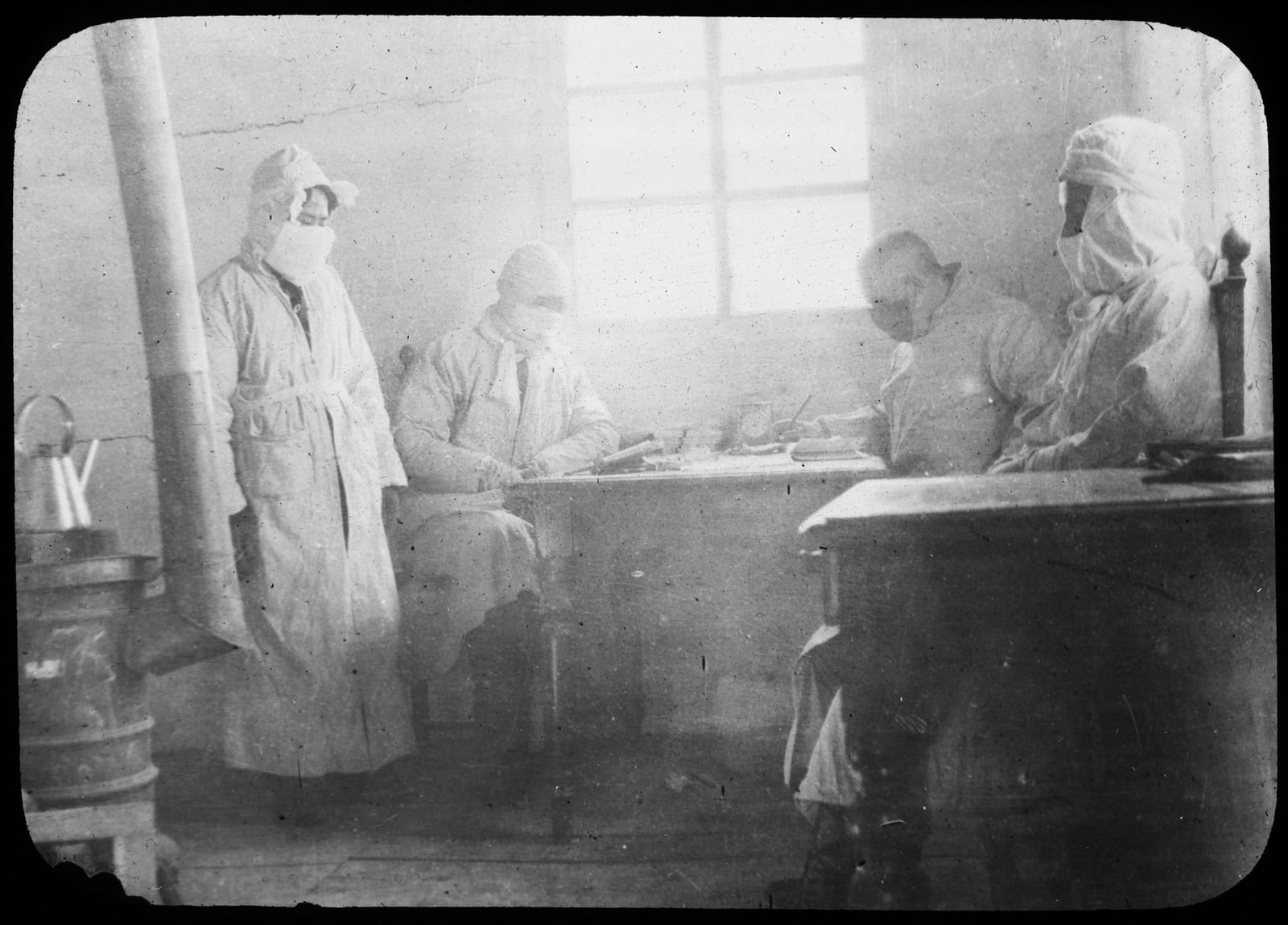
Image context: the cover is a real photograph from the papers of American physician Richard Pearson Strong, taken during the epidemic in Fuchiatien, the Chinese-administered district of Harbin now generally called Fujiadian. It shows Graham Aspland receiving reports rather than Wu posing as a solitary hero. That is exactly the point: epidemic control depended on information and labor moving through a team.[7]
Autumn 1910: a fur route became a respiratory route
The outbreak's ecological beginning is probable, not perfectly reconstructed. Historical accounts connect it to tarbagan marmots hunted for fur near the Russian border, where infected animals could expose trappers to Yersinia pestis. Yet the epidemic that followed was not sustained chiefly by rats and fleas. Once plague reached the lungs, sick people could transmit it to others through infectious respiratory droplets.[8] The 1911 conference report noted that 13,000 rats examined in Mukden showed no plague, while the human epidemic followed towns and railway lines.[1][5]
That distinction changed the control problem. Rat destruction and a vaccine designed around experience with bubonic plague could not be assumed to stop a fast person-to-person chain. The conference's near-contemporary figures show the scale. In Fuchiatien, more than 5,000 people died within roughly three months from a population the report placed near 30,000. Shuangchengfu, a more spacious city about 30 miles south, lost about 1,500 of 60,000 residents in seven weeks. Poverty and crowding intensified exposure, but they did not explain everything; plague also tore through better-built households.[1]
The railway concentrated all these risks. Harbin itself was divided between Russian-controlled Chinese Eastern Railway territory and Chinese-administered Fuchiatien; farther south, Japan controlled the South Manchuria Railway zone. Chinese laborers crossed those boundaries to work but did not cross them with equal political standing. Ruth Rogaski's history makes the geopolitical stakes explicit: controlling disease was also a test of whether the Qing government could govern Chinese lives in territory where foreign powers operated railways, police, hospitals, and quarantine regimes.[3]
Late December: the lung finding changed the job
The Chinese government ordered Wu north on December 19. Sources differ by several days on when he reached Harbin, but they agree that he was at work there before the end of the month. An early post-mortem examination found plague bacilli in the lungs, supporting what the clinical pattern already suggested: this was primary pneumonic plague, not an ordinary bubonic outbreak waiting for rats to be controlled.[1][2][6]
That finding did not produce a treatment. Contemporary antiserum and vaccines performed poorly against the explosive lung disease, and the recorded case-fatality rate approached 100 percent. It instead changed the target from an invisible animal reservoir alone to the encounters connecting patients, relatives, clinicians, inn residents, transport workers, and burial crews.[1]
Wu promoted a layered gauze-and-cotton mask tied closely over the mouth and nose. The object should not be mistaken for a modern certified respirator, nor was face covering invented from nothing in Harbin; surgical gauze masks already existed. Christos Lynteris's history locates the novelty in how Wu refashioned and circulated the mask as anti-epidemic equipment: a portable barrier linked to a bacteriological account of respiratory danger and made visible in public-health photography.[4]
The mask was widely adopted, but the protection afforded by the gauze-and-cotton design remained uncertain. Wu later wrote that Dr. Gérald Mesny died in mid-January 1911 after working in plague hospitals without wearing his mask; Lynteris cautions that this retrospective anecdote is not independent proof of the mask's efficacy.[2][4] Mesny's death nevertheless underscored the danger of close exposure. The operational lesson was broader than any single fabric design: staff protection had to travel with rules about distance, patient handling, and contaminated material.
January 1911: the counter-network took physical form
The response began mirroring the network it had to interrupt. Teams searched houses for cases. Patients went to dedicated plague hospitals; contacts and suspected cases went to observation sites. Homes and belongings were disinfected or, in some cases, burned. Roads, frozen rivers, stations, and rail traffic were watched. Converted train carriages became isolation and observation spaces. Headquarters collected reports each day so the response could follow the epidemic rather than wait for rumors.[2][6]
The numbers reveal an operation larger than one physician. One account records about 1,200 soldiers, 600 police, and 120 railway cars mobilized around the Harbin response.[2] The conference proceedings also describe shelters, food, baths, ambulance work, and medically supervised lodging for laborers displaced when inns and houses were closed.[1] Public health here was not only prohibition. If authorities removed the places where poor workers slept, they also had to create somewhere safer for people to go.
But assistance and coercion ran together. Officials portrayed migrant laborers as the dangerous population and restricted their movement most aggressively. Foreign and Chinese administrations used armed cordons, detention, house searches, and class-based railway controls. The conference record itself repeatedly speaks of workers through a demeaning administrative category rather than as people navigating hunger, work, and a lethal infection.[1][3][5] A successful account cannot praise the system's reach while hiding who bore its force.
The photograph on this article's cover catches the system in a quieter register. Aspland is receiving reports in Fuchiatien. Nothing in the frame resembles a eureka moment. Its subject is circulation: observations arriving, being assembled, and becoming instructions. The epidemic had exploited a transport network; the response needed an information network fast enough to answer it.
Lunar New Year: cremation was a rupture, not a magic ending
By late January, frozen ground and mass death had left more than 2,000 bodies awaiting burial. Wu and local officials sought imperial permission for cremation, a profound break with prevailing funeral practice. Approval arrived after consultation. The Lunar New Year began on January 30, and mass cremation in Fuchiatien began around the following day. Separately, the Russian-run Harbin Antiplague Bureau reported cremating 1,416 corpses during February, 1,002 of them exhumed.[1][2]
It is tempting to turn that day into the outbreak's single hinge: bodies burned, deaths fell, plague ended. The sources do not support so neat a causal line. Safe handling reduced exposure for people moving corpses and removed potentially contaminated material. Yet pneumonic plague was being sustained mainly through living respiratory chains. At the same time, case isolation, household avoidance, transport controls, public education, shelter changes, and the seasonal turn were all altering contact.
The experts who met soon afterward disagreed about the decline. Some delegates argued that mortality in Fuchiatien had started falling before the full control program could take effect and asked whether temperature or an epidemic's natural course contributed. Others pointed to cities, villages, and households where rapid isolation and voluntary avoidance appeared to cut new chains. The published proceedings preserve both positions rather than awarding one intervention all the credit.[1]
That disagreement is the responsible boundary. Wu's later chronology placed Fuchiatien's last local case on March 1, 1911, while conference and regional accounts show remaining cases dwindling through March. An observational epidemic curve cannot isolate the effect of a mask, a cordon, cremation, weather, or changed behavior as though they were randomized treatments.[1][2] The strongest conclusion is about the combined system: it created multiple obstacles between an infectious lung and the next susceptible person, while communities also learned to recognize and avoid danger.
April 1911: emergency practice became an institution
The International Plague Conference opened in Mukden, now Shenyang, on April 3; Wu delivered his inaugural address on April 4. Delegates from 11 countries reviewed transmission, clinical findings, protective equipment, quarantine, trade, vaccines, serum, weather, and the possibility of recurrence. Wu chaired the proceedings; Aspland, the physician in the cover photograph, served as medical secretary.[1][2]
The conference mattered scientifically, but also politically. China was not merely a specimen being examined by foreign experts. The Qing government convened the meeting, Chinese clinicians presented evidence, and Wu made field experience into an international research agenda. At the same time, Russian, Japanese, European, American, and Chinese personnel had all participated in the response. Calling the episode either a solitary national triumph or a simple importation of “Western medicine” erases the mixed, contested structure that made it possible.[3][5]
In 1912, the North Manchurian Plague Prevention Service was established in Harbin with branches in the region. It joined outbreak surveillance to hospitals, laboratories, clinical care, health education, and data collection. The emergency counter-network became a standing public-health organization designed to be present before the next alarm.[6]
That is the larger achievement behind the familiar mask. Wu Lien-teh did not defeat plague by discovering one object. He helped turn a correct idea about respiratory spread into coordinated practice across faces, houses, wards, railcars, streets, and borders. The Manchurian epidemic also leaves a warning inside its success: public-health capacity can save lives while distributing hardship unjustly, and heroic memory can hide both the workers who made a system function and the people most tightly controlled by it.
The best reason to remember the winter of 1910–1911 is therefore not that it supplied a perfect template. It showed what happens when an epidemic moves through infrastructure—and what it takes to build an answering infrastructure quickly enough.
Sources
- International Plague Conference, Report of the International Plague Conference Held at Mukden, April, 1911 (Bureau of Printing, 1912) — primary proceedings, field statistics, control measures, opening addresses, and the contemporary debate over why the epidemic declined.
- Kam Hing Lee, Danny Tze-ken Wong, Tak Ming Ho, and Ng Kwan Hoong, “Dr Wu Lien-teh: modernising post-1911 China's public health service,” Singapore Medical Journal 55, no. 2 (2014) — appointment, Harbin arrival, post-mortem work, field mobilization, cremation, final case, and conference timeline.
- Ruth Rogaski, “The Manchurian Plague and COVID-19: China, the United States, and the ‘Sick Man,’ Then and Now,” American Journal of Public Health 111, no. 3 (2021) — railway jurisdictions, sovereignty, coercion, and the political meaning of epidemic control.
- Christos Lynteris, “Plague Masks: The Visual Emergence of Anti-Epidemic Personal Protection Equipment,” Medical Anthropology 37, no. 6 (2018) — history of Wu's gauze-and-cotton design and the mask's emergence as epidemic PPE and public symbol.
- Mark Gamsa, “The Epidemic of Pneumonic Plague in Manchuria 1910–1911,” Past & Present 190, no. 1 (2006) — peer-reviewed reconstruction of the epidemic, its rail geography, social structure, and competing interpretations.
- Qingmeng Zhang, Niaz Ahmed, George F. Gao, and Fengmin Zhang, “Inception of the Modern Public Health System in China and Perspectives for Effective Control of Emerging Infectious Diseases,” Virologica Sinica 35, no. 6 (2020) — operational components of Wu's prevention system and the 1912 service that institutionalized them.
- Wikimedia Commons, “Dr. Aspland receiving reports, Fuchiatien 1910–1911” — archival glass-lantern-slide photograph from Richard Pearson Strong's papers used as the article image.
- World Health Organization, “Plague” (July 7, 2022) — current medical guidance on person-to-person transmission of pneumonic plague through infectious respiratory droplets.