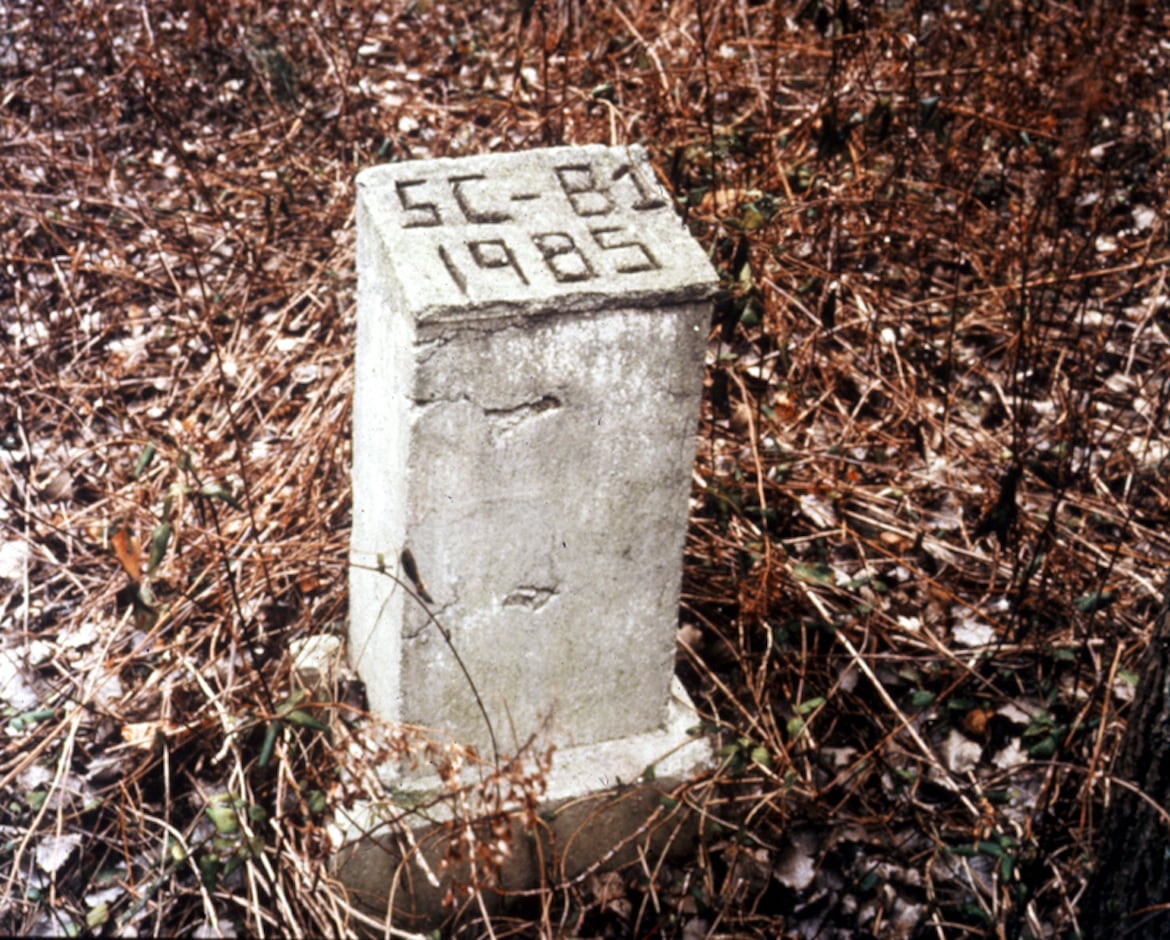
A concrete post rises from the brush on Hart Island. Four characters and a year have been cut into its sloping cap: SC-B1 1985. New York City identifies the grave as belonging to the first child to die in the city of an AIDS-related illness. The city also expands the code: “SC” meant special case and “B1” meant Baby 1.[1]
That distinction is the beginning of the memorial, not a footnote to it. SC-B1 is not a name. It is a classification produced by the burial system that received the child. Reporter Lizzy Ratner spent years trying to recover an identity from medical, burial, and institutional traces and could not. Her reporting also corrected a comforting story that had grown around the letters: the inscription did not mean “Special Child.” Special case was an administrative designation used for a segregated group of people who died of AIDS.[4]
The marker therefore holds two truths at once. It is an unusually durable physical trace of a child whose name is not publicly attached to the grave. It is also evidence of how fear entered the cemetery: diagnosis became more visible than identity. Calling the post a memorial is only justified if remembrance does more than preserve the code. It must also reconstruct the system that made the code, protect the records that can reconnect people to graves, and make the site accessible enough for memory to be practiced rather than merely admired from a distance.
The code came from a separate burial system
Hart Island had already been New York City's public cemetery for more than a century when AIDS appeared. Burials began there in 1869. More than one million people have since been interred on the island, and the city says thousands of people who died of AIDS-related illness have been buried there since 1985.[1][2] That long history matters: Hart Island was not created for the epidemic, and the people buried there cannot be reduced to a single disease or a single idea of abandonment.
The first documented AIDS burials nevertheless formed a distinct system. The NYC LGBT Historic Sites Project reports that between 1983 and 1986, 31 adults and one infant were placed in individual graves in a separate four-acre section at the island's southern tip. Burial permits were labeled “AIDS.” The graves were deeper than ordinary burials, and crews of incarcerated people supervised by correction officers wore disposable protective clothing.[3] The Hart Island Project describes the 1985–86 graves as fourteen feet deep and identifies SC-B1's marker as the one photographed by Melinda Hunt and Joel Sternfeld after they gained access to the site in the early 1990s.[7]
Those practices did not emerge from ignorance alone. Public agencies were learning in real time while stigma, workplace anxiety, family estrangement, cost, and funeral refusals shaped what happened after death. In 1983, the New York State Funeral Directors Association advised members not to embalm people who had died of AIDS; the Hart Island Project argues that finding a funeral director then became harder.[7] The historic-sites record likewise documents funeral homes and religious institutions refusing bodies or charging more, while some families could not afford private burial and others did not claim relatives.[3]
Period medical guidance shows why the boundary must be drawn carefully. A 1983 CDC notice recommended protection for people performing autopsies or mortuary work. It focused on preventing contact between blood or body fluids and workers' mucous membranes or broken skin, using precautions similar to those for hepatitis B.[5] It did not prescribe an isolated cemetery, an extra-deep grave, or a burial category that would permanently foreground the diagnosis.
The right correction is not that body handlers faced no occupational hazard. They did, and standard precautions remain important. The current CDC explanation says HIV transmission requires particular body fluids to reach a mucous membrane, damaged tissue, or the bloodstream; HIV is not transmitted by touching and does not reproduce outside a human host. It describes occupational transmission as extremely rare when standard precautions are used.[6] The historical failure was a category error: a manageable work-practice risk expanded into spatial segregation and a public identity for the dead.
SC-B1's concrete post is the residue of that expansion.
A marker can preserve a record and erase a person
The phrase “Special Child” made the inscription sound tender, as though someone had built a private monument for a baby. “Special case” changes the object. Ratner's reporting traces it to a Department of Correction category applied to a cohort of early AIDS burials. The child was not set apart only as an individual life; the child was sorted into a group that the burial system considered exceptional.[4]
Yet the marker also kept the case from disappearing completely. Hunt's 1993 photograph made the post portable. An inaccessible grave at the island's southern edge could enter books, archives, exhibitions, reporting, and advocacy. The photograph did not restore a name, but it allowed later viewers to ask why a diagnosis and a burial number had survived when the ordinary biographical coordinates of a child had not.[7]
That question belongs inside Hart Island's wider record problem. The City Council says the official cemetery database is searchable from 1977 onward, but it also documents inconsistencies between datasets that can make loved ones harder to locate.[2] Record repair is therefore not clerical housekeeping added after commemoration. A cemetery lookup, a plot map, a permit number, and a reliable chain between them are parts of the memorial architecture. Without that chain, a person can be legally recorded and practically unreachable.
The same Council data corrects another easy myth. Hart Island is routinely described as an island of the unknown or unclaimed. Some people buried there do fit those categories, but in 2018 approximately 62 percent had next of kin who chose a public burial; about 33 percent had family who were unknown or could not be reached, and only a small number were unidentified.[2] Poverty, public provision, family choice, administrative failure, and social isolation are not synonyms. A truthful memorial should not strip identity from people a second time by declaring every public burial forgotten.
SC-B1 is powerful precisely because the limit is visible. The marker tells us what the city chose to record on the ground. It does not tell us everything the child was.
Access changed the meaning of the island
For most of Hart Island's burial history, the Department of Correction controlled both the cemetery and entry to it. Incarcerated workers performed burials until April 3, 2021. Cameras were banned until 2021, and relatives fought through lawyers and public-records requests for the ability to find and visit graves. A 2015 legal settlement established regular gravesite visits for relatives.[8]
That arrangement mattered symbolically as well as practically. A family approaching a public cemetery encountered the procedures and atmosphere of a correctional site. The institution that controlled access thereby shaped what kind of memory was possible: private grief had to pass through penal custody.
Local Law 210 of 2019 set up a transfer, and management moved from Correction to Parks and the Human Resources Administration in 2021.[9] Parks began gravesite visits that October and launched free ranger-led public tours in November 2023. By the city's October 2025 testimony, more than 2,200 people had attended loved-one visits, more than 1,100 had joined public tours, and nearly 220 students had visited in school groups.[9] Those figures do not prove that access is complete. They do show that jurisdiction changes the social life of a cemetery: the same island can be administered as a restricted work site or interpreted as a civic landscape.
The next question is what visitors will be invited to remember. The city's 2025 concept plan proposes a welcome center, a Remembrance Walk, reuse of the historic chapel as a place for reflection, and infrastructure that would make visits less austere.[2][9] Physical dignity matters. So does interpretation. As of 2026, the NYC LGBT Historic Sites Project still finds no named grave markers and no on-site commemoration of Hart Island's AIDS history.[3] A beautiful path can improve access without explaining why SC-B1 was once put into a separate, extra-deep burial regime.
What an honest memorial would have to do
Hart Island does not need one monument that claims to summarize more than a million lives. It needs a memory system capable of holding difference.
For the early AIDS graves, that system would preserve the marker and its landscape while explaining the “special case” designation, the funeral refusals, the occupational fears, the evidence available at the time, and the line between sensible blood-and-body-fluid precautions and burial segregation.[3][5][6] For families and chosen families, it would keep improving the links among names, permits, plot numbers, maps, and visit procedures.[2][8] For everyone buried there, it would resist the idea that public burial automatically means an unclaimed life.
It would also respect the boundary of what is not known. Commemoration does not license a writer, agency, or visitor to invent SC-B1's identity or treat recovery as inevitable. The ethical task is narrower and harder: preserve the evidence, keep the search possible, state uncertainty honestly, and remember that a child cannot be reduced to the category under which the city buried them.
The photograph makes that obligation difficult to evade. A weathered post stands amid leaves and stems. Its inscription is legible enough to survive, but not complete enough to satisfy. SC-B1 is evidence. It is not a name. Hart Island's AIDS memorial will remain unfinished as long as the code is allowed to do all the remembering.
Sources
- City of New York, “Hart Island” — official history of the public cemetery, the SC-B1 marker, AIDS-related burials, and the 2021 management transfer.
- New York City Council Data Team, “Hart Island: The City Cemetery” — burial demographics, record-system gaps, visitation context, and the 2025 concept plan.
- NYC LGBT Historic Sites Project, “City Cemetery, Hart Island” — researched site history of AIDS-era funeral exclusion, the early segregated burials, and the present commemoration gap.
- Lizzy Ratner, “The Search for Special Case–Baby 1,” The Nation, March 12, 2024 — investigation of SC-B1's still-unresolved identity and the Department of Correction's “special case” designation.
- Centers for Disease Control, “Acquired Immunodeficiency Syndrome (AIDS): Precautions for Health-Care Workers and Allied Professionals,” MMWR, 1983 — period guidance for postmortem and mortuary precautions.
- Centers for Disease Control and Prevention, “How HIV Spreads,” updated November 25, 2024 — current transmission boundaries and the role of standard precautions.
- The Hart Island Project, “AIDS Initiative” — early AIDS burial practices and source page for Melinda Hunt's 1993 archival photograph of the SC-B1 marker used here.
- The Hart Island Project, “The History” — burial administration, the 2015 access settlement, the end of incarcerated burial labor, and the transition toward public access.
- New York City HRA, OCME, and Parks, joint testimony on Hart Island capital projects, October 16, 2025 — official account of the jurisdiction transfer, visits, public tours, and concept-plan goals.