
Pressing a nasal-spray pump feels almost too simple to get wrong. The bottle fires, the mist disappears, and there is no visible way to tell whether medicine coated the nasal lining, struck the central septum, or ran into the throat. That uncertainty is why Asthma + Lung UK's two-and-a-half-minute demonstration is worth slowing down. It turns one squeeze into a delivery sequence: prepare the device, clear a path, aim laterally, breathe gently, and clean up.[1][2]
The video was published on September 14, 2022 and is presented by a respiratory nurse. Its companion page later cited clinical sources accessed in September 2025 and names a clinical reviewer, so this is not merely a creator's dexterity trick.[1][2] The useful way to watch is as a lesson in local delivery. A dose leaving the nozzle is not the same thing as a dose arriving where it is meant to act.
The scope matters. This sequence fits common metered pump sprays used for allergic rhinitis, including many intranasal corticosteroids. It is not a universal script for every product placed in a nostril: single-use emergency sprays, vaccines, drops, and saline rinses can have different instructions. Even among steroid sprays, priming and dosing vary by device. The medicine leaflet and a clinician or pharmacist determine what and how much to use; the video helps with how to deliver it.[2][6]
At 0:39, priming becomes a quality check
After the introduction, the video moves to first-use preparation: shake the capped bottle for ten seconds, remove the cap, point away from the face, and pump until a fine mist appears.[1][2] The point is not ceremony. A pump that contains air, has settled, or has sat unused may not deliver the expected plume on its first press. Seeing a fine mist establishes that the device is ready before the nozzle is in the nose.
This is also where generic instruction has a boundary. The video's priming demonstration is a model, not a license to pump every bottle repeatedly before every dose. NHS guidance for beclometasone, reviewed on March 16, 2023, likewise tells first-time users to pump until a fine mist appears, while directing readers back to the instructions supplied with their medicine.[6] Some devices need repriming after a period without use; the interval and number of test sprays are product-specific. Good technique begins with reading the device, not memorizing one number for every bottle.
After priming, the opposite hand changes the aim
The most valuable visual cue arrives when the nurse switches hands: left hand for the right nostril, right hand for the left. With the head tipped slightly forward, that cross-body grip makes it easier to point the nozzle outward, away from the septum at the center of the nose.[1][2] The maneuver is small because the target is small. The goal is to direct the spray toward the lateral nasal wall rather than fire it into the more vulnerable midline.
An observational study shows why this deserves more than a passing gesture. Researchers assessed 150 people using intranasal corticosteroid sprays between September 1, 2020 and August 31, 2021. Only 29.3% performed all five steps the authors classified as essential, and only 56.7% aimed the tip outward. Participants who failed to aim away from the septum had higher odds of reported epistaxis or nasal irritation: odds ratio 3.63, with a 95% confidence interval of 1.39–9.48.[3]
Those figures need a careful reading. This was a single-center observational study, not a randomized trial proving that one hand position caused every nosebleed. Its sample and technique checklist do not represent every user or device. What it does show clearly is that outward aim is often missed, and that missing it was associated with the adverse effects the maneuver is intended to reduce.[3] The opposite hand is therefore best understood as a practical aiming aid, not as magic in itself.
In the final minute, a hard sniff becomes an exit route
Once the nozzle is just inside the nostril and angled outward, the nurse presses the pump while breathing in very gently, then removes the nozzle and breathes out through the mouth. She explicitly warns against a hard sniff.[1][2] That warning corrects a natural but counterproductive instinct. If a little inhalation should pull mist inward, it seems as though a forceful sniff should pull it farther. In practice, "farther" can mean past the nasal surface and down the throat.
The 2022 review of intranasal corticosteroid pharmacology supports a calm, sequence-based approach—clear the nose, keep the head neutral or slightly forward, aim away from the septum, use the opposite hand, breathe in gently, then breathe out through the mouth. It also makes the evidence boundary visible: deposition depends on anatomy, plume properties, airflow, device design, and administration angle, and the literature cannot assign a precise benefit to every isolated step in every product.[4] The video is useful because it bundles the best-supported practical cues into one reproducible motion. It should not be mistaken for proof that technique erases all variation between noses and devices.
The throat offers immediate feedback. Dripping or a medicinal taste can signal that the spray has traveled backward, although the absence of taste does not certify perfect deposition.[2] The better correction is not to inhale harder. Reset the head slightly forward, keep the bottle upright, direct the nozzle outward, and use a quiet breath. If soreness or bleeding persists, the answer is not endless self-adjustment; ask a pharmacist or clinician to review both the technique and the medicine.[2][6]
Technique can rescue delivery, but it cannot choose the prescription
The last trap is to turn a technique video into a dosing guide. Intranasal corticosteroids are generally used regularly rather than as instant relievers.[2][6] That slow feedback makes an imperfect first attempt hard to distinguish from an impatient expectation. It can tempt users to add sprays, stop early, or switch methods without knowing which part of the system failed.
The safer division of labor is simple. Product instructions and professional advice set the indication, dose, schedule, age limits, and duration. Technique protects the path from bottle to tissue. The video contributes most when it is used as a rehearsal: prime only as directed, gently clear the nose, lean slightly forward, cross hands, aim outward, breathe softly, exhale through the mouth, wipe the nozzle, and replace the cap.[1][2][6]
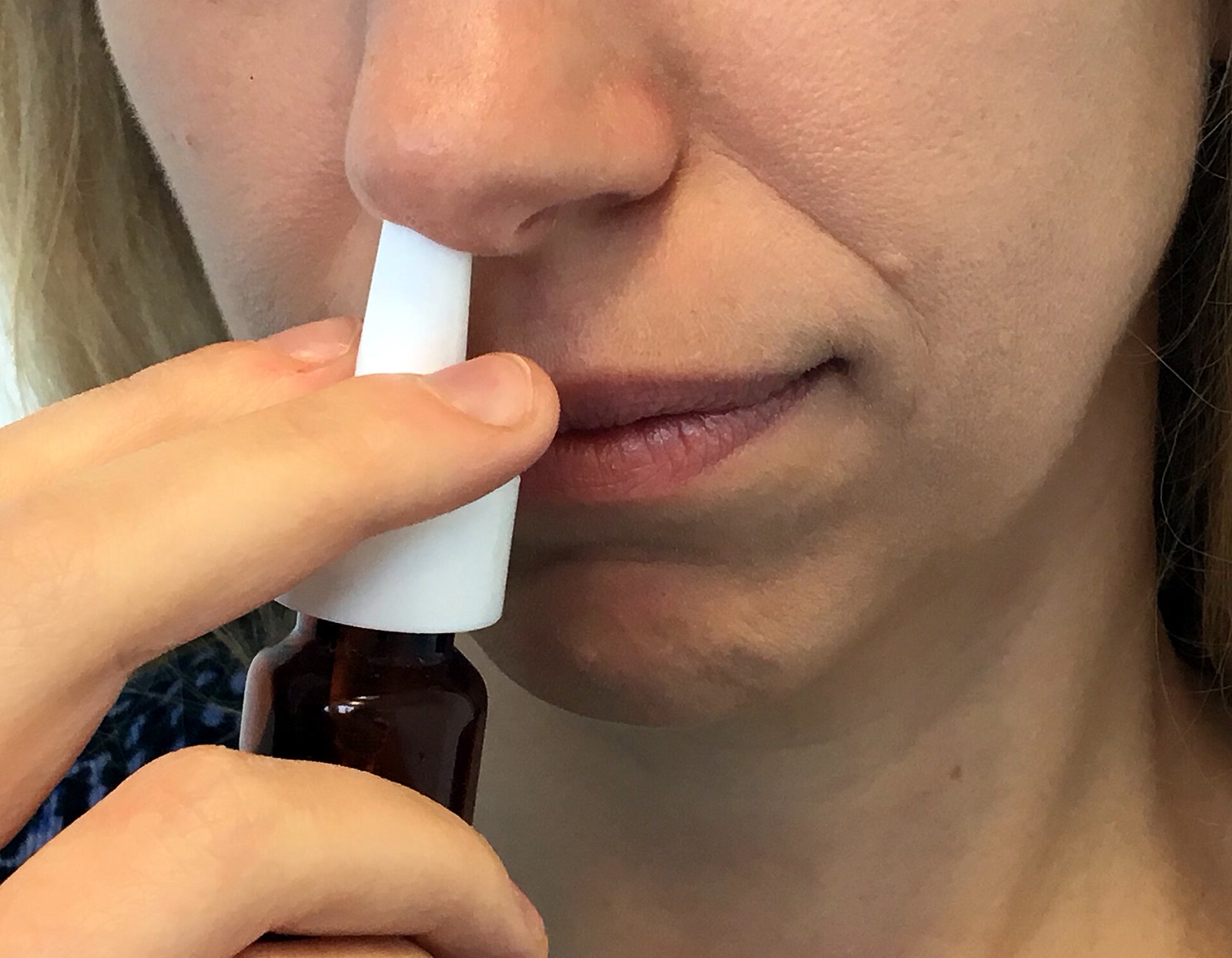
That is why the cover photograph, made by NIAID in August 2018, fits this story: it records an ordinary act whose success is mostly invisible.[5] A nasal steroid spray works not because the pump made a sound, but because device, hand, angle, breath, and routine gave the mist a better chance to remain in the nose. The best evidence does not make that chance absolute. It makes the motion deliberate—and gives a pharmacist or clinician something concrete to correct when symptoms, side effects, or uncertainty persist.
Sources
- Asthma + Lung UK, "How to use a nasal spray," YouTube video, published September 14, 2022.
- Asthma + Lung UK, "How to use a nasal spray" — clinically reviewed technique guide and full video transcript.
- Supachet Rattanawong, Panuwat Wongwattana, and Supatat Kantukiti, "Evaluation of the techniques and steps of intranasal corticosteroid sprays administration," Asia Pacific Allergy 12(1), 2022.
- Corine Rollema et al., "Pharmacology, particle deposition and drug administration techniques of intranasal corticosteroids for treating allergic rhinitis," Clinical & Experimental Allergy 52(11), 2022.
- NIAID, "Nasal Spray (46057881342)," 2018 documentary photograph archived by Wikimedia Commons under CC BY 2.0.
- NHS, "How and when to use beclometasone nasal spray," reviewed March 16, 2023.