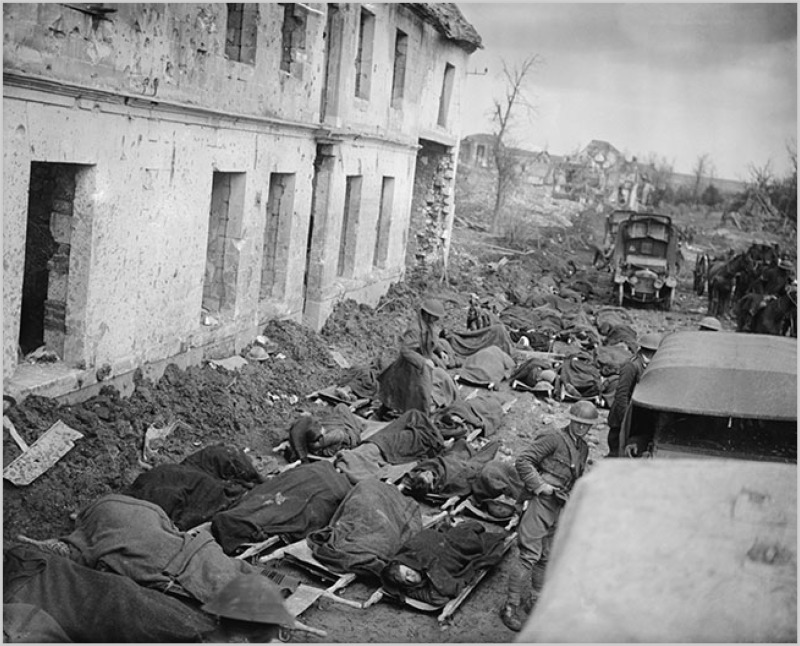
On April 14, 1917, wounded soldiers lay on stretchers outside a roofless, shell-pocked building at Blangy, near Arras. Vehicles approached along the road. The men were waiting to be moved from a dressing station toward a casualty clearing station; those able to walk followed a different path.[10] Nothing in John Warwick Brooke's photograph resembles the tidy fan of colored arrows now associated with triage. The system is visible anyway. Bodies, bearers, vehicles, surgical capacity, distance, and time have become one queue.
That queue is older than the photograph, but it was not invented in one clean moment. The familiar origin story gives a French surgeon a date—Dominique-Jean Larrey, 1792—then draws a straight line to the modern emergency department. The documentary history is rougher. Larrey changed the priority of battlefield care and helped bring treatment closer to the wounded. Other surgeons changed evacuation, categories, and the use of scarce operating time. First World War hospitals turned sorting into a chain of destinations. Civilian hospitals later adapted the practice to a different scarcity: many patients arriving through one door while not everyone could be assessed and treated at once.[1][2][3]
Triage survived each move because it is not really a color, a number, or a desk. It is a repeatable answer to a changing question: who needs which next action first, given the people and resources available here?
1792–1812: reach the wounded before sorting them
Larrey encountered an army medical system in which wounded soldiers could remain on the field until fighting ended. In the campaigns of the French Revolutionary and Napoleonic era, he developed light, mobile ambulances volantes—“flying ambulances” in the sense of speed, not aircraft—to bring trained care and transport nearer to battle. By his account of the 1812 Russian campaign, the dangerously wounded were to receive attention before the less severely injured, without rank deciding the order.[1]
That was a moral reversal, but also a logistical one. “Treat the worst first” is meaningless if nobody can collect the wounded, carry them to a clinician, and move them onward after the first intervention. Larrey's important unit was therefore not the lone heroic surgeon. It was the linked service of assessment, immediate treatment, and evacuation.
Even the word's origin resists a commemorative plaque. A 2017 review by Hiroyuki Nakao and colleagues found no use of triage in Larrey's diary and reported the term in fellow surgeon Pierre-François Percy's diary in 1808. The authors argue that the prototype probably emerged across the late 1790s and early 1800s, while also acknowledging that key documents do not survive and that Larrey and Percy pursued different approaches.[2] That interpretation does not erase Larrey's contribution. It corrects the category error of treating a later label as proof of a single instant of invention.
The distinction matters because the early rules were not interchangeable. Larrey emphasized urgent need over status. British naval surgeon John Wilson argued in 1846 that surgeons should also consider whether immediate treatment was likely to succeed, deferring both minor injuries and wounds unlikely to be survivable with the resources at hand. During the U.S. Civil War, Jonathan Letterman's work from 1862 joined front-line care, ambulance transport, and more organized sorting in the Army of the Potomac.[1] Triage was already becoming less like one ranking and more like an operating system for movement.
1914–1918: the queue becomes a chain
The First World War forced that operating system to work at industrial scale. A wounded British soldier might pass from a regimental aid post to an advanced dressing station, then by horse or motor ambulance to a casualty clearing station, and later by train, barge, or ship to a base hospital. Each stop did different work. Sorting could determine not only who entered an operating theatre first, but who could travel, who needed resuscitation before travel, and which destination could provide the next treatment.[4][5]
Casualty clearing stations were often placed roughly six to nine miles behind the front. Built to receive perhaps 150 to 400 patients, some faced surges of 1,000 or more. Under that pressure, the rule “most severely wounded first” could collide with operating time. A long procedure for one salvageable patient might consume the interval in which several other urgent casualties could be treated. Some wartime manuals therefore made population outcome and military manpower explicit parts of the sorting rule.[1][4]
This is the uncomfortable turn in triage history. Urgency alone did not settle priority; likely benefit, treatment time, transport, and the war's institutional goals entered the calculation. Different services weighted them differently. The word became common, but the values inside it did not become uniform.
The chain itself kept changing. British records show that during 1915 the most serious wounds increasingly went directly to casualty clearing stations, bypassing intermediate stages. In 1916, stations moved closer to the front to reduce deaths during transfer.[5] Proximity shortened one delay while making hospitals more exposed to shelling and sudden movement. Every gain altered the queue somewhere else.
Brooke's Blangy photograph captures that truth better than a category chart. The patients are not abstract severities. They occupy stretchers that other bearers need; vehicles must reach them; a damaged building has become a treatment node; the next facility lies farther down the road.[10] Triage was embedded in this material flow before it became a standardized mark on a chart.
1963: the battlefield verb enters the hospital door
Civilian emergency departments inherited the sorting problem under a different resource balance. The usual assumption was that all patients could eventually receive care, but not at the same time. The immediate task was to recognize those who could not safely wait. A second, more contentious task was to decide whether some patients should be redirected elsewhere.[1][3]
One of the earliest systematic U.S. accounts came from Grace–New Haven Community Hospital. During a one-month study from October 14 to November 13, 1963, 3,743 people registered with the emergency service. Of the 2,662 screened while the new triage program operated, 469—17.6 percent—were judged nonurgent and discharged or referred for follow-up outside the emergency service. The results appeared in Public Health Reports in 1965.[6]
This was recognizably triage, but it was not simply Larrey's battlefield rule brought indoors. The New Haven officers were also managing demand across an emergency service, outpatient clinics, private physicians, and community resources. Their paper recorded whether referred patients kept later appointments and described the social profile of the group sent elsewhere. In other words, the queue now extended beyond the hospital door. A sorting decision could shift waiting and risk into another part of the health system.[6]
That expansion exposed a lasting tension. Prioritizing a patient with shock ahead of a stable ankle injury is different from deciding that the ankle injury belongs somewhere else. Both actions allocate care, but the second depends on whether an accessible alternative actually exists. Triage can make a queue safer; it cannot create missing capacity by renaming it.
1976: the first judgment becomes nursing work
As emergency departments grew, the brief assessment at entry increasingly became a specialized nursing responsibility. A 1976 study at San Francisco General Hospital evaluated a trained registered nurse who directed apparently nonemergent ambulatory patients to a walk-in service. Over three months, 11,329 people registered and 4,150—37 percent—were referred there. Seventy-seven of those patients were eventually admitted; reviewers judged that six needed treatment within a few hours. The authors reported 98 percent overall accuracy while tracing errors to mistaken diagnosis and underestimated severity.[7]
The high percentage and the misses belong in the same sentence. Triage is designed around a short first encounter, before the fuller history, repeated observations, tests, and response to treatment are available. A strong process can sort reliably without becoming omniscient. The study also made visible why training, communication, and a route back into urgent care matter: the first category is a working hypothesis, not a discharge diagnosis.
2000: a queue gets five levels—and a test
By the late twentieth century, emergency systems were trying to replace broad, locally improvised labels with scales whose decisions could be reproduced and evaluated. The Emergency Severity Index (ESI), developed in the United States in the late 1990s, used five levels. Its highest levels centered on immediate intervention and high-risk presentation; lower levels incorporated the resources a patient was expected to need.[3][8]
The original multicenter validation, published in 2000, enrolled 538 adults during 100 hours at two urban referral hospitals; 45 incomplete cases were excluded, leaving 493. Blinded paired assignments produced a weighted kappa of 0.80 (95% confidence interval 0.76–0.84), and triage level was strongly associated with resource use and hospitalization. The result supported a more reproducible common language in those settings.[8]
It did not turn five into a natural law. The cohort was a convenience sample from two hospitals, and association with later resource use does not make the entry assessment a diagnosis. Other systems built their levels from different combinations of presenting complaint, vital signs, urgency, and expected time to assessment. Standardization made the reasoning easier to teach and audit; it did not eliminate judgment or local context.[3][8]
The present: one verb, different scarcities
The World Health Organization's current Interagency Integrated Triage Tool, developed with the International Committee of the Red Cross and Médecins Sans Frontières, makes the context distinction explicit. Its routine facility tool uses three colors—red for immediate care, yellow for care soon, and green for those who can wait. It provides a separate mass-casualty protocol for situations that generate more patients than a facility can manage with its usual resources and procedures.[9]
That is not a contradiction of five-level emergency-department systems. It is the point of the history. A routine hospital queue, a prehospital scene, and a mass-casualty surge do not have the same ratio of patients to clinicians, beds, blood, operating rooms, or transport. A useful triage method has to declare which problem it is sorting.
Across the changes, three principles endure. First, triage assigns priority for a next action, not a complete account of the patient. Second, priority depends partly on the capacity around the patient, so the same clinical finding can create different operational decisions in different settings. Third, triage is dynamic: when a patient's condition or the available resources change, the original ordering may no longer hold.[1][3][9]
That last principle is the quiet link between Larrey's wagons, the stretchers at Blangy, the nurse at a 1970s intake desk, and a modern acuity scale. None works by attaching the perfect label once. Each works by turning an undifferentiated crowd into a sequence, moving people toward care, and looking again before the queue becomes a verdict.
Triage was not invented once because scarcity does not appear only once. Every era rebuilt the answer around its own doorway, transport, staff, and treatment capacity. The achievement is not the color attached to a patient. It is a system disciplined enough to change that color when reality changes.
Sources
- Kenneth V. Iserson and John C. Moskop, “Triage in Medicine, Part I: Concept, History, and Types,” Annals of Emergency Medicine 49(3), 2007 — definitions, military chronology, scarcity continuum, and distinctions among emergency, military, incident, and disaster triage.
- Hiroyuki Nakao, Isao Ukai, and Joji Kotani, “A review of the history of the origin of triage from a disaster medicine perspective,” Acute Medicine & Surgery 4(4), 2017 — documentary uncertainty around Larrey, Percy, terminology, and the late-eighteenth-century origin story.
- Iain Robertson-Steel, “Evolution of triage systems,” Emergency Medicine Journal 23(2), 2006 — development of prehospital, scene, and receiving-hospital triage and the requirement for dynamic reassessment.
- M. M. Manring, Alan Hawk, Jason H. Calhoun, and Romney C. Andersen, “Treatment of War Wounds: A Historical Review,” Clinical Orthopaedics and Related Research 467, 2009 — First World War casualty clearing stations, surge pressure, transport, and the evolution of military care.
- The National Archives (UK), “Medicine on the Western Front (part one)” — primary-source teaching collection and chronology of aid posts, dressing stations, casualty clearing stations, and the 1915–1916 changes in evacuation and surgery.
- E. Richard Weinerman, S. Robert Rutzen, and David A. Pearson, “Effects of Medical ‘Triage’ in Hospital Emergency Service,” Public Health Reports 80(5), 1965 — Grace–New Haven's 1963 civilian emergency-service program, patient flow, referrals, and follow-up data.
- J. Mills and colleagues, “Effectiveness of nurse triage in the emergency department of an urban county hospital,” JACEP 5(11), 1976 — prospective San Francisco evaluation, referral volumes, admissions, accuracy, and error types.
- Richard C. Wuerz and colleagues, “Reliability and validity of a new five-level triage instrument,” Academic Emergency Medicine 7(3), 2000 — original ESI cohort, interrater reliability, resource use, and hospitalization validation.
- World Health Organization, “Interagency Integrated Triage Tool” — current definition of acuity-based triage, three-color routine tools, and the separate facility-based mass-casualty protocol.
- Wikimedia Commons and Imperial War Museums, “Stretcher cases awaiting transport to a Casualty Clearing Station … Blangy near Arras, April 1917” — provenance and metadata for John Warwick Brooke's archival photograph Q 6195.