DNA extracted from a bone recovered near Srebrenica does not carry a person's name. The profile becomes an identification lead when it shows a statistically supported kinship relationship with profiles donated by living relatives. Anthropologists, pathologists, and investigators then test that match against the recovery site, the biological profile, and the case record. Authorities make the official determination of identity; the family decides whether and when the recovered remains should be buried.[1][2][3]
That chain is Potočari's distinctive health history. Forensic genetics, anthropology, pathology, official records, family liaison, and psychosocial support meet at the point where anonymous remains can be restored to a legal and social identity.[2][5] The graves are not merely downstream memorials. They are public outcomes of a process that must be accurate enough for courts and humane enough for families.
The attempt to hide the crime also attacked identity
In July 1995, Bosnian Serb forces murdered more than 8,000 Bosniak men and boys in and around Srebrenica. The International Commission on Missing Persons records a second operation after the executions: perpetrators used heavy machinery to move bodies from primary mass graves into secondary sites, sometimes tens of kilometers away, in an effort to conceal evidence. The process disarticulated and mixed remains. Parts of one person are typically recovered from three or four different graves.[1]
This matters for more than reconstructing how the crime was hidden. It explains why a body, a name, and a burial could not simply be reunited by opening one clandestine grave site. Clothing and personal objects might suggest an identity, but mass displacement, decomposition, commingling, and redistribution made visual or circumstantial identification dangerously uncertain.[2] The concealment operation turned identification itself into a large-scale scientific problem.
The International Commission on Missing Persons put its DNA laboratory system online in 2001.[1] Its 2019 technical account describes a population-based process: scientists generate DNA profiles from skeletal samples, collect reference profiles from relatives of missing people, search for statistically supported kinship relationships, and integrate the resulting match with a multidisciplinary identification process.[2] This is not a barcode scan in which a bone contains a person's printed name. The power comes from combining preserved biological material, family relationships, database-scale comparison, forensic context, and official review.
By June 2023, relatives had supplied 22,337 biological reference samples connected to reported missing people from Srebrenica and nearby places. ICMP said it had identified 6,981 victims through family-reference comparison and that 7,017 had been identified through DNA and non-DNA methods combined.[1] Those figures are institutionally reported totals, not a declaration that the work is finished. Fewer witnesses remain able to point investigators toward undiscovered graves, and in July 2026 ICMP still estimated that approximately 1,000 people were missing.[1][7]
Identification names a person, not necessarily a complete body
The phrase DNA match can make identification sound like a clean ending. At Srebrenica it is often a beginning of another kind of work.
Because remains from one person can be scattered across several sites, laboratories may issue multiple match reports for the same individual as additional bones are recovered. ICMP reported in 2023 that the average identified victim had generated seven or eight separate DNA match reports.[3] Forensic teams then face two linked questions: do newly recovered fragments belong to a person who has already been identified, and have some of that person's remains already been buried?
The resulting process is called reassociation. A later-recovered bone can be connected to remains identified earlier; if the person has already been buried, authorities may seek the family's consent to reopen the grave, add the recovered material, and rebury the remains. After the July 11 burials in 2023, ICMP and Bosnian institutions planned 71 such reassociations.[3] The language is procedural, but the act is intimate. A family that has already held a funeral is asked to decide whether a grave should be opened because another part of the person has been found.
Some families bury partial remains once an identity is established. Others wait, hoping that further searches will recover more. Many of the 30 victims buried in 2023 had been identified in previous years, but their relatives had chosen to wait for additional remains.[3] Neither choice is the technically correct one. DNA can support identity; it cannot decide when enough of a person has returned for burial. That boundary belongs to the family.
This is why consent is not an administrative courtesy added after the science. It is part of the memorial's moral structure. The perpetrators treated bodies as material to be moved and fragmented. A responsible identification system must not repeat that removal of agency in the name of efficiency. It has to explain what was found, what remains missing, what a match means, and what choices are still open.
The cemetery receives people over time
Potočari's commemorative rhythm follows the identification process. The Memorial Center records that the first collective funeral there took place on March 31, 2003, when 600 victims were buried. Further funerals followed on July 11 and September 20, the date the center officially opened.[4] From its first year, the cemetery joined memorial ritual to the repeated return of newly identified people.
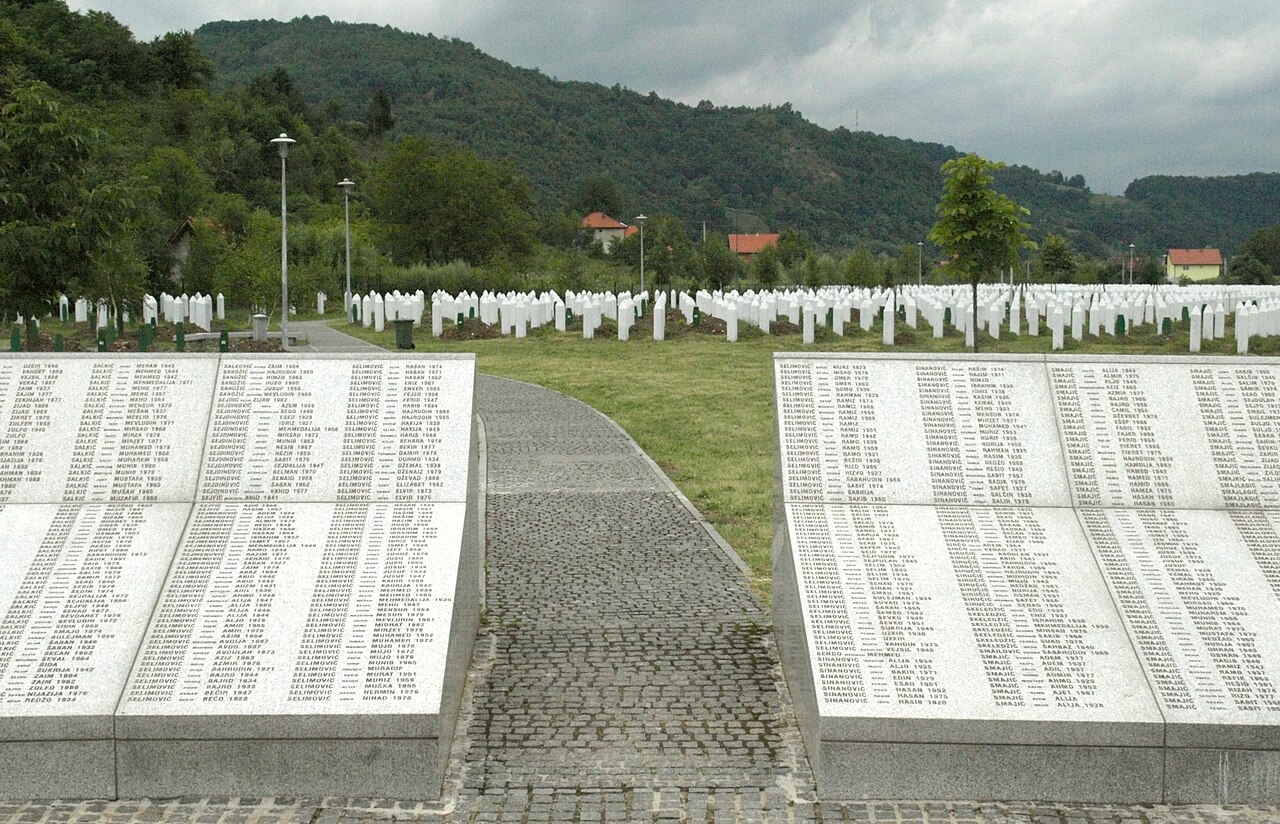
The scale of each annual burial has changed as the search has become harder. In July 2025, the International Committee of the Red Cross described seven identified people scheduled for that year's burial and noted that the cemetery preserves empty spaces so people who are still missing can eventually be buried near relatives if they are found and identified.[5] On July 11, 2026, ten more victims were buried there; ICMP reported that more than 90 percent of the genocide's more than 8,000 victims had been accounted for.[7] The open spaces preserve capacity for the same sequence to work again: recovery, identification, family decision, and burial.
The photograph used with this article shows the result from ground level—rows of individual markers rather than a single monumental block.[8] It cannot show the reference samples, the degraded bone, the statistical comparisons, the case files, or the family meetings that precede burial. Yet that absence is exactly why the image matters. The calm field is not the alternative to forensic work. It is what that work, at its best, allows: a person returned from an anonymous or concealed grave to a named place.
Identification is an answer, not a cure for grief
Public accounts of forensic identification often reach for the word closure. The word is too neat for Potočari.
Research on families confronting a loved one's disappearance describes an especially difficult uncertainty: relatives may have neither reliable evidence of life nor confirmed death, which can complicate mourning and social rituals. A systematic review found that reported rates of post-traumatic stress and depression varied considerably across 15 studies conducted in war or state-terrorism settings. The authors stressed that this small, heterogeneous evidence base limits general conclusions and does not support one universal response to disappearance.[6] The ICRC likewise describes families of the missing as facing psychological, social, legal, and economic burdens over long periods.[5]
A scientifically supported identification can resolve one central uncertainty. It can establish that recovered remains belong to a particular person, enable an official death record, return remains to relatives, and make a named burial possible.[1] Those are profound changes. They should not be minimized merely because grief continues.
But identification does not restore the person, make fragmented remains whole, erase traumatic memory, or guarantee that every part of the body will be recovered. It may create new decisions about waiting, burial, or reassociation. For families whose relatives remain missing, the success of thousands of other identifications can coexist with the continuing pain of having no match at all. The health boundary is therefore precise: forensic identification can end uncertainty about identity and fate in a case; it cannot be prescribed as a treatment that ends mourning.
Keep the chain intact
Potočari connects a series of acts that can look separate on an organization chart: a relative donates a reference sample; a team recovers remains; a laboratory finds a kinship association; specialists test the result against the case; authorities determine identity; a family chooses burial; later-recovered fragments may be reassociated with consent.[1][2][3]
Each link constrains the next. Without family reference profiles, a usable profile from bone may remain unmatched. Without multidisciplinary review, a DNA match report is evidence but not an official identification. Without family choice, technical efficiency can displace the people to whom the remains are being returned. Without burial and public memory, a verified identity may remain visible only inside a case file.
The rows at Potočari are the public register produced by that chain, one identification and one family decision at a time. A named marker shows where the process reached burial. A reserved space keeps room for it to operate again. That is the memorial's distinctive demand: keep recovering, matching, checking, asking, and returning until every person who can be found has a name and every family receives an answer grounded in evidence.
Sources
- International Commission on Missing Persons, "Srebrenica" — official overview of the July 1995 killings, movement and fragmentation of remains, DNA-led identification process, reported totals through June 2023, and the continuing search.
- Thomas J. Parsons and colleagues, "Large scale DNA identification: The ICMP experience," Forensic Science International: Genetics 38 (2019) — technical account of skeletal sampling, family-reference databases, kinship matching, multidisciplinary identification, and the Srebrenica program.
- International Commission on Missing Persons, "For the Families of Srebrenica the Wait Never Ends," July 7, 2023 — account of fragmented remains, repeat DNA match reports, family decisions about partial burial, consent, and reassociation.
- Srebrenica Memorial Center, "Commemoration of the 21st anniversary of the first funeral at the Memorial Center," March 31, 2024 — Bosnian-language official record of the first 600 burials in 2003, subsequent funerals, and the center's opening.
- International Committee of the Red Cross, "Srebrenica: 30 Years of Remembrance and Search for Missing Family Members Continues," July 2025 — account of the search, annual burials, reserved cemetery spaces, and families' psychosocial and practical burdens.
- Lonneke I. M. Lenferink and colleagues, "Toward a Better Understanding of Psychological Symptoms in People Confronted With the Disappearance of a Loved One: A Systematic Review," Trauma, Violence, & Abuse (2019) — review of ambiguous loss, psychological outcomes, evidence heterogeneity, and research limits.
- International Commission on Missing Persons, "Thirty-One Years After the Srebrenica Genocide: Preserving Facts, Honoring Victims and Supporting Survivors," July 11, 2026 — current account of the ten victims buried in 2026, the identification rate, the continuing search, and the forensic record.
- Wikimedia Commons, "File:Srebrenica Graveyard.JPG" — source and metadata page for Mazbln's 2008 photograph of the Srebrenica-Potočari cemetery, later cropped and color-adjusted by Michael Bueker, used as the article image.