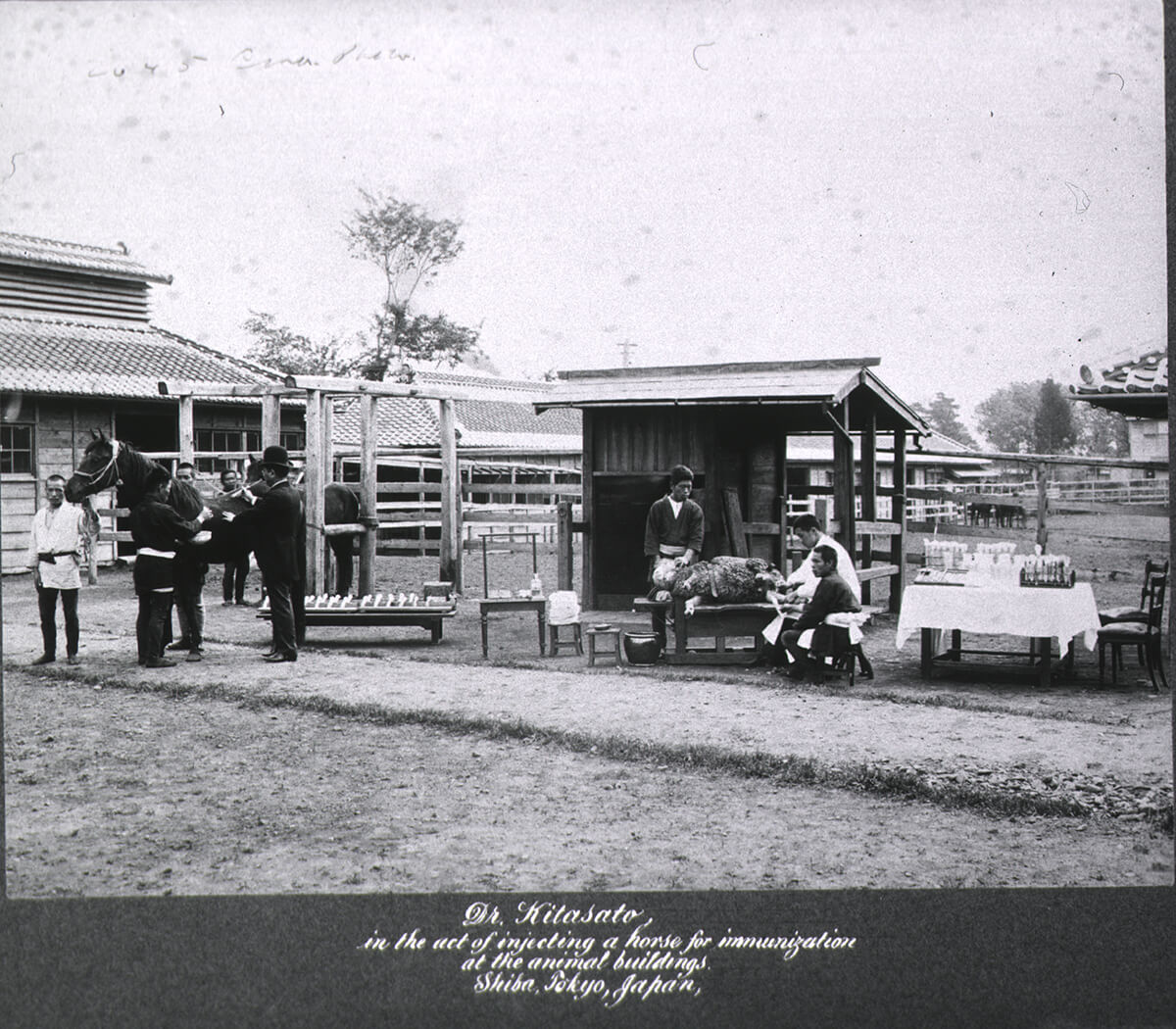
On the afternoon of October 26, 1901, St. Louis health commissioner Max C. Starkloff received a physician's warning: two children under the doctor's care had developed tetanus after receiving diphtheria antitoxin supplied by the city. Starkloff stopped distribution that day and opened an investigation.[1]
The stop order was necessary, but it came at the wrong end of the system. The injections had already happened. The children were not transmitting tetanus to one another, and the cluster could not be contained by isolating a household. Investigators had to move backward—from muscle spasms to a syringe, from a syringe to a bottle, from a bottle to a date, and from that date to a horse named Jim.
By the time the inquiry was finished, 13 children had died. The serum had been drawn while Jim was incubating tetanus, released before the documented guinea-pig potency test could have produced a result, and partly placed in bottles carrying an earlier date.[2][3][4] The disaster is often compressed into a memorable sentence about a contaminated horse. That sentence names the source but hides the mechanism. A horse became ill; a production system made his illness distributable.
A treatment the city was trying to make accessible
Diphtheria antitoxin was not a speculative tonic. In the 1890s, it was one of bacteriology's most important practical successes: serum from an immunized horse could neutralize circulating diphtheria toxin, especially when administered early. American city health departments adopted local production partly because diphtheria killed children and partly because municipal supply could put treatment within reach of families who could not easily buy it.[3]
St. Louis employed bacteriologist Amand Ravold to supervise that work. In Ravold's contemporaneous account, Jim was a former ambulance horse retired after a shoulder injury; he had supplied more than 30 quarts of antitoxin during roughly three years of service.[1] He was therefore not an unknown animal entering an improvised experiment. He belonged to a routine that had appeared to work.
That record matters. If the event is told as proof that horse serum was inherently reckless, the later policy response makes little sense. Officials did not outlaw antitoxin. They tried to preserve a valuable therapy by changing the conditions under which biological products could be made and sold. The question was not whether serum could save a child with diphtheria. It was whether a manufacturer—or a city laboratory—could demonstrate that the contents of this particular bottle were what its label claimed.
September 30: one blood draw crossed several missing boundaries
The later reconstruction fixed its attention on a short sequence. On September 22, Ravold injected Jim with strong diphtheria toxin as part of antitoxin production; on September 30, he bled the horse. On October 2, the health department veterinarian diagnosed tetanus and ordered Jim killed.[1][3] A safe process would have treated the final draw as quarantined material: physically identified, held apart, tested, and destroyed once the donor animal became ill.
Instead, the identity of the serum became unstable. Testimony summarized in the 1902 journal Pediatrics described serum from different draws being kept unlabeled in an icebox, distinguished through the memory of Henry Taylor, a Black janitor who moved the flasks within the health department. Assistant bacteriologist Martin Schmidt testified that the final serum had not been tested on guinea pigs before distribution.[2]
Those details show why “human error” is too small an explanation. Memory had been made into the batch record. An unlabeled vessel could change identity without changing appearance. A subordinate could handle release material without a documented status that said tested, held, or condemned. The guinea-pig antitoxic-potency assay existed in principle, and the committee later concluded that it would also have exposed this serum's toxicity; the product moved faster than the assay.[2]
The investigative committee's laboratory findings made the failure more precise. Its report said the implicated serum was sterile—it did not contain growing tetanus bacilli—but it did contain tetanus toxin. The committee also concluded that there were two materially different sera carrying the date August 24: one was non-toxic, while another matched the toxic September 30 serum. In other words, the earlier date did not reliably identify the earlier draw.[2]
That distinction is the center of the case. Sterility answered one question and missed the fatal one. The bottle could contain no live contaminating organism and still carry a toxin already present in the donor horse's blood. A completed guinea-pig potency test would have made the toxic effect visible before release, the committee concluded.[2] A trustworthy batch identity would have shown which bottles had to remain behind the laboratory door.
October 26: a clinical cluster became a product investigation
The first public signal arrived through care, not through manufacturing records. A physician noticed an implausible association and reported it. Starkloff's contemporaneous account said he immediately stopped distribution, asked Ravold for an explanation, and began an inquiry with coroner Robert Funkhouser.[1]
The household pattern helped make the product hypothesis visible. The American Association of Immunologists' historical synthesis describes Bessie Baker receiving antitoxin for severe diphtheria while her sister May and their two-year-old brother received it prophylactically; all three children died. Their physician, R. C. Harris, then learned of other tetanus cases after use of the city supply.[3] One therapeutic dose and two preventive doses had created a shared product exposure that ordinary wound histories could not explain.
By November 5, 11 children had died, and the inquiry was taking testimony. On December 5, a special municipal commission convened; on December 10, it heard Schmidt's account of untested serum and unlabeled storage.[2][3] These dates did not simply accumulate toward a verdict. Each one exposed a different lag: the interval between bleeding the horse and recognizing his illness, between distributing the serum and seeing tetanus in children, and between recalling bottles and reconstructing who had allowed them to leave.
The inquiry also had to separate two kinds of causation. The biological cause was toxin in serum taken from Jim during the incubation of tetanus. The organizational cause was a release path with weak identity, no completed guinea-pig potency test, inadequate segregation, and disputed responsibility. Finding the horse did not by itself establish how serum that Ravold said he and Taylor had emptied into the laboratory sink reached physicians. The laboratory comparison between the dates did.[1][2]
Later accounts assign responsibility most heavily to Ravold. They say Taylor did not know the serum was toxic and bore no blame for the deaths, although he was dismissed after the commission characterized contradictions in his testimony as obstruction.[3] The surviving record therefore carries a social boundary as well as a technical one: authority over production and knowledge of danger sat above the worker whose memory had been used in place of labels. A modern reading should not turn that vulnerable position into the mechanism of failure.
The law converted the failure chain into control points
St. Louis was not the only 1901 warning. In Camden, New Jersey, another tetanus outbreak followed contaminated smallpox vaccine. Historical research treats the St. Louis and Camden investigations together as early product-safety studies that made manufacturing failures visible to a national audience.[7]
On July 1, 1902, Congress approved what became known as the Biologics Control Act or Virus-Toxin Law. The statute was narrower than a modern promise that every medicine had undergone federal premarket review for safety and effectiveness. It governed biological products sold in the District of Columbia or moving through interstate or foreign commerce.[5]
Within that boundary, however, the law translated the disaster into an operating system. Covered serum, vaccine, toxin, and antitoxin had to come from a licensed establishment. Packages had to carry the product name, the manufacturer's name, address and license number, and a date beyond which the material could not reasonably be expected to work as intended. False labeling was prohibited. Federal officers could inspect production establishments, and the Treasury secretary could issue, suspend, or revoke licenses.[5]
The first regulations became effective on August 21, 1903. FDA's historical account says they required annual licensing, facility inspection, qualified scientific supervision, and specified label information.[4] These controls did not reproduce the St. Louis committee's exact laboratory protocol in statutory prose. They did something more durable: they made the establishment, its supervisor, its labels, and its continuing license accountable objects of federal oversight.
The law also reveals what officials thought the disaster was not. Congress did not treat a clinician's October report as the ideal safety sensor. It placed controls before the syringe: where a biologic was produced, who supervised it, whether an inspector could enter, whether a package could be traced to a licensed maker, and whether the label told the truth. The adverse event still mattered, but it was evidence that upstream control had failed.
The useful lesson is not “never trust a biologic”
Jim's story is easy to make into a parable about one unlucky animal. The investigative record resists that simplicity. The horse's tetanus was a hazard. Unlabeled storage allowed identities to blur. Release before the guinea-pig potency test was complete converted uncertainty into inventory. A false date defeated traceability. Distribution put the failure into children's bodies, and only then did the reporting system become fast enough to stop additional bottles.[1][2][3]
The counterfactual is unusually concrete. If the September 30 draw had remained unmistakably labeled and segregated, Jim's diagnosis on October 2 could have condemned it. If release had waited for the guinea-pig potency test, toxicity should have appeared before dispensing. If the date on every bottle had preserved the draw's identity, investigators would not have needed laboratory comparison to discover that some “August 24” serum was actually from September 30.[2]
None of those controls depends on pretending that risk can be abolished. They depend on arranging production so that a warning can arrive while the material is still containable. The 1901 deaths became a regulatory turning point because the inquiry changed the unit of explanation. It moved from a sick horse to a batch, from a batch to an establishment, and from an establishment to a public authority able to inspect, license, and stop it.
The serum was sterile. That fact was true and catastrophically insufficient. Safety lived in the chain around the test: identity, time, segregation, supervision, labeling, and release. St. Louis learned those controls after the dose had crossed the last boundary. The 1902 law tried to move them to the other side of the needle.
Sources
- Journal of the American Medical Association, “Fatal Results from Diphtheria Antitoxin in St. Louis” (9 November 1901), pp. 1260–1261 — Health Commissioner Max C. Starkloff's contemporaneous account of the October 26 alert, distribution stop, and opening investigation.
- Pediatrics, “The Investigation of the Tetanus Cases in St. Louis” and “The Report of the Committee on Tetanus Inquiry in St. Louis” (1902), pp. 36–37 — period summaries of testimony and the committee's findings on unlabeled storage, premature release before guinea-pig potency testing, toxin, and false batch dates.
- American Association of Immunologists, “Hero Horses in the Fight Against Disease,” AAI Newsletter (October 2021), pp. 34–37 — sourced reconstruction of municipal antitoxin production, the Baker siblings, Jim's final draw, the inquiry, and its personnel.
- U.S. Food and Drug Administration, “Science and the Regulation of Biological Products” (2002) — official history of the St. Louis deaths, the 1902 act, and the regulations effective in 1903.
- United States Statutes at Large, 57th Congress, chapter 1378, 32 Stat. 728–729 (approved 1 July 1902) — original text of the Biologics Control Act's commerce scope, licensing, labeling, inspection, and enforcement provisions.
- U.S. National Library of Medicine, “Dr. Kitasato Injecting a Horse for Immunization, c. 1900” — institutional exhibition and collection record for image OB22716 and its antitoxin-production context.
- David E. Lilienfeld, “The First Pharmacoepidemiologic Investigations: National Drug Safety Policy in the United States, 1901–1902,” Perspectives in Biology and Medicine 51 (2008) — historical analysis connecting the St. Louis and Camden investigations to federal biologics regulation.