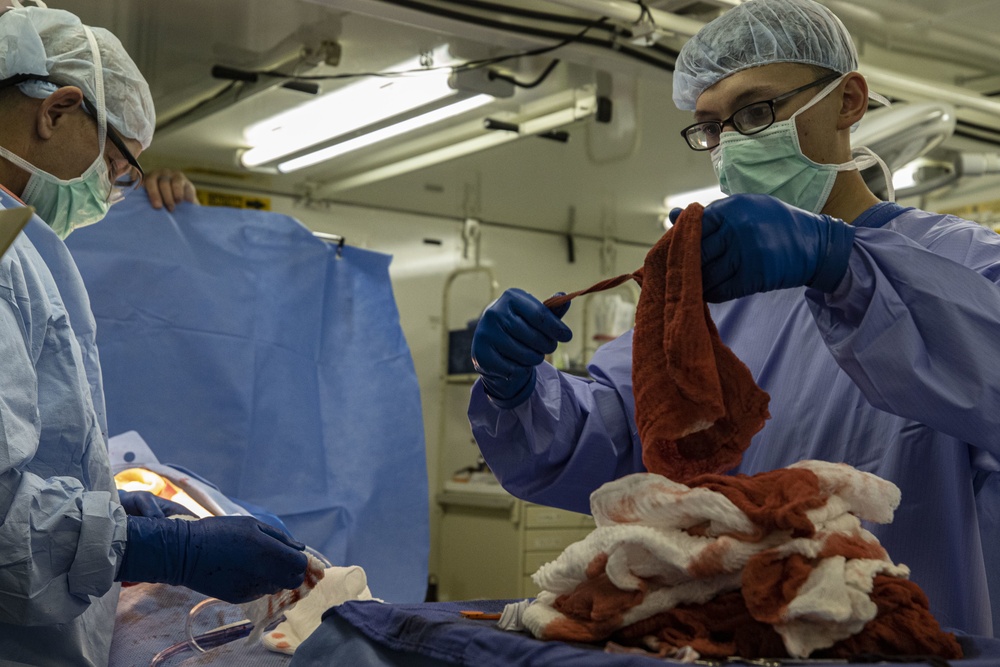
In a 2019 U.S. Army field-hospital exercise, operating-room specialist Austin Latuszek lifts one blood-darkened Ray-Tec sponge from a pile and looks along its length. The simulated patient is almost outside the frame. The act at the center of the photograph is accounting: one soft object, visibly separated from the others, held where another person can see it.[8]
The gesture looks like the whole solution. Count every sponge before it enters the wound; count every sponge when it comes back. If the totals agree, close. Yet the history of retained surgical sponges is largely a history of discovering why that arithmetic can be honestly performed and still produce false reassurance. A package may begin with eleven sponges when the team assumes ten. A sponge may be placed where the count does not reach. A result may be called across a noisy room but never change what happens next. An X-ray marker may be present and still go unseen.[6][7]
The sharp question is not why an operating-room team would bother to count. It is how surgery learned that a correct count is one test result, not proof that the patient contains nothing unintended. Over nearly a century, prevention accumulated layers: make the sponge visible to X-rays, standardize the count, map the situations in which work becomes unstable, examine the wound, escalate discrepancies, and add detection technology without pretending that a machine can repair a broken conversation.
1929: give cotton an X-ray signature
Cotton gauze is useful in surgery because it is soft, absorbent, and easy to place. Those same qualities make it treacherous once saturated. A white square becomes dark, compressible, and visually similar to the field around it. Before an operation ends, the team may have handled many such pieces while instruments move, personnel change, and the patient's condition sets the pace.
The first major material countermeasure was to make the textile visible after ordinary sight failed. A later systematic review traces the introduction of radiopaque thread in surgical gauze to Cahn in 1929 and says the practice became general in the United States around 1940.[1] Modern surgical sponges and white surgical towels intended for use inside a wound contain X-ray-detectable markers; many other small items and device fragments do not.[6]
That thread changed the evidentiary problem. Without it, a missing sponge could resemble a postoperative mass or abscess and remain unidentified for a long time. With it, imaging could reveal a deliberately added signature. But visibility is not the same as detection. The marker has to be present, the right image has to be taken, someone has to recognize the pattern, and the finding has to reach a team still able to act. Radiopacity created a rescue layer. It did not make the earlier layers unnecessary.[6][7]
1985–2001: disruption becomes measurable
For much of the twentieth century, retained items were discussed as obvious lapses: someone forgot, someone failed to count, someone should have looked harder. A case-control study published in 2003 made the surrounding conditions more legible. Atul Gawande and colleagues reviewed claims and incident reports filed from 1985 through 2001 with a Massachusetts malpractice insurer. They identified 54 patients with 61 retained objects; 69 percent of the objects were sponges, 37 patients required another operation, and one patient died.[2]
The comparisons did not describe an error evenly distributed across calm, routine work. Emergency surgery was associated with a risk ratio of 8.8 compared with matched controls, while an unplanned change in the operation was associated with a risk ratio of 4.1. Higher body-mass index also tracked with increased risk. The study was retrospective and drawn from one insurer's claims and reports, so its ratios are not a universal prediction tool. Its historical importance is more bounded: it showed that retention clustered where the operation's original script broke down.[2]
That finding moved the explanation away from memory alone. An emergency compresses time. An unexpected procedural change introduces new instruments and sponges after the opening inventory. A larger or deeper operative field makes visual recovery harder. None of those conditions excuses a retained item. They explain why a safety system designed for the smooth case is weakest precisely when the case stops being smooth.
2008: a hidden complication enters the public ledger
On October 1, 2008, a Medicare payment policy gave the event a new institutional status. The Centers for Medicare & Medicaid Services classified a foreign object left after surgery among hospital-acquired conditions considered reasonably preventable through evidence-based practice. If the condition was acquired in the hospital, Medicare would no longer raise the hospital's payment to cover the resulting additional cost, although necessary treatment remained covered.[3]
Payment classification did not prove that every individual event had one simple, preventable cause. It did something else: it made retention a reportable quality failure with consequences beyond a private operating-room review. The forgotten object moved from the language of rare complication toward the language of accountable system design.[3]
2016: the standard becomes a bundle
By 2016, the American College of Surgeons' prevention statement no longer treated counting as sufficient by itself. Its recommended defenses included standardized counts, a methodical wound exploration before closure, X-ray-detectable items in the wound, an operating-room environment that permits focused work, imaging or technologies such as radiofrequency detection and bar coding when indicated, and documentation of both discrepancies and the actions taken to resolve them.[5]
The list matters because its elements ask different questions. The count asks whether recorded quantities agree. Wound exploration asks whether touch and sight find anything still present. A radiopaque marker asks whether an image can expose what the field concealed. Documentation asks whether a warning survives a handoff. Tagged-sponge technology asks whether electronic detection can provide a check independent of mental arithmetic. No single answer is asked to carry the whole safety claim.
The bundle also redistributed responsibility. Surgeons, perioperative nurses, surgical technologists, anesthesia professionals, radiology staff, facilities, and manufacturers occupy different points in the chain.[5][7] This is not responsibility diluted until nobody owns the outcome. It is responsibility made specific enough that one person's correct action does not have to compensate silently for every other possible failure.
2018: the reports widen the map beyond the operating room
A 2018 study of 319 retained-sponge events voluntarily reported to the Joint Commission's Sentinel Event Database showed how wide that chain had become. Operating rooms accounted for 64.1 percent of reports, but labor and delivery accounted for 32.7 percent. Among 318 reports with contributing-factor data, each named between one and twelve factors, most often involving human factors and leadership. Unexpected additional care or a longer stay was recorded in 69.6 percent of events; 14.7 percent caused severe temporary harm, and one patient died.[4]
Those figures describe a selected collection of voluntarily reported sentinel events, not an incidence rate for all procedures. They cannot tell a patient the probability of retention after a particular operation. What they can show is that the old mental picture—one surgeon, one deep abdominal wound, one forgotten pad—was too narrow. Sponges were also retained after childbirth and in procedural settings where conventional operating-room count routines might not travel intact.[4]
The study also complicates the phrase “never event.” Calling an outcome unacceptable is ethically clear. It does not reveal which defense failed or how to redesign it. For that, the event has to be reconstructed as work: what items entered the field, who could see them, which count domain included them, what changed, how the result was communicated, and whether anyone had both the authority and time to stop closure.
2025: the correct count is recognized as a false negative
The most unsettling modern evidence concerns cases in which the paperwork says the safety process succeeded. A 2025 federal patient-safety review examined 46 confirmed retained-sponge cases that had drawn administrative penalties. In 40 of the 46 cases—87 percent—the final sponge count had been called correct. Five cases had no count, and only one manual-count case was correctly identified as unresolved before the patient left the operating room.[7]
The review treats a sponge count as a test. An incorrect count that triggers a successful search is not mere nuisance; it is a true warning. A correct count when nothing remains is reassurance earned. But a correct count when a sponge remains is a false negative, and it is particularly dangerous because it lowers the team's suspicion at the moment further checking matters.[7]
One reconstructed heart-surgery case shows how a false negative can cross every layer. A second package contained eleven 4-by-4 sponges rather than the expected ten because such packs are filled by weight, not verified by an inviolable item count. The added sponges were not individually separated and counted, so the team recorded twenty when twenty-one had actually entered the case. The surgeon's wound examination did not find the extra sponge. Its radiopaque marker appeared on a postoperative chest X-ray but was initially mistaken for monitoring hardware. Only later review by a radiologist identified it and started the return to the operating room.[7]
No single dramatic mistake explains that sequence. The starting number was wrong, the count preserved the wrong baseline, wound exploration did not catch the item, the marker was visible but misread, and communication delayed the final defense. The lesson is not that counting failed and should be discarded. It is that inventory control cannot independently verify the physical state it is meant to represent.
Technology inherits the same boundary. The federal review describes barcode, radiofrequency-detection, and RFID systems as adjuncts to manual counts, not replacements. It also notes retained tagged sponges in cases where device-assisted counts were documented as correct, as well as a Veterans Health Administration experience in which buying count technology alone did not reduce events because practice and communication problems persisted.[7] A sensor can introduce another independent signal. People still have to use it correctly, believe it when it conflicts with expectation, and know what action follows.
The century-long change is therefore quieter than a perfect machine or a perfect checklist. Surgery has learned to distrust agreement that comes from only one channel. The safest account of a sponge is redundant: the pack is opened and separated; two people see and audibly count; the field is examined; materials can be recognized on imaging; discrepancies stop the sequence; and additional detection can challenge a result that feels settled.[5][7]
The 2019 field-hospital photograph captures the indispensable first layer: a person holds one sponge apart so it can be seen and accounted for.[8] The history around that gesture supplies the correction. Counting is not a ritual that certifies an empty wound. It is one measurement inside a system designed to notice when measurements disagree.
Sources
- T. Patial, V. Thakur, N. Vijhay Ganesun, and M. Sharma, “Gossypibomas in India—A Systematic Literature Review,” Journal of Postgraduate Medicine 63(1), 2017 — historical account of the 1929 radiopaque marker and its later adoption.
- Atul A. Gawande, David M. Studdert, E. John Orav, Troyen A. Brennan, and Michael J. Zinner, “Risk Factors for Retained Instruments and Sponges after Surgery,” New England Journal of Medicine 348(3), 2003 — case-control study of emergency surgery, unplanned procedural change, body-mass index, reoperation, and mortality.
- Centers for Medicare & Medicaid Services, “Medicare Takes New Steps to Help Make Your Hospital Stay Safer,” August 4, 2008 — hospital-acquired-condition classification and the October 2008 payment-policy change.
- Victoria M. Steelman, Clarissa Shaw, Laurel Shine, and Abbey J. Hardy-Fairbanks, “Retained Surgical Sponges: A Descriptive Study of 319 Occurrences and Contributing Factors from 2012 to 2017,” Patient Safety in Surgery 12, 2018 — setting, contributing-factor, and harm data from voluntarily reported events.
- American College of Surgeons, “Revised Statement on the Prevention of Unintentionally Retained Surgical Items After Surgery,” October 1, 2016 — recommendations for counts, wound exploration, detectable materials, imaging, technology, communication, and documentation.
- Patrick S. Romano and Verna C. Gibbs, “Retained Surgical Items: Definition and Epidemiology,” AHRQ Patient Safety Network, January 4, 2024 — current taxonomy of countable and non-countable items, radiopaque materials, and the harm profile of retained sponges.
- Verna C. Gibbs and Patrick S. Romano, “Retained Surgical Items: Causation and Prevention,” AHRQ Patient Safety Network, 2025 — false-negative counts, the 46-case penalty review, layered defenders, technology limits, and the reconstructed heart-surgery case.
- Spc. ShaTyra Reed-Cox, “One Call Away: Medical Teams Answer the Call During Emergency Deployment Readiness Exercise,” U.S. Army Forces Command/DVIDS, October 29, 2019 — public-domain source page and caption for the Ray-Tec sponge-count photograph.