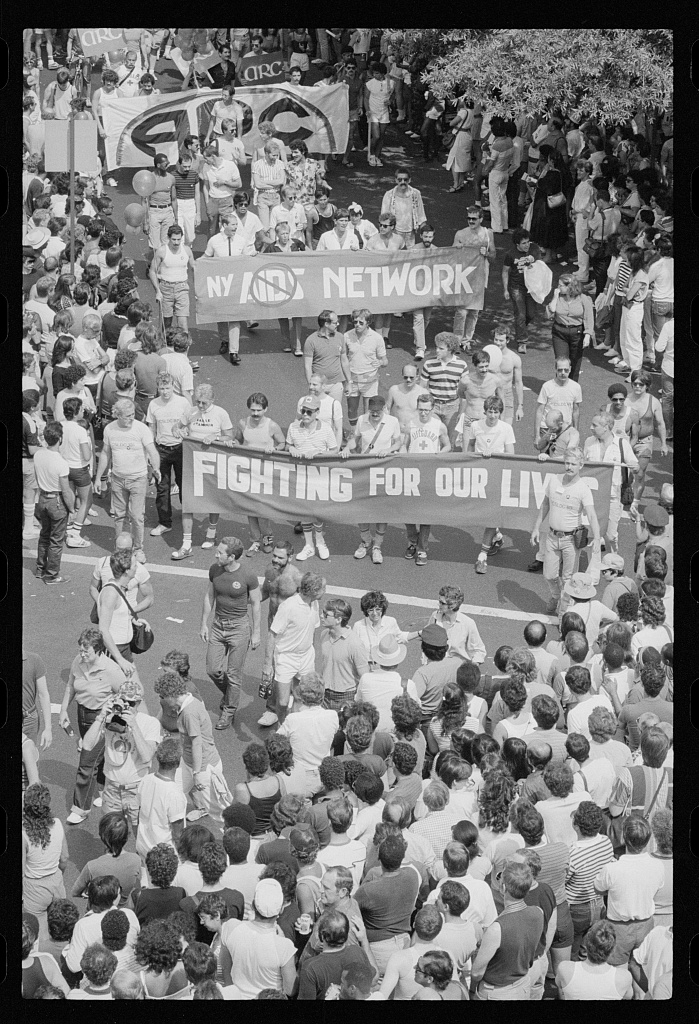
In John T. Bledsoe’s overhead photograph from June 26, 1983, a banner reading “NY AIDS Network” moves down a packed New York street behind another that says “Fighting for Our Lives.” The picture does not offer one face as the epidemic’s explanation. It records a community already organizing inside a crisis whose biological cause had only just been identified and whose infections had been spreading, mostly unseen, for years.[5][6]
Four years later, a very different image took hold. The French Canadian flight attendant Gaétan Dugas was publicly named as “Patient Zero,” supposedly the man who brought AIDS to the United States and stood at the center of its early spread. The story offered a beginning, a villain, and a route map in two words.
The evidence supports none of that origin claim. Dugas was important to an early contact investigation because he was connected to cases in more than one city and gave investigators unusually detailed names. That study helped show that AIDS was consistent with a sexually transmissible infectious agent before researchers had isolated HIV. It did not identify who first carried the virus into the United States. The “zero” began as an O, meaning a case from outside California; the contact diagram recorded reported relationships, not a chain with a proven first link; and viral genomes later showed extensive U.S. HIV diversity years before AIDS was recognized.[1][2][3][4]
The myth is therefore more instructive than a simple factual correction. It shows how a useful index case can be mistaken for a primary case, how a partial network can look like a family tree, and how cooperation with investigators can make one patient appear more causally important than people whose histories remain unknown.
The timeline has no zero point
- June 5, 1981: the CDC published the first report of the syndrome later called AIDS, describing five men in Los Angeles with Pneumocystis pneumonia. By the end of that year, 159 cases of Kaposi sarcoma or life-threatening opportunistic infection had been reported, including illnesses retrospectively dated to 1978.[5]
- June 1982: a CDC report described an unexpected cluster among Los Angeles and Orange County patients. Investigators obtained partner information for 13 of 19 reported cases and found that nine had had sexual contact with another reported case within the preceding five years.[1]
- March 1984: the expanded peer-reviewed study reported 40 linked patients among 90 investigated across ten cities. Its conclusion was that the pattern was consistent with an infectious agent transmitted through sexual contact.[2][5]
- 1987: publicity for Randy Shilts’s And the Band Played On converted Dugas from an unnamed case in a study into the named “Patient Zero” of a national morality tale.[3]
- October 26, 2016: researchers published full or nearly full HIV genomes recovered from archived 1978–79 blood samples, along with Dugas’s genome. They found neither biological nor historical evidence that he was the primary U.S. case.[4]
These dates matter because three different events are often collapsed into one: the virus entered and diversified in a population; clinicians recognized an unusual syndrome; and investigators assembled a contact cluster from the cases available to them. The first happened well before the second. The third was a study of transmission clues among a selected set of recognized illnesses—not a census of everyone already infected.
Myth: the central circle marked the beginning
The 1982 investigation began with a practical question. Between June 1, 1981, and April 12, 1982, the CDC received reports of 19 cases of Kaposi sarcoma and/or Pneumocystis pneumonia among previously healthy gay men in Los Angeles and Orange counties. After hearing that some patients might be connected, investigators interviewed all eight who were still living and friends of seven who had died. A relationship counted only when the other person, or a close friend, substantiated or did not deny it.[1]
The resulting pattern was striking. Seven Los Angeles County patients reported contact with other local patients, while two Orange County patients both reported contact with the same non-Californian man. That nonresident also reported contacts with cases in Los Angeles and New York. The cluster was unlikely to have appeared by chance among so few reported cases, although the CDC editorial note kept a competing explanation visible: shared sexual contacts might be a marker for a narrower lifestyle and some unidentified noninfectious exposure rather than transmission itself.[1]
That is good early epidemiology, not indecision. Investigators had a pattern before they had a virus. The pattern strengthened the infectious hypothesis while leaving an alternative open. By the 1984 expanded report, four southern California patients were linked to the non-Californian patient, who was also linked to four New York City patients. The authors concluded that the cluster was consistent with an infectious cause and helped estimate an incubation interval; they did not call the non-Californian patient the source of AIDS in America.[2]
A circle’s position on a page cannot establish biological priority. Network layouts put a well-connected or bridging case in the middle because that makes relationships readable. They do not prove that infection flowed outward from that circle. In this study the arrows of transmission were especially uncertain: contacts stretched across years, many partners were anonymous or absent from the reported-case set, symptom onset did not equal infection date, and the long asymptomatic period of HIV was not yet understood.[1][2][3]
Evidence: the O described geography
Within the investigation, Dugas was the case from outside California—“Patient O.” Historian Richard McKay’s reconstruction shows that the letter evolved within CDC usage into the numeral “0” before the 1984 journal article printed a zero at the center of its diagram. Investigator William Darrow later stressed that the study was intended to examine transmissibility, never origin. The term nevertheless carried meanings the abbreviation did not: zero suggested a starting point, and “ground zero” suggested an event radiating from one place.[3]
This was not one clean typographical error that instantly invented a myth. It was a chain of small transformations. A geographic label became a spoken number; a number appeared in a memorable diagram; the diagram outlived the study’s caveats; and a journalist recognized the narrative force of “Patient Zero.” Shilts’s book and its publicity then supplied a name, personality, foreignness, mobility, and alleged intent. In October 1987, the New York Post compressed the result into the front-page claim “The Man Who Gave Us AIDS.”[3]
Dugas’s visibility had a less sinister explanation. Diagnosed with Kaposi sarcoma in May 1980, before the syndrome had a settled name or cause, he cooperated with CDC investigators and supplied 72 names from his sexual history—an unusually usable record for contact tracing. That cooperation made more lines attach to his circle. It did not make him the first infected person, and it did not establish the direction of every possible transmission.[3]
The distinction is basic but easy to lose. An index case is the case that brings a person, cluster, or outbreak to an investigator’s attention, or serves as a practical reference inside an inquiry. A primary case is the person who first introduces infection into a defined group. One can be an index case without being primary. In a years-old, geographically dispersed epidemic with incomplete sampling, the primary individual may be unknowable—and may not be a useful public-health object at all.
Myth: an early case must be the source
Dugas was early among the people whose AIDS-related illnesses entered the recognized record. But “early recognized illness” is not “first infection.” HIV can remain clinically silent for years, so a contact diagram built from diagnoses naturally looks downstream from the transmissions it is trying to understand.
The CDC’s later retrospective makes that lag visible. Stored specimens from a San Francisco cohort of about 7,000 gay men showed that when the first few AIDS cases appeared in the cohort in 1981, roughly 30 percent were already infected with HIV. The visible syndrome was the crest of a much larger field of unrecognized infection.[5]
This also explains why the cluster study could be both historically important and genealogically incomplete. In 1982, linking rare illnesses through sexual contact was powerful evidence that exposure moved through a network. Once the incubation period expanded from months to years, however, many unobserved people and contacts could sit between a reported relationship and a later diagnosis. A network could support a mode of transmission without revealing a unique origin or even the direction of a particular edge.[2][3][5]
Evidence: archived blood replaced a culprit with a population history
The strongest biological correction arrived through samples collected before AIDS had been recognized. Michael Worobey and colleagues screened more than 2,000 archived serum samples from 1970s studies and recovered eight coding-complete HIV genomes from New York City and San Francisco samples drawn in 1978–79. The viruses were already genetically diverse. Their analysis supported a pre-existing Caribbean epidemic, a movement of subtype B into New York City around 1970, and later spread from New York to other U.S. locations.[4]
The team also recovered the HIV genome from Dugas’s stored sample. It did not sit at the base of the U.S. viral family tree. It was one branch within existing diversity. In the paper’s careful formulation, there was neither biological nor historical evidence that Dugas was the primary U.S. case or the primary case for subtype B as a whole.[4]
Genomics did not discover the “real Patient Zero.” That would repeat the same conceptual mistake with a more sophisticated instrument. Phylogenetic analysis estimates relationships among sampled viral lineages and reconstructs population movement under stated assumptions. It cannot name an undocumented first individual from an incompletely sampled epidemic. The better result is a history without a single human origin point: a virus circulating across places and networks before surveillance could see the syndrome it produced.
What the myth gets right—and then distorts
The Patient Zero story borrowed its durability from one truth: Dugas mattered to the investigation. His contacts helped connect cases on opposite coasts, and the cluster helped move the infectious hypothesis forward before HIV was isolated. Erasing that contribution would flatten the history in the opposite direction.[1][2][3]
The distortion begins when usefulness becomes blame. Dugas was central partly because he remembered names and spoke with investigators. People with fewer records, anonymous partners, earlier infections, or no recognized illness left fewer lines. Treating the best-documented person as the source rewards missing data with innocence and punishes cooperation with causal prominence.
The myth also turns a population emergency into a character test. McKay shows how the 1987 portrayal made rapidly changing knowledge in 1982–83 look more settled than it was and converted disputed recollections into a posthumous account of deliberate spread. That story then traveled into arguments for HIV criminalization. Correcting the origin claim does not require pretending every choice was harmless; it requires refusing to infer intent, sequence, and responsibility from a diagram that was never designed to prove them.[3]
The Library of Congress photograph offers a better visual grammar. The 1983 march contains networks, but not the kind that reduce to a culprit: people carrying one another’s warnings, grief, demands, and knowledge through public space.[6] By then, residents were fighting for lives while laboratory science and federal surveillance were still assembling the disease’s basic map. A single circle could never contain that history.
“Patient Zero” survives because zero promises a clean beginning. The evidence offers something less cinematic and more useful: an index case is not necessarily a source; a contact is not a proven direction of transmission; recognition is not arrival; and a sampled genome is not the first infection. The right correction is not to move blame to an earlier anonymous person. It is to stop asking a complex epidemic to supply one.
Sources
- Centers for Disease Control and Prevention, “A Cluster of Kaposi’s Sarcoma and Pneumocystis carinii Pneumonia among Homosexual Male Residents of Los Angeles and Orange Counties, California,” MMWR 31, June 1982 — original cluster report, case window, reported contacts, and competing infectious and noninfectious hypotheses.
- David M. Auerbach, William W. Darrow, Harold W. Jaffe, and James W. Curran, “Cluster of Cases of the Acquired Immune Deficiency Syndrome: Patients Linked by Sexual Contact,” American Journal of Medicine 76(3), 1984 — expanded ten-city cluster and the study’s bounded conclusion about an infectious, sexually transmissible cause.
- Richard A. McKay, “‘Patient Zero’: The Absence of a Patient’s View of the Early North American AIDS Epidemic,” Bulletin of the History of Medicine 88(1), 2014 — archival reconstruction of Patient O, the shift to zero, Dugas’s cooperation, the 1987 publicity campaign, and the later blame narrative.
- Michael Worobey et al., “1970s and ‘Patient 0’ HIV-1 Genomes Illuminate Early HIV/AIDS History in North America,” Nature 539, 2016 — archived 1978–79 genomes, Caribbean-to-New York reconstruction, U.S. diversity, and genomic evidence excluding Dugas as a primary case.
- James W. Curran and Harold W. Jaffe, “AIDS: The Early Years and CDC’s Response,” MMWR Supplements 60(4), 2011 — retrospective chronology of surveillance, the national contact study, early transmission evidence, and the San Francisco stored-serum cohort.
- John T. Bledsoe, “Marchers, Some Holding Banners Reading ‘Fighting for Our Lives’ and ‘NY AIDS Network,’” June 26, 1983, U.S. News & World Report Magazine Photograph Collection, Library of Congress — catalog record and archival photograph used for the article image.