On March 10, 1930, Cincinnati General Hospital admitted a man whose feet and wrists were failing. The day before, press dispatches had reported a strange leg paralysis in Oklahoma City among people who drank fluidextract of Jamaica ginger, popularly called “Jake.” Within days, Cincinnati patients were arriving with the diagnosis already on their lips. By the end of May, the hospital had admitted 316 cases.[2]
The bottle made the event look simpler than it was. Jake contained enough alcohol to serve as a Prohibition workaround, and the association between drinking it and paralysis emerged quickly. But Jamaica ginger had been sold for decades. Many patients had consumed it for years without losing control of their feet. The implicated dose was often gone seven to fourteen days before weakness began. Labels did not reliably identify what was inside, and shame made exposure histories difficult to obtain.[1][2]
The sharp question was therefore not merely, “Did these patients drink Jake?” It was: what had changed inside certain bottles, and how could investigators prove that a delayed, mostly nonfatal disability came from one adulterant rather than from alcohol, infection, or ginger itself? The answer required four evidence chains to meet—bedside pattern, patient history, chemical analysis, and an experimentally reproduced delay.
February 25–March 28: a point-source epidemic with a slow fuse
Cincinnati's first recorded onset was February 25. Cases then accumulated rapidly and stopped just as sharply on March 28. That curve did not resemble a contagious disease generating successive waves. Nor did the clinical pattern look like ordinary alcoholic neuropathy or epidemic poliomyelitis. The weakness was strikingly symmetrical. It began as foot drop, often advanced to wrist drop, and could leave people unable to walk, feed themselves, or use their hands, while objective sensory loss was limited.[2]
The distinction mattered immediately. With a new paralytic illness arriving at five to ten cases a day and more than 250 admissions, Cincinnati General had to decide whether to isolate patients as infectious. The investigators later called their noncontagious judgment “somewhat of a gamble.” They based it on the lack of meaningful contact patterns or secondary cases, the age and sex distribution, the symmetry of the paralysis, and negative laboratory work. Subsequent pathology supported a toxic injury rather than an infection.[2]
This was the first control decision, made before the poison had a name. Event reconstruction can make discovery look linear because the final answer organizes all earlier clues. In real time, hospital beds, nursing arrangements, and public warnings could not wait for a completed toxicology paper.
The medicine label concealed a beverage market
Jamaica ginger was sold in pharmacies as a digestive aid and carminative. A standard preparation was intensely pungent and roughly 70 percent alcohol; people commonly diluted a two-ounce bottle with a soft drink. During Prohibition, the official U.S. Pharmacopeia preparation remained legally marketable because its ginger solids made it ostensibly nonpotable. Illicit manufacturers could reduce the harsh oleoresin and substitute cheaper material while still presenting the bottle as the official extract.[1]
That hybrid identity shaped the disaster. Jake was medicine on the label, alcohol in practice, and an adulterated industrial product in the toxic lots. Each identity pointed investigators toward a different system: food-and-drug law, Prohibition enforcement, pharmacy distribution, clinical medicine, or bootlegging. No single agency naturally owned the whole chain.
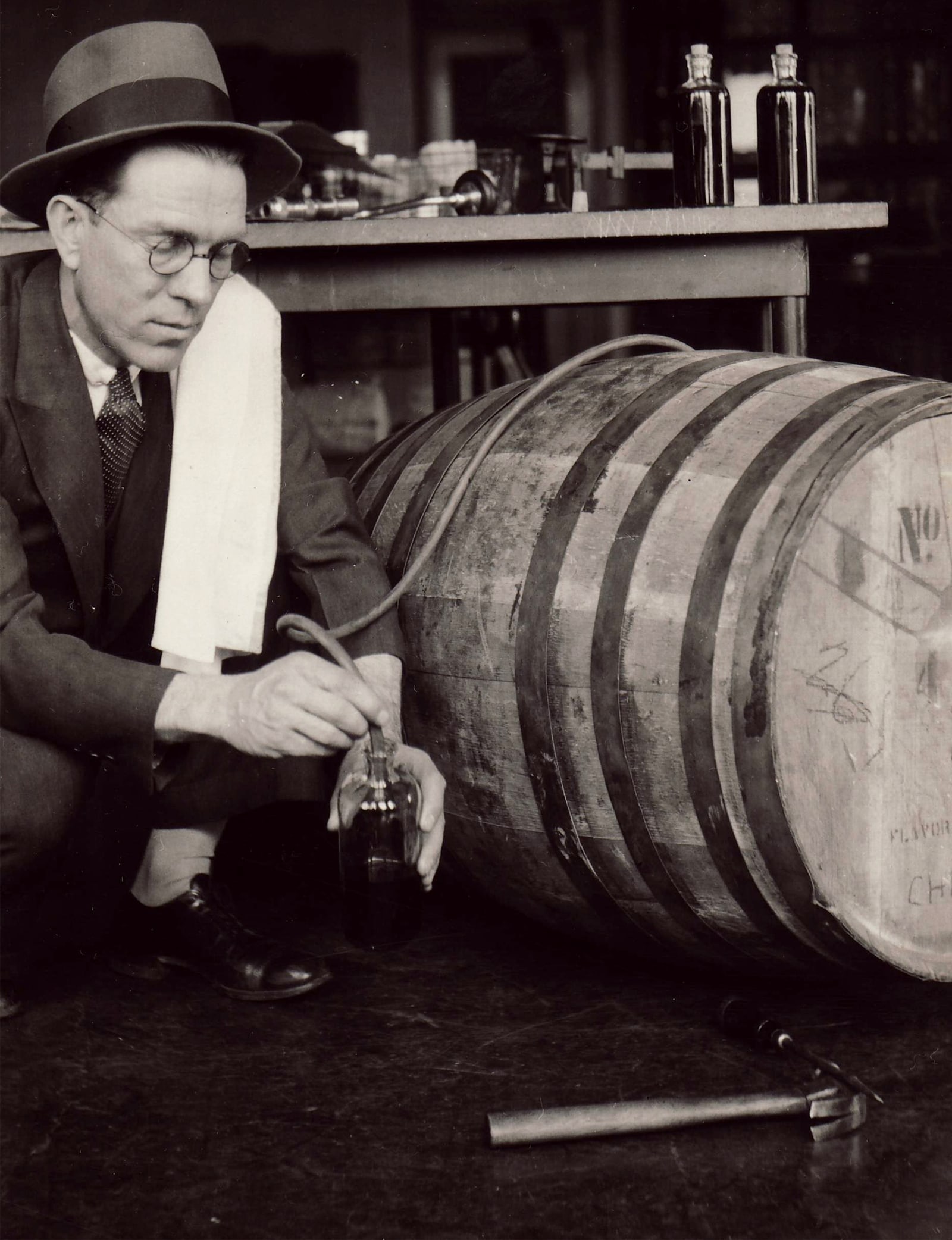
The FDA archival photograph used here records the evidentiary work this hybrid market demanded: an investigator draws a sample from a wooden barrel while retail bottles stand on the bench behind him. The archive identifies the material as tainted Jamaica ginger in wholesale and retail containers; the photograph appeared on a Boston Post page dated April 2, 1932, although its original exposure date is not supplied.[9] The scene makes the relevant unit visible. A medicine label was not enough; investigators had to connect bulk material, individual bottles, and patients.
Patient histories pointed backward through stigma
Cincinnati investigators interviewed 117 patients in detail. At first, 107 reported Jamaica ginger among their beverages and ten did not. Over time, most denials changed; the investigators ultimately judged that all but one had used Jake, and doubted the remaining denial. More important than that near-unanimity was the temporal comparison: many patients had drunk Jamaica ginger for up to a decade, yet the syndrome appeared only after bottles sold in late February and early March.[2]
The histories were imperfect evidence. Most people drank repeatedly, sometimes through the onset of weakness, so a precise dose-to-symptom interval was hard to recover. In the smaller set with an isolated exposure, reports ranged from 13 hours to six weeks; the investigators considered seven to fourteen days the best approximation. Labels were also unstable. Dealers refilled bottles, and one bulk shipment could appear under several brand names.[2]
Shame was not background noise. Patients knew that admitting to Jake meant admitting to illicit drinking, and contemporary clinicians often described them in openly contemptuous class terms. That could produce denial, delayed care, and incomplete case counts. The investigators still found a strong exposure pattern, but the record should not be mistaken for a neutral census. It was built from people asked to confess a criminalized and stigmatized behavior while newly disabled.
Thirteen recovered samples became the causal bridge
The decisive material evidence was hard to retrieve because the relevant two-ounce bottles were usually empty. Public Health Service historian John Parascandola later found that investigators assembled 13 samples, some seized from distributors and some linked directly to patients. A few discarded bottles were recovered from outdoor toilets. Patient-linked contents mattered most: a suspicious barrel alone could establish contamination, but not that the same contamination preceded a particular person's illness.[1]
On July 25, 1930, Maurice Smith, Elias Elvove, and Prohibition Bureau chemists published a preliminary report. The offending samples behaved unlike normal ginger or alcohol. Chemical work pointed to a phenolic compound bound to phosphoric acid, and dosing experiments showed that material from implicated ginger produced delayed toxicity. The team had narrowed the class of poison but had not yet securely identified the exact member.[3]
The second report, published October 17, made the match. Chemical fractionation indicated roughly 2 percent tricresyl phosphate in the studied paralytic ginger. Comparisons among related compounds isolated the ortho isomer—tri-ortho-cresyl phosphate, or TOCP—as the distinctive motor poison. Calves developed a delayed “hoof drop”; chickens given sufficient TOCP developed lameness and then leg paralysis after a latent interval. A fraction isolated from suspected ginger reproduced the same pattern.[4]
Animal experiments from 1930 do not meet modern ethical or methodological standards, and species responded differently. Their evidentiary role was nevertheless specific: they joined the chemical found in implicated samples to the unusual clinical signature and, crucially, reproduced the delay. Epidemiology supplied association, analytical chemistry supplied identity, and pharmacology supplied a matching temporal phenotype.
The delay was part of the mechanism, not missing evidence
Modern toxicology classifies Jake leg as organophosphorus compound-induced delayed neurotoxicity. TOCP is metabolically activated to a compound that inhibits and “ages” neuropathy target esterase, now known as NTE/PNPLA6. What follows is a distal degeneration of long axons in the peripheral and central nervous systems; the complete downstream sequence remains an active mechanistic question.[6]
That is not the familiar acute organophosphate picture of immediate cholinergic collapse. The exposed person could finish the bottle, discard it, and feel no defining neurological sign for days. By the time toes dragged and feet slapped the ground, the product might have moved through several wholesalers or been sold under another label. The latency was not a gap around the evidence. It was a property investigators had to build into the exposure window.
Early physicians called the syndrome a peripheral neuritis because foot and wrist drop dominated the bedside picture. A 1978 follow-up of 11 survivors in eastern Tennessee found spasticity and abnormal reflexes consistent with an upper motor-neuron syndrome decades later. The later examination did not erase the original observations; it showed that the injury extended beyond the simple peripheral label first placed on it.[7]
Control succeeded once—and mixed lots nearly hid the recurrence
Cincinnati confiscated the suspected shipment, restricted Jamaica-ginger sales to prescription, and publicized the danger. The abrupt end of onset after March 28 strengthened the exposure argument while stopping new cases.[2] But control was incomplete. Poisoned stock continued to circulate, and a second outbreak appeared in Southern California around January 1931.[5]
That recurrence exposed a subtle sampling failure. Los Angeles officials sent dozens of bottles bearing the same Superior label. Researchers initially pooled about two dozen and found only possible traces of the poison. When they returned to individual bottles, some contained about 0.25 or 0.5 percent tricresyl phosphate while others contained none; pooling had diluted the signal. Shipment dates, pharmacy sales, individual assays, and cases in Whittier and Sawtelle then reconstructed a roughly 125-case outbreak. Early recognition and recall brought it under control by February.[5]
The lesson was not simply “test the bottle.” It was test the right unit. A brand was not a batch, and a pooled sample could average a dangerous minority of bottles into apparent safety. Distribution evidence had to determine which containers belonged together before laboratory evidence could answer the exposure question.
A mass disability that resisted an exact count
The national total remains uncertain. A modern review notes 4,837 officially reported cases, a contemporary Prohibition Bureau estimate of at least 20,000, and later figures as high as 50,000. Those are not interchangeable measurements, and the highest number should not be repeated as a settled count. Underreporting is plausible because many people were poor, drinking was criminalized, some cases were treated outside hospitals, and the illness was usually disabling rather than fatal.[6]
Survivors formed the United Victims of Ginger Paralysis Association, which claimed 35,000 members. At least a dozen rural Southern recordings referred to Jake or its effects. Morgan and Tulloss's study of those songs found not only documentation but mockery: some performances framed the gait as a drinker's deserved punishment.[1][8] A distinctive “Jake walk” made disability culturally visible while blame made its victims politically easier to neglect.
The legal result was correspondingly narrow. Investigators traced much of the poisoned product to Hub Products in Boston. Harry Gross and Max Reisman were initially fined $1,000 each and received suspended two-year prison sentences; after further FDA investigation, Gross was ordered in 1932 to serve his term. Under the 1906 law, the central food-and-drug charge concerned selling a product that differed from the U.S. Pharmacopeia standard—not placing an untested toxic additive on the market as such. Jake leg became one argument for stronger law, but the 1937 Elixir Sulfanilamide deaths supplied the more immediate political force behind the 1938 Food, Drug, and Cosmetic Act.[1]
Jake leg was solved neither by one brilliant assay nor by the label on one bottle. Clinicians recognized a symmetrical syndrome. Patient histories placed exposure weeks earlier. Local controls interrupted sales. Chemists separated a suspect fraction. Animal studies reproduced the delay and motor pattern. Shipment tracing connected variable bottles to particular communities. Each chain corrected a weakness in the others.
That is why the episode still matters. In a delayed toxic outbreak, the first symptom may arrive after the physical evidence has been thrown away, the commercial trail has branched, and the exposed person has reasons not to tell the whole story. Reconstruction must reach backward farther than memory comfortably goes—and must treat latency, stigma, and batch variation as parts of the causal system rather than inconveniences around it.
Sources
- John Parascandola, “The Public Health Service and Jamaica Ginger Paralysis in the 1930s,” Public Health Reports 110(3), 1995 — product context, sample recovery, interagency investigation, legal aftermath, victim organization, and music.
- Charles E. Kiely, Murray L. Rich, T. J. LeBlanc, W. E. Brown, and colleagues, “An Epidemic of Motor Neuritis in Cincinnati, Ohio, Due to Drinking Adulterated Jamaica Ginger,” Public Health Reports 47(42), October 14, 1932 — clinical course, case timing, exposure interviews, control measures, pathology, and follow-up.
- Maurice I. Smith, Elias Elvove, P. J. Valaer Jr., William H. Frazier, and G. E. Mallory, “Pharmacological and Chemical Studies of the Cause of So-Called Ginger Paralysis: A Preliminary Report,” Public Health Reports 45(30), July 25, 1930 — the first laboratory narrowing of the toxic factor.
- Maurice I. Smith, Elias Elvove, and William H. Frazier, “The Pharmacological Action of Certain Phenol Esters, with Special Reference to the Etiology of So-Called Ginger Paralysis,” Public Health Reports 45(42), October 17, 1930 — TOCP identification, chemical fractionation, dose-delay experiments, and species comparisons.
- Maurice I. Smith and Elias Elvove, “The Epidemic of So-Called Ginger Paralysis in Southern California in 1930–31,” Public Health Reports 46(21), May 22, 1931 — recurrence timeline, shipment tracing, mixed bottle results, pooling error, and local control.
- Rudy J. Richardson and John K. Fink, “Neuropathy Target Esterase (NTE/PNPLA6) and Organophosphorus Compound-Induced Delayed Neurotoxicity,” Advances in Neurotoxicology 4, 2020 — modern mechanism, axonal injury, and the uncertainty around national Jake-leg case counts.
- John P. Morgan and Paul Penovich, “Jamaica Ginger Paralysis: Forty-Seven-Year Follow-up,” Archives of Neurology 35(8), 1978 — long-term examination of survivors and evidence of upper motor-neuron involvement.
- John P. Morgan and Thomas C. Tulloss, “The Jake Walk Blues: A Toxicologic Tragedy Mirrored in American Popular Music,” Annals of Internal Medicine 85(6), 1976 — clinical summary and analysis of twelve recordings that documented and stigmatized the epidemic.
- U.S. Food and Drug Administration, “Sampling ‘Ginger Jake’” (FDA 186), reproduced via Wikimedia Commons — public-domain archival image and catalogue description of tainted wholesale and retail containers being sampled by an investigator.