At Oregon State Hospital in Salem, a reunion was designed to leave a hole. Under the memorial's original process, when cremated remains were returned to a family, their ceramic urn left the columbarium wall. A hollow brass tube took its place. Light and air passed through the opening, so the wall became more permeable as fewer people remained in state custody.[1]
That mechanism has now reached a material limit. Oregon Health Authority's current unclaimed-cremains page says the hospital can no longer remove remains from the memorial because of structural-integrity concerns. Relatives may request a rubbing of a person's name medallion, but physical return is no longer available.[7] The change gives the memorial a sharper question: what remains of a promise of return when recognition can continue but transfer cannot?
The latest dated handoff report, from September 2025, said 1,300 people's remains had been identified and returned from an original population the state describes as nearly 3,500; 116 families were recognized in that year's ceremony alone.[6] The current notice supersedes the report's description of physical handoff, but it does not say when removal stopped.[7] The evidence establishes the sequence, not the precise change date.
This is why the site belongs to health history rather than only funerary history. The people memorialized there died while living or working at Oregon State Hospital and several other Oregon institutions. Their afterlives were shaped by the same systems that had shaped their care: admission records, privacy rules, public budgets, family distance, stigma, institutional architecture, and the state's capacity to remember a name after a patient was no longer alive.
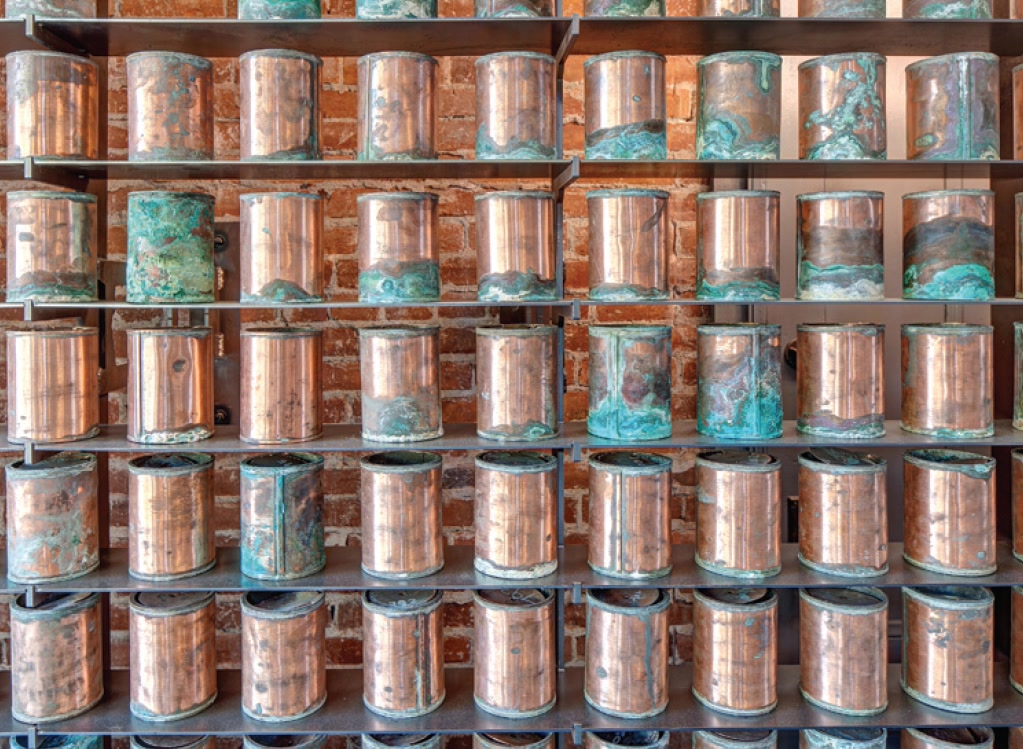
Image context: the cover photograph looks directly at the rows of original copper canisters inside the memorial. Their turquoise corrosion is not decorative patina invented for an artwork. It is physical evidence of where and how the canisters were stored before the ashes were transferred to new ceramic vessels.[1][2]
In 1913, burial became an administrative system
Oregon State Hospital opened in 1883, and an asylum cemetery soon became the last resting place for patients whose relatives did not take their bodies home. Burial at the hospital was a last option, not the fate of every person who died there. As the institution grew, however, the cemetery became difficult to maintain.[2]
In 1913, the Oregon legislature passed Senate Bill 109. The law established a crematorium at the asylum, required cremation when a body from a state institution remained unclaimed after relatives had been notified, and ordered the graves in the asylum cemetery exhumed. Hospital staff later made individual copper canisters for the ashes. The system eventually received remains not only from the state hospital but from the Oregon State Tuberculosis Hospital, Fairview Training Center, the state penitentiary, and other institutions.[1][2]
The canister solved one problem: it kept a person's cremated remains in a distinct container. It did not solve identity, communication, or durable custody. A name in a ledger could become detached from living family knowledge. A container could be moved without the person ever leaving the institution's administrative world.
That distinction matters. Unclaimed describes what happened to remains at a particular moment; it does not prove that a person was unloved, deliberately abandoned, or forgotten by everyone who knew them. The surviving record is too incomplete for that verdict.
The first memorial failed as storage
Beginning in 1976, the copper canisters were moved from a basement room into Memorial Circle, where underground vaults sat beneath a flower garden. They were numbered, relocated, and rededicated in a 1984 ceremony. It looked like a final resting place. Then the vaults leaked. Groundwater reached the copper, the containers corroded, and the remains had to be moved indoors again.[2]
A 2004 hospital tour that included Oregon Senate President Peter Courtney brought renewed official attention to the rows of canisters; reporting in 2005 made their condition a public indictment of the hospital. Courtney called the storage space the "Room of Forgotten Souls." The phrase was effective because it joined the physical neglect of the urns to the history of people with mental illness being kept out of public sight.[1][5]
But the canisters should not be reduced to a horror image. Corrosion can show that a custody system failed. It cannot tell the life inside any one file, explain why no relative completed a claim, or stand in for the person whose ashes it held. The memorial's harder task was therefore to keep the damaged objects visible without allowing their strange beauty to replace the people.
The 2014 memorial separates evidence from custody
In 2007, the Oregon legislature authorized the release of patients' names for reunification and memorial purposes, creating an exception to the privacy barriers that had kept the list from public use. In 2011, artists Annie Han and Daniel Mihalyo of Lead Pencil Studio were selected to design a permanent memorial. It was dedicated on July 7, 2014.[1][2]
Their design separates three jobs that earlier storage had blurred together.
First, the cremated remains were transferred into handmade ceramic urns and placed in a weathering-steel columbarium. Each niche bears a number, a name when known, and birth and death years when available. This is the resting place.[1]
Second, the empty copper canisters remain visible in a restored 1896 brick structure that once served as a pestilence house and morgue. They are artifacts of the institution's custodial history. Their emptiness is important: visitors can confront the material record without confusing the display with the present location of the ashes.[1]
Third, the memorial was designed to remain operational. Under the original process, a family could receive the ceramic urn, the original copper canister, and a rubbing of the person's inscription. The replacement brass tube marked an absence that was not another loss. It recorded a return.[1][6]
This was commemoration as procedure. The building did not merely say that people once disappeared into an institution. Its directory, records, staff, volunteers, claim process, and removable urns made it possible for someone to leave. The current structural restriction breaks the last link in that chain without erasing the links that still work.[7]
A name must remain searchable to become a return
Architecture alone cannot find a family. Public records and patient files have to preserve enough links among names, dates, places, and relationships for research to move backward from an urn to living descendants.
The Oregon State Archives says its hospital holdings include admission, commitment, discharge, death, cremains, and patient case-file records. For a patient who is deceased and whose record is more than 25 years old, a file may be released after review and verification of death. Researchers are asked to provide whatever identifiers they know, including names used, patient number, birth date, admission or discharge date, death date, and county of residence.[3] The list may be public, but the reconstruction is still careful record work rather than a frictionless name search.
Volunteer genealogist Phyllis Zegers has supplied much of the human bridge. Independent reporting in 2021 described her tracing census files, family trees, and descendants, then contacting relatives who often had no idea that someone in their family had died at the hospital.[5] Oregon State Hospital's 2024 account shows why the work requires humility. Relatives of Sarah Ellen Oldham found a family letter that had asked about her after she died, yet no surviving record explains why her ashes were not claimed. The letter defeats the easy conclusion that silence at the hospital meant silence in the family.[4]
The same uncertainty surrounds many entries. Poverty, distance, broken communication, shame, estrangement, death of the contact person, or simple administrative failure may all be plausible in an individual case. Unless a record supports one of them, they remain possibilities, not explanations. A responsible memorial restores names without inventing motives for the people who were absent.
Recognition and return are no longer the same
The hospital's current page still publishes an alphabetical directory of the people whose remains are in its custody. It warns that names may appear under different spellings because the database was assembled from multiple archival sources, many handwritten. It also gives relatives an email address for requesting a name rubbing.[7] Search, verification, contact, and a tangible acknowledgment therefore remain possible.
A rubbing is meaningful, but it is not the same act as returning remains. It can carry a name into a family home; it cannot transfer physical custody. The distinction matters precisely because the original design joined those acts so elegantly. Identification led to handoff, handoff removed an urn, and the new brass opening made the return publicly visible.[1]
The current notice gives structural integrity as the reason removal stopped but publishes no engineering diagnosis, repair plan, or timetable.[7] It would be speculation to say whether the constraint is temporary, reversible, or the result of a new failure. What can be said is narrower: preserving the memorial's structure and releasing the urns have come into conflict, and the physical choice once available to families is no longer available.
The right measure is not an empty wall
Even under the original design, some remains could stay because no relative was found or because a family chose the memorial as the right resting place. Its purpose was never to achieve an empty wall at any cost, and a physical claim was never the only valid proof that a person had been remembered.[1]
But those outcomes should not be blurred with a third: a family identifies a relative and wants a transfer that the structure cannot now permit. A responsible account has to keep lack of identification, a family's choice, and an institutional constraint separate.
The better measure is whether custody remains accountable. Can a person be found by name? Can the institutional trail be examined? Can a family learn what the evidence does and does not establish? Is the limit on return stated plainly? Will the hospital keep the directory, records, remains, and relatives' contact route usable while that limit persists?[1][3][7]
Oregon State Hospital's memorial now holds three kinds of evidence. The corroded copper canisters record the failures of earlier storage. The brass openings record completed returns. The urns that can no longer be removed expose a present boundary between commemoration and restitution.
The wall was built around the idea that memory is not possession. Precisely because the state continues to possess the remaining ashes, its work now includes candor about the difference between naming a person, honoring a person, and returning that person to family.
Sources
- Oregon Health Authority, "Oregon State Hospital Memorial" — official history, memorial design, canister photography, columbarium process, and artists' statement.
- Oregon State Hospital Museum of Mental Health, "OSH Cremains Memorial Project Public Meeting to Be Held August 18 in Salem" (2011) — institutional history of the asylum cemetery, the 1913 cremation law, Memorial Circle, storage failures, and the 2007 name-release authorization.
- Oregon Secretary of State Archives, "Oregon State Hospital Records" — current description of patient, death, and cremains holdings and the review process for deceased-patient records.
- Oregon State Hospital, Recovery Times (October 1, 2024) — account of annual reunifications, Phyllis Zegers's research, Sarah Ellen Oldham's family record, and the claim process.
- Angela Decker, "Oregon State Hospital finds family for its once-forgotten dead," Jefferson Public Radio (November 23, 2021) — independent reporting on the 2004 discovery, public response, and genealogical reunification work.
- Oregon Health Authority, "Oregon State Hospital ceremony celebrates the reunification of 116 families with historical cremains" (September 23, 2025) — latest dated return totals and the physical handoff process then in use.
- Oregon Health Authority, "Honoring the Past — List of Unclaimed Cremains" (accessed August 9, 2026) — current directory, spelling caveat, name-rubbing contact, and notice that structural-integrity concerns now prevent removal of remains.