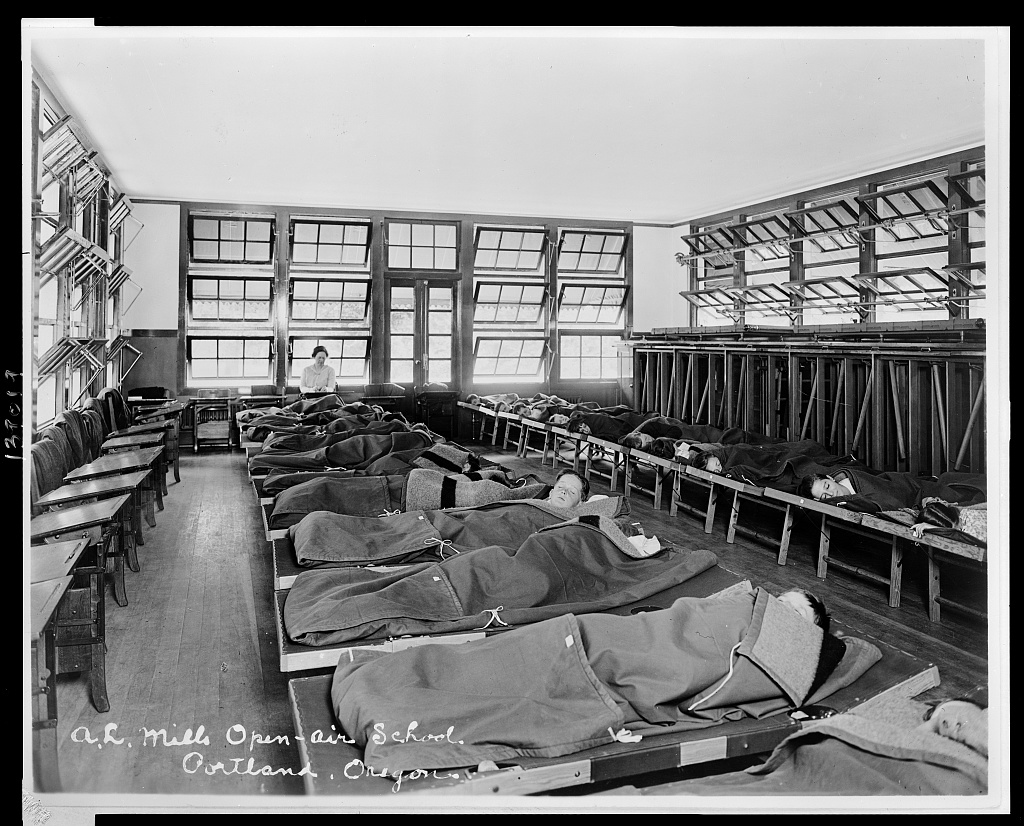
The windows dominate the photograph. Along two walls of Portland's A.L. Mills Open-Air School, they tilt outward in ranks, turning a classroom into something closer to a sheltered veranda. But look below them. Children lie in ordered rows under heavy blankets. Cots replace desks. An adult watches from the back of the room. The image, made sometime between 1917 and 1925, does not show fresh air acting alone. It shows a rest period being administered.[7]
That distinction corrects the most persistent myth about the open-air school movement. These schools are often remembered as an era when doctors believed a cold breeze could cure tuberculosis. Air mattered: reformers were reacting to crowded, overheated rooms and to a disease that spreads through the air. Yet their actual intervention was much larger. It combined ventilation and sunlight with meals, sleep, warm clothing, smaller classes, medical examinations, nursing follow-up, hygiene, transport, and altered schoolwork.[1][2]
Many pupils gained weight, attended more regularly, or returned to ordinary classes. The historical record supports those observations. It does not show that an open window caused the gains. Most early reports followed selected children before and after a bundled program, used loose diagnostic categories, and lacked a contemporaneous comparison capable of separating the breeze from the breakfast, the nurse, or the nap.[1][2][4]
The honest legacy is therefore neither miracle nor folly. Open-air schools made the building part of health care, but their most durable innovation was to make the school answer for conditions outside the lesson.
Myth: the movement began with a missing wall
The first widely copied model opened at Charlottenburg, outside Berlin, in 1904. Leonard P. Ayres's 1910 survey described its purpose as keeping physically debilitated children in education while giving them a sanatorium-like regimen. England opened an open-air school in 1907. On January 27, 1908, Providence, Rhode Island, opened the first U.S. example in a disused brick schoolhouse whose south wall had been replaced by windows that could be raised toward the ceiling.[1][3][5]
The architecture was dramatic, but admission rules reveal what the institution actually was. Providence began with ten pupils and later held no more than twenty-five. Its children were six to thirteen years old and were selected because they were sickly, anemic, undernourished, exposed to tuberculosis, or showing early signs of disease while falling behind at school.[1][3] Charlottenburg excluded children with acute or infectious illnesses; Providence did not admit “open” cases or pupils with a persistently raised temperature. Other cities created separate hospital or sanatorium classes for children considered actively contagious.[1][2]
Those categories should not be translated too neatly into modern diagnoses. “Pretuberculous,” “tuberculosis-threatened,” “delicate,” and “below par” mixed suspected infection with thinness, fatigue, poverty, exposure at home, and poor school performance. International programs classified and housed such children differently, which is evidence that the category was partly medical and partly administrative.[2][5]
The open-air school was thus not simply an outdoor classroom for pupils with confirmed tuberculosis. It was a protected school day for children whom ordinary schools, families, clinics, and compulsory-attendance rules were failing to fit into one system.
Evidence: the breeze arrived with soup, blankets, and a shorter lesson
Ayres's account of Charlottenburg lists the treatment before it reports the windows: outdoor life, ample food, strict cleanliness, suitable clothing, and schoolwork reduced in both amount and intensity. Classes were capped at twenty-five. A physician examined pupils, a trained nurse assisted, and the timetable included baths, exercise, frequent meals, and two hours of rest after dinner.[1]
Providence adapted the bundle to a city schoolhouse. A cylinder stove tempered the room without closing it. Children used blanket bags, felt shoes, and soapstone foot-warmers. At midmorning they received hot soup; lunch added milk-based cocoa and a hot pudding to whatever food they brought. The local tuberculosis league paid for meals and streetcar fares, while a woman physician observed the class. Handwashing, tooth cleaning, gardening, and light exercise sat inside the same program.[1]
By 1917, a U.S. Bureau of Education bulletin stated the theory with unusual clarity: the school's value came from the combination of fresh air, nourishment, and a freer alternation of work and rest. Its chapters then widened the system further—kitchens, clothing, medical records, dental defects, home visits, family income, sleeping arrangements, and nursing service all counted as open-air-school work.[2]
The federal survey compiled social and economic information from 886 families across 15 cities. Its investigators found crowded homes, low incomes, undernutrition, decayed teeth, adenoids, and household tuberculosis alongside the conditions that had put children in special classes. The same report acknowledged incomplete answers and said reliable comparison with ordinary-school records was generally impossible.[2]
That is the central causal clue. When a program changes the room, food, rest, class size, clinical attention, transport, clothing, and sometimes the home at once, “fresh air” is its most visible feature—not an isolated treatment.
What the early gains proved—and what they could not
The Providence report for the 1908–09 school year followed twenty-eight enrolled pupils. It said all but one improved markedly and recorded an average weight gain of five pounds. Those are real observations, and they matter: a child who eats, rests, learns, and becomes strong enough to return to an ordinary class has experienced a meaningful benefit.[1]
But weight gain is not a mechanism test. Children were chosen because they were unwell or underweight, were growing with age, and then received extra food and attention. There was no comparable group assigned to the same meals, rest, clothing, transport, and nursing in a conventional room. The result cannot say how much of the five pounds belonged to air.
The larger federal bulletin makes the same problem visible at scale. Its one-year table compiled physical outcomes for 1,218 children, while its educational section compared 151 Chicago pupils with their own marks from the preceding year. Average marks rose from 74.43 to 84.54, but the school year changed, and the report did not show that class arrangement, health care, or the rest of the regimen had been held constant. The design showed that children could continue learning inside a health program; it did not identify which ingredient raised a grade.[2]
The evidence also relied on endpoints whose meanings shifted. “Improved appearance,” “general tone,” hemoglobin readings taken with period instruments, attendance, weight, and the word “cured” were sometimes placed beside one another as if they measured the same thing.[1][2] A later nursing-history review found positive early reports but conflicting student-outcome studies, including inconsistent academic results, and placed the closure of many programs between 1938 and 1941.[4]
This does not turn every favorable report into an illusion. It narrows the claim. Open-air schools demonstrated the feasibility of combining education with sustained care for children who had been excluded or poorly served. They did not demonstrate that wind was medicine.
Counter-myth: because the evidence was weak, air was irrelevant
The opposite simplification is no better. Tuberculosis spreads through the air, especially in enclosed spaces with poor circulation. Current World Health Organization guidance still treats well-ventilated spaces as one component of infection control in institutions.[6] Reformers who challenged sealed, crowded rooms were acting on a real environmental pathway even if their outcome reports could not measure ventilation's independent contribution.
The boundary is treatment. WHO now distinguishes ventilation and respiratory precautions from diagnosis, preventive treatment, and multidrug antibiotic therapy for tuberculosis disease. Air movement can reduce the chance that infectious particles accumulate; it does not clear Mycobacterium tuberculosis from a person's body.[6] A modern reader should therefore resist turning an archival classroom into either a prescription or a joke.
Two interpretations remain. The heroic version says exposure to outdoor air cured fragile children. The stronger version says an open-air setting was one part of a school-based welfare and infection-control package whose observed benefits cannot be assigned to a single component. A well-matched comparison that held food, rest, staffing, and medical care constant while varying ventilation would change that assessment. The cited historical record does not provide one.[1][2][4]
The institution hidden inside the photograph
Open-air schools eventually lost their special administrative category, but several of their questions became ordinary public-school questions. Who notices the child who cannot keep up because of illness? Who records weight, vision, hearing, teeth, attendance, or exposure at home? Who provides a meal, follows up with a family, adapts a timetable, or prevents a health condition from becoming an educational exit?[2][4]
The movement did not answer those questions equitably or with modern diagnostic precision. Its labels could turn poverty into bodily deficiency, and its reformers often spoke about families in paternalistic terms.[2][5] Still, the daily design recognized something the “fresh air cure” story obscures: a room cannot be separated from the food, time, labor, and household circumstances that a child brings into it.
Return to the Portland photograph. The windows are open, but the cots occupy the floor. Blankets make cold air tolerable. An adult remains in the room while children sleep during the school day. The visual lesson is not that air cured tuberculosis. It is that ventilation became consequential because an institution reorganized everything around it.
Fresh air was real. The intervention was the school.
Sources
- Leonard P. Ayres, Open-Air Schools (Doubleday, Page & Co., 1910) — public-domain Library of Congress scan documenting Charlottenburg, Providence, program components, and early outcome claims.
- Sherman C. Kingsley and F. B. Dresslar, Open-Air Schools, U.S. Bureau of Education Bulletin No. 23 (Government Printing Office, 1917) — federal report on facilities, food, family conditions, health supervision, records, and outcome limitations.
- Richard A. Meckel, “Open-Air Schools and the Tuberculous Child in Early 20th-Century America,” Archives of Pediatrics & Adolescent Medicine 150(1), 1996 — historical reconstruction of the Providence school and its selected pupils.
- Diane M. Fesler, “Open-Air Schools,” The Journal of School Nursing 16(3), 2000 — review of the bundled regimen, conflicting outcomes, nursing roles, and program closures.
- Aina Schiøtz, “'Tuberculosis-threatened Children': The Rise and Fall of a Medical Concept in Norway, c.1900–1960,” Medical History 52(3), 2008 — open-access comparative history of the risk category and international institutional models.
- World Health Organization, “Tuberculosis” fact sheet (March 24, 2026) — current boundaries among airborne prevention, testing, preventive treatment, and antibiotic therapy.
- Library of Congress, “A.L. Mills Open-Air School, Portland, Oregon” — catalog record for the Columbia Commercial Studio photograph of children resting on cots between 1917 and 1925.