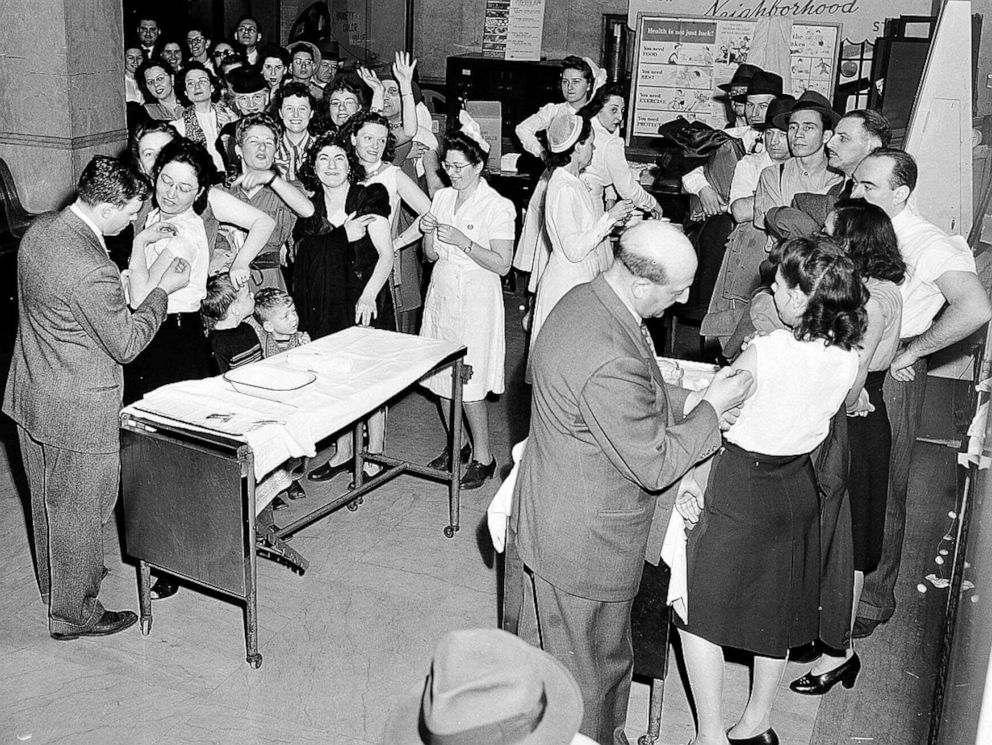
Tony Camerano's photograph records the public face of New York's smallpox emergency on April 14, 1947: people crowding a Health Department room for vaccination. Doctors work at the front while adults and children wait behind them.[8] The less photographable work was reconstructing where a handful of patients had been.
The question behind the queues is how those two operations fitted together. A city can mobilize impressively while leaving uncertainty about which intervention interrupted transmission. New York's surviving records let us follow the response without turning its outcome into proof that every part was equally necessary.
March: the diagnosis came after the journey
Eugene Le Bar arrived in New York from Mexico on March 1, 1947, already ill. He entered Bellevue on March 5 and was transferred to Willard Parker Hospital on March 8. Smallpox was considered but rejected: his rash was atypical, he had a vaccination scar, and he reported no exposure. He died on March 10 with his illness still misidentified.[2]
Other patients who had shared the hospital subsequently developed suspicious rashes. Their illness prompted laboratory investigation and a reexamination of Le Bar's tissue. Health Commissioner Israel Weinstein's account dates telephone confirmation of one secondary case to April 4. It describes vaccination of hospital staff and patients as soon as smallpox was suspected, followed by searches for contacts and hotel guests.[2]
Recognition therefore changed the meaning of an existing itinerary. A hospital admission became an exposure; a discharge became a possible route into another institution. Investigators had to work backward through movements already completed while trying to prevent the next infection.
April 5: reassurance and urgency shared a message
The next day's New York Times reported three cases. Weinstein judged the chance of an epidemic slight but urged people who had not been vaccinated since childhood to receive another vaccination. The article described free provision through health stations and municipal hospital clinics, alongside a search for contacts both inside and outside the city.[3]
Read at its original date, the report contains two audiences. Residents were being asked to act on a general precaution. Investigators were pursuing particular people whose histories gave them a more specific reason to act. The newspaper even placed the search beyond New York under its own subheading.[3]
That distinction matters when judging the campaign afterward. A public announcement must be broad enough to reach people officials cannot yet identify. A contact investigation becomes useful by narrowing attention. Both can be reasonable responses to uncertainty, but they should not be measured only by the same count of injections.
The room depended on a much larger organization
The Health Department's bicentennial history describes 1,100 outside physicians, 242 clerks and 3,000 civilian volunteers joining departmental employees. Police managed queues. Staff also visited the apartment buildings of early patients to vaccinate neighbors. The mayor sought additional vaccine from manufacturers and federal services.[1]
Those clerks belong in the story beside the doctors. Vaccination required people to arrive, move through a site, receive care and leave a usable record. A dose available somewhere in the country was not yet a dose administered in a neighborhood. The photograph captures one point in that sequence; the staffing account reveals how much work surrounded it.
Supply briefly failed to keep pace. In his 2004 reconstruction from contemporary newspaper reports, infectious-disease physician Kent Sepkowitz found an April 16 interruption that turned people away, followed by renewed supplies on April 17.[4] Successful publicity could fill a queue faster than distribution could serve it.
The totals tell different kinds of stories
Weinstein's November report recorded 12 cases, including three in Millbrook outside the city, and two deaths. It reported more than 6.35 million vaccinations in less than a month.[2]
Sepkowitz challenged the vaccination arithmetic. Newspaper daily figures suggested roughly 2.5 million recipients; one published cumulative total rose from 3.45 million to 4.4 million despite a stated daily addition of only 200,000.[4] This is a discrepancy in surviving reports, not an audited replacement count. Settling it would require reconciled records from the participating providers, rather than confidence in either a celebratory total or a newspaper reconstruction.
The causal argument is similarly bounded. Sepkowitz's reading places apparent interruption of the linked outbreak before the mass campaign ended. The city's own later history allows that targeted neighborhood vaccination may have contributed more to containment than the citywide effort.[4][1] The strongest case for broad vaccination is protection against missed chains; the strongest case for targeted work is the concentration of known cases within traceable connections. The outcome alone cannot allocate credit between them.
Why following contacts had biological force
The importance of those connections was specific to smallpox. CDC describes its usual transmission as prolonged, close face-to-face exposure. Contaminated clothing and bedding could also spread infection, and airborne spread occasionally occurred within buildings. Infectiousness extended from the first mouth or throat sores until the final scab fell off.[5]
This makes a patient's movements and care arrangements valuable evidence. A hospital roster or household visit could identify people with much greater exposure than someone elsewhere in the city. It also explains why finding contacts could never mean asking only who remembered standing beside a patient: contaminated materials and shared indoor settings widened the investigation.[5]
This is a biological explanation for the value of tracing, not proof that every exposure in 1947 was found. The historical record supports a combined response whose components addressed different gaps in knowledge.
The archive later faced a safety question
In 2004, Lorna Thorpe and colleagues returned to 81,529 death certificates from March through June in 1946, 1947 and 1948. They tested whether cardiac deaths increased after the vaccination campaign, comparing periods while adjusting for seasonal and longer-term trends.[6]
They found no significant increase. An adjusted analysis reported a rate ratio of 1.01, with a 95 percent confidence interval of 0.95–1.06. But they did not know each deceased person's vaccination status, and very small increases could escape detection. This was evidence about population cardiac mortality, not a finding that the vaccine caused no adverse effects of any kind.[6]
The study illustrates another task hidden behind the queues: preserving records that permit later questions. Contemporary reassurance, a count of doses and a subsequent safety analysis are different kinds of evidence. Keeping them distinct makes the achievement more useful to understand.
Smallpox was declared eradicated in 1980; CDC does not recommend routine smallpox vaccination for the general public today.[7] The enduring value of New York's emergency lies in its working parts: recognizing a missed diagnosis, finding exposed people, staffing accessible clinics, replenishing supplies and retaining evidence. The crowded room deserves its place in memory. So does the investigator following someone who had already left it.
Sources
- New York City Department of Health and Mental Hygiene, Protecting Public Health in New York City: 200 Years of Leadership (2005), pp. 43–44 — staffing, supplies and neighborhood vaccination.
- Israel Weinstein, “An Outbreak of Smallpox in New York City,” American Journal of Public Health and the Nations Health 37 (November 1947), pp. 1376–1384 — the health commissioner's contemporary account of diagnosis, contacts and campaign totals.
- “Smallpox in City, Inoculation Urged,” The New York Times (April 5, 1947) — contemporary reporting; original clipping preserved by Virology Blog.
- Kent A. Sepkowitz, “The 1947 Smallpox Vaccination Campaign in New York City, Revisited,” Emerging Infectious Diseases 10 (May 2004), pp. 960–961 — newspaper reconstruction, supply interruption and disputed arithmetic.
- Centers for Disease Control and Prevention, “How Smallpox Spreads” (October 22, 2024) — transmission routes and the infectious period.
- Lorna E. Thorpe et al., “Mass Smallpox Vaccination and Cardiac Deaths, New York City, 1947,” Emerging Infectious Diseases 10 (May 2004), pp. 917–920 — death-certificate analysis, estimates and limitations.
- Centers for Disease Control and Prevention, “About Smallpox” (October 22, 2024) — eradication and the present boundary for general-public vaccination.
- Erin Schumaker, “How COVID-19 vaccine rollout compares to smallpox, polio and others in the past,” ABC News / Good Morning America (February 5, 2021) — provenance and caption for Tony Camerano's April 14, 1947 AP photograph.