A warning about grapefruit invites a tidy household solution: drink the juice at breakfast, take the tablet later. The two never meet in the glass, and several hours separate them in the day. Yet an experiment published in 1995 found that grapefruit juice could still raise the peak blood concentration of felodipine when consumed 24 hours before the medicine.[2]
That finding changes how the warning should be read. The question is what grapefruit has changed along the drug's route into the bloodstream. For some medicines, that change persists after the drink itself has moved on. For others, grapefruit produces the opposite problem: less medicine gets through.[1][5]
The same tablet delivered a different exposure
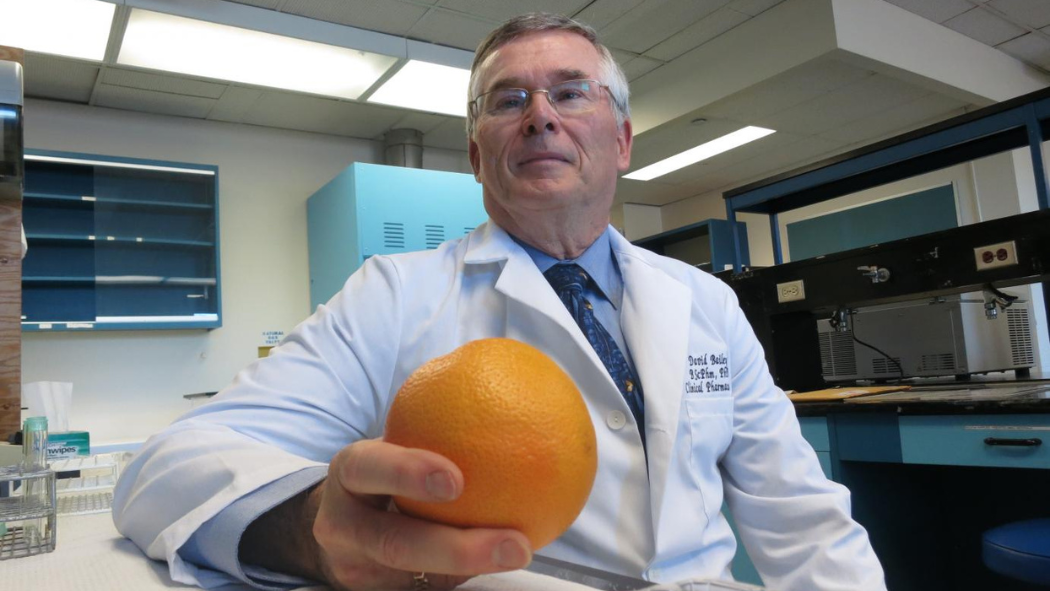
The photograph above shows clinical pharmacologist David Bailey holding the fruit that became inseparable from his research. London Health Sciences Centre traces his unexpected observation to 1989, when grapefruit juice was being used to disguise alcohol's taste during a study involving the blood-pressure medicine felodipine.[7]
The subsequent experiment supplied a concrete comparison. In a February 1991 Lancet report, Bailey and colleagues described six men with borderline hypertension who took felodipine with water, grapefruit juice, or orange juice. With grapefruit, the drug's mean bioavailability was 2.84 times the value with water; individual values ranged from 1.64 to 4.69 times. Bioavailability describes how much of a dose reaches the circulation. Orange juice did not produce the same effect in this experiment.[3]
The variability matters as much as the average. These were six participants taking a particular medicine under controlled conditions. The results demonstrate an interaction; they cannot predict the multiplier for someone else's breakfast. Nor does a change in drug exposure translate automatically into the same percentage change in benefit or harm. The study nevertheless found more vasodilation-related side effects with grapefruit, alongside lower diastolic blood pressure and a higher heart rate.[3]
The interaction can remain in the intestinal wall
Part of an oral dose can be broken down before reaching the general circulation. One enzyme involved is CYP3A4, present in the small intestine as well as the liver. Less intestinal breakdown can allow more of a susceptible medicine to pass through.[4]
A May 1997 study examined this directly. Ten healthy men drank eight ounces of grapefruit juice three times daily for six days. Researchers sampled the intestinal lining before and after the regimen. CYP3A4 protein in small-intestinal cells fell by 62%, while the test of liver CYP3A4 activity showed no change.[4]
This was a substantial, repeated juice exposure, so its percentage should not be assigned to every occasional glass. Its value is anatomical: the investigators found a change in the tissue that an oral medicine encounters on its way in. A stomach emptied of breakfast does not establish that this processing system has returned to its earlier state.[4][5]
A longer gap is not a universal solution
The 1995 timing experiment involved nine healthy men in a randomized crossover study, meaning participants received different treatments on separate occasions. They drank 200 mL of grapefruit juice with felodipine or at intervals of one, four, ten, or twenty-four hours before it.[2]
Across these schedules, average peak concentrations were 32–99% higher than with water. A peak-concentration effect remained at twenty-four hours. The study also measured total exposure over time, known as AUC; that measure was significantly increased when the juice preceded the medicine by up to ten hours. Those are different findings, and neither supplies a universal waiting period.[2]
A 2003 study helped explain the persistence. Twenty-five healthy volunteers received oral midazolam, another medicine used to probe CYP3A activity, before and after grapefruit exposure. Researchers estimated a recovery half-life of about 23 hours, interpreting the recovery pattern as consistent with replacement of enzyme function after inactivation. That estimate concerns the interaction's recovery, not the medicine's own elimination half-life.[5]
The studies make a narrow but useful point: shifting the clock does not reliably remove every grapefruit interaction. They do not establish that everyone must wait a specified number of days. Different medicines, juice exposures, and patients require instructions grounded in the particular product.[2][5]
Grapefruit does not always turn the dose up
The enzyme explanation is powerful enough to become a misleading rule of its own. Some medicines depend on transport proteins that help them enter the body. Grapefruit can interfere with this uptake, reducing rather than increasing exposure. The FDA identifies the antihistamine fexofenadine as an example; apple and orange juice can also interfere with it.[1]
In a 2002 randomized crossover study of 24 healthy adults, a regimen of double-strength grapefruit juice reduced fexofenadine's peak concentration and total exposure by approximately 30%. The same study found no change in the bioavailability of desloratadine, another antihistamine. Participants had repeated juice exposure before the drug and additional juice around administration, so the result is not an estimate for every ordinary serving.[6]
The comparison challenges two shortcuts at once: grapefruit does not always raise drug levels, and medicines used for the same purpose need not respond alike. The measured reduction was in blood exposure, not a demonstrated thirty-percent loss of allergy relief. Reading that distinction preserves what the experiment actually tested.[6]
Read the warning with the medicine's name attached
The useful next step is specific: check the medication guide or OTC Drug Facts label and ask a pharmacist whether the exact product interacts. The FDA emphasizes that grapefruit affects only some drugs within a category, with severity varying by medicine, person, and amount consumed. Whole grapefruit and related fruits may also matter; changing the form of breakfast is not automatically a solution.[1]
These small studies give the familiar label a more precise meaning. A tablet's stated dose and the body's eventual exposure are separate quantities. Breakfast can change the relationship between them, and the effect may survive a carefully planned gap. When a medicine carries a grapefruit warning, a homemade timetable cannot replace its instructions.[1][2][5]
Sources
- U.S. Food and Drug Administration, “Grapefruit Juice and Some Drugs Don't Mix” — drug-specific warnings, intestinal enzymes, transporters, and patient-label guidance; accessed September 25, 2026.
- J. Lundahl et al., study of grapefruit timing and felodipine exposure, European Journal of Clinical Pharmacology 49:61–67 (1995) — randomized crossover results through a twenty-four-hour interval.
- D. G. Bailey et al., “Interaction of citrus juices with felodipine and nifedipine,” The Lancet 337:268–269 (February 2, 1991) — early human exposure and physiological findings.
- K. S. Lown et al., study of intestinal CYP3A protein and felodipine availability, Journal of Clinical Investigation 99:2545–2553 (May 15, 1997) — human biopsy evidence after repeated grapefruit juice consumption.
- David J. Greenblatt et al., study of CYP3A recovery after grapefruit juice, Clinical Pharmacology & Therapeutics 74:121–129 (2003) — midazolam exposure and estimated enzyme-function recovery.
- Christopher Banfield et al., comparison of grapefruit effects on fexofenadine and desloratadine, Clinical Pharmacokinetics 41:311–318 (2002) — reduced fexofenadine exposure and unchanged desloratadine exposure.
- London Health Sciences Centre, “Citrus surprise: A juicy discovery at LHSC changed drug safety around the world” — institutional account of Bailey's research and source of his 2017 laboratory photograph.