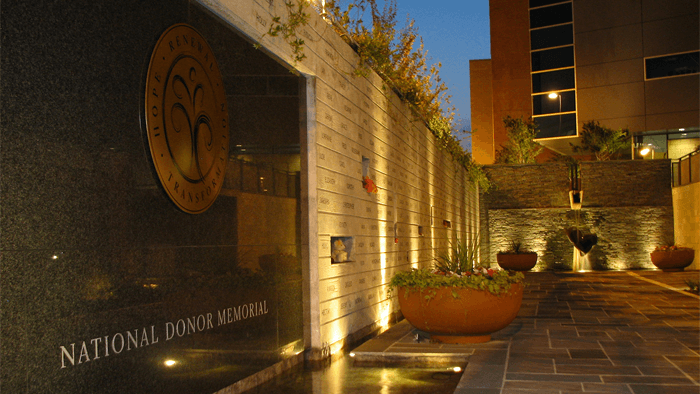
At the entrance to the National Donor Memorial in Richmond, Virginia, the first words are not the names of organs or hospitals. They are relationships: friend, wife, son, daughter, mother, sister, husband, brother, father. Water runs over them. Farther inside, first names appear on a granite wall. Beyond that wall, the garden opens into a lawn and grove.[2]
The order matters. Organ donation is necessarily managed through clinical facts and urgent logistics.[5] Bereavement moves in the other direction. It begins with the particular person who is absent. The memorial's achievement is to let those two truths share a public address without pretending they are the same kind of knowledge.
Dedicated on November 20, 2003, the 10,000-square-foot garden does not disclose the complete story of every donor, identify every recipient, or turn a death into an uncomplicated triumph. It does something more restrained. It makes donation publicly visible while leaving room for privacy, ambivalence, grief, and gratitude.[2][3] A donor can remain private without becoming nameless.
Image context: the photograph above shows the memorial as a real courtyard rather than a symbolic logo. Its walls, water, plants, and places to sit make remembrance something visitors move through at their own pace.[1]
The network learned to match organs before it built a place to mourn
The United States built the modern administrative framework for organ sharing before it built this national memorial. Congress passed the National Organ Transplant Act in 1984, creating the Organ Procurement and Transplantation Network and a national registry for matching donated organs with candidates. The Department of Health and Human Services solicited proposals to operate the network in 1986.[4] The memorial would later be built on the grounds of UNOS, the organization that dedicated it.[1][3]
That sequence reflects the immediate problem of transplantation. A donated organ cannot wait while institutions negotiate from scratch. A national system has to turn medical information into a timely match, coordinate procurement and transport, and preserve a record of what happened. The donor enters that system as a person, but the matching process must temporarily foreground compatibility and logistics.
After a deceased donation, the organ procurement organization tells the family which organs were transplanted but does not name the recipients. It may also provide grief support. The separation is not indifference; it protects people at an emotionally intense moment and prevents the matching system from becoming a route to unwanted exposure.[5]
Yet a system can perform those tasks correctly and still leave a representational gap. A database can record a donation. It cannot, by itself, show the public that the donor was somebody's daughter, friend, husband, or mother. The memorial was built inside that gap.
The garden begins with the people who lost someone
UNOS did not ask transplant administrators alone to decide what remembrance should look like. Its account of the dedication says a volunteer committee of donor relatives, living donors, and recipients from across the country guided the design.[3] The result is not a straight celebratory avenue. It is a sequence of three metaphorical rooms.
The Wall of Tears comes first. Water crosses words for family and social bonds, keeping death at the entrance rather than hiding it behind the language of a “gift.” The central area holds the Wall of Names and the words “Hope, Renewal, Transformation.” The Butterfly Lawn and Memorial Grove then open outward.[2] The path moves toward renewal, but it never requires a visitor to call loss good.
That is a crucial ethical choice. Public campaigns often describe donation through the lives that can be saved or improved. The claim is real, but if it becomes the only frame, the donor's family can be reduced to the opening step in somebody else's recovery. At Richmond, grief has architectural priority. Recipients and living donors belong in the space, but they enter through a design whose first attention is to the bereaved.
The garden also changes the scale of national medicine. The OPTN exists because no single hospital can fairly coordinate all candidates and donated organs. The memorial, by contrast, is deliberately walkable. The visitor meets water, a wall, a name, a bench. A vast system becomes comprehensible through a few bodily acts: entering, pausing, reading, sitting, continuing.
First names make a careful public language
The Wall of Names is not a comprehensive roll of every U.S. organ, eye, and tissue donor. UNOS describes it as holding hundreds of names that represent the diversity of donors.[1][2] That distinction protects the wall from making a false claim to completeness. It also explains why first names are so effective there.
A first name restores individuality without pretending to deliver a full biography. It gives visitors enough to resist abstraction, but not enough to collapse every boundary between donor family and recipient. The names stand together because donation connects them; they remain separate because no donation makes one life interchangeable with another.
That balance resembles the information boundary outside the garden. OPTN guidance hosted by HRSA recommends that routine exchanges between deceased-donor families and recipients remain general and nonidentifying. Organ procurement organizations and transplant centers can relay letters, screen them for privacy concerns, and support direct contact when both sides mutually choose it. Direct identifying contact is neither automatic nor permanently barred; it can proceed when both sides agree.[6]
The memorial creates a third option between total disclosure and silence. A recipient who does not know a donor's identity can still have somewhere to direct gratitude. A family that does not want contact with recipients can still see donation recognized as part of the person's public legacy. Neither side has to surrender private information to participate in remembrance.
Meaning can help grief, but it does not settle grief
Qualitative evidence shows that bereaved families may seek meaning, acknowledgment, and closure—but the evidence does not license a simple claim that donation heals bereavement. A 2014 thematic synthesis brought together 34 qualitative studies involving 1,035 participants. It found recurring themes of altruism and meaning alongside uncertainty about death, decisional conflict, vulnerability, mistrust, respect for the donor, and the need for closure.[7]
Those findings make the memorial's mixed vocabulary look less decorative. Tears, hope, renewal, and transformation are not successive clinical stages with predictable outcomes. They are possibilities that can coexist. A family may find meaning in donation while also experiencing mistrust or feeling dismissed. Someone may visit immediately; someone else may need years; another person may never want to come.
The garden should not be treated as therapy with a guaranteed effect. It cannot repair a rushed request for donation, answer every question about a loved one's care, or substitute for continuing family support. Its value is that it does not demand one emotional result. A wall stays available when the visitor is ready.
That availability now extends through a 360-degree virtual tour.[2] The digital version cannot reproduce water, weather, or the pace of walking through the courtyard. It does, however, matter for a national community whose members may live far from Richmond or find travel difficult. In this case, digitization did not replace the site. It widened the doorway.
A memorial is a promise to remember, not proof that the system is just
By the memorial's 20th anniversary in November 2023, thousands of visitors had come to the site, according to UNOS.[1] Longevity gives the garden an institutional role: it tells donor families that transplantation intends to remember the person as well as the organs recovered.
But a memorial beside a transplant institution also creates an obligation. Beautiful language about gifts cannot stand in for fair allocation, accurate data, respectful approaches to families, careful stewardship of donated organs, or transparent correction when the system fails. Commemoration is credible only when the living institution accepts those duties.
The strongest reading of the Richmond memorial is therefore not that death becomes life, full stop. Its physical sequence is more honest. Death remains death. Grief receives the first room. Names interrupt the machinery's categories. Renewal appears farther along the path, as a possibility rather than a command.
Transplant medicine depends on converting a singular loss into coordinated action under extreme time pressure. The National Donor Memorial performs the reverse translation. It takes a national system of matches, messages, and protected records and returns it to relationships, names, water, and a place to sit. That is what public memory can add without violating private grief.
Sources
- United Network for Organ Sharing, “National Donor Memorial” — official overview of the memorial, its 20th anniversary, visitors, wall of names, and the source page for the article photograph.
- United Network for Organ Sharing, “Tour the National Donor Memorial” — official description of the garden's three rooms, Wall of Tears, Wall of Names, access, and design symbolism.
- United Network for Organ Sharing, “UNOS Dedicates the National Donor Memorial” (December 11, 2003) — contemporary account of the November 20 dedication and the volunteer design committee.
- Health Resources and Services Administration, “About the OPTN” — official history of the 1984 National Organ Transplant Act, the national matching registry, and the 1986 contract process.
- Health Resources and Services Administration, “Deceased Donation” — official explanation of matching, recovery, family notification, recipient confidentiality, and post-donation support.
- Health Resources and Services Administration, “Guidance for Donor and Recipient Information Sharing” — recommendations on nonidentifying routine information, mediated correspondence, privacy, and mutually chosen direct contact.
- Ralph et al., “Family perspectives on deceased organ donation: thematic synthesis of qualitative studies,” American Journal of Transplantation 14, no. 4 (2014) — synthesis of 34 studies and 1,035 participants on meaning, vulnerability, trust, respect, and closure.