The field trial began before anyone lifted a syringe. After the Michigan state laboratory finished its routine milk and water work, Pearl Kendrick and Grace Eldering went back out into Grand Rapids carrying shallow dishes of culture medium. In dark homes during the Great Depression, sometimes working by kerosene light, they held those “cough plates” in front of children convulsed by whooping cough. A specimen could reveal Bordetella pertussis, replenish the laboratory’s supply of fresh strains, and connect one sick child to a citywide record of transmission.[1][2]
That sequence is the real subject of their biography. Kendrick and Eldering did not conjure pertussis vaccination from an empty bench. Other investigators had made candidate vaccines, and by 1931 the failure of many commercial preparations had made the American medical establishment openly skeptical. What the two bacteriologists built between 1932 and 1939 was a feedback system: cases generated cultures; cultures informed a killed whole-cell vaccine; a preschool survey supplied a sampling frame; clinics delivered doses; district nurses tracked exposure and illness; outside epidemiologists attacked the design; and revised records made the result harder to dismiss.[1][2]
Their achievement was therefore larger than a formula and less tidy than a eureka story. It depended on a state laboratory willing to do research, a city health department able to visit homes, thousands of families willing to participate, and investigators willing to let criticism change their analysis. The trial was controlled, but it was not randomized. Its evidence mattered because Kendrick and Eldering strengthened it in public view—not because their first design was flawless.
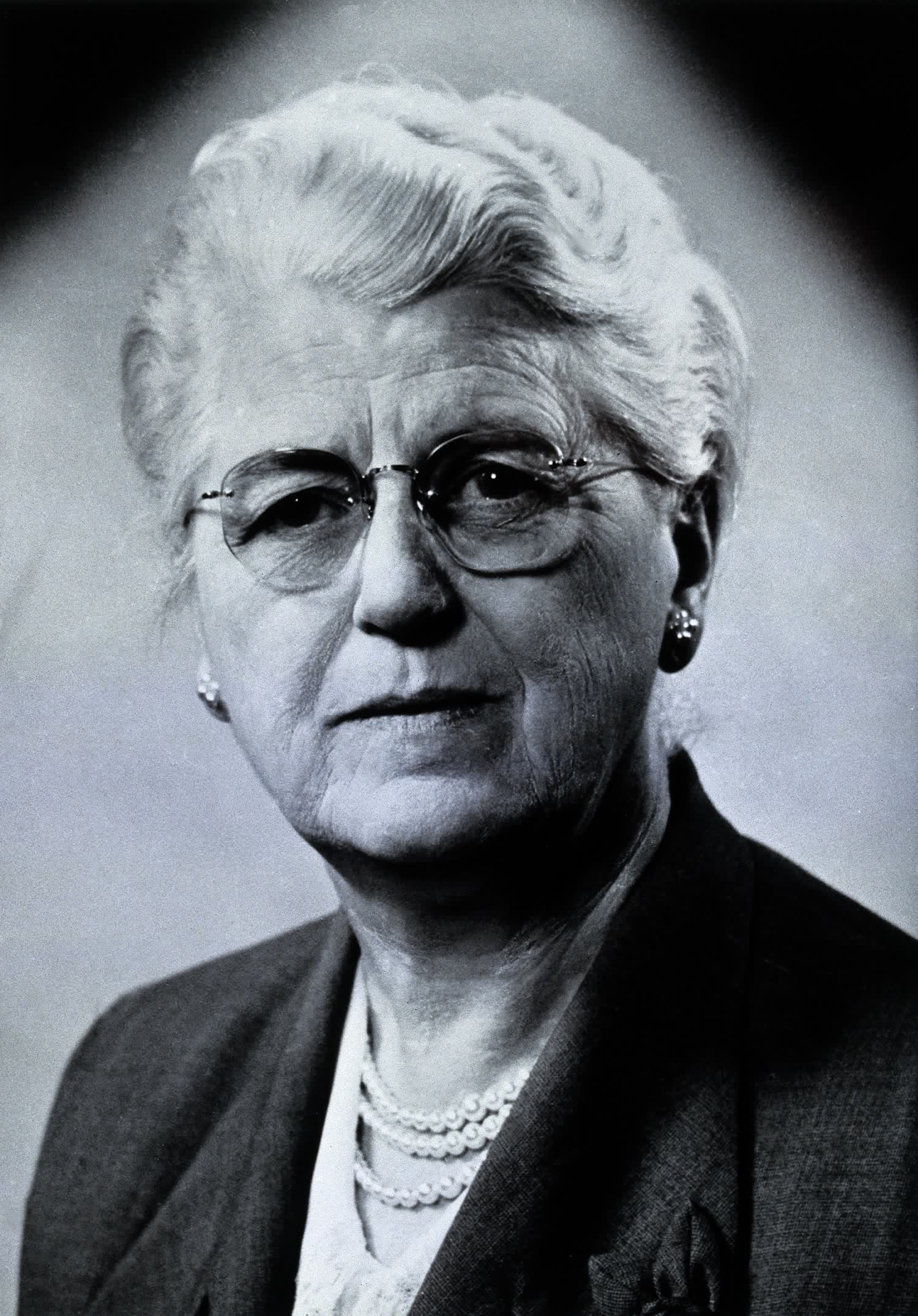
Image context: the cover is a real archival portrait of Kendrick, one of the two scientists at the center of this microhistory. The formal pose is quieter than the work she shared with Eldering: night calls, culture plates, school clinics, household records, and years of follow-up.[7]
Two careers met inside a public laboratory
Kendrick joined the Michigan Department of Health in 1920 and took charge of its Western Michigan laboratory in Grand Rapids in 1926. She had begun as a teacher, then moved into bacteriology and work on serologic testing. Eldering, also a former teacher, entered the department in 1928 and joined Kendrick in Grand Rapids four years later. Kendrick returned from doctoral training at Johns Hopkins in 1932 just as a severe local pertussis season gave the laboratory both an urgent problem and a supply of cases to study.[1]
The institutional setting mattered. State laboratories are easy to treat as plumbing: places that test water, confirm diagnoses, and execute decisions made elsewhere. Michigan’s Bureau of Laboratories also produced biological products and encouraged staff research when resources allowed. That meant Kendrick and Eldering could connect discovery to ordinary public-health operations. They did not have to invent a separate organization for every specimen, clinic, or follow-up visit.[1][2]
Money was still precarious. The Depression had cut local capacity, and Kendrick assembled support from state and city government, federal relief programs, private donors, and volunteer labor. Physicians, technicians, parent groups, and nurses supplied work that no single grant fully covered.[1][2] This should not be romanticized as proof that scarcity produces ingenuity. Scarcity threatened recordkeeping and follow-up. The more useful point is that Kendrick understood vaccine evaluation as an organizational problem early enough to build a coalition around it.
The cough plate turned illness into a working map
On November 1, 1932, the Grand Rapids laboratory began offering physicians a cough-plate diagnostic service. The plate was simple in principle: a child coughed toward prepared medium, and the laboratory tried to grow the organism from the expelled droplets. In practice, timing was decisive. Kendrick and Eldering found that cultures were most productive early in illness; by the fourth and fifth weeks, far fewer children remained culture-positive. Their work helped Grand Rapids replace loose quarantine conventions with rules tied to time and negative cultures.[1][5]
The service did three jobs at once. It gave clinicians bacteriological support, helped health officials decide when isolation could end, and brought recent local strains back into the vaccine laboratory. By 1935, the Grand Rapids branch examined 4,515 cough plates in a year.[1] That volume was not background activity. It was the bridge between the city’s sickrooms and the vaccine’s production.
It also taught the researchers what a trial would have to observe. Pertussis exposure did not arrive on an appointment schedule. Symptoms could be missed or classified differently by different families. A vaccine comparison would need a way to identify susceptible children, find illnesses after enrollment, distinguish exposure from outcome, and keep watching both vaccinated and unvaccinated groups through repeated household contact.
A trial assembled from clinics, districts, and home visits
The first plan was to compare vaccinated and unvaccinated children exposed within the same household. It failed operationally: by the time the laboratory learned of a family exposure, a child could already be incubating disease. Kendrick and Eldering redesigned. Children whose families voluntarily brought them to clinics formed the vaccinated group. Controls were selected from unvaccinated children in the same areas, using a federally supported 1934 preschool immunization survey to identify candidates.[2]
That is why “controlled” is accurate and “randomized” is not. Families chose vaccination, so the two groups could differ in health behavior, exposure, or willingness to report illness before any dose was given. Control selection also changed as the study evolved. The researchers tried to reduce those differences by drawing controls from comparable districts and ages, documenting prior disease and exposure, and applying shared case definitions. Those safeguards improved the comparison; they could not erase self-selection.[2][4]
The city’s 18 health districts supplied the human infrastructure. Nurses completed inoculation forms, home-visit slips, exposure records, and case histories. At roughly three- to four-month intervals, they returned to participating families to ask about contact with pertussis and signs of illness. The eventual study ran from March 1934 to November 1937 and enrolled 5,815 children across its successive cohorts. The final analysis excluded 1,603 early or inadequately documented observations, leaving 4,212 children in the evaluable comparison—a reminder that enrollment and evidence are not the same denominator.[1][2]
The preliminary report published in 1936 made the signal vivid. Among 712 vaccinated children, four developed mild pertussis; among 880 controls, 45 developed the disease.[1][3] Those counts were promising, but they were not self-interpreting. If exposure differed between groups, or if a nurse knew a child’s vaccination status when assessing a borderline cough, a crude comparison could exaggerate protection. The numbers opened the argument. They did not close it.
Wade Hampton Frost made the result harder to love—and easier to trust
Kendrick and Eldering invited scrutiny through the American Public Health Association’s pertussis committees. Wade Hampton Frost, a leading epidemiologist at Johns Hopkins, reviewed their plans, tables, and draft reports. His correspondence pressed on the control group, the definition and severity of cases, differences in exposure, and the way the data should be stratified and presented. Other statisticians and public-health specialists also questioned whether the comparison could support the weight being placed on it.[2]
This part of the story is often flattened into an endorsement: famous epidemiologist checks work, vaccine passes. The archival reconstruction is more interesting. Frost remained concerned about the design, recommended further studies, and contributed substantially to the final analysis without appearing as an author. Kendrick and Eldering revised their procedures and reporting rather than treating outside criticism as an attack on ownership.[2]
Their full 1939 paper preserved a strong protective signal after a more careful accounting of age, district, exposure, and disease severity.[2][4] It still did not resemble a modern blinded randomized trial. Nor did publication instantly end the dispute; specialists called for replication, British reviewers remained wary of American control methods, and later trials tested newer vaccine preparations.[1][2] The defensible claim is narrower: the Grand Rapids study moved pertussis vaccination from scattered promise toward controlled, inspectable evidence.
The victory belonged to a system, not one batch
Accounts place Michigan’s move into broader vaccine production and distribution between 1938 and 1940; major U.S. professional endorsements followed in 1943–1944.[1][2] Across the United States, the reported pertussis incidence fell from 209 cases per 100,000 people in 1934 to 51 per 100,000 in 1948; the reported death rate fell from 5.9 to less than 1 per 100,000 over the same interval.[1] Those national changes reflect expanding vaccination, manufacturing and potency standards, public-health delivery, and disease reporting—not a clean estimate of the effect of one Grand Rapids batch.
There is another boundary worth keeping visible. Kendrick and Eldering evaluated killed whole-cell pertussis vaccines. The United States shifted to acellular pertussis products during the 1990s, so their trial cannot be used as direct evidence for the durability or transmission effects of today’s formulation.[6] What travels forward is the method: a vaccine claim becomes trustworthy only when production, surveillance, comparison, follow-up, and criticism are made to work together.
That method also corrects the scale of the hero story. Kendrick and Eldering were its designers and persistent center, but the trial’s instrument was Grand Rapids itself. Laboratory staff prepared media and vaccine. Physicians and clinics delivered doses. Relief-era surveys located children. Nurses turned encounters into longitudinal records. Families opened their doors. Frost and other skeptics forced the comparison to become more explicit. None of those contributions diminishes the two bacteriologists. They reveal what the pair knew how to build.
The cough plate is the best emblem of that intelligence. It sat for a moment between a scientist and a sick child, then traveled. From the doorstep it went to the incubator, from the incubator into a strain collection, from the laboratory into a vaccine, and from the clinic back into district records. Kendrick and Eldering made each handoff answerable to the next. That is how a city became a trial—and how a trial began to quiet a cough.
Sources
- Carolyn G. Shapiro-Shapin, “Pearl Kendrick, Grace Eldering, and the Pertussis Vaccine,” Emerging Infectious Diseases 16, no. 8 (2010) — CDC-hosted historical review of the state laboratory, cough-plate service, community coalition, trial, and adoption timeline.
- Harry M. Marks, “The Kendrick–Eldering–(Frost) Pertussis Vaccine Field Trial,” Journal of the Royal Society of Medicine 100, no. 5 (2007) — archival reconstruction of the changing control design, 5,815-child cohort, funding constraints, Frost correspondence, analysis, and unresolved limitations.
- Pearl Kendrick and Grace Eldering, “Progress Report on Pertussis Immunization,” American Journal of Public Health 26, no. 1 (1936) — the investigators’ primary preliminary report on the first Grand Rapids comparison.
- Pearl Kendrick and Grace Eldering, “A Study in Active Immunization Against Pertussis,” American Journal of Hygiene 29, section B (1939) — source page and full-text scan of the investigators’ final field-study report.
- Pearl Kendrick and Grace Eldering, “Cough Plate Examinations for B. pertussis,” American Journal of Public Health 24, no. 4 (1934) — primary report on the Grand Rapids diagnostic service, culture timing, and its relationship to community control.
- Liang et al., “Prevention of Pertussis, Tetanus, and Diphtheria with Vaccines in the United States,” MMWR Recommendations and Reports 67, no. 2 (2018) — CDC history of routine pertussis vaccination and the later U.S. transition from whole-cell to acellular products.
- Wellcome Collection, “Pearl Kendrick. Photograph” — source record for the undated archival portrait used as the article image, with the high-resolution Wellcome JPEG presented via Wikimedia Commons.