In the placebo arm of J. Bruce Moseley's knee trial, the surgeon called for instruments and splashed saline to imitate the sounds of an operation. Three small skin incisions completed the simulation; no arthroscope entered the joint. The account appears in the methods section of the paper published on July 11, 2002.[1]
That scene can overwhelm the finding. It is easy to remember the theatrical details and forget the question they made answerable: how much benefit came from the work inside the knee?
The Veterans Affairs announcement described 180 patients allocated among three treatments for osteoarthritis. Lavage washed out the joint; debridement removed damaged tissue and debris; the third group received the simulated operation. Over two years, all three groups reported improvement, without an advantage for the actual procedures.[2] A patient could therefore be truthful about feeling better while remaining mistaken about what had produced the change.
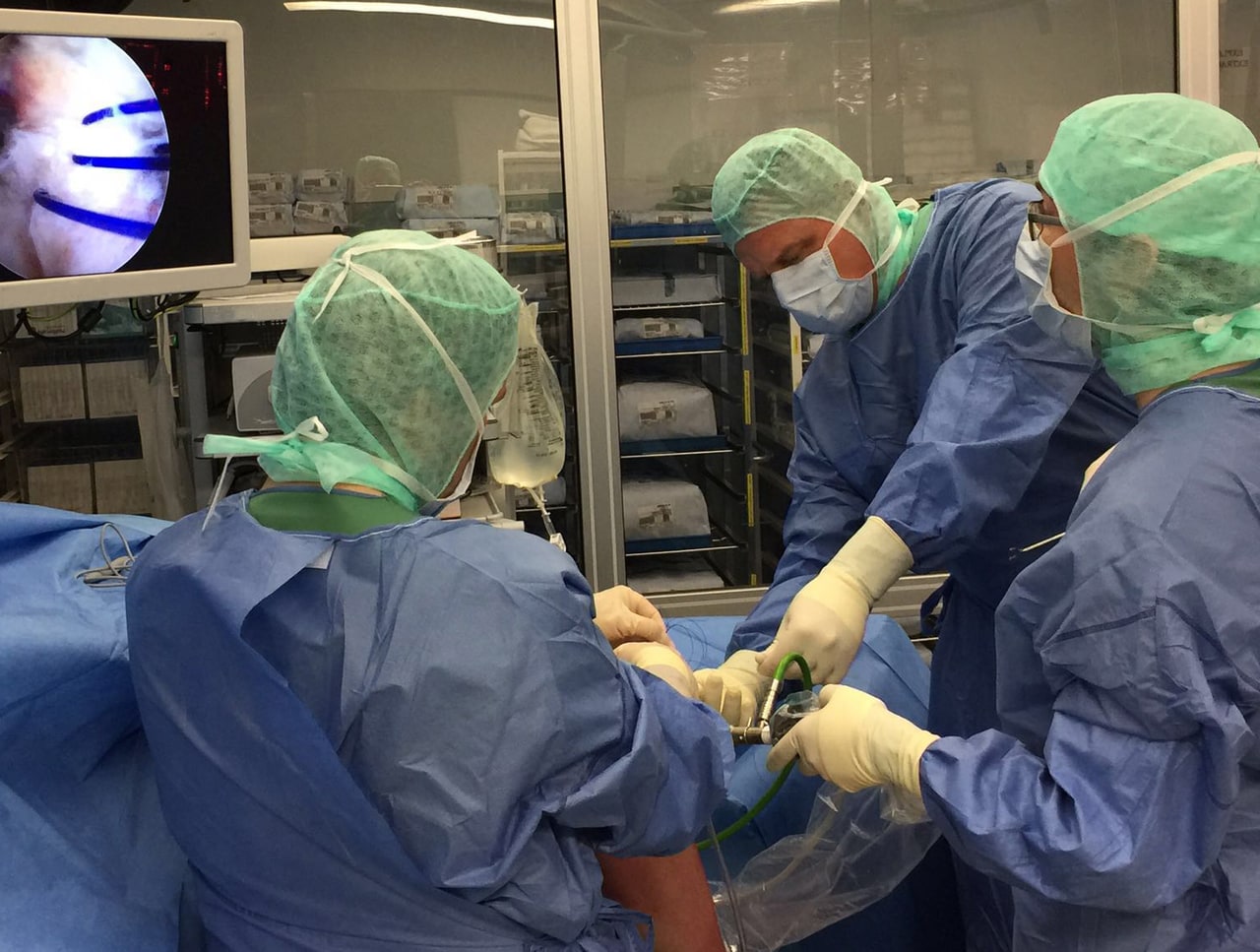
What the simulation held in place
Patients and outcome assessors were unaware of treatment assignments. The postoperative protocol provided the same walking aids, exercise program and pain medicines across groups. Participants had consented to the possibility of placebo surgery. The operating surgeon knew the allocation but did not assess outcomes.[1]
These details define the comparison. Had the control group simply stayed home, the groups would have differed in more than the procedure: one would have received the experience and expectations of surgery. Keeping much of that experience shared made it possible to ask what the additional intervention contributed.
This is also why the word placebo needs care. It names a control designed for a particular experiment. Here, it did not mean an absence of care, an absence of physical intervention, or a group of people whose pain was imaginary.
At two years, mean knee-pain scores were 51.6 with placebo, 53.7 with lavage and 51.4 with debridement, on a scale from zero to 100 where higher meant worse pain.[1] The useful comparison runs across those groups. Looking only at improvement within the surgery groups would miss the experiment's central result.
Improvement has more than one possible cause
A closely related problem had been set out in 2001, when Asbjørn Hróbjartsson and Peter Gøtzsche examined trials comparing placebo with no treatment. Their methodological point was straightforward: change after a placebo cannot all be credited to the placebo. The course of illness, other care and regression to the mean can contribute.[4]
Regression to the mean is especially easy to overlook. If people seek help during an unusually bad stretch, a later measurement may be closer to their usual experience even without an effective new treatment. The timing of entry into care can make an intervention appear responsible for a change that would have happened anyway.
Applied to Moseley's design, this means the simulated-surgery group's improvement cannot tell us how much came from expectations, exercises, medicines, symptom fluctuation or their combination. There was no group that isolated each component. The experiment tested the added value of the procedures against its chosen control; explaining every improvement would require further comparisons.
That leaves room for two observations to coexist. Relief matters to the person who experiences it. Establishing which part of treatment deserves credit requires evidence beyond the sequence “I had treatment, then I improved.”
The next comparison removed the simulated operation
Alexandra Kirkley's team asked a more directly practical question in a trial published on September 11, 2008: did arthroscopic surgery add benefit to optimized physical and medical therapy? Both groups received that nonsurgical care; one also received surgery. This time, there was no sham operation.[5]
At two years, average WOMAC scores—a measure of pain, stiffness and physical function—were 874 with surgery and 897 without it, on a scale reaching 2,400, where higher meant worse symptoms. The estimated difference was −23 points, with a 95% confidence interval from −208 to 161. The study did not establish an additional benefit from surgery.[5]
The two designs answered related questions through different controls. Moseley's comparison tested the procedure while preserving much of the surgical experience. Kirkley's comparison asked what adding surgery accomplished when both groups received organized nonsurgical treatment. Agreement across them made the clinical argument less dependent on the unusual simulation.
How far the finding travels
The later evidence also widened the population under examination. A 2022 Cochrane review, searching through April 2021, included 16 trials and 2,105 participants with degenerative knee disease; 56% were women. Four trials compared arthroscopy with placebo surgery. The reviewers found high-certainty evidence of little or no clinically important difference in pain or function at three months for that comparison.[7]
Certainty varied by outcome. Evidence about serious adverse events was less secure, partly because events were few and reporting incomplete.[7] Strong evidence about a lack of meaningful benefit does not automatically supply a precise estimate of every possible harm.
The 2017 BMJ guideline had already recommended against arthroscopy for nearly all patients with degenerative knee disease. It included people with degenerative meniscal tears and common symptoms such as clicking or catching. But it identified a possible exception requiring further study: a genuinely locked knee that cannot fully straighten. Young patients with sports injuries and people with major knee trauma were outside its scope.[6]
Those boundaries belong beside the finding. A conclusion about washing out or trimming a degenerative knee cannot become a verdict on every operation performed through an arthroscope.
The lasting achievement of Moseley's trial was to make an apparently simple success story harder to tell carelessly. An improved patient and an effective procedure are two claims. A well-chosen comparison lets medicine take the first seriously while investigating the second.
Sources
- J. Bruce Moseley et al., “A Controlled Trial of Arthroscopic Surgery for Osteoarthritis of the Knee,” New England Journal of Medicine 347:81–88 (2002) — original paper, hosted by Fort Lewis College.
- U.S. Department of Veterans Affairs, “VA Study Questions Common Knee Surgery” (July 10, 2002) — the trial institution's contemporary account.
- Ligamentaxis, “Kniegelenksarthroskopie” (June 29, 2017), Wikimedia Commons — photograph of knee arthroscopy, CC BY-SA 4.0.
- Asbjørn Hróbjartsson and Peter C. Gøtzsche, “Is the Placebo Powerless? An Analysis of Clinical Trials Comparing Placebo with No Treatment,” New England Journal of Medicine 344:1594–1602 (2001) — methodological distinction; original paper hosted by Princeton University.
- Alexandra Kirkley et al., “A Randomized Trial of Arthroscopic Surgery for Osteoarthritis of the Knee,” New England Journal of Medicine 359:1097–1107 (2008) — original paper, hosted by Prairie Trail Physiotherapy.
- Reed A. C. Siemieniuk et al., “Arthroscopic surgery for degenerative knee arthritis and meniscal tears: a clinical practice guideline,” BMJ 357:j1982 (2017) — recommendation and scope, archived in PubMed Central.
- Denise O'Connor et al., “Arthroscopic surgery for degenerative knee disease (osteoarthritis including degenerative meniscal tears),” Cochrane Database of Systematic Reviews CD014328 (2022) — evidence synthesis and certainty by outcome.