A blood donor passes the hemoglobin check and the appointment can continue. It is easy to carry away a broader reassurance: my iron must be fine. Yet the American Red Cross makes a narrower claim about its screening. It measures hemoglobin before donation; it does not directly measure iron.[1] The difference matters most when a generous habit becomes a regular one.
Canadian Blood Services addresses the misunderstanding explicitly in its donor information: normal hemoglobin can coexist with low iron stores.[2] A passing result is useful information about eligibility at that visit. Turning it into a verdict on the body's reserves asks the test to answer a question it was not designed to settle.
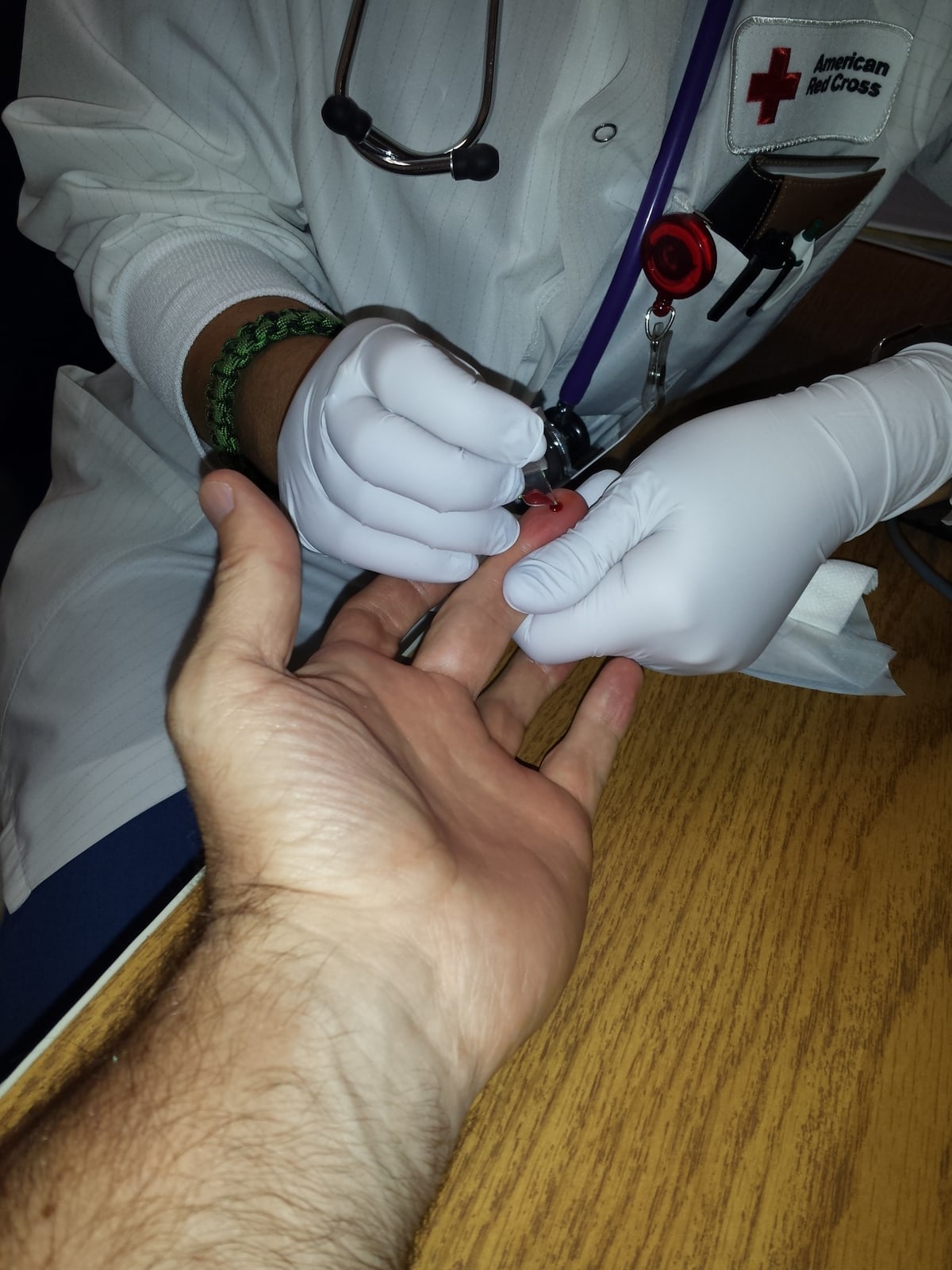
Hemoglobin is the oxygen-carrying protein in red blood cells, and iron is part of its working structure. Much of the body's remaining iron is held in storage proteins, including ferritin, in organs such as the liver and spleen. A hemoglobin measurement and a serum ferritin measurement therefore look at different parts of iron's use and storage.[4] The names belong to the same biological story; the results are not interchangeable.
The NIH Office of Dietary Supplements describes iron deficiency as a progression. Reserves diminish first. Red-cell production can then become iron-restricted while hemoglobin remains within the normal range; iron-deficiency anemia comes later. Ferritin helps reveal the earlier loss of reserves, although inflammation can affect its concentration and complicate interpretation.[4] There is no need to imagine that the screening instrument malfunctioned. A technically accurate measurement can still leave an important condition unmeasured.
This was already visible in 1981. Toby Simon, Philip Garry and Elizabeth Hooper examined 516 female and 505 male blood donors, combining laboratory measurements with donation and medical histories. They found reduced iron stores in 23% of the women and 8% of the men. Hemoglobin, hematocrit and serum iron were less sensitive indicators of depleted reserves than ferritin.[5]
Those percentages describe that study's donors, not the prevalence at every modern blood drive. Its more durable observation concerns the donation calendar: donations per year predicted depleted stores better than the lifetime total.[5] A record of many donations spread across decades says something different from repeated withdrawals in a short period. The body's opportunity to recover belongs in the account alongside the donor's cumulative contribution.
The question of recovery became unusually concrete in the 2015 HEIRS trial. Researchers randomized 215 eligible adult donors with normal hemoglobin to daily iron or no iron after a whole-blood donation. The unblinded study used 37.5 mg of elemental iron and followed participants for 24 weeks. Among donors whose starting ferritin was 26 ng/mL or less, the estimated time to replace 80% of the donation-related hemoglobin decrease was 32 days with iron and 158 days without it.[6]
That endpoint was partial hemoglobin recovery. The researchers separately followed ferritin back to its starting value. Without supplements, 67% had not recovered their starting iron stores by day 168.[6] Even “back to baseline” requires care: returning to a low starting reserve does not establish that the reserve is adequate. These measurements explain why recovering a blood count and replenishing stores should remain separate questions. The trial dose describes the experiment; it is not an individual prescription.
A larger experiment tested what happens when the next appointment comes sooner. Published in 2017, INTERVAL recruited 45,263 donors in England. Men were assigned donation intervals of eight, ten or twelve weeks; women, twelve, fourteen or sixteen weeks. Over two years, the shorter schedules collected more blood. Comparing the shortest with the standard interval, the increase averaged 1.69 units per male donor and 0.84 per female donor.[7]
The benefit to supply came with more iron deficiency, more deferrals for low hemoglobin and more donation-related symptoms. At the same time, the trial found no significant differences in overall quality of life, physical activity or cognitive function between the randomized groups.[7] Both findings belong in the story. The evidence supports taking depletion seriously without claiming that every frequent donor experiences a major decline in wellbeing. A broad wellbeing measure and a laboratory measure can describe different consequences of the same schedule.
Taken together, the studies change the meaning of a familiar reassurance. “I have always passed” reports a series of screening results. It does not reconstruct what happened to iron reserves between visits. Equally, a depleted reserve does not make the earlier donations worthless or the screening pointless. It identifies another part of donor care that needs attention.
Blood services can respond by changing intervals, checking reserves or helping donors replace losses. Canadian Blood Services' ferritin programme, introduced in January 2023, added selective testing beyond the routine hemoglobin check. Its published guidance asks donors with low ferritin to pause whole-blood donation for six months and consult their healthcare provider. It also cautions that low iron can have causes beyond donation and that diet alone may be insufficient to replenish donation losses.[2] That is one service's approach, not a universal timetable.
For an individual donor, the useful conversation starts with donation frequency, the actual tests performed and any results already available. The Red Cross encourages younger and frequent donors to discuss whether an iron-containing supplement is appropriate with their healthcare provider.[1] A clinician can consider why iron is low rather than assuming that giving blood explains everything; Canadian Blood Services also advises discussing whether ferritin should be retested before returning.[2]
The hemoglobin check earns its place by answering a limited question. Keeping that limit visible helps protect the person who returns, rolls up a sleeve and hopes to keep helping. Passing today and recovering for the next donation are connected achievements, each deserving its own evidence.
Sources
- American Red Cross, “What Donors Should Know About Iron and Blood Donation” — screening, hemoglobin and advice for frequent donors.
- Canadian Blood Services, “Donor wellness and Iron: Ferritin Testing” — selective testing programme, normal hemoglobin with low reserves, and follow-up guidance.
- Whoisjohngalt, “Hemoglobin Test American Red Cross.jpg” (November 9, 2013), Wikimedia Commons — photograph and location record; CC BY-SA 3.0.
- NIH Office of Dietary Supplements, “Iron: Fact Sheet for Health Professionals” — iron storage, stages of deficiency and limits of laboratory indicators.
- T. L. Simon, P. J. Garry and E. M. Hooper, “Iron stores in blood donors,” JAMA (1981) — observational study of donation history and iron depletion.
- Joseph E. Kiss et al., “Oral iron supplementation after blood donation: a randomized clinical trial,” JAMA (2015) — HEIRS recovery endpoints and results, hosted by study collaborator RTI.
- Emanuele Di Angelantonio et al., “Efficiency and safety of varying the frequency of whole blood donation (INTERVAL),” The Lancet (2017) — randomized donation schedules and donor outcomes; paper hosted by the study team.