Medicine once treated one infection by deliberately giving the patient another. That sentence makes malaria therapy sound like either barbarism or a medical miracle. It was neither so simple nor so clean.
The intended target was general paresis, the devastating neuropsychiatric form of late syphilis then often called general paralysis of the insane. Patients could develop delusions, cognitive decline, tremor, weakness, paralysis, and death. Before an effective treatment existed, the diagnosis filled asylum beds and carried the force of a sentence. In 1917, Viennese psychiatrist Julius Wagner-Jauregg began inoculating patients with malaria in the hope that repeated fever would interrupt the disease. Ten years later, the Nobel committee rewarded him for it.[1][2][4]
Two interpretations have grown around that sequence. In the first, the malariotherapy regimen was the first treatment to return a meaningful share of people with an otherwise fatal condition to their homes and work. In the second, reported remission rates could not show how much malaria itself contributed because the case series mixed selected patients, elastic diagnoses, bundled treatments, short follow-up, and institutional power. The records document remissions after the regimen more securely than they identify malaria's independent effect or a trustworthy rate. They show why a treatment could be rational in its moment and still acquire a reputation more confident than its evidence.[1][3][4]
From an observation about fever to a chain of patients
Wagner-Jauregg had proposed using febrile illness against psychosis as early as 1887. Malaria appealed to him for a practical reason: unlike many infections, physicians believed they could terminate it with quinine after the desired fevers. His first malaria series began in 1917 with blood from a soldier who had tertian malaria, the form generally associated with Plasmodium vivax.[1][4]
Even the foundational result changes shape depending on the account. In his 1927 Nobel lecture, Wagner-Jauregg said that six of nine patients experienced extensive remission; three were still in uninterrupted remission, back in their former occupations, ten years later. A 2013 historical review reports the same opening series as one death, two transfers to asylums, six initial improvements, and four later relapses, leaving two full recoveries.[1][4] Whether that gap reflects follow-up, classification, or conflicting sources, it exposes the questions that would follow the therapy everywhere: What counted as remission? When was it measured? Did discharge mean recovery? How should relapse change an earlier success?
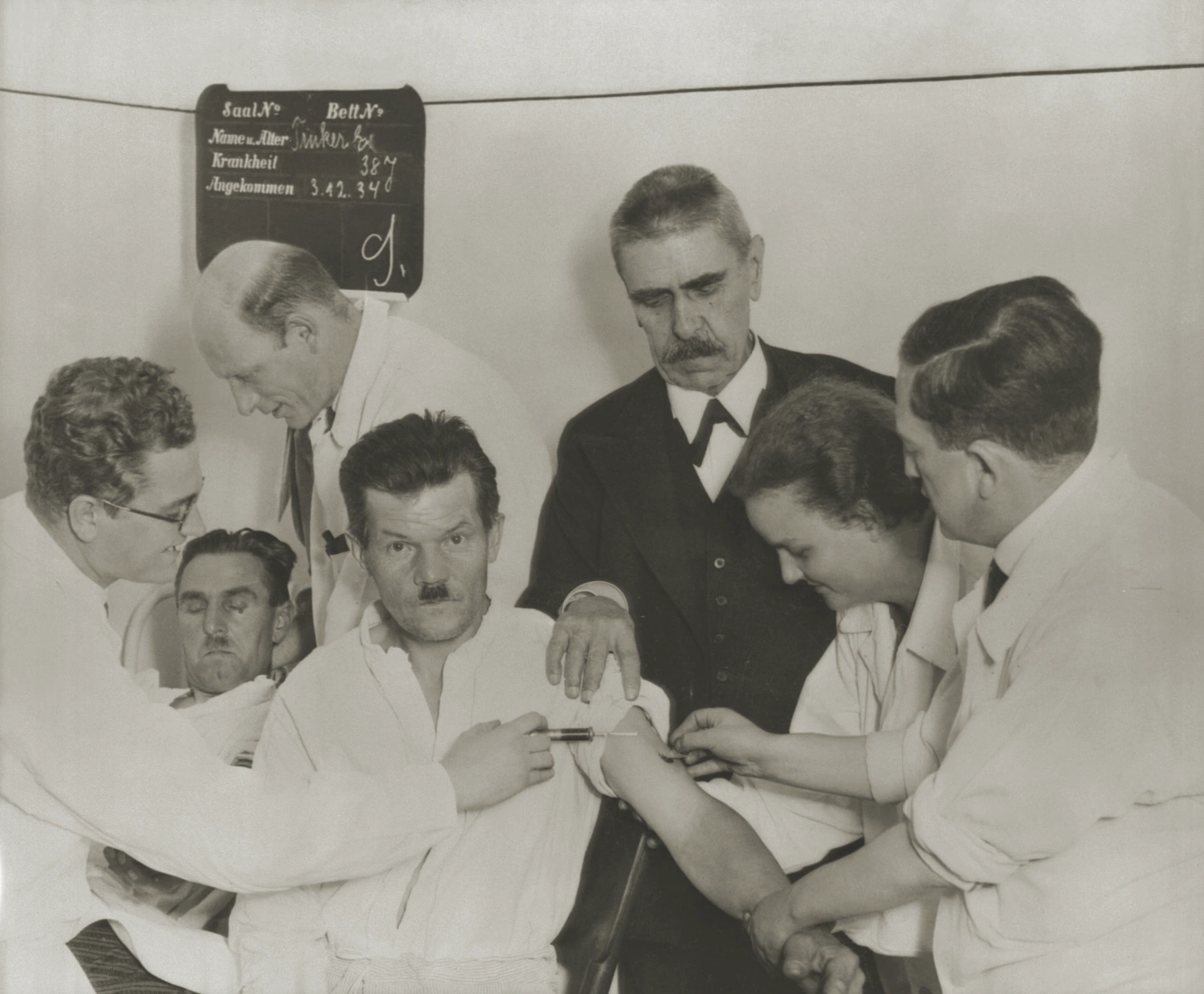
The 1934 photograph above fixes that system in one clinical room. Clinics could use infected mosquitoes, but direct blood passage let a hospital keep a strain alive from one patient to the next.[1][3][7] The image is crowded because the treatment was not a single injection: diagnosis, inoculation, fever observation, nursing, quinine, and usually an arsenical antisyphilitic drug all had to be coordinated.
Interpretation one: the regimen produced consequential remissions
The strongest case for malariotherapy begins with the untreated disease, not with modern revulsion at the procedure. General paresis was usually fatal, existing arsenical and mercury treatments performed poorly once the central nervous system was involved, and spontaneous recovery was uncommon enough that patients returning to demanding work drew attention. A therapy did not need to be gentle to look preferable to that course.[1][4]
Nor did the evidence consist of Wagner-Jauregg's nine patients forever. His lecture described assigning alternate patients to malaria alone or malaria followed by neoarsphenamine: he reported full remission in 25 percent of the malaria-only group and 48.5 percent of the combined-treatment group, with deaths of 18.7 percent and 12 percent, respectively.[1] A review of 35 studies published by 1926 found 27.5 percent full remissions, 26.5 percent partial remissions, and 46 percent dead or unchanged.[4] Those categories and denominators were heterogeneous, but the signal seemed large beside the prior expectation of steady deterioration.
That is why the 1927 Nobel presentation speech framed practical recovery at roughly 30 percent, with the best reports approaching 50 percent.[2] It is also why the treatment spread through Europe, the Americas, Africa, Asia, and Australia. For psychiatry, the effect was conceptual as well as clinical. A syndrome housed in mental hospitals had a known infectious cause and appeared responsive to a biological intervention. Malariotherapy weakened therapeutic nihilism—the belief that the asylum could observe decline but rarely reverse it.[4]
Calling this response irrational would make the history too easy. Physicians were facing a lethal disease, saw striking changes in some patients, and possessed no comparably effective alternative. The procedure's danger was visible, but so was the danger of doing nothing. The serious historiographical question is not why anyone tried it. It is how the emergency logic of trying became the statistical confidence of a cure.
Interpretation two: reported rates cannot isolate malaria's effect
The foundational trials did not answer the causal question cleanly. Wagner-Jauregg had previously used alternate allocation and a comparison group in tuberculin experiments, yet his early malaria series were uncontrolled. Later reports often compared treated patients with people admitted in earlier years, when diagnostic practice, nursing, nutrition, and available antisyphilitic drugs were different.[3] A patient could improve after malaria without malaria being the only reason—or even the decisive reason.
The treatment bundle is the first problem. Malaria was stopped with quinine and commonly followed by neoarsphenamine or tryparsamide. Patients judged fit enough to survive induced fever received concentrated medical and nursing attention. When the outcome improved, the case series could not separate fever from the arsenical drug, quinine, better supportive care, natural fluctuation, or their combination.[1][3]
Selection is the second. Wagner-Jauregg acknowledged that earlier-stage patients did better and reported an exceptionally high remission proportion in a subgroup chosen at admission because it promised a favorable result.[1] Elsewhere, clinicians excluded people with severe debility or heart, kidney, and respiratory disease because they might not survive malaria. That was sensible bedside triage. It was also a mechanism for making the treated cohort healthier than the historical patients used as its comparison.[3]
Diagnosis is the third. Treatment eligibility widened from general paresis to the broader category of “neurosyphilis,” which could include earlier, milder, or asymptomatic disease with a positive laboratory test. If the new clinic treated people earlier in the disease—or people who would never have followed the old asylum course—then improved discharge statistics did not measure the same population as the pre-malaria death rate.[3]
These were not anachronistic objections. Clinicians of the 1920s and 1930s already criticized short follow-up, historical controls, spontaneous remissions, mixed diagnoses, and enthusiastic reporting. In 1932, British psychiatrist Benjamin Reid followed a series for six to nine years and found only 12 percent alive and mentally well; he still considered malaria useful, but argued that longer observation diminished the optimistic view. His own patients usually received adjunct tryparsamide, so even this more cautious estimate did not isolate malaria.[3]
The Mont Park files put the published rate on trial
A recent archival study makes the dispute unusually concrete. Historian Alison Clayton matched the published malaria statistics from Mont Park Hospital in Victoria, Australia, against admission registers, discharge records, post-mortem files, and coroner material from 1927–1928. She found records for 98 percent of psychiatrist Reginald Ellery's listed cohort of 90 patients.[3]
Ellery's public account was spectacular: 76 percent improved, 42 percent discharged, and no deaths caused by treatment. The pooled figure concealed sharply different populations. By June 1929, 25 of 29 voluntary patients—often earlier, healthier, and from a different socioeconomic position—had been discharged, an 86 percent rate. Only 13 of 59 involuntary patients, who more closely resembled the older asylum population used as the historical baseline, had been discharged, a 22 percent rate.[3]
The mortality record was harder still. Fourteen of 59 involuntary patients treated in 1928 died between the start of that year and June 1929; four died within six weeks of inoculation. That timing does not prove malaria caused every death, and Clayton does not claim that it does. It does show why a published claim of no treatment deaths required scrutiny, especially when Ellery omitted malaria treatment from several coroner reports and one additional patient, absent from his list, died two weeks after inoculation.[3]
Mont Park cannot settle every hospital in every country. It is one local archive, and Clayton explicitly stops short of proving that malariotherapy was universally ineffective. Its force lies elsewhere. The study demonstrates, patient by patient, that selection, diagnostic drift, adjunct treatment, outcome labels, and underreported deaths were not hypothetical biases imported by later critics. They operated inside a celebrated program and pushed the reported rate toward apparent success.[3]
The ethical dispute does not collapse into the efficacy dispute
There is a tempting but faulty symmetry here: if malaria helped, the experiment was justified; if the statistics were inflated, it was abuse. Efficacy and ethics do not cancel each other so neatly.
General paresis could impair the very cognition needed for meaningful consent, and many recipients were confined in psychiatric institutions. At Mont Park, the surviving sources give no indication that certified patients or their relatives consented, while voluntary patients may have given only implicit consent. Denmark's requirement for written patient or family consent was unusual enough to stand out.[3] A history of human challenge research argues that intentional infection was not unethical in itself; the central concerns included inadequate consent, exploitation of vulnerable people, and whether the risks were justified. For malariotherapy specifically, it questions patients' capacity to consent and continued use once penicillin was available.[5]
Historical desperation therefore explains the therapy's appeal; it does not supply missing consent. Likewise, questionable consent does not prove that every remission was spontaneous. The efficacy question asks what caused improvement and by how much. The ethical question asks whether exposing these patients to infection was justified and chosen. A real effect would not answer the second question for them.
Penicillin changed the comparison, not just the drug
By the 1940s, penicillin attacked the causative bacterium without requiring physicians to maintain a second infection in human bodies. Penicillin appears to have been used for neurosyphilis at Mont Park beginning in 1945; malaria therapy disappeared from its reports after 1947 and ended there around 1950.[3] Current CDC guidance recommends aqueous crystalline penicillin G for adult neurosyphilis; deliberate malaria infection has no clinical place.[6]
That transition clarifies the fairest verdict. Malariotherapy was not merely quackery that happened to win a prize. Its reported remissions challenged the expectation that general paresis could only decline, and some patients almost certainly improved after receiving the regimen. But the foundational evidence could not reliably isolate malaria's contribution from the whole program of treatment and care.
The celebratory history mistakes adoption for measurement. The skeptical history is strongest when it says that reported remissions do not yield a clean causal estimate—not when it turns biased measurement into proof of zero effect. The case files leave a more useful lesson between them: when a desperate field finally sees patients improve, the first task is not to turn hope into a clean percentage. It is to make the comparison worthy of the claim.
Sources
- Julius Wagner-Jauregg, “The Treatment of Dementia Paralytica by Malaria Inoculation,” Nobel Lecture, December 13, 1927 — primary account of the 1887 proposal, 1917 opening series, treatment sequence, comparative claims, patient selection, and unresolved mechanism.
- Nobel Prize, “Award Ceremony Speech: Physiology or Medicine 1927” — contemporary official framing of malariotherapy's reported practical recovery rates and prize rationale.
- Alison Clayton, “Malaria therapy for neurosyphilis at Mont Park Hospital for the insane in Australia, 1927–1928,” History of Psychiatry 37(2), 2026 (first published online December 30, 2025) — archival comparison of 90 listed patients with hospital records, including selection, diagnostic drift, adjunct treatment, consent, discharge, mortality, and reporting discrepancies.
- Cynthia J. Tsay, “Julius Wagner-Jauregg and the Legacy of Malarial Therapy for the Treatment of General Paresis of the Insane,” Yale Journal of Biology and Medicine 86(2), 2013 — historical synthesis of the opening series, international uptake, pooled contemporary outcomes, and psychiatry's response.
- Euzebiusz Jamrozik and Michael J. Selgelid, “History of Human Challenge Studies,” in Human Challenge Studies in Endemic Settings, 2021 — ethical history of intentional infection, including malariotherapy, consent capacity, therapeutic expectation, and the penicillin boundary.
- Centers for Disease Control and Prevention, “Neurosyphilis, Ocular Syphilis, and Otosyphilis,” STI Treatment Guidelines — current diagnostic context and recommended penicillin regimen for adult neurosyphilis.
- CDC Public Health Image Library, image 26350 (1934) — institutional record and high-resolution source for the archival clinical photograph of Julius Wagner-Jauregg supervising pyrotherapy used as the article image.