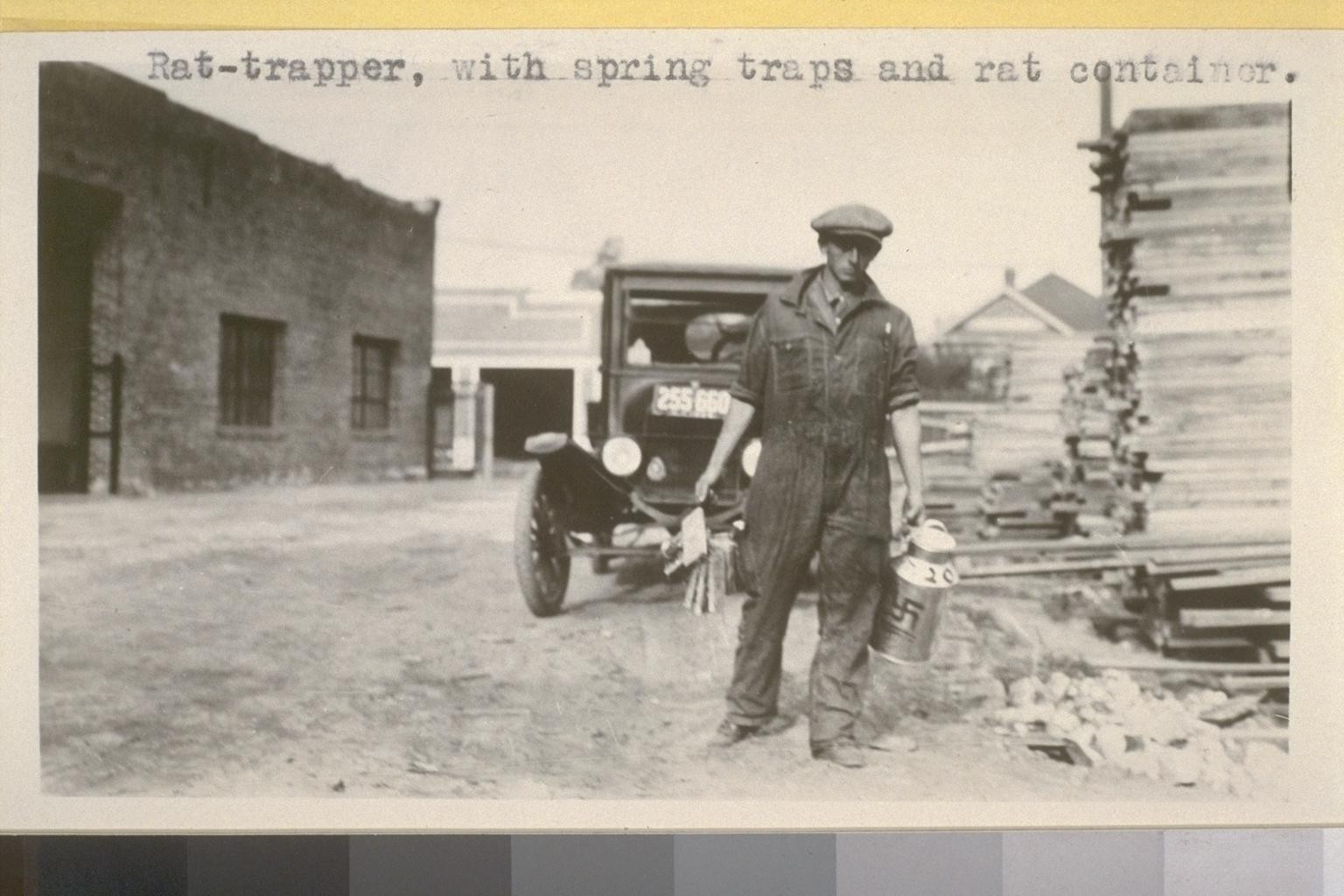
The man in the cover photograph holds two technologies of plague control. Spring traps hang from one hand. In the other is a metal rat container. Campaign records explain the information system around those objects: collected animals were tagged by location before laboratory examination. Behind him, a motorcar waits in a rough Los Angeles yard. The photograph belongs to a 1924 archive of outbreak sites, rat runs, crews, traps and repaired buildings.[2][6]
He appears after the part of the story that looks most like an epidemic. By the time Los Angeles photographed its rat-trappers, a chain of pneumonic plague had already moved through households, a boardinghouse, caregivers, an ambulance driver and a priest. A cordon had gone up around the working-class Macy Street district near today’s Union Station. Patients and contacts had been taken to Los Angeles County General Hospital. The neighborhood-wide quarantine came down on November 13, 1924.[1][3]
But the emergency did not end with the rope. It changed scale. A fast respiratory outbreak became a slower campaign against infected rats, fleas, food stores, wooden floors, double walls, rubbish, freight yards and the city’s port. Active federal participation continued until June 30, 1926.[2] Los Angeles therefore had at least two plague endings: one for person-to-person transmission and another for the urban conditions that could begin it again.
October 1: an animal infection becomes a human chain
The earliest case reconstructed by state investigators began on October 1, 1924. A 55-year-old Mexican laborer—identified as Jesús Lejun in one later account, with variant spellings across the records—developed a swollen groin node. It was diagnosed as a venereal lesion rather than the bubo of plague. His daughter became ill at about the same time and died on October 5 with what was called lobar pneumonia. Investigators later concluded that her illness had begun as bubonic plague and reached her lungs, creating an opportunity for respiratory spread.[1][2][3]
That distinction matters. Bubonic plague usually begins when an infected flea transmits Yersinia pestis. Pneumonic plague can follow when infection reaches the lungs; a person with pneumonic disease can then transmit infectious respiratory droplets during close contact. The Los Angeles cluster became the last recognized U.S. plague outbreak with sustained person-to-person transmission.[5]
The Lejun home stood half a block from a boardinghouse at 742 Clara Street. Illness accumulated there through family, nursing, funeral and household contact. On October 29, a physician called city health officials and the county hospital about several desperately ill people in Macy Street and nearby Belvedere Gardens. Thirteen more patients with similar high fever, chest and back pain, bloody sputum and cyanosis were found the next day. On October 31, lung tissue from a patient who had died showed bacilli with the characteristic appearance of plague. The diagnosis had arrived almost a month after the first illness began.[1][2]
There was little effective treatment to offer. A CDC reconstruction of U.S. plague records found that before antibiotics were first used against plague in 1942, 93% of reported pneumonic cases with known outcomes were fatal.[5] Antiserum reached Los Angeles on November 5, but the surviving records indicate that it arrived in time for very limited use and that officials doubted its value for pneumonic disease.[1] In this setting, finding cases, separating contacts and stopping exposure were not supporting measures around a cure. They were the intervention most likely to break the chain.
November 2: the city closes a neighborhood
At 1 a.m. on November 2, Los Angeles placed roughly eight blocks of Macy Street under quarantine. Contemporary accounts put the affected population between about 1,800 and 2,500 people, predominantly Mexican. Guards restricted movement; public-health nurses made house-to-house inspections; the county delivered seven-day food rations; and suspicious illnesses were sent to the hospital. Officials admitted 114 known contacts for observation, none of whom developed plague, as well as 82 people suspected of having the disease while their diagnoses were resolved.[1][2][3]
The sources do not agree on one final human toll. Arthur Viseltear’s 1974 reconstruction describes 30 pneumonic-plague deaths—28 Mexican residents and two White residents—during the concentrated October–November outbreak.[1] Vernon Link’s 1955 U.S. Public Health Service monograph, using a wider window through January 10, 1925, contains two close but inconsistent counts: 32 pneumonic patients with 30 deaths in one passage and 33 cases with 31 deaths in another, plus eight cases classified as bubonic.[2] A 2023 archaeological review counts at least 39 deaths across five linked outbreaks between October and January.[3]
Those totals are not interchangeable. They vary with the date window, whether the original patient is classified by his primary bubonic illness or his place in the pneumonic chain, and whether later rodent-associated clusters are folded into the main outbreak. The stable finding is more important than a forced single number: the October respiratory chain was exceptionally lethal, it struck a Mexican neighborhood overwhelmingly, and later human cases no longer propagated through the city in the same way.
The neighborhood-wide cordon was lifted on November 13, when the main pneumonic outbreak appeared controlled. Later cases brought quarantine to individual houses rather than another broad district closure.[3] That is a plausible endpoint if the question is, “When did uncontrolled person-to-person spread stop?” It is the wrong endpoint if the question is, “When was Los Angeles no longer finding plague in the animals beneath its buildings?”
November 6: the map moves under the floorboards
Intensive rat operations began on November 6. The city was divided into districts with trappers, poisoners, inspectors and wrecking crews. Captured rats, mice and squirrels were tagged by location and sent to a dedicated laboratory. The trapper’s container in the photograph was part of that information system: without an address, a dead rat was a count; with an address and a laboratory result, it could reveal a focus that needed investigation.[2][6]
From November 6 through May 13, 1925, the laboratory examined 106,951 rats and found 187 infected with plague. It also examined 16,094 squirrels, finding nine infected, and 3,812 mice, finding none infected. Positive rats appeared not only near residences but at hog ranches, packinghouses and the industrial city of Vernon. The animal reservoir did not respect the boundary that had contained the human outbreak.[2]
Control therefore moved beyond trapping. Crews removed rat harborage from wooden floors, double walls and ceilings. Food depots were pushed toward concrete floors and protected openings. Garbage and animal feed had to be separated from rodents. Rail yards, warehouses, docks and outgoing freight were inspected, trapped, poisoned or fumigated. A San Pedro hog ranch was demolished after an infected rat was found nearby; other buildings were repaired rather than destroyed.[1][2][3]
This second phase was slower because its evidence worked differently. A person with bloody sputum could trigger immediate isolation. An infected rat indicated a local focus, but a negative trap did not prove a district free of plague. Success had to be inferred from repeated capture, laboratory testing, fewer positive animals and physical changes that made recolonization harder. Surveillance could not end on the date of the last visible patient.
December 22: plague becomes a fight over the port
The campaign also exposed a divided public-health state. City, county, California and federal officials shared expertise but argued over authority, laboratory capacity, money and publicity. Los Angeles had sold itself as a healthy climate and depended on tourism, trade and a growing harbor. To acknowledge plague risked commercial damage; to understate it risked the disease and a harsher outside quarantine.[1]
On November 15, California health secretary Walter Dickie warned city leaders that even suspicion of plague could stop ships and strand goods. The City Council appropriated $250,000—half the sum he requested—for control. On December 22, the U.S. Public Health Service designated San Pedro a plague-infected port, although no infected rat had yet been found at the waterfront. The first positive rat in the harbor area was trapped on December 29 at a hog ranch about four miles away.[1]
Two readings of that order remain possible. It can be understood as precaution under uncertainty: freight, workers and rodents connected the city to the port, and waiting for a dockside positive could be waiting too long. It can also be read as federal leverage in an administrative struggle, because Public Health Service officers believed California’s campaign lacked staff and laboratory discipline and wanted a larger role. Viseltear’s archival reconstruction supports both pressures rather than reducing the order to either pure science or pure bureaucracy.[1]
By mid-1925, the federal service had taken operational control. The work expanded into a citywide program of trapping, laboratory surveillance, public meetings, rubbish removal and ratproofing. Link’s official account records 412,587 square yards of planking removed and 1,400 truckloads of rubbish hauled away. It estimated that property owners completed more than $3 million in ratproofing and that the campaign cost Los Angeles nearly $4 million over roughly 19 months.[2]
A real cluster inside a racialized city
The geographic logic of the quarantine is disputed because the medical map and the racial map overlapped. The 2023 archaeological review argues that authorities cordoned places after human cases appeared, notes that nearby Chinatown was excluded because it had no cases, and emphasizes that many structures were ratproofed rather than razed.[3] On that reading, a clustered respiratory disease—not ethnicity by itself—drew the first boundary.
Historian Emily Abel places the same actions within a longer Los Angeles policy that cast Mexican and Filipino residents as public-health burdens and potential outsiders. Her analysis notes that official reports stressed the ethnicity of patients and blamed neighborhood “uncleanliness,” while quarantine, property destruction and later health policy landed on communities already confined to dangerous housing and work.[4] The 1955 official monograph unintentionally preserves some of that administrative gaze: it describes each infected district by the number of Mexican homes and imposed special examination rules on Mexican bodies in infected areas.[2]
The evidence does not require choosing between a fictional outbreak and a blameless response. A genuine chain of pneumonic plague demanded fast case finding and separation. It was also governed through institutions that described people racially, tolerated industrial hazards and overcrowding before the emergency, and acquired extraordinary power once infection appeared. Disease location can explain why a boundary was drawn without settling whether the boundary was enforced equally or what officials chose to rebuild after it disappeared.[2][3][4]
This is why the rat-trapper’s photograph deserves a careful caption. It documents practical surveillance, not a neutral city discovering public health for the first time. The campaign made hidden animal infection locatable and helped prevent another urban human outbreak. It also turned homes, bodies and neighborhoods into inspected objects under authorities whose judgments were shaped by the city around them.
June 30, 1926: the second ending
When active federal participation ended on June 30, 1926, it left recommendations for routine rodent trapping and laboratory examination, rat-resistant construction, removal of harborages, protected food businesses and modern refuse collection.[2] The emergency had become municipal maintenance.
Nationally, the epidemiology changed too. A CDC analysis of 1,006 U.S. plague cases from 1900 through 2012 identifies 1900–1925 as an era of port-city outbreaks and Los Angeles as its last person-to-person pneumonic episode. After 1925, reported disease became rarer and shifted inland toward rural parts of the West as Y. pestis persisted in wild-rodent ecologies.[5] Los Angeles had stopped the respiratory chain; it had not eradicated plague from the continent.
The two endings clarify what the campaign accomplished. The November cordon addressed people who might infect one another now. The work that lasted into 1926 addressed the possibility that fleas, rats, freight, food and buildings could assemble the same emergency again. One endpoint was the absence of new linked patients. The other was a city learning—unevenly and coercively as well as effectively—to treat housing and animal surveillance as part of epidemic control.
Sources
- Arthur J. Viseltear, “The Pneumonic Plague Epidemic of 1924 in Los Angeles,” Yale Journal of Biology and Medicine 47(1), 1974 — archival reconstruction of the human outbreak, interagency conflict, port order and rat campaign.
- Vernon B. Link, A History of Plague in the United States of America, Public Health Monograph No. 26 (U.S. Public Health Service, 1955), Chapter VIII — official case chronology and operational figures for quarantine, animal testing, wrecking and ratproofing.
- Marc A. Beherec, “The Archaeology of Macy Street and the 1924–1925 Los Angeles Plague Outbreak,” Proceedings and Papers of the Mosquito and Vector Control Association of California 91(1), 2023, pp. 162–173 — archaeological and documentary reappraisal of neighborhood conditions, quarantine boundaries and building work.
- Emily K. Abel, “Only the Best Class of Immigration: Public Health Policy Toward Mexicans and Filipinos in Los Angeles, 1910–1940,” American Journal of Public Health 94(6), 2004 — historical analysis of racialized public-health policy surrounding the outbreak and its aftermath.
- Kiersten J. Kugeler et al., “Epidemiology of Human Plague in the United States, 1900–2012,” Emerging Infectious Diseases 21(1), 2015 — national case reconstruction, clinical-form definitions, mortality before antibiotics and the shift from port outbreaks to the rural West.
- The Bancroft Library, University of California, Berkeley, “Rat-trapper, with spring traps and rat container,” BANC PIC 1988.052:029--PIC, 1924 — catalog record and scan provenance for the article image.