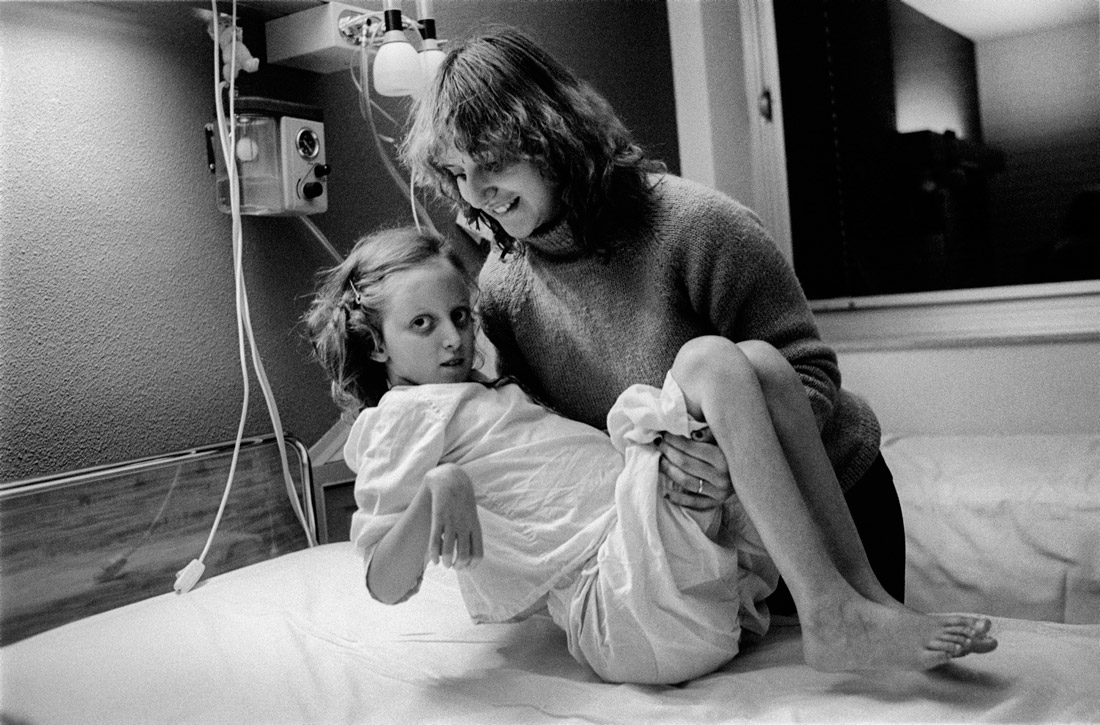
In 1981, photographer Miguel González found nine-year-old Silvia Muñoz in Madrid's Primero de Octubre hospital. Silvia had been admitted with her mother and her pregnant sister, Pilar. Their mother died. González photographed Pilar lifting Silvia back into bed: a family gesture inside a public-health emergency that medicine had not seen before.[9]
The usual account gives that emergency a clean ending. Industrial rapeseed oil was fraudulently sold as food, people were poisoned, and investigators solved the case. The skeptical account gives it no ending at all: because no laboratory isolated one molecule and reproduced the syndrome, the oil explanation remains unproved.
Both versions collapse different questions into one. Investigators learned, with strong epidemiological evidence, which product carried the outbreak into homes. They did not establish with the same confidence which chemical in that product produced the disease, or precisely how it did so. Spain's toxic-oil syndrome is therefore not a story about epidemiology defeating toxicology, or uncertainty defeating public health. It is a case in which the exposure route was identified well enough to stop an epidemic while the last link in the causal chain stayed open.[2][4][5]
Myth: the outbreak announced itself as poisoning
It first looked like an infection. On May 1, 1981, a child from Torrejón de Ardoz arrived at Madrid's Hospital del Rey in fatal respiratory failure. Several relatives were ill, and the death was attributed to atypical pneumonia. As cases multiplied around Madrid and northwestern Spain, legionellosis and other infectious explanations seemed plausible.[1]
The clinical picture did contain a lung illness: fever, breathlessness, pulmonary infiltrates and pleural disease. But it also contained rash, severe muscle pain and a striking rise in eosinophils, white blood cells associated with allergic, parasitic and other inflammatory responses. Microbiological testing did not identify a known pathogen. Nor did investigators see the secondary spread in schools and other closed settings that a readily transmitted respiratory infection should have produced.[1][7]
Then the disease changed shape. By August 1981, clinicians were recognizing muscle wasting, weakness, sensory loss, joint contractures and scleroderma-like skin changes in people whose chest X-rays could already look normal.[7] A later review of 121 patients found that severe neuromuscular illness appeared in 23%, on average 96 days after onset.[3] The name atypical pneumonia described the front door of the syndrome, not the rooms behind it.
The moving case count also matters. A contemporary CDC report recorded 13,222 hospitalizations and 246 deaths by December 24, 1981.[7] A subsequent clinical-epidemiology paper counted 19,828 cases and 315 deaths by June 1, 1982.[3] These are not rival totals; they are time-stamped views of an outbreak whose definition, recognition and delayed complications were still developing.
Evidence: kitchens supplied the comparison group
The decisive evidence did not begin with a mass spectrometer. It began with households.
On June 11, 1981, the Spanish government publicly linked the illness to unbranded cooking oil sold through street markets. That announcement preceded the strongest published analyses, so it did not end the inquiry. Investigators still had to ask whether the apparent oil link could be recall bias, a marker for poverty or neighborhood, or a coincidence produced by searching many household exposures at once.[1]
Different studies approached that problem from different directions. In Pozuelo de Alarcón, investigators compared 48 families of patients with 96 control families from the same district. Case families were far more likely to have a five-liter bottle of unbranded oil at home; the reported odds ratio was 14.[1] In Las Navas del Marqués, a town of 4,009 people, successive case-control studies again tied illness to illegally sold oil and narrowed the association further toward purchases from a particular street vendor.[2]
The strength was not one dramatic statistic by itself. It was the pattern across levels: sick households versus nearby controls, exposure to unbranded oil, kitchen handling, vendor routes and later chemical differences between oils associated with cases and comparison oils. A 1992 assessment reported an odds ratio around 30, a dose-response relationship and a highly specific association. It concluded that the adulterated product could be treated as a necessary cause of this outbreak even though the toxic agent was still unknown.[5]
That distinction is the center of the case. Epidemiology can identify a vehicle without pretending the vehicle is a molecule.
Evidence: removing the product changed the epidemic curve
The Spanish government moved in late June 1981 to recover suspect oil from circulation. Around the same time, occurrence of the acute pneumonic illness fell sharply; the last reported new epidemic case occurred in September.[7]
Withdrawal is not a randomized experiment. Public warnings can change reporting, several interventions may happen together, and exposure may already be declining. But the timing fits the household studies: identify the shared product, remove it, and the arrival of new acute cases collapses. Meanwhile, people already exposed continued into delayed neuromuscular disease. The split between falling incidence and continuing sequelae is exactly what one would expect from an exposure that had stopped but had initiated a long biological process.[3][7]
By October 19, 1981, a royal decree had moved the response beyond case finding and product withdrawal. It created provisional pensions, income support and other protections for affected people and families, explicitly recognizing that the epidemic had produced disability, death and economic precarity that would outlast the acute curve.[8]
Myth: ordinary rapeseed oil—or aniline alone—is the answer
The implicated product was not normal culinary rapeseed oil. Rapeseed oil had been imported for industrial use after being denatured with 2% aniline. It was then processed in Spain in an effort to remove the denaturant and sold door to door or in itinerant markets as inexpensive cooking oil, sometimes represented as olive oil. Recovered products were heterogeneous mixtures that could contain rapeseed oil, other seed oils and animal fat.[1][7]
That supply chain explains why the popular label “rapeseed-oil poisoning” misleads. A food fraud routed a processed industrial product into kitchens; the plant species by itself was not the demonstrated toxin. It also explains why simply naming aniline is insufficient. The contemporary CDC assessment said the clinical syndrome did not resemble known aniline toxicity, and detected compounds did not provide a convincing toxic dose or animal model.[7]
Later chemistry made the trail more specific without closing it. A WHO-supported multidisciplinary review found that case-related oils were strongly associated with fatty-acid esters of 3-(N-phenylamino)-1,2-propanediol, usually shortened to PAP. Researchers could produce these compounds under conditions intended to simulate the suspected oil processing. Yet attempts to reproduce toxic-oil syndrome in laboratory animals failed, and the review left a crucial alternative unresolved: PAP esters might have caused disease, or they might merely mark the processing history of oils that carried some other toxic agent.[4]
The correct statement is therefore narrower than either slogan. The adulterated oil was the outbreak vehicle. Aniline exposure and heat processing helped define the suspect supply chain. No single compound was proved to be the poison.
The serious skeptical reading is about the missing link
Early investigators considered contaminated produce and pesticide exposure, among many other hypotheses.[1] Those alternatives later became part of a broader public argument that the oil attribution had been mistaken or politically convenient. A disputed episode deserves a fair test: what does each explanation account for, and where does it depend on missing evidence?
The strongest skeptical point is real. Toxicological confirmation never matched the epidemiological confidence. No recovered sample reliably recreated the human syndrome in animals, no unique toxicant completed the chain, and the disease itself was unprecedented. Benedetto Terracini, a member of the joint scientific committee that followed the outbreak, described its etiology as unusually complex and emphasized the limits inherent in reconstructing it.[6]
But uncertainty about the molecule does not give every alternative equal weight. A pesticide or produce hypothesis would still need to explain the repeated association with household oil, specific vendors, dose-response evidence, chemical markers in case-related oils and the fall in new acute illness after suspect oil was removed.[1][2][4][5][7] The oil explanation has that converging structure. The alternatives did not acquire comparable positive evidence merely because the toxicology remained incomplete.
This is a useful boundary for reading observational evidence. “Not proved at every biological layer” is not the same as “unsupported.” It tells us which claim can be made strongly and which must remain provisional.
What was solved, and what remains
Spain's toxic-oil syndrome can be separated into four causal layers:
- Distribution: an illicit, unlabeled cooking-oil market carried a hazardous product into households. Evidence: strong.
- Vehicle: case-associated oil was necessary to the outbreak pattern. Evidence: strong, primarily epidemiological.
- Agent: PAP esters, oleyl anilide and other processing-related compounds were investigated, but one disease-producing toxicant was not established. Evidence: suggestive and incomplete.
- Pathogenesis: immune and endothelial injury may explain the multisystem course, but the exact sequence from ingestion to chronic disease remains unresolved. Evidence: incomplete.[4][6]
Public health had to act before all four layers were equally secure. Waiting for the final molecule would have left suspect oil in circulation. Declaring the chemistry finished would have misrepresented what laboratories had found. The responsible position sat between those errors: withdraw the exposure supported by converging evidence, care for affected people, preserve cohorts and samples, and keep the mechanistic claim open.
Return to González's photograph. Silvia Muñoz is not evidence for one compound over another. She is evidence of why the layers matter. The route into her household was understood well enough to stop new families entering the same hospital. The biological route through her body was not understood well enough to offer an antidote or a clean prognosis.[4][9]
The oil was proven in the sense that mattered for stopping the outbreak. The poison was not. Holding both facts at once is not a weakness in the historical record. It is the most accurate account of what the investigation achieved—and of what it still owed the people in the beds.
Sources
- Andreu Segura, Eduardo Spagnolo and José Angel Oñorbe de Torre, “The Toxic Oil Epidemic in Spain, 40 Years Ago,” International Journal of Epidemiology 51(2), 2022 — first-case chronology, June 11 announcement, Pozuelo household study and supply-chain reconstruction.
- J. G. Rigau-Pérez et al., “Epidemiologic Investigation of an Oil-Associated Pneumonic Paralytic Eosinophilic Syndrome in Spain,” American Journal of Epidemiology 119(2), 1984 — Las Navas case-control studies, vendor association and unresolved mechanism.
- E. M. Kilbourne et al., “Clinical Epidemiology of Toxic-Oil Syndrome: Manifestations of a New Illness,” New England Journal of Medicine 309(23), 1983 — time-stamped case totals and the 121-patient clinical-course review.
- Emilio Gelpí et al. and the WHO/CISAT Scientific Committee, “The Spanish Toxic Oil Syndrome 20 Years after Its Onset: A Multidisciplinary Review of Scientific Knowledge,” Environmental Health Perspectives 110(5), 2002 — PAP-esters evidence, animal-model failure and mechanistic uncertainty.
- J. M. Ortega-Benito, “Spanish Toxic Oil Syndrome: Ten Years after the Disaster,” Public Health 106(1), 1992 — assessment of association strength, dose response and the distinction between an epidemiologically identified vehicle and an unidentified toxic agent.
- Benedetto Terracini, “The Limits of Epidemiology and the Spanish Toxic Oil Syndrome,” International Journal of Epidemiology 33(3), 2004 — retrospective on the outbreak's scale, novel clinical course and etiological complexity.
- Centers for Disease Control and Prevention, “Follow-Up on Epidemic Pneumonia with Progression to Neuromuscular Illness—Spain,” MMWR 30, 1982 — contemporary clinical sequence, oil withdrawal, supply-chain details and toxicology boundary.
- Government of Spain, Royal Decree 2448/1981 of October 19 on protection for people affected by toxic syndrome — primary legal text establishing provisional support for affected people and families.
- Cristina G. Lucio and Virginia Hernández, “Antes del COVID, fue la colza,” El Mundo, 2021 — survivor retrospective and source page for Miguel González's archival photograph of Silvia and Pilar Muñoz.