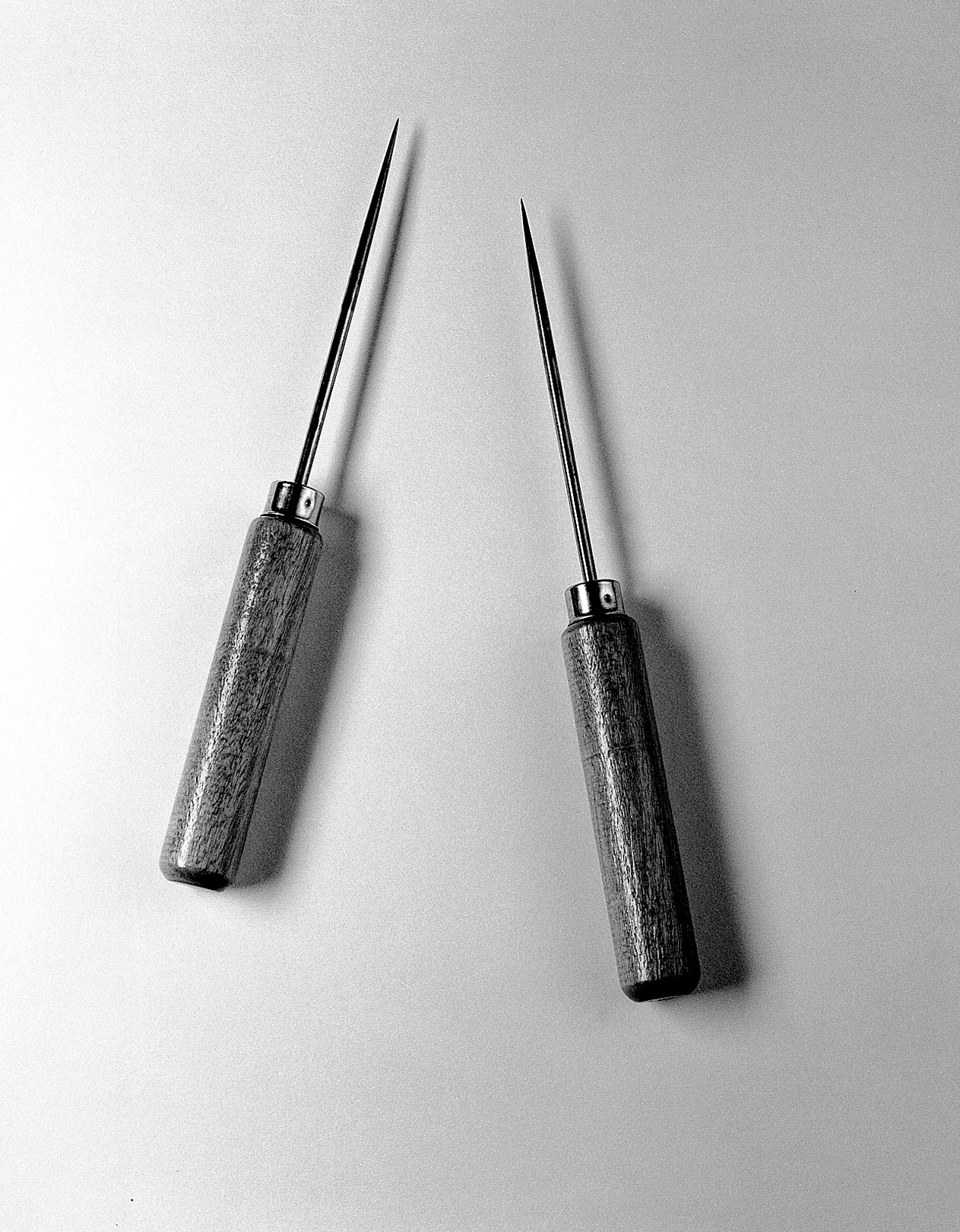
Two polished steel points rise from wooden handles against a plain white field. The objects look menacing now because the history around them has changed. Around 1950, they belonged to a named medical instrument set: Watts–Freeman lobotomy instruments, preserved today by Wellcome Collection.[7]
That ordinary provenance corrects the most comforting myth about lobotomy. It was not simply a bizarre stunt performed at the edge of medicine by one man with an ice pick. Walter Freeman became its most aggressive American promoter, and his transorbital technique deserved the resistance it provoked. But lobotomy also moved through university departments, state hospitals, government surveys, medical journals, teaching films, and a Nobel Prize.[1][2][3][4][5][6]
Calling the procedure mainstream does not mean it was universally accepted or medically sound. Neurosurgeons objected to Freeman's transorbital method; clinicians argued over selection and harms; patients and families lived with results that institutional records could flatten into “improved.” The sharper lesson is that controversy did not keep an irreversible treatment from acquiring authority. Lobotomy became respectable enough to scale before medicine had outcome measures, trial designs, and consent protections proportionate to what the operation could take away.
Myth 1: lobotomy began with the ice pick
The familiar image is the transorbital operation: a pointed instrument passed through the roof of the eye socket and moved through frontal white matter. That was not the beginning.
In November 1935, Portuguese neurologist António Egas Moniz and neurosurgeon Almeida Lima began operating on psychiatric patients after Moniz heard reports that frontal-lobe surgery had altered the behavior of primates. Their first approach injected alcohol into prefrontal white matter. Moniz then developed a leucotome, inserted through openings in the skull to cut cores of white matter. He called the operation prefrontal leucotomy.[3][5]
Freeman, a neurologist, and James Watts, a neurosurgeon, introduced their version in the United States in 1936. Their “standard” prefrontal lobotomy also entered through holes in the skull and used anatomical landmarks to guide a blade. It was already destructive and imprecise, but it remained a surgical procedure performed with a neurosurgeon.[4][5]
Freeman's later transorbital method changed the distribution problem. Adapted from an approach developed by Italian psychiatrist Amarro Fiamberti, it was quicker and did not require a conventional operating room or a neurosurgeon. In an April 1949 paper, Freeman presented transorbital lobotomy as simple, rapid, and suitable for mental hospitals without major neurosurgical facilities.[1] The route through the orbit became infamous because it stripped away some of the practical restraints that had limited brain surgery.
The ice pick is therefore not the whole history. It is the scaling mechanism. Lobotomy had already gained a professional foothold; the transorbital technique made it easier for one promoter to carry the procedure into institutions that lacked specialist surgical capacity.[1][4][5]
Myth 2: respectable medicine rejected it on sight
The documentary trail says otherwise. The National Library of Medicine catalogs a 1942 film in which Freeman and Watts demonstrated prefrontal lobotomy for a professional audience.[6] A film did more than record an operation. It made the procedure teachable and portable: skull landmarks, instruments, radiographs, and technique could be shown beyond one operating room.
In 1947, Britain's Board of Control published Pre-frontal Leucotomy in 1,000 Cases, drawing returns from 43 hospitals.[2] A government survey of that scale does not prove efficacy. It does prove institutional reach. By then, the operation was established enough to require a common questionnaire and a national accounting.
Then came the strongest badge of prestige. In 1949, Moniz received half of the Nobel Prize in Physiology or Medicine for what the award described as the therapeutic value of leucotomy in certain psychoses.[3] The prize did not create lobotomy's authority from nothing. It ratified a treatment already circulating internationally.
None of this amounts to consensus. Watts separated from Freeman over the transorbital method, and the neurosurgical community's objections grew as Freeman treated the operation as something closer to an office procedure.[5] “Mainstream” is not a synonym for unanimous. It means the procedure could command hospitals, surveys, journals, training media, and elite recognition despite serious dissent.
That distinction matters. If lobotomy is remembered only as one rogue doctor's performance, institutions disappear from the explanation. The harder record asks why so many systems found the operation usable.
Myth 3: there was no evidence at all
There was evidence. The problem was what it could prove.
The 1947 British report classified 35 percent of its 1,000 patients as discharged and another 32 percent as improved while still in hospital. It recorded an operative mortality of about 3 percent, mostly from hemorrhage, and classified about 1 percent as worse because of the operation.[2] To contemporary administrators and clinicians facing wards full of people with severe, persistent illness, those figures could look persuasive.
But “discharged,” “quieter,” and “easier to nurse” are not interchangeable with recovery on the patient's terms. An operation might reduce agitation while also producing apathy, emotional blunting, disinhibition, impaired initiative, or a changed personality. Later clinical literature named a post-leucotomy syndrome around those losses.[5] A patient could become less distressed, less expressive, more manageable, or all three. A coarse category could not tell those outcomes apart.
The design problem ran deeper. Patients were selected because they were severely ill and had often received other treatments. Diagnoses were heterogeneous. Procedures and lesion locations varied. Follow-up was uneven. There were no credible randomized comparisons capable of separating surgery from the illness's course, changes in care, selection, observer expectation, and the powerful incentive to interpret a dangerous intervention as worthwhile. The U.S. National Commission's 1977 review of psychosurgery would later emphasize how the absence of adequate controls and objective evidence left major uncertainty about both benefit and impairment.[4]
It is too simple to say every favorable observation was fabricated. Some patients and families reported real relief, and severe psychiatric illness before effective medication could be devastating.[3][4][5] The evidentiary failure was not that doctors collected nothing. It was that optimistic case series and institution-centered outcomes were allowed to carry the burden of proof for irreversible brain injury.
Myth 4: desperation made adoption inevitable
The therapeutic landscape explains urgency, not inevitability. In the 1930s and 1940s, hospitals had few reliable ways to relieve chronic psychosis. Insulin coma therapy, convulsive treatments, prolonged hospitalization, sedation, restraint, and custodial care could themselves be dangerous or dehumanizing. Effective antipsychotic medication was not yet available.[3][5]
At the same time, psychiatric institutions were crowded and under-resourced. Lobotomy promised two outcomes at once: relief of otherwise intractable symptoms and a reduction in the labor required to manage disturbed wards.[4][5] That double promise created a serious conflict. An outcome helpful to a patient could also be helpful to an institution, but the two were not necessarily the same.
Freeman's transorbital method intensified that conflict because ease of delivery looked like access. If a state hospital lacked a neurosurgeon and operating theater, a technique advertised as minor, quick, and safe could be framed as democratizing treatment.[1] The same features also removed friction that might have slowed poor selection or forced another specialist to challenge the plan.
Desperation should therefore remain in the explanation, but not become an excuse. Scarcity made clinicians and families receptive to hope. Overcrowding made administrators receptive to manageability. Professional prestige reduced uncertainty. A simplified technique increased throughput. Those pressures joined; none made irreversible surgery compulsory.
Myth 5: chlorpromazine ended the story overnight
The arrival of chlorpromazine in the early 1950s changed the comparison. For the first time, clinicians had a medication that could reduce severe psychotic symptoms without deliberately destroying frontal connections. As antipsychotic treatment spread, lobotomy's use declined sharply during the later 1950s.[3][5]
The drug was not a clean off-switch. Reports of death, epilepsy, profound personality change, and disabling postoperative syndromes had already altered professional judgment. Neurosurgery was also moving toward smaller, stereotactically targeted lesions. Public opposition grew. Questions of informed consent and the use of surgery on institutionalized people became impossible to treat as side issues.[4][5]
In 1977, the U.S. National Commission for the Protection of Human Subjects published recommendations that placed informed consent, independent review, demonstrable benefit, and protection from social or institutional control at the center of psychosurgery oversight.[4] The existence of modern, highly targeted psychiatric neurosurgery does not rehabilitate frontal lobotomy. It marks how much the evidentiary and ethical threshold had to change: narrower indications, more precise anatomy, multidisciplinary review, and an explicit recognition that altering a brain can alter a person.[4][5]
The useful myth correction is not that every doctor believed in lobotomy, every patient was harmed in the same way, or every reported benefit was false. It is that the procedure crossed too many thresholds on evidence too weak for its permanence.
The two instruments in the photograph are frightening, but their sharpness is not the deepest warning. A sharp object declares its danger. A hospital survey, a teaching film, a journal article, and a Nobel Prize can make danger look settled. Lobotomy's history belongs inside medicine because that is where its lesson has force: authority can accumulate faster than knowledge, especially when an intervention answers both a patient's suffering and an institution's need for order.
Sources
- Walter Freeman, “Transorbital Lobotomy,” American Journal of Psychiatry 105(10), April 1949 — PubMed record for Freeman's article presenting the simplified transorbital procedure and its intended hospital setting.
- Great Britain Board of Control, Pre-frontal Leucotomy in 1,000 Cases (H.M.S.O., 1947) — primary government report, digitized by Wellcome Collection, on outcomes reported by 43 hospitals.
- Bengt Jansson, “Controversial Psychosurgery Resulted in a Nobel Prize,” NobelPrize.org (1998) — Nobel institutional history of Moniz's procedure, the 1949 award, reported outcome surveys, and the arrival of chlorpromazine.
- U.S. National Commission for the Protection of Human Subjects of Biomedical and Behavioral Research, “Use of Psychosurgery in Practice and Research: Report and Recommendations,” Federal Register 42(99), May 23, 1977 — evidence review and proposed safeguards for consent, independent review, vulnerable patients, and institutional-control risks.
- Michael D. Staudt et al., “Evolution in the Treatment of Psychiatric Disorders: From Psychosurgery to Psychopharmacology to Neuromodulation,” Frontiers in Neuroscience 13 (2019) — peer-reviewed history of leucotomy, lobotomy, transorbital scaling, adverse effects, decline, and later targeted techniques.
- U.S. National Library of Medicine, “Guide to Mental Health Motion Pictures” — institutional catalogue context for the 1942 Freeman–Watts teaching film and the professional audiences for historical mental-health films.
- Wikimedia Commons, “Watts-Freeman lobotomy instruments. Wellcome L0026980” — source page and catalogue context for the real photographic image of the circa-1950 instrument set used as the article cover.