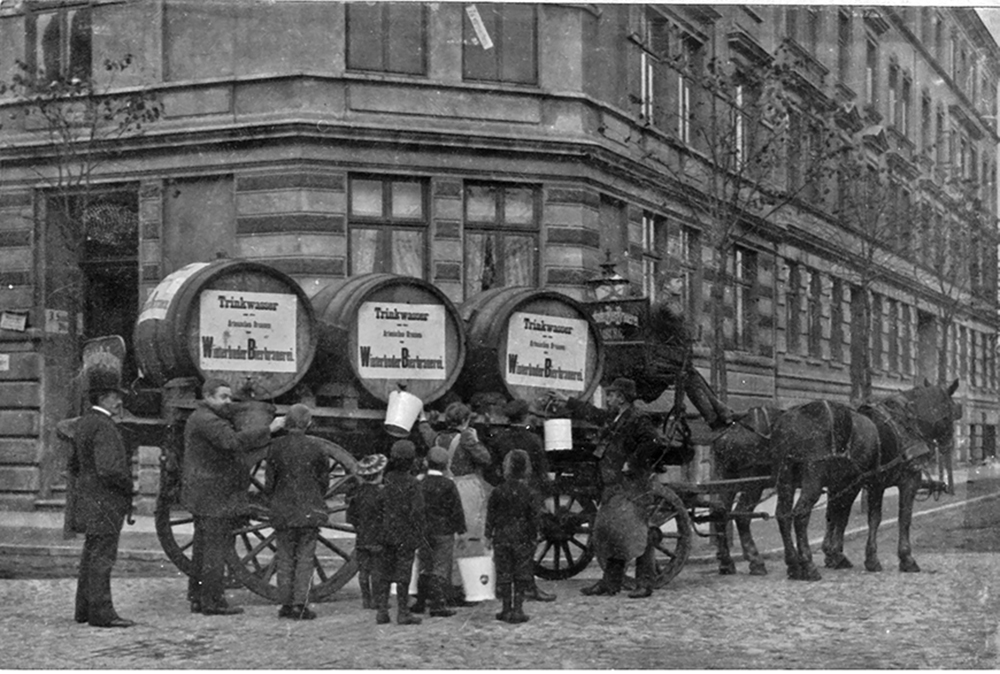
Two horses are harnessed to a wagon carrying three large barrels. Children cluster near the rear wheel; adults wait with pails on a cobbled Hamburg street. One barrel bears the word Trinkwasser—drinking water. The photograph was made during the cholera epidemic of 1892, when safe water had to be carried through the city because the water already moving invisibly through its pipes could kill.[7]
The wagon is an image of rescue, but also of lateness. A mobile barrel can reach one corner and one queue. A municipal supply reaches kitchens, courtyards, workshops, tenements, and taps before anyone has to decide whether the water is safe.
That difference became visible at Hamburg's western edge. Hamburg and Altona were separate jurisdictions in 1892, yet their streets formed one continuous urban fabric. Both drew drinking water from the Elbe. Hamburg distributed it without effective filtration; Altona drew from farther downstream—after the river had received more of Hamburg's waste—but passed it through slow-sand filters. Cholera devastated Hamburg while Altona experienced far less disease.[1][4]
The contrast is often polished into a slogan: filtration saved Altona. The evidence supports that conclusion, but the history is better than the slogan. People crossed the border, case counts were imperfect, poverty altered exposure and survival, and Altona was not literally untouched. Then, in the winter of 1892–1893, faults in some of Altona's filters were followed by a small waterborne outbreak. The two cities therefore offer more than a tale of one wise municipality and one foolish one. Together they show what preventive infrastructure does, how epidemiologists recognized its effect, and why even a successful barrier has to be watched.
One urban body, two water histories
Altona's advantage had been built decades before the epidemic. Its Baursberg waterworks opened in 1859 with multiple basins in which Elbe water was filtered. Hamburg also possessed an ambitious piped-water system, but it had not completed the same protective step. By 1892, its water was still being taken from the Elbe and Alster and delivered unfiltered. A filtration project was under construction, but not ready.[1][3]
This was not simply a contest between modern science and medieval ignorance. Piped water was itself modern infrastructure. It made water more available and could support firefighting, washing, and urban growth. Yet a distribution network is indifferent to what it distributes. Once Vibrio cholerae entered the source, the same efficiency that normally served the city could create a broad, nearly simultaneous exposure.
The scientific chronology made Hamburg's delay harder to excuse. John Snow's London work had supplied strong epidemiological evidence for waterborne cholera in the 1850s. Robert Koch isolated the cholera organism in 1884. But evidence does not install a filter by itself. Hamburg's commercial priorities, cost objections, and continued attachment to rival environmental theories all slowed the conversion of knowledge into a working barrier.[1][4]
Altona made the opposite infrastructural bet. Its intake lay downstream of Hamburg and was therefore, before treatment, the less reassuring source. The comparison did not ask whether pristine water was better than dirty water. It asked whether treatment could turn a more contaminated source into a safer supply. That inversion is why the case became so persuasive to sanitary engineers: the downstream city did better.[4]
August 1892: the pipes outran the warning
Hamburg's official history places the first recognized death on August 15, 1892, followed the next day by a coworker with similar vomiting and diarrhoea. Sixteen more people reportedly became ill during the first two days. Yet the city did not promptly announce Asiatic cholera. By the time a physician from Altona took the question to Koch's institute on August 22, more than 200 people had died and illness had spread across Hamburg.[2]
The delay mattered because cholera is an exposure problem before it becomes a hospital problem. A warning can tell people to boil water. Isolation can reduce transmission from patients. Barracks can separate the sick from crowded wards. None of those measures is as early in the causal chain as preventing contaminated water from entering the network.
From August into October, Hamburg recorded nearly 17,000 illnesses and 8,605 deaths according to modern institutional accounts.[1][2][7] Contemporary totals were not perfectly stable: Koch's later English-language report rounded the summer epidemic to 18,000 cases and 8,200 deaths.[5] The disagreement is a useful warning against treating historical surveillance as a laboratory instrument. Diagnostic criteria, reporting cutoffs, late registrations, and the boundary between severe cholera and milder diarrhoeal illness could all move a total. No reasonable version of the record, however, makes the catastrophe small.
Nor was exposure socially flat. Hamburg's museum history emphasizes the dense, unhygienic housing of districts near the port.[7] Koch's account likewise cautioned that cleanliness, nourishment, housing density, and habits could modify the pattern even during a common water exposure.[5] The network explains the epidemic's reach, not every difference in who became ill or died.
The border became an epidemiological instrument
The cleanest comparison appeared where urban similarity was greatest. In 1894, Georg Gaffky published a map of cholera along the Hamburg–Altona boundary. It marked illnesses in black and deaths in red. On either side of the municipal line stood parts of the same metropolitan settlement, with comparable weather and adjacent streets. Yet the marks accumulated mainly on the Hamburg side, where households received Hamburg water.[1]
That boundary did not randomize residents. People worked, visited, shopped, and drank across it. Koch's report says that many Altona cases during the summer could be connected to Hamburg—people had likely acquired the infection on Hamburg soil or from someone exposed there.[5] Mobility blurred the comparison, as it would in any real city.
But mobility should have blurred it toward sameness. Instead, a strong discontinuity remained. The National Research Council's historical review describes Koch tracing incidence through the cities' contorted border areas, where climate and soil could not plausibly change at the municipal line. The most important variable that did change was the water supply.[4]
Three layers of evidence therefore pointed in the same direction:
- At city scale, Hamburg suffered an explosive epidemic while filtered Altona had markedly lower incidence.[1][4]
- At the boundary, disease followed water-service territory more closely than the continuous street grid.[1][4]
- At the individual level, investigators could explain a share of Altona's cases through contact with Hamburg, rather than treating every Altona address as evidence that filtration had failed.[5]
None of those layers alone is a randomized trial. Together they form a strong historical causal argument. The comparison had a mechanism, a sharp exposure contrast, a spatial pattern, and exceptions that could often be investigated rather than hidden.
Altona's winter outbreak made the lesson stricter
If the story ended at the border map, filtration might sound like a passive possession: build it once, and a city becomes safe. Altona's winter experience shows why that is wrong.
From late December 1892 into February 1893, cholera appeared again in scattered Altona households. This time, many patients had no plausible contact with Hamburg. Koch's investigators turned back to the waterworks. Routine samples from the combined clean-water reservoir had shown bacterial counts rising; on January 12, one count reached 1,516 bacteria per cubic centimetre. Later testing found that some individual filters were performing badly even when water mixed from all the filters made the reservoir result look less alarming.[5]
The investigation did not prove that every winter case came through the same route. It identified both a contaminated well and disturbances in the filters. Koch counted 47 cases and 27 deaths in Altona between December 23 and February 12. Authorities repaired the filtration faults, closed the implicated well, isolated patients, relocated exposed residents where housing made separation impossible, and intensified disinfection. The outbreak ended.[5]
This episode does not weaken the summer comparison. It supplies a second, smaller comparison inside Altona itself: filtration working versus filtration underperforming. When the barrier was maintained, the downstream intake was made far safer. When performance deteriorated, scattered disease reappeared. The protection lived in operation—filtration rate, cleaning, sampling points, laboratory review, and corrective action—not in the mere existence of filter beds.
It also exposed a measurement problem that still feels modern. Testing only the blended output could conceal a badly performing unit because better filters diluted its signal. The response was to make individual filters testable. Public-health infrastructure became safer when the city could observe its components, not just admire the average at the end.
What changed after the comparison
Hamburg rushed its delayed filtration works at Kaltehofe into operation in May 1893. The epidemic also helped institutionalize a broader hygiene authority responsible for water, wastewater, food control, and outbreak prevention.[1][2] The lesson traveled beyond one city. The Hamburg–Altona contrast became a standard demonstration that water treatment could interrupt disease even when the raw source remained exposed to sewage.[4]
It would be too neat to say that one epidemic created modern water safety. Slow-sand filtration was already in use; Snow's water evidence was decades old; bacteriology had identified the organism; and political choices had determined which city acted on that knowledge. Hamburg's catastrophe was not an unavoidable price of discovery. It was, in part, the price of delayed implementation.
The modern boundary is also wider than filtration alone. The World Health Organization describes cholera as an acute infection acquired from food or water contaminated with Vibrio cholerae, and places safe water, sanitation, hygiene, surveillance, rapid treatment, and vaccination inside the control system. Severe disease can become fatal within hours without rehydration.[6] A filter is one barrier in that system, not a substitute for sewage control, reliable operation, prompt warning, or care.
That is why the water wagon remains such a sharp photograph. It shows a city improvising a visible supply after its invisible one had betrayed it. Altona's filters worked earlier and at a more powerful scale: before a family needed a pail, before a doctor needed a diagnosis, before a hospital needed another bed.
Hamburg and Altona shared a river, a labor market, and a metropolitan street grid. What they did not share was the same preventive infrastructure. The epidemic made that administrative difference biologically legible—and Altona's winter failure added the necessary final clause: a barrier protects a population only while a system keeps it working.
Sources
- University Medical Center Hamburg-Eppendorf, Medical History Museum, “Karte ‘Die Cholera an der Grenze’” — institutional account of Gaffky's 1894 border map, the divided water systems, Hamburg's epidemic totals, and completion of filtration at Kaltehofe.
- Free and Hanseatic City of Hamburg, Institute for Hygiene and Environment, “Die Cholera in Hamburg” — official chronology of the August 1892 recognition delay, deaths, emergency controls, filtration, and creation of the hygiene institute.
- Free and Hanseatic City of Hamburg, Altona District Office, “Wasserwerk Altona” — institutional history of the Baursberg waterworks, opened in 1859 with basins for filtering Elbe water.
- National Research Council, Drinking Water and Health, “Historical Note” (National Academies Press, 1977; NCBI Bookshelf) — synthesis of the same-river, downstream-intake, border, and filtration comparison.
- Robert Koch, Professor Koch on the Bacteriological Diagnosis of Cholera; Water-Filtration and Cholera; and, The Cholera in Germany during the Winter of 1892–93 (English translation by George Duncan, 1894; Wellcome Collection) — primary account of case classification, the summer comparison, Altona's winter filter faults, water testing, and response.
- World Health Organization, “Cholera” (fact sheet, December 5, 2024) — current transmission, prevention, surveillance, and treatment context.
- Stiftung Historische Museen Hamburg, Sönke Knopp, “Cholera in Hamburg” (April 2020) — source page for the archival water-wagon photograph and museum account of emergency water stations, isolation barracks, housing conditions, and the 1893 filtration works.