
An incentive spirometer looks almost too simple to deserve instruction: a clear chamber, a piston, a small coaching indicator, a tube, and a mouthpiece. Yet its simplicity is the point. After an operation, pain, sedation, fatigue, and time in bed can make ordinary deep breaths less ordinary. The device gives a patient something visible to do with an otherwise invisible action: inhale slowly, sustain the breath, pause, and repeat according to the plan set by the care team.[5][7]
The two NHS videos below make different parts of that action legible. Portsmouth Hospitals University NHS Trust places the device in its broader “iCOUGH” recovery program; University Hospitals of Derby and Burton demonstrates it for patients preparing for upper-gastrointestinal or bariatric surgery.[1][2][3][4] Together they teach the mechanics well. They also create a useful question that neither plastic nor video can answer alone: does performing the maneuver correctly prove that the device, by itself, prevents postoperative lung complications?
It does not. Technique and outcome are separate evidence problems. The spirometer can coach a slow, sustained inspiration. Whether it should be used, how often, what target is appropriate, and how it fits with pain control, coughing, movement, and other respiratory care depend on the patient and the clinical plan.[5][6][7] That boundary is not a reason to dismiss the device. It is the reason to watch closely and describe its job precisely.
Video 1: the useful motion is slow, not spectacular
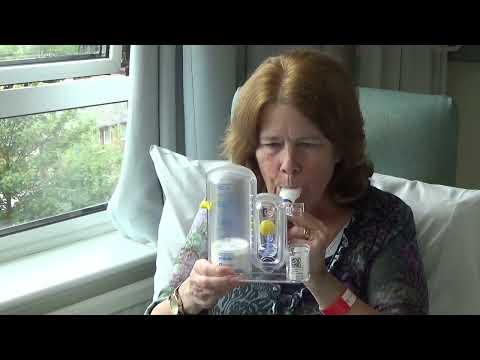
Portsmouth’s short demonstration begins by reducing the task to one breath. The patient sits upright, seals her lips around the mouthpiece, and draws air in rather than blowing out through the tube.[1] Watch the two moving parts: the large piston records how much air is inhaled, while the smaller coaching indicator responds to the rate of that inhalation. A high number reached by a hurried gasp is not the same maneuver as a controlled rise held over time.
The video is valuable because it shows restraint. The patient is not trying to make the device jump. She keeps it upright, makes a seal, and lets the piston rise with a deliberate inspiration. The small indicator acts as a tempo cue: on common volume-oriented devices, it moves out of its target range if the breath is too fast or too slow.[5][7] The chamber therefore displays two different facts at once—volume and pace—and the viewer has to resist collapsing them into a single score.
That distinction explains the breath hold. The aim is not merely to touch a line and release it. AARC describes incentive spirometry as a sustained maximal inspiration, and both its guideline and MedlinePlus place a brief hold after the slow inhalation.[5][7] The exact duration and target should follow the device instructions and the treating team. The transferable idea is sequencing: exhale normally, seal, inhale slowly and deeply, pause, then exhale and rest before another attempt.
The frame also reveals what can go wrong without looking dramatic. A loose lip seal leaks the effort around the mouthpiece. A tongue over the opening obstructs flow. Tilting the chamber changes how gravity acts on the piston. Repeated fast pulls can turn a breathing exercise into a race, while repetitions without a pause can make someone light-headed. MedlinePlus advises stopping, removing the mouthpiece, and breathing normally if dizziness occurs; it also lists worsening shortness of breath, chest pain, fever, or increased cough as reasons to contact a clinician.[7]
Portsmouth’s own page sets this demonstration inside a larger routine. It pairs incentive spirometry with coughing and deep breathing, oral care, education, getting out of bed, and head-of-bed elevation.[3] That context changes the meaning of the clip. The device is not presented as a lone machine that “opens the lungs” while everything else becomes scenery. It is one coached action among several actions that address different parts of postoperative recovery.
Video 2: the target is personal, and the setup is clinical
The University Hospitals of Derby and Burton video starts one step earlier, with the spirometer still packaged and the pieces separated.[2] That opening is more than housekeeping. Assembly, an upright device, a clear mouthpiece, and a target explained by a clinician are preconditions for useful feedback. The trust’s surgical pages tell patients that the device will be supplied at a preoperative appointment or on the day of surgery, placing the lesson inside a real care pathway rather than treating it as a generic home challenge.[4]
Watch how the demonstrator handles the instrument before watching the piston. The base remains level; the tube is connected without kinking; the mouthpiece is brought to the user rather than forcing the body into a collapsed posture. When the inhale begins, the large chamber and the flow cue again move together.[2] The visible number is feedback on that attempt, not a diagnosis of lung health and not a competition with another patient.
This is where a target can help or mislead. A clinician-set marker gives the next breath a concrete aim and can make changes over time visible.[5][7] But a number copied from a stranger, a package chart, or yesterday’s best attempt may be inappropriate for the person in the bed today. Pain, the type of surgery, pre-existing lung disease, fatigue, positioning, and the device design all affect performance. A falling value may be a reason for the care team to reassess technique or the patient; it is not a result that an article can interpret safely at a distance.
Frequency deserves the same caution. Portsmouth’s program asks its patients to alternate breathing work and spirometry during waking hours, while MedlinePlus gives a common range and immediately defers to the prescriber’s directions.[3][7] The AARC guideline found no evidence establishing one optimal frequency.[5] Those differences are not editorial noise. They show why “do ten every hour” should not be detached from the service, operation, device, and patient for which it was taught.
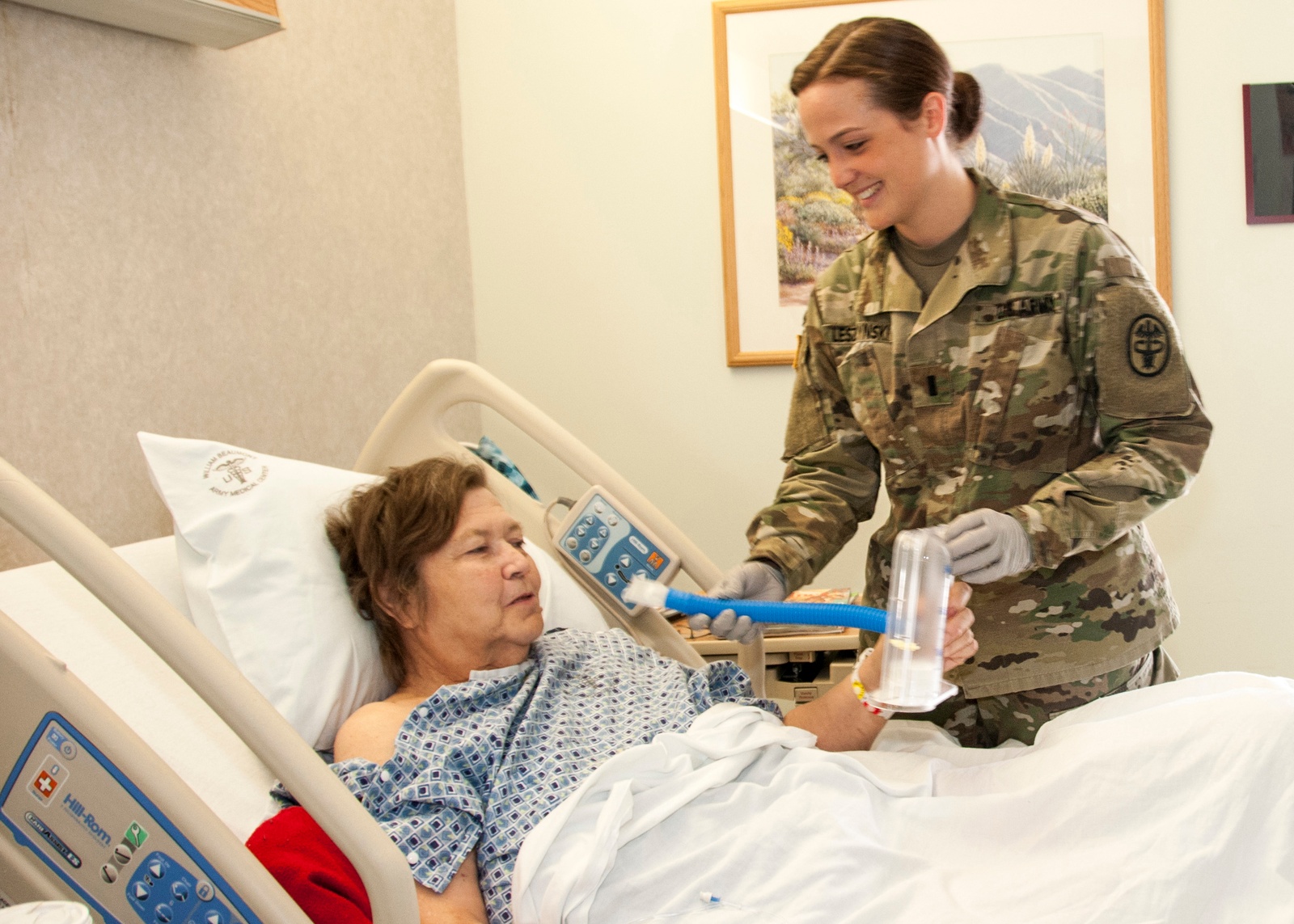
The second video therefore adds a crucial layer to the first: correct motion is taught, not inferred. The nurse and patient in the lead photograph make that relationship especially clear.[8] The patient holds the chamber, but a clinician can check posture, seal, pace, pain, dizziness, understanding, and the fit between the exercise and the rest of the recovery plan. A public video is good at refreshment. It is not a substitute for that assessment.
The outcome evidence is less tidy than the bedside script
The physiological story is plausible. A slow, deep inspiration gives visual feedback and encourages a larger breath than shallow postoperative breathing may otherwise produce.[5] Plausibility, however, is not the same as proof that routinely handing out the device prevents pneumonia, atelectasis, respiratory failure, or death.
The most useful quantitative check comes from a 2021 systematic review and meta-analysis of 31 randomized trials involving 3,776 adults after cardiac, thoracic, or upper-abdominal surgery.[6] When incentive spirometry was compared with other rehabilitation strategies or no intervention, it did not significantly reduce 30-day postoperative pulmonary complications: the pooled risk ratio was 1.00, with a 95% confidence interval of 0.88 to 1.13.[6] Mortality and length of stay also showed no clear advantage. The review’s conclusion was appropriately narrow: incentive spirometry alone probably produces little or no reduction in those outcomes compared with the alternatives studied.
That word alone matters. AARC’s guideline reviewed 54 trials and systematic reviews and recommended against routine stand-alone use before or after surgery to prevent pulmonary complications.[5] It instead placed the device, when used, alongside deep-breathing techniques, directed coughing, early mobilization, and adequate analgesia. The same guideline suggested that coached deep-breathing exercises may provide similar benefit. In other words, the plastic chamber may make the breath easier to teach and observe without being the uniquely effective ingredient.
This evidence does not prove that no selected patient can benefit, that feedback has no teaching value, or that a clinician should discard a prescribed plan. Trials vary in surgery type, comparison treatment, adherence, coaching, and outcome definitions; some evidence remains low certainty.[5][6] The responsible conclusion is smaller and more useful: do not convert a clear demonstration into a guaranteed outcome claim. Ask what the device contributes to the whole program, and keep the uncertainty visible.
What to carry from both videos
Used together, the clips offer a compact technique check. The device is upright. The lips seal around the mouthpiece. The user inhales through it rather than blowing into it. The large piston rises slowly while the coaching indicator helps regulate pace. The inhale ends in a brief hold, followed by an unforced exhale and a rest. The target and schedule come from the patient’s own care plan.[1][2][5][7]
The more important synthesis sits outside the frame. Pain must be controlled well enough to breathe and cough. Secretions may need to be cleared. The person needs appropriate movement and positioning. Equipment has to be understood, clean, and close enough to use. A concerning symptom needs escalation, not another attempt at beating the marker.[3][5][7]
That is why an incentive spirometer is best understood as a coaching interface. It translates one slow inspiration into movement a patient and clinician can see. The videos teach that translation clearly. The evidence sets its limit just as clearly: a well-performed breath can be part of recovery, but no piston can carry the whole system by itself.
Sources
- Portsmouth Hospitals University NHS Trust, “Incentive spirometer” (YouTube, published May 1, 2024) — the embedded patient demonstration of slow inhalation and device feedback.
- University Hospitals of Derby and Burton NHS Foundation Trust, “Using an Incentive Spirometer” (YouTube, published February 5, 2026) — the embedded setup and technique demonstration.
- Portsmouth Hospitals University NHS Trust, “iCOUGH” — institutional context for spirometry, coughing and deep breathing, oral care, education, mobilization, and positioning in postoperative recovery.
- University Hospitals of Derby and Burton NHS Foundation Trust, “Upper Gastro-Intestinal (GI) surgery” — official placement of the spirometer demonstration in preoperative and postoperative physiotherapy education.
- Restrepo RD, Wettstein R, Wittnebel L, Tracy M, “Incentive Spirometry: 2011,” Respiratory Care 56(10):1600–1604 — AARC clinical practice guideline on technique, evidence, frequency uncertainty, and combined care.
- Sullivan KA, Churchill IF, Hylton DA, Hanna WC, “Use of Incentive Spirometry in Adults following Cardiac, Thoracic, and Upper Abdominal Surgery to Prevent Post-Operative Pulmonary Complications,” Respiration 100(11):1114–1127 (2021) — systematic review and meta-analysis.
- MedlinePlus Medical Encyclopedia, “Using an incentive spirometer” (reviewed October 19, 2025) — patient technique, clinician-set targets, common scheduling language, and symptom boundaries.
- Marcy Sanchez, William Beaumont Army Medical Center, “WBAMC exceeds patient care benchmark” (DVIDS, photographed April 11, 2017) — source page for the documentary bedside photograph.