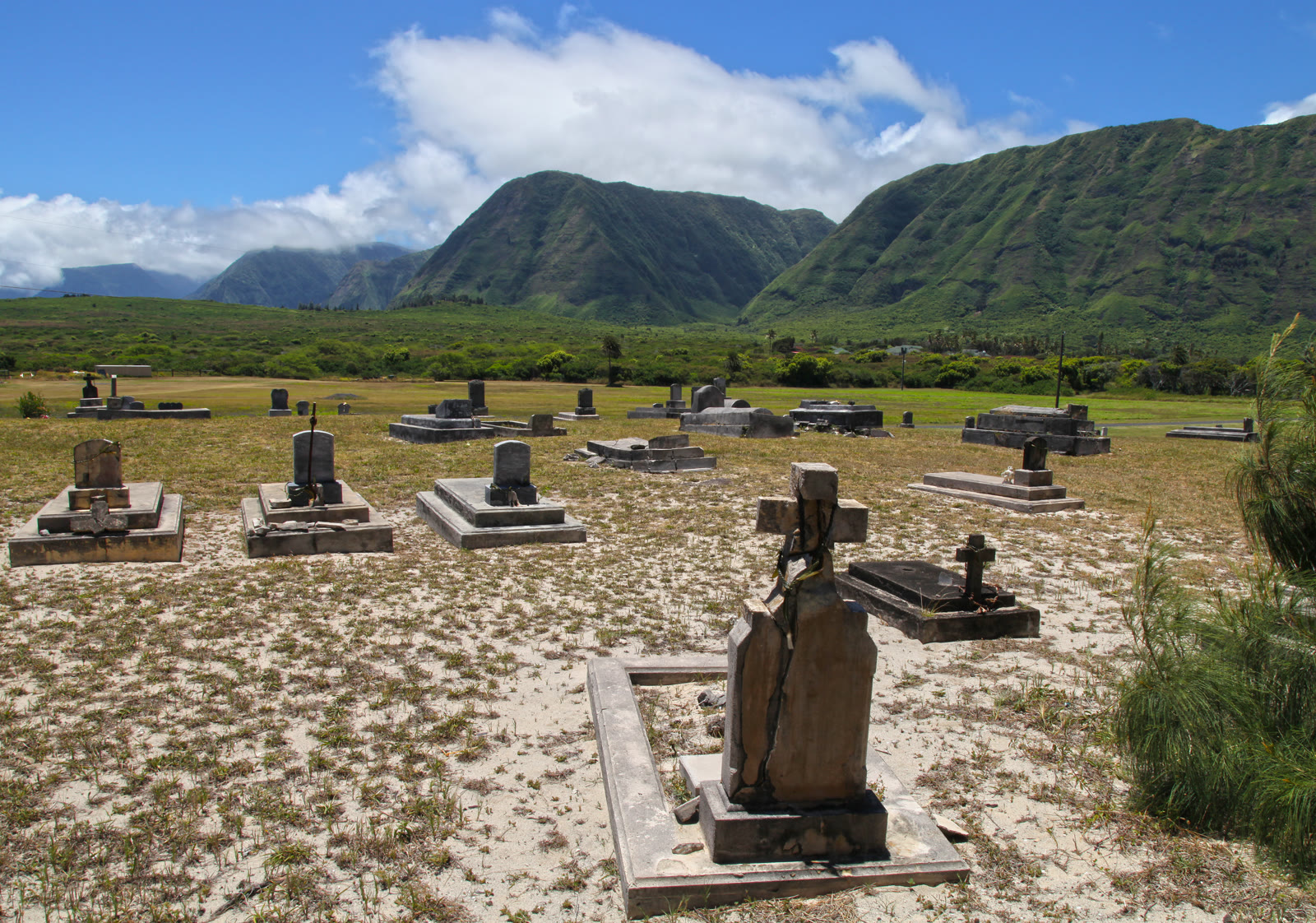
The cover photograph looks across Papaloa Cemetery. Stone markers occupy a field of sand and dry grass; beyond them, Kalaupapa's green cliffs fill the horizon. The view might read as scenery if the graves did not interrupt it. The cliffs did not create a prison by themselves. Public policy recruited the landscape for isolation.[1][2][10]
The proposed Kalaupapa Memorial is not in the frame. Its central material currently exists as a digitally compiled list of people taken to the peninsula under Hawai‘i’s Hansen's disease policy; the disease was historically called leprosy.[3][4] Those names have not yet reached their intended place in the landscape, but they already reverse the work of an old archive. An admission register once recorded a person's arrival inside forced isolation. Researchers and descendants are now reading the same trail in the opposite direction: from category back to individual, from an admission date back to a family, and from enforced disappearance back to public presence.
What can an unbuilt memorial already do? At Kalaupapa, the answer is unusually concrete. The Names Project has turned records into family connections while the physical monument has spent years moving through law, funding, land, design, and preservation review. The project therefore reveals both the power and the limit of commemoration. Recovering a name can repair an absence in the historical record. It cannot make forced isolation just, and it does not release institutions from finishing the place that patient residents asked them to build.
The first register served separation
The Hawaiian Kingdom authorized the isolation of people believed to have Hansen's disease in 1865, and forced relocation to the Kalaupapa peninsula began in 1866. The policy also displaced Native Hawaiian communities already living there. Over the next century, more than 8,000 people were exiled to Kalaupapa; Ka ‘Ohana O Kalaupapa estimates that about 90 percent were Native Hawaiian.[1][3][7]
The administrative record could be detailed. Admission registers carried names, ages, dates, home islands, hometowns, and sometimes dates of death.[4] But detail did not guarantee recognition. In the machinery of isolation, those fields documented a population the government had transported and retained under a diagnosis. Husbands and wives were separated; children could be taken from parents; many people never returned to their former homes.[1][3][7]
To remember only that machinery would flatten the people again. Kalaupapa residents made homes, friendships, congregations, clubs, music, work, newspapers, and political claims under coercive conditions. The State of Hawai‘i’s current account describes both severe hardship and the community residents built over time.[1][3][4][7] That distinction matters: the policy imposed exile, but it did not author every meaning of life on the peninsula.
Medicine changed before the law did. Sulfone drugs were introduced in Hawai‘i in 1946, bringing effective treatment and undercutting the medical rationale for compulsory separation. Hawai‘i did not repeal the isolation requirement until 1969.[1][7] The 23-year interval is part of the health history. It shows that a control policy can outlast the condition used to defend it when law, administration, and stigma move more slowly than treatment.
The cemetery cannot carry every name
Kalaupapa's landscape is already a memorial, but it is an incomplete index. The National Park Service counts roughly 1,200 grave markers and several hundred unmarked graves across more than 15 cemeteries. Ka ‘Ohana O Kalaupapa uses a different measure and says only about 1,000 graves can now be identified. Those figures need not describe precisely the same set: a marker may be damaged or illegible, and a burial may never have had a durable marker. Both accounts point to the same gulf between thousands of lives and the much smaller number that the ground can still identify by name.[2][3]
Absence has more than one cause here. Salt, weather, vegetation, disaster, and limited maintenance damaged markers over time. Since 2008, the Park Service has run a recurring preservation program, treating gravestones not merely as objects but as family records that can reconnect descendants with a line of kinship.[2]
That work makes the proposed memorial more necessary, not less. Cemetery conservation protects what survives in place. A comprehensive roll of names can acknowledge people whose burial location is uncertain, whose marker has vanished, or whose place in family history was obscured by separation and stigma.[2][3][4] The two forms of memory answer different questions: What remains here? and Who must not disappear from the account?
Congress established Kalaupapa National Historical Park in 1980, after deliberation and at the request of patient residents.[1] The park protects a living community as well as a historic landscape. That fact should restrain the familiar tourist story of a beautiful “natural prison.” The cliffs and ocean made state control easier, but residents did not become scenery. Any memorial worthy of them has to preserve their authorship, not simply arrange their suffering for visitors.
Residents asked for everyone, not another lone hero
The call for a comprehensive memorial came from Kalaupapa residents themselves. Ka ‘Ohana traces the idea to Paul Harada in 1985. Other residents returned to it over the following years, and in 2003 a petition circulated through the settlement before residents, relatives, and friends formed Ka ‘Ohana O Kalaupapa. Their request was exacting: honor all the people sent away, by name.[3]
That choice changes the center of the story. Kalaupapa is often narrated through Saint Damien or another prominent caregiver. Those lives belong in its history, but a monument organized around nearly 8,000 names refuses to let a celebrated helper stand in for the community. It makes the people governed by public-health policy the grammatical subjects of remembrance.
The list had to be made. In the spring of 2007, Kalaupapa leader Bernard Punikai‘a urged the organization to begin compiling names. Law worked from handwritten records held by the Hawai‘i State Archives and assembled the first 5,000 people admitted between 1866 and 1896. Hawaiian-language specialists reviewed the work. The project later expanded beyond an engraved roll into a digital library joining admission registers to birth, marriage, death, census, church, newspaper, and letter records. Native Hawaiian genealogist Lenneth Lorenzo joined the research in 2024.[4]
Even the right to publish that list had to be clarified. A 2003 Hawai‘i information-practices opinion had treated the names as potentially protected, depending on which agency held them. On January 9, 2020, the state's Office of Information Practices reconsidered after the federal memorial law and a change to federal health-privacy rules. It concluded that the names must be disclosed; in this specific case, it also found that the public interest outweighed the privacy interest in disclosing date of birth, age at admission, and gender.[8]
That was a narrow ruling, not a declaration that old health records lose all privacy. Its significance lies in the reversal it formalized. The memorial did not merely consume a list that had always been public. Its legal requirement helped change the public status of records created under the isolation regime. Commemoration became a reason to open part of the archive, while the decision still required an explicit balance between family history and medical privacy.[5][8]
This is slow, interpretive labor, not data entry. A historical name may appear under variant spellings. A register can record where someone was sent without explaining who mourned the separation. A date of admission can locate the beginning of custody while concealing the life that followed. Connecting sources does not eliminate those gaps, but it keeps one bureaucratic line from becoming the entire biography.
The clearest measure of the project's value is not the length of its spreadsheet. By mid-2019, Ka ‘Ohana reported that the archive had helped more than 1,000 descendants learn about ancestors connected to Kalaupapa.[4] That is commemoration operating before construction: not simply preserving information, but restoring family ties that isolation and stigma had broken.
Congress turned the list into a public obligation
The federal law signed on March 30, 2009 did more than permit an unspecified monument. Section 7108 of Public Law 111-11 directed the interior secretary to authorize Ka ‘Ohana to establish it and required the design to display the first 5,000 names from 1866–1896 and roughly 3,000 names from the later settlement. It also made location, size, design, and inscriptions subject to federal approval and assigned fundraising and construction costs to the nonprofit.[5]
The precision is important. “Nearly 8,000” can become a tragic statistic that a reader absorbs and forgets. The statute made the research itself part of the memorial's legal design. It also created a difficult division of responsibility: government authorized the work and retained approval power, while a community organization had to assemble the names and secure the money needed to give that mandate physical form.[5]
Ka ‘Ohana's conceptual design refuses an alphabetical wall. It places names chronologically because residents remembered the people with whom they arrived by ship; the changing density of names from year to year will also expose waves of exile. An alphabetical reference book at the site is meant to help descendants find relatives. The two orders serve different forms of knowledge: one preserves arrival cohorts and the pressure of policy over time, while the other supports a family search.[9]
In 2022, Hawai‘i appropriated $5 million for planning and construction, according to Ka ‘Ohana.[3] Even then, land and preservation questions remained. A State of Hawai‘i staff paper dated August 28, 2026 recommended a one-year right of entry for due diligence and approval of a 65-year lease covering about 5.9 acres near Saint Philomena Church. Before a lease can be executed, the organization still must complete cultural-resource consultation, reach a written agreement with the Park Service, and obtain approval of the location, design, and inscriptions from the secretary of the interior. Final design and construction also return to the state land board for approval.[6]
Those requirements are not empty obstacles. Kalawao is a burial landscape where cultural and archaeological resources require formal review. Building a memorial to people whose wishes were overridden cannot justify overriding the place again. Consultation and careful design are part of the ethical work.[6]
But procedure also has a human clock. Many residents who advocated for the memorial died before seeing it built. Ka ‘Ohana now describes an October 2028 dedication as a hope, not a completed schedule.[3] The distinction between protection and drift is therefore crucial: review should make the memorial more faithful, while delay without decision can reproduce the very disappearance the project was formed to resist.
A name is a beginning, not restitution
The future monument cannot reverse exile. It cannot give back childhoods, marriages, land, health, or years spent under a law that remained after effective treatment arrived. Nor can a wall of names, by itself, prevent disease stigma from finding a new target. Commemoration becomes sentimental when it turns recognition into proof that an institution has settled its debt.
The Names Project does something both smaller and more durable. It changes the unit of public memory. The history no longer begins and ends with an old diagnostic label, a count, or a famous caregiver. It opens onto named people with home islands, occupations, relationships, words, descendants, and choices made inside confinement. It also lets families decide how to reconnect rather than treating exposure as the price of inclusion.
That is why the list matters, and why it is not enough. Its entries already help descendants move through an archive that once separated their relatives from ordinary family history. The physical memorial would make that reversal collective and visible in the place where the policy was lived. One form repairs relationships one search at a time; the other promises that the whole public record will have to stand among the names.
At Kalaupapa, remembrance is not waiting passively for stone. It is happening whenever a register yields a family connection, a marker is made legible, or a resident's demand governs the design. Finishing the monument would not complete justice. It would complete one specific promise: that the people whom public health once sorted for removal will be encountered, together, as people who belonged.
Sources
- State of Hawai‘i Department of Health, “Kalaupapa Updates” — official history of forced relocation, repeal of isolation in 1969, the living community, and creation of the national historical park.
- National Park Service, “Cemeteries” — official account of Kalaupapa's marked and unmarked graves, threats to grave markers, and the preservation program's role in family history.
- Ka ‘Ohana O Kalaupapa, “The Kalaupapa Memorial: Long an Idea of the Kalaupapa Residents” — patient-led origins, petitions, demographic context, legislative milestones, and the organization's hoped-for dedication window.
- Ka ‘Ohana O Kalaupapa, “The Kalaupapa Names Project” — research methods, archival fields, family-restoration work, and current project updates.
- U.S. Government Publishing Office, Omnibus Public Land Management Act of 2009, Public Law 111-11, § 7108 — enacted authorization, required name groups, approval structure, and funding responsibility for the Kalaupapa memorial.
- State of Hawai‘i Department of Land and Natural Resources, Board of Land and Natural Resources Item D-10 (August 28, 2026) — official staff paper on the proposed right of entry, 65-year lease, site, due-diligence conditions, and remaining approvals.
- National Park Service, “A Brief History of Kalaupapa” — official chronology of the settlement, introduction of sulfone treatment in Hawai‘i in 1946, and repeal of compulsory isolation in 1969.
- State of Hawai‘i Office of Information Practices, U Memo 20-5, “Names of Individuals Sent to Kalaupapa” (January 9, 2020) — ruling on disclosure of names and specified biographical data after the federal memorial law.
- Ka ‘Ohana O Kalaupapa, “The Design of the Kalaupapa Memorial” — patient-supported conceptual design, interlocking circles, chronological name order, and alphabetical reference book.
- National Park Service, “Papaloa Cemetery” — source page and provenance for the article's documentary photograph of surviving grave markers and Kalaupapa's cliffs.