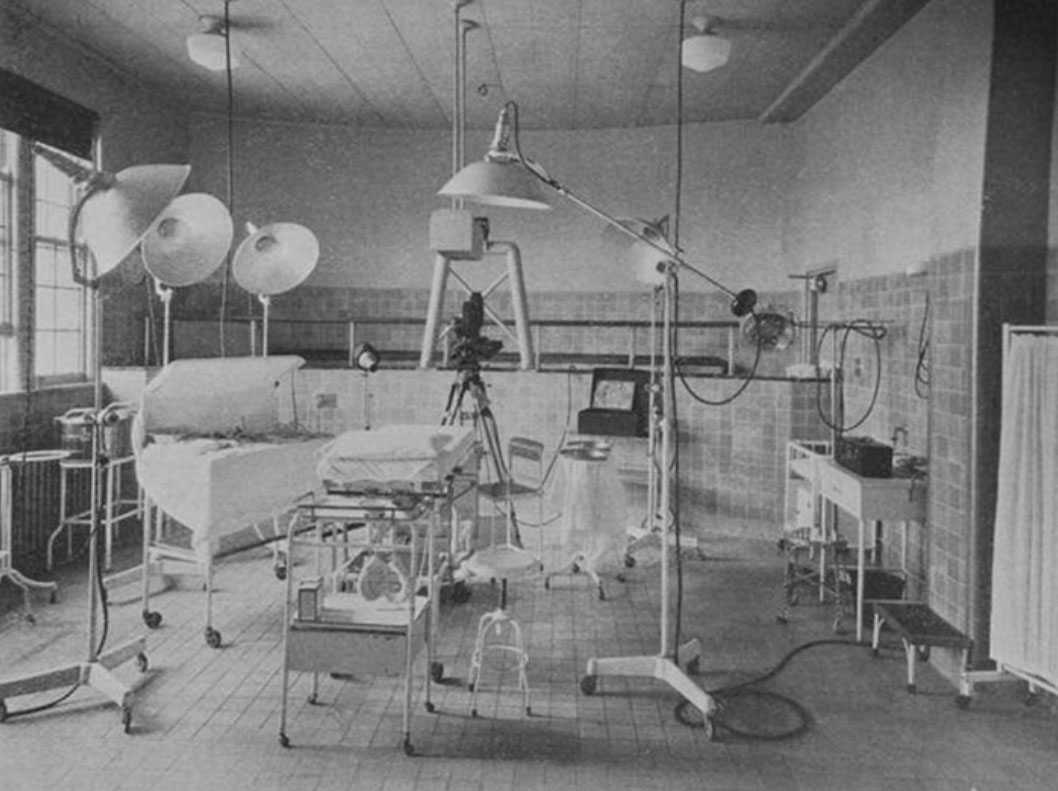
The room in the cover photograph is both a place of birth and a film set. A motion-picture camera faces the table. Banks of lamps wait to make clinical gestures legible. Joseph DeLee, the influential Chicago obstetrician who fitted out this studio, believed that childbirth could be made safer by replacing watchful waiting with a controlled sequence of anaesthesia, incision, forceps, delivery, and repair. In 1920, he described that sequence as the “prophylactic forceps operation.”[1][10]
A century later, episiotomy—the surgical incision that enlarges the vaginal opening during birth—is often told as a simple fall from grace. A procedure spread on authority and anatomy; trials exposed its harms; selective use replaced routine cutting. That account is substantially true for births expected to proceed without instruments.[3][6][7] It is not the whole history.
In 2024, a Swedish randomized trial studied a much narrower delivery room: first-time mothers who required vacuum assistance. In that setting, a standardized lateral episiotomy reduced clinically diagnosed obstetric anal sphincter injury from 13% to 6%.[9] The finding did not restore DeLee's interventionist programme. It revealed why the old argument had been badly framed. “Does episiotomy work?” is not one question. It changes with the reason for the cut, the mode of delivery, the patient's obstetric history, the incision's direction, and the outcome being protected.
This is an evidence history, not advice for an individual birth. Its sharp question is how medicine moved beyond a false routine versus never binary to a harder and more useful distinction: routine for whom, under what conditions, and at what cost?
The first room: making intervention preventive
DeLee did not invent episiotomy, and his 1920 paper did not casually recommend it for every labour. He proposed a bundled operation for first births, and for later births whose soft tissues resembled a first labour, once the fetal head had reached the pelvic floor. He argued that a deliberate incision and forceps-assisted delivery could prevent uncontrolled tearing, spare the infant a prolonged final stage, and allow anatomical repair afterward. He also warned that the technique was unjustifiable in unskilled hands.[1][2]
The distinction matters because it keeps the historical case from becoming a caricature. A straight incision looked measurable and repairable; an unpredictable tear did not. Forceps appeared to offer a controlled exit from a stage of labour thought dangerous to the fetal head and pelvic floor. Within DeLee's framework, prevention through a planned operation had an internal logic: replace uncertain injury with a timed, teachable sequence whose damage the operator expected to repair.[1]
Yet the evidence underneath that logic was mostly clinical experience, anatomical theory, and professional authority. DeLee's later films helped turn technique into a reproducible performance. By the early 1930s, he had made a series of obstetric teaching films, using scripts, rehearsals, sound, close views, and a purpose-built birth-room studio.[10] The camera did more than document practice. It helped define what modern, teachable practice looked like: active, standardized, and directed by the obstetrician.
Hospital birth expanded, and episiotomy travelled with it. A socio-historical review describes a long middle period, roughly 1920 to 1980, in which institutional birth and medicalization helped routine episiotomy become conventional across many Western settings.[2] Once embedded in training, the procedure generated its own confirmation. Clinicians became skilled at cutting and suturing; intact births became less visible; a manageable surgical wound could feel safer than the tear that might have occurred.
That is the strongest historical interpretation in favour of the old practice: episiotomy was an attempt to substitute a controlled injury for an uncontrolled one. Its weakness was not that the goal—preventing severe trauma—was frivolous. It was that a plausible mechanism was allowed to stand in for a comparative test.
The review that found a custom, not a verdict
By 1983, Stephen Thacker and Howard Banta could review more than 350 English-language books and articles published since 1860 and still find no clearly defined evidence for routine episiotomy's efficacy. They estimated that the procedure was used in more than 60% of U.S. deliveries and more often in first births. The literature also contained signals of increased postpartum pain and serious complications, but even harms were poorly measured.[3]
Their conclusion was not “never perform an episiotomy.” It was more disruptive: a very common operation had not earned a routine policy. That shifted the burden of proof. Instead of asking women who wished to avoid the incision to justify restraint, researchers had to ask whether routinely cutting produced better outcomes than cutting only for a stated indication.
Small randomized trials began to make the comparison concrete. In a 1984 Dublin study of 181 women in their first pregnancy who delivered vaginally, 92 were allocated to avoid episiotomy unless it was considered essential; only seven in that group received one. Nineteen retained an intact perineum. The authors questioned routine use while preserving clinical judgment at imminent delivery.[4]
The larger Argentine trial published in 1993 made the policy contrast harder to dismiss. Across eight public maternity units, 2,606 women were assigned to selective or routine mediolateral episiotomy. The procedure was performed in 30.1% of the selective group and 82.6% of the routine group. Severe perineal trauma was uncommon in both—1.2% versus 1.5%—while posterior surgical repair, pain, healing complications, and wound separation were less frequent under the selective policy. Anterior perineal trauma, however, was more common with selective use.[5]
These studies did not compare episiotomy with a promise that no one would ever be cut. “Selective” still allowed an incision when the clinician judged it necessary. They tested a policy: should episiotomy be the default posture of the room, or an intervention that needs an indication?
What the pooled evidence actually rejected
The 2017 Cochrane review assembled 12 randomized trials involving 6,177 women. For births in which an unassisted vaginal delivery was anticipated, selective use may reduce severe perineal or vaginal injuries compared with routine use: a risk ratio of 0.70, with a 95% confidence interval from 0.52 to 0.94, across eight trials and 5,375 participants. The reviewers rated that evidence low certainty, but they found no maternal or neonatal benefit that rescued a routine policy.[6]
The boundaries are as important as the headline. The review could not establish a clear difference in longer-term painful intercourse or urinary incontinence. Pain was inconsistently assessed. Women's preferences were not reported. Only one small trial addressed intended instrumental birth, leaving that branch underpowered.[6] The review concluded that the evidence did not justify default cutting in an anticipated non-instrumental birth; it was not a universal comparison of every technique in every emergency.
The World Health Organization encoded that distinction in 2018. Recommendation 39 says routine or liberal episiotomy is not recommended for spontaneous vaginal birth. WHO said that an acceptable population rate was difficult to determine, required informed consent and effective local anaesthesia when an episiotomy is performed, and preferred a mediolateral rather than midline incision because of anal-sphincter injury risk.[7] A 2025 WHO guideline revalidated the rejection of routine or liberal use in spontaneous vaginal birth, while stating that episiotomy's role in instrumental births and obstetric emergencies remains to be established.[8]
The first delivery room in the debate is therefore settled more firmly than the broad slogan suggests. When birth is expected to be spontaneous and non-instrumental, routine episiotomy does not buy protection by guaranteeing a wound. A selective policy produces fewer procedures and, on pooled trial evidence, may produce fewer severe injuries.[6][7][8]
The second room: vacuum assistance changes the denominator
Vacuum-assisted delivery creates a different risk landscape. The instrument is used because birth already requires assistance; the patient is no longer in the lower-risk population for whom an unassisted delivery was anticipated. The fetal head, perineum, traction, speed, and operator's manoeuvres meet under time pressure. An incision directed away from the midline might reduce the chance that an uncontrolled tear extends into the anal sphincter—but it also guarantees tissue injury and can introduce wound complications.[9]
For years, that narrower argument rested largely on observational studies and underpowered trials. The 2024 EVA trial provided the first adequately sized randomized test. Eight Swedish hospitals randomized 717 first-time mothers carrying a singleton, live, cephalic-presenting fetus at 34 weeks or later who required vacuum extraction; 702 remained in the primary analysis. The intervention was not “episiotomy” in the abstract. It was a standardized lateral cut, begun one to three centimetres from the posterior vaginal opening at crowning, angled about 60 degrees from the midline, and approximately four centimetres long. The comparison group received no episiotomy unless the clinician considered it indispensable.[9]
Obstetric anal sphincter injury occurred in 21 of 344 women (6%) allocated to lateral episiotomy and 47 of 358 (13%) allocated to no episiotomy. The risk difference was −7.0 percentage points with a 96% confidence interval from −11.7 to −2.5; the number needed to treat was about 14. The groups showed no significant differences in measured postpartum pain, blood loss, neonatal outcomes, or total adverse events. Self-referred wound infection occurred in 9% versus 5%—a number needed to harm of about 22—and wound separation in 9% versus 3%, a number needed to harm of about 17.[9]
This result strengthens the best case for prophylaxis without reviving the old regime. DeLee began with a general theory of childbirth and built intervention outward. EVA began with a precisely defined high-risk moment and tested one incision against a conditional no-incision strategy. It does not establish benefit for spontaneous birth, multiparous patients, forceps delivery, midline episiotomy, other incision geometries, or settings with different training and baseline injury rates.[9]
It also leaves measurement and time unfinished. The trial was open-label because the incision was visible, and the primary outcome was diagnosed clinically after birth. One of the two care providers assessing injury was often the physician who had performed the vacuum extraction, creating a possible risk of detection bias that the investigators acknowledged. They also called for longer-term patient-reported evidence on pelvic-floor function and quality of life. Avoiding a sphincter injury is consequential; so are infection, wound separation, pain, sexual function, continence, and the experience of the birth itself.[9]
By July 2026, professional guidance was reading this evidence in different ways. An International Urogynecological Association guideline described mediolateral or lateral episiotomy during operative vaginal birth in nulliparous women as associated with a lower risk of sphincter injury—more strongly with forceps than with vacuum—and advocated liberal use, a Grade A recommendation. Yet it rated EVA's evidence level 1−, discussed the trial's extra wound infections and separation, and acknowledged possible drawbacks. Guidance therefore diverges: WHO's 2025 statement left episiotomy's instrumental and emergency role to be established, while IUGA's 2026 guideline extended the case into a broader preventive policy for nulliparous operative birth.[8][11]
Two interpretations, one narrower rule
The first interpretation is the classic evidence-based correction. Routine episiotomy became a surgical habit before comparative evidence justified it. Trials then showed that, in anticipated non-instrumental birth, selective use reduced intervention without sacrificing protection and may have reduced severe trauma. On this reading, the history is a warning about turning anatomical plausibility and technical mastery into policy.[3][5][6]
The second interpretation is about heterogeneity. The fall of routine episiotomy tempted medicine toward an equal and opposite simplification: treating all cuts, patients, instruments, and delivery rooms as the same exposure. EVA shows that a procedure rejected as a broad default can reduce one serious outcome in a tightly specified high-risk situation; the overall balance still depends on wound harms and longer-term outcomes.[9] On this reading, the correction must be precise enough not to erase a subgroup in which the procedure could prove useful.
The evidence supports both interpretations because they address different populations. What would change the map now is not another global episiotomy rate. It would be replication of the vacuum result across health systems; comparable randomized evidence for forceps-assisted birth; and long-term outcomes that patients can feel, not only injuries clinicians can classify. Technique fidelity matters too: an incision's starting point and angle are part of the intervention, not decorative details.[7][9]
Consent belongs inside that evidence map. Early advocacy centred what the obstetrician could control. The Cochrane review found that women's preferences were absent from the trials it assembled; WHO now places explanation and informed consent alongside technique.[6][7] EVA showed one practical route in an urgent setting by obtaining consent during pregnancy when possible, before the need for vacuum extraction was known.[9] A statistically favourable procedure is not a self-executing command.
The episiotomy debate has two delivery rooms because the denominator changed. In one, routine cutting exposes many people anticipating spontaneous birth to an intervention that has not shown better outcomes than a selective policy. In the other, first-time mothers already requiring vacuum assistance face a higher baseline risk, and one standardized lateral incision reduced clinically diagnosed sphincter injuries while increasing wound infection and separation; its longer-term balance remains unresolved. The mature lesson is neither “always” nor “never.” It is that prophylaxis earns its name only after the patient, the risk, the technique, the comparator, and the outcome are all kept in the same frame.
Sources
- Joseph B. DeLee, “The Prophylactic Forceps Operation” (American Journal of Obstetrics and Gynecology, 1920) — original primary-source proposal for the bundled preventive operation and its stated skill boundary.
- C. Clesse et al., “Socio-historical evolution of the episiotomy practice: A literature review” (Women & Health, 2019) — review of the practice's phases, institutional adoption, and later reversal.
- Stephen B. Thacker and H. David Banta, “Benefits and risks of episiotomy: an interpretative review of the English language literature, 1860–1980” (Obstetrical & Gynecological Survey, 1983) — review of more than 350 publications and the evidentiary challenge to routine use.
- Robert F. Harrison et al., “Is routine episiotomy necessary?” (BMJ, 1984) — early randomized comparison in first pregnancies and evidence that a restrictive policy could preserve intact perineums.
- Argentine Episiotomy Trial Collaborative Group, “Routine vs selective episiotomy: a randomised controlled trial” (The Lancet, 1993) — eight-hospital Argentine trial comparing procedure rates, severe trauma, pain, repair, and healing outcomes.
- Hong Jiang et al., “Selective versus routine use of episiotomy for vaginal birth” (Cochrane Review, 2017) — pooled randomized evidence, certainty ratings, outcome boundaries, and the instrumental-birth evidence gap.
- World Health Organization, WHO Recommendations: Intrapartum Care for a Positive Childbirth Experience, Recommendation 39 (2018) — spontaneous-birth policy, technique, consent, and evidence-to-decision discussion.
- World Health Organization, Consolidated Guidelines for the Prevention, Diagnosis and Treatment of Postpartum Haemorrhage, Recommendation 6 (2025) — revalidation of the recommendation against routine or liberal episiotomy in spontaneous vaginal birth.
- Sandra Bergendahl et al., “Lateral episiotomy or no episiotomy in vacuum assisted delivery in nulliparous women (EVA)” (BMJ, 2024) — randomized trial design, injury reduction, adverse events, and remaining long-term evidence needs.
- Caitjan Gainty, “A Bit of Hollywood in the Operating Room” (U.S. National Library of Medicine, 2019) — provenance and context for the circa-1933 photograph of DeLee's birth-room film studio used as the cover image.
- International Urogynecological Association, “IUGA International Guidelines on Obstetric Anal Sphincter Injuries” (International Urogynecology Journal, online July 10, 2026) — current recommendations for episiotomy in operative vaginal birth, evidence grades, and acknowledged tradeoffs.