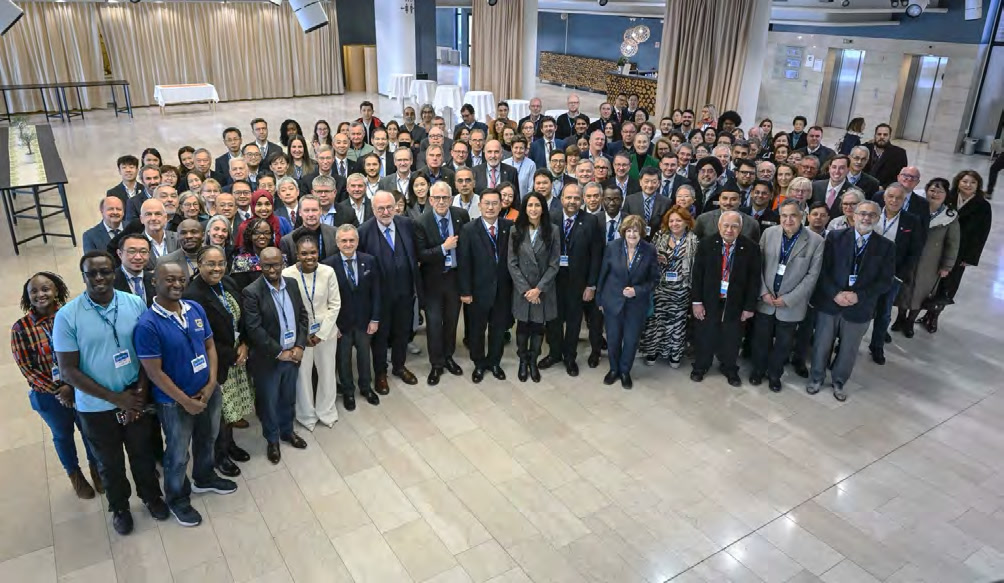
On October 19, 2024, delegates to the World Medical Association gathered in Helsinki and unanimously adopted a new version of the Declaration of Helsinki. The group photograph is almost aggressively orderly: rows of physicians and medical-association representatives, conference badges visible, everyone facing the same camera. Sixty years after the Declaration was born in the same city, consensus had a face.[6][7]
The text they approved is less settled than the photograph. It replaces subjects with participants. It tells researchers to reckon with structural inequity, not only individual risk. It asks for community engagement before, during, and after a study, and treats exclusion from research as a possible harm rather than an automatic form of protection. Yet some of these ambitions arrive with the softer verb should, while consent, review, registration, and many post-trial duties arrive with must.[1][5]
That uneven grammar is the point. The 2024 Declaration does not announce that justice has been achieved. It moves justice upstream, toward the questions a protocol and an ethics committee must confront: Who helped set the research question? Who bears the burden? Who is missing from the evidence? Who receives the benefit after the trial ends? It expands the ethical frame beyond a signature without weakening the individual's right to say no.
Sixty years of revision, not one frozen code
The June 1964 original called itself a set of recommendations guiding doctors in clinical research. Its world was explicitly physician-led: the investigator was a doctor, the person enrolled was a subject, and the central ethical problem was framed as how medical authority should restrain itself.[3]
The Declaration did not remain fixed. The 1975 revision made informed consent more explicit and introduced independent ethical review.[8] By October 2013, the document already addressed underrepresented groups, environmental harm, trial registration, compensation for injury, and post-trial access. Those duties are not inventions of 2024, and treating them as such would erase decades of ethical argument.[2]
The latest revision began in April 2022 and ran for roughly 30 months. Its workgroup drew representatives from 19 countries and held regional or topical meetings on issues including artificial intelligence, placebo use, public-health emergencies, global justice, community inclusion, vulnerability, and post-trial access.[4] The return to Helsinki in 2024 was therefore symbolic, but the document was not nostalgic. It was an attempt to adapt a physician-authored code to research now conducted by international teams, sponsors, data systems, community partners, and institutions whose decisions can shape a study long before a participant meets a consent form.
The title changed its subject
In 2013, the title referred to medical research involving human subjects. Paragraph 2 said the Declaration was addressed primarily to physicians and encouraged other people involved in research to adopt its principles.[2] In 2024, the title says participants, and paragraph 2 says the principles should be upheld by all individuals, teams, and organizations involved in medical research.[1]
The vocabulary change matters because subject describes a person's position inside an investigator's design; participant at least opens the possibility that the person has standing in how the work is conceived, conducted, and explained. The new paragraph 6 supplies the substance that keeps this from being a courtesy rename. It says potential and enrolled participants and their communities should be meaningfully engaged across the life of research: sharing priorities and values, contributing to design and implementation, and helping to understand and disseminate results.[1]
But the shift is incomplete. The Declaration is still adopted by physicians, still begins with physician duties, and still uses medical research rather than the wider category of health-related research. A contemporary analysis of the revision calls this a compromise: responsibility broadens to teams and organizations, while the document retains its professional center of gravity.[5] The close reading is therefore not “subjects became co-governors.” It is narrower and more credible: people once described mainly as objects of protection are now named as agents whose knowledge should enter the research process.
Paragraph 6 moves justice upstream
The sharpest new sentence is not in the consent section. It appears near the beginning, where paragraph 6 locates medical research inside structural inequities and asks researchers to consider how benefits, risks, and burdens are distributed.[1] This changes the scale of the ethical question.
A consent form can explain a blood draw, randomization, data reuse, or a foreseeable adverse effect. It cannot by itself answer why a trial recruits in one community while its successful intervention is likely to remain unaffordable there. It cannot show whether a condition common in an underrepresented population was omitted from the research agenda, or whether a study's endpoints reflect what participants value. Those are design and distribution problems.
The Declaration says it must be read as a whole. It also says that every study's design and performance must be justified in a protocol, and that the protocol should explain how the Declaration's ethical principles have been addressed.[1] Read together, those clauses carry structural inequity and community engagement into protocol review. Justice is no longer only a moral atmosphere around the trial. It becomes a question that can be asked of the written design.
Still, the wording stops short of a formula. The text does not define a fair distribution, identify who legitimately speaks for a community, or grant a community veto. “Meaningful” engagement is not paired with a required budget, timetable, or enforcement mechanism. The Declaration changes what responsible reviewers should ask; it does not predetermine every answer.
Protection now includes the harm of exclusion
The 2013 version grouped “vulnerable groups and individuals” together and emphasized special protection. It also already said underrepresented groups should have appropriate access to participation.[2] The 2024 version keeps that access provision but rewrites the vulnerability section around situations rather than labels. Vulnerability may be fixed, contextual, or dynamic. Researchers must weigh the harms of exclusion against the harms of inclusion, while those fairly included should receive specifically considered support and protections.[1][5]
That is a difficult but necessary turn. Exclusion can prevent exploitation, yet categorical exclusion can also leave clinicians without evidence for children, pregnant people, older adults, people with disabilities, or communities underserved by research. Protection from research can become exposure to uncertainty in ordinary care. Inclusion, however, is not automatically just: it can merely relocate risk onto people with less power.
The revised language refuses both shortcuts. It permits research involving people in situations of particular vulnerability when the work responds to their health needs and they stand to benefit from the resulting knowledge or intervention. It also says inclusion may be justified when exclusion itself would perpetuate disparities.[1] The ethical task is not to choose protection or participation once and for all. It is to design responsible participation with safeguards strong enough for the actual context.
The verbs reveal where consensus is strongest
One analysis counted 58 uses of must in the 2024 text, up from 46 in 2013.[5] The number is less important than where the stronger verbs land.
Post-trial access is the clearest example. In 2013, sponsors, researchers, and host-country governments should make provisions for participants who still needed a beneficial intervention.[2] In 2024, sponsors and researchers must arrange provisions in advance; exceptions require ethics-committee approval, and the arrangements must be disclosed during consent.[1] The revision cannot guarantee who ultimately pays or how long access lasts, but it turns an aspiration into a duty that should be visible before recruitment begins.
Research ethics committees also acquire a more concrete operating description. They must have sufficient resources, collective expertise and diversity, familiarity with local context, and at least one member of the general public. International collaborative research requires approval in both sponsoring and host countries.[1] Those details matter because an independent committee without time, local knowledge, or authority can be independent only on paper.
Elsewhere, the language remains deliberately softer. Researchers should consider distribution and enable community engagement. Research should avoid or minimize environmental harm and strive for sustainability. The 2013 Declaration already mentioned environmental harm; 2024 strengthens the wording but supplies no common metric.[1][2] The verb map therefore shows the revision's boundary: it can state a global direction more easily than it can impose one distributive rule across every disease, country, sponsor, and research system.
Community engagement does not replace individual consent
Moving beyond consent does not mean moving past it. Paragraph 25 calls free and informed consent essential to autonomy. Family members or community representatives may be consulted, but a capable individual cannot be enrolled unless that person freely agrees.[1]
That distinction protects both sides of the revision. Community engagement prevents research from treating a population as a recruitment pool with no voice in priorities or results. Individual consent prevents “the community” from becoming a new authority that can volunteer someone else's body or data. Partnership can shape the question; it cannot erase the personal veto.
A wider frame is not a finished institution
The Declaration remains a high-level ethical consensus, not a complete operating manual. Its practical force depends on sponsors writing duties into protocols, committees having the capacity to review them, institutions monitoring studies, journals enforcing registration and reporting, and regulatory systems deciding how the principles connect to binding rules. The 2024 text itself leaves unresolved questions around artificial-intelligence governance, the definition of vulnerability, the cost of sustained community engagement, and responsibility for long post-trial access.[1][5]
That limit should not be mistaken for emptiness. A declaration changes practice partly by changing what counts as an ethical failure. Under the narrower reading, a study could look ethical if risks were disclosed and each signature was valid. Under the 2024 reading, those signatures do not cure a wasteful design, an unjust exclusion, a community ignored until recruitment, an ethics committee starved of expertise, or a beneficial intervention abandoned at trial close.
The Helsinki photograph records a moment of agreement. The document records something more useful: the points where agreement becomes obligation and the places where it remains an argument. Its strongest achievement is not replacing one noun. It is making the protocol answer for a wider moral field while preserving, for a capable prospective participant in research that requires consent, the right to refuse.
Sources
- World Medical Association, Declaration of Helsinki: Ethical Principles for Medical Research Involving Human Participants — current text adopted October 2024, including structural inequity, engagement, vulnerability, protocols, ethics review, consent, and post-trial provisions.
- World Medical Association, Declaration of Helsinki: Ethical Principles for Medical Research Involving Human Subjects — official archived October 2013 text used for paragraph-by-paragraph comparison.
- World Medical Association, Recommendations Guiding Doctors in Clinical Research — official archived June 1964 text of the original Declaration.
- Jack Resneck Jr. and the World Medical Association, The Declaration of Helsinki Revision Process 2024 — April 2022 workgroup launch, 30-month process, participating countries, and consultation topics.
- Haihong Zhang et al., “Sixty years of ethical evolution: The 2024 revision of the Declaration of Helsinki,” Health Care Science, 2024 — close comparison of terminology, responsibility, inclusion, governance, and unresolved compromises.
- World Medical Association, “The World Medical Association General Assembly 2024 in summary” — unanimous adoption, assembly context, and the WMA's summary of the revision's substantive areas.
- World Medical Association, WMA 2024 Annual Report — General Assembly dates, adoption context, and source for the official photograph of delegates in Helsinki.
- World Medical Association, “Background information on the Declaration of Helsinki” — official historical summary of major revisions, including the 1975 introduction of independent ethical review committees.