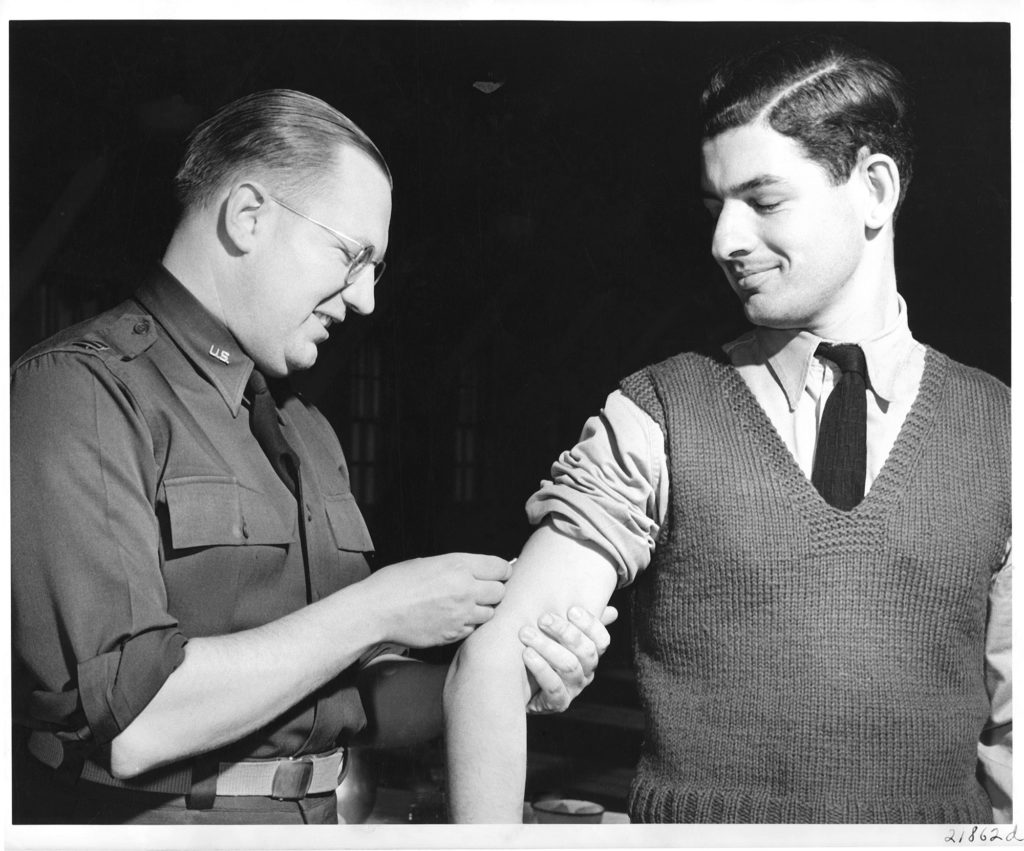
The 1942 photograph looks like preventive medicine doing exactly what it should. A uniformed medical officer steadies a soldier's arm and delivers yellow fever vaccine. The recipient is one of millions being prepared for a war that could move troops through places where mosquito-borne yellow fever remained a lethal threat. Nothing in the frame reveals the other virus that some vaccine lots carried.[5][7]
That distinction matters. The attenuated 17D yellow fever virus was not the source of the disaster, and the vaccine did protect against the disease it was designed to prevent. The hidden hazard was pooled human serum added as a stabilizer. Some serum came from people carrying an agent that laboratories could neither name nor test for in 1942. It would eventually be identified as hepatitis B virus.[1][4]
The outbreak's sharp question is therefore not whether vaccination was good or bad. It is more useful: how did investigators connect jaundice appearing months later in scattered Army units to a few production lots, then remove the right ingredient before the causative virus could be detected? The answer came from time, geography, batch records, and a natural experiment created by the switch to serum-free vaccine.
1937–1941: a successful vaccine meets wartime scale
Max Theiler and colleagues developed the 17D yellow fever vaccine in 1937 by attenuating the virus through repeated passage in chick-embryo tissue. It was a major technical achievement. As war expanded, so did the perceived exposure: an epidemic in the Anglo-Egyptian Sudan in 1940 strengthened the case for protecting troops who might deploy to Africa, India, or other yellow-fever zones.[2][5]
Scale changed the manufacturing problem. Between January 1941 and April 10, 1942, the Rockefeller Foundation's International Health Division distributed about 7 million doses without charge. Vaccine was produced in eggs, while human serum helped stabilize it for use and transport. A biological ingredient that had seemed manageable in smaller campaigns was now being pooled, processed, and injected across an army.[5][6]
There had been warnings. Researchers in Britain and Brazil had described jaundice after yellow fever vaccine containing human serum in the late 1930s. Brazilian teams stopped using serum and followed vaccine recipients closely. The U.S. Army's later official history argued that serum hepatitis was not widely understood in American medicine, that heating the serum had encouraged confidence, and that the threat of yellow fever made mass immunization a defensible calculated risk. A later systematic review and archival history make the countercase: the published warning pattern existed, and confidence in the New York process led decision-makers to discount evidence gathered elsewhere.[2][3][6]
Those interpretations differ on culpability, but not on the crucial boundary. Nobody in 1941 could screen a donor for a virus that had not yet been identified. They could, however, observe that post-vaccination jaundice had clustered when human serum was used. The pathogen was unknown; the process signal was not entirely invisible.
February–March 1942: geography obscures the common clock
The first Army cases later recognized as serum hepatitis appeared in February 1942. By the week ending March 7, jaundice was being reported from widely separated posts. Early explanations included yellow fever itself, ordinary infectious hepatitis, contaminated food, and an agent activated inside the vaccinated person. Movement made the picture harder to read: affected troops surfaced in California, Hawaii, Northern Ireland, Iceland, Australia, and aboard troopships.[1][2]
If this had been a fast reaction, clinicians could have looked at yesterday's injections. Instead, the defining delay was roughly 60 to 150 days. Men vaccinated in the autumn of 1941 became ill the following spring; men vaccinated during the Army-wide push of early 1942 supplied a later wave. The national curve therefore continued rising long after the suspect product had entered arms, reaching its continental peak in the week ending June 20.[1][2]
One camp made the delayed association difficult to dismiss. At Camp Polk, Louisiana, about 5,000 men received vaccine lot 369 on February 27. The Army history records 1,004 subsequent cases of hepatitis with jaundice. A transmissible infection spreading by ordinary contact would not be expected to sort itself so sharply by a numbered vial months earlier.[2]
Investigators then reconstructed vaccination histories across units. Seven lots—331, 334, 335, 338, 367, 368, and 369—were associated with the outbreak, with the last three accounting for the largest case burden. Units could share an exposure without sharing a barracks, meal, climate, or deployment. The lot number supplied the common geography.[1][2]
The batch records turned absence into evidence
The inquiry did more than find sick men who had received vaccine. It compared high-attack and low-attack lots, reconstructed likely contributions from pooled donor serum, and tested competing components of the process. Eggs were an obvious suspect because 17D was propagated in chick embryos. But other materials grown in eggs from the same farms did not reproduce the jaundice pattern. Investigators could not demonstrate the agent in a particular component; the epidemiology instead made human serum the leading shared explanation. Pooling, carryover between production runs, and incomplete donor histories limited exact donor-to-lot tracing.[1][3]
The military distribution itself produced useful negative comparisons. The Navy received only small quantities from two implicated lots and largely escaped the epidemic. Later, troops given a new serum-free yellow fever vaccine did not show the same post-vaccination wave. Neither comparison was a randomized trial, but together with the lot gradients, long incubation, and multi-site recurrence, they narrowed the causal chain.[2][4]
This was an investigation conducted before hepatitis antigen tests or viral sequencing could settle the question. Its strongest instrument was record linkage: which man received which lot, where, and how long before jaundice began? The 1944 investigation could infer an infectious agent in apparently healthy donor serum without being able to see that agent directly.[1]
April 9–14: control outran naming
By early April, reports from multiple posts were moving faster than any one local explanation. On April 9, 1942, the Rockefeller laboratory decided to stop producing yellow fever vaccine with human serum. On April 14, Surgeon General James C. Magee approved suspension of the Foundation product and temporary use of the U.S. Public Health Service vaccine made at its Rocky Mountain Laboratory. Formal directions over the next two days paused the implicated product while new serum-free supplies were prepared; Public Health Service production of serum-free vaccine began on June 1.[2][3][6]
The epidemic did not stop on the date of that decision. The 60-to-150-day incubation meant already infected soldiers would keep arriving at hospitals into the summer. That lag could make a correct intervention look ineffective if the outcome were judged too soon. What mattered was the cohort boundary: after serum-free vaccine replaced the implicated formulation, the distinctive vaccine-associated hepatitis pattern failed to recur.[1][2][3]
That sequence is stronger than a simple before-and-after story. Investigators first showed concentration in particular lots, then implicated human serum as the leading shared component, removed it, and finally observed disappearance after allowing for the expected delay. Control did not require conclusive identification of the agent in one material. It required acting on the exposure the combined evidence had made most plausible.
Why the case totals do not agree
The outbreak is often assigned one dramatic number, but the records count different things. A vaccine history reports 26,771 cases of jaundice among U.S. personnel after roughly 7 million doses. The Army's official medical history lists 49,233 hospital admissions for hepatitis in 1942 and presumes that most were vaccine-related. A 1987 follow-up describes about 50,000 clinically jaundiced soldiers and estimates that approximately 330,000 people may have been infected.[2][4][5]
These figures should not be collapsed into a false precision. Jaundice is a visible subset of hepatitis B infection; hospital admissions depend on military reporting and case definitions; a retrospective infection estimate includes people who never became visibly ill. The 330,000 figure was not a head count made in 1942. It was an inference from later serology, extrapolated from surviving veterans.[4]
The layered numbers reveal something medically important. Counting yellow skin and hospital beds captured the clinical epidemic, but it missed silent infection. The manufacturing fault was larger than the symptom ledger suggested.
1985–1987: blood tests retrospectively identify the passenger
More than four decades later, Leonard Seeff and colleagues located and tested 597 veterans from three exposure groups. Among men who had received implicated serum-stabilized vaccine and developed jaundice, 97 percent had antibodies to hepatitis B virus. Among recipients of implicated vaccine who had remained well, 76 percent had antibodies. In the serum-free, non-jaundiced comparison group, 13 percent did.[4]
The contrast did two things the wartime investigators could not. It retrospectively identified hepatitis B as the contaminant and showed how much infection had occurred without recognized jaundice. Antibodies to hepatitis A did not follow the same group pattern, weakening the alternative that an ordinary food- or contact-borne hepatitis epidemic happened to coincide with selected vaccine lots.[4]
The follow-up also set a boundary around the long-term story. Only one tested recipient of implicated vaccine had detectable hepatitis B surface antigen, giving a carrier estimate of 0.26 percent in that sample. That result should not be universalized: the cohort consisted largely of young, healthy men who survived long enough to be traced four decades later. It does show why a catastrophic acute outbreak need not translate mechanically into the chronic-carrier rate observed after every other route or age of infection.[4]
The failure was an ingredient and a surveillance assumption
Calling the episode a failed yellow fever vaccine obscures both the cause and the repair. The 17D platform survived because it worked. The serum stabilizer was removed; production and use continued in a safer form. The lesson is not that a successful vaccine became useless. It is that efficacy against the target disease cannot certify every ingredient, donor pool, manufacturing step, and distribution decision around it.[3][5]
The dispute over foreseeability also resists a tidy verdict. Wartime planners faced a real yellow fever threat and lacked a hepatitis B test. At the same time, post-vaccination jaundice reports from Britain and Brazil offered a reason to remove serum or intensify recipient follow-up before millions of doses were issued. The fairest reconstruction separates molecular ignorance from organizational uncertainty: the precise virus was unknowable with 1941 tools, while the warning attached to human serum was available but contested.[2][3][6]
What would shift that assessment is operational evidence. Proof that decision-makers received a clear, serum-specific warning and had a validated, field-ready serum-free process before scale-up would strengthen the preventable-failure interpretation. Evidence that the alternative could not yet preserve potency or meet wartime supply, while the warning cases could not distinguish serum from another component, would strengthen the calculated-risk defense. The surviving record establishes both warning and uncertainty; it does not make manufacturing readiness a binary fact.[1][2][3][6]
The photograph remains powerful because it captures both truths at once. The injection represented effective protection from one virus and, in some lots, accidental exposure to another. Only the production record could tell the two stories apart. In 1942, that record was enough to stop transmission. In 1987, surviving blood retrospectively confirmed what the wartime lot map had only inferred.
Sources
- Wilbur A. Sawyer, Karl F. Meyer, Monroe D. Eaton, and colleagues, “Jaundice in Army Personnel in the Western Region of the United States and Its Relation to Vaccination Against Yellow Fever,” American Journal of Hygiene 39–40, 1944 — original multi-part investigation of lot associations, incubation, production components, and the inferred serum-borne agent.
- U.S. Army Medical Department, “Viral Hepatitis,” Internal Medicine in World War II, Volume III — official retrospective account of prior warnings, wartime rationale, geographic spread, lot tracing, case counts, and the April 1942 intervention.
- Roger E. Thomas, Diane L. Lorenzetti, and Wendy Spragins, “Mortality and Morbidity Among Military Personnel and Civilians During the 1930s and World War II From Transmission of Hepatitis During Yellow Fever Vaccination,” American Journal of Public Health 103(3), 2013 — systematic review of outbreak evidence, rates, earlier warnings, and the serum-free response.
- Leonard B. Seeff et al., “A Serologic Follow-up of the 1942 Epidemic of Post-vaccination Hepatitis in the United States Army,” New England Journal of Medicine 316, 1987 — 597-veteran comparison that retrospectively identified hepatitis B and estimated recognized, silent, and persistent infection.
- J. Gordon Frierson, “The Yellow Fever Vaccine: A History,” Yale Journal of Biology and Medicine 83(2), 2010 — 17D development, wartime production scale, reported jaundice, and the shift to serum-free vaccine.
- Ilana Löwy, “The 1942 Massive Contamination of Yellow Fever Vaccine: A Public Health Consequence of Scientific Arrogance,” American Journal of Public Health 111(9), 2021 — archival reconstruction of Brazilian warnings, production decisions, internal correspondence, and the April 1942 halt.
- Rockefeller Archive Center, “A U.S. soldier receives the yellow fever vaccine, 1942” — archival photograph, Rockefeller Foundation records, photographs, FA003, Series 100, Box 1, Folder 22.