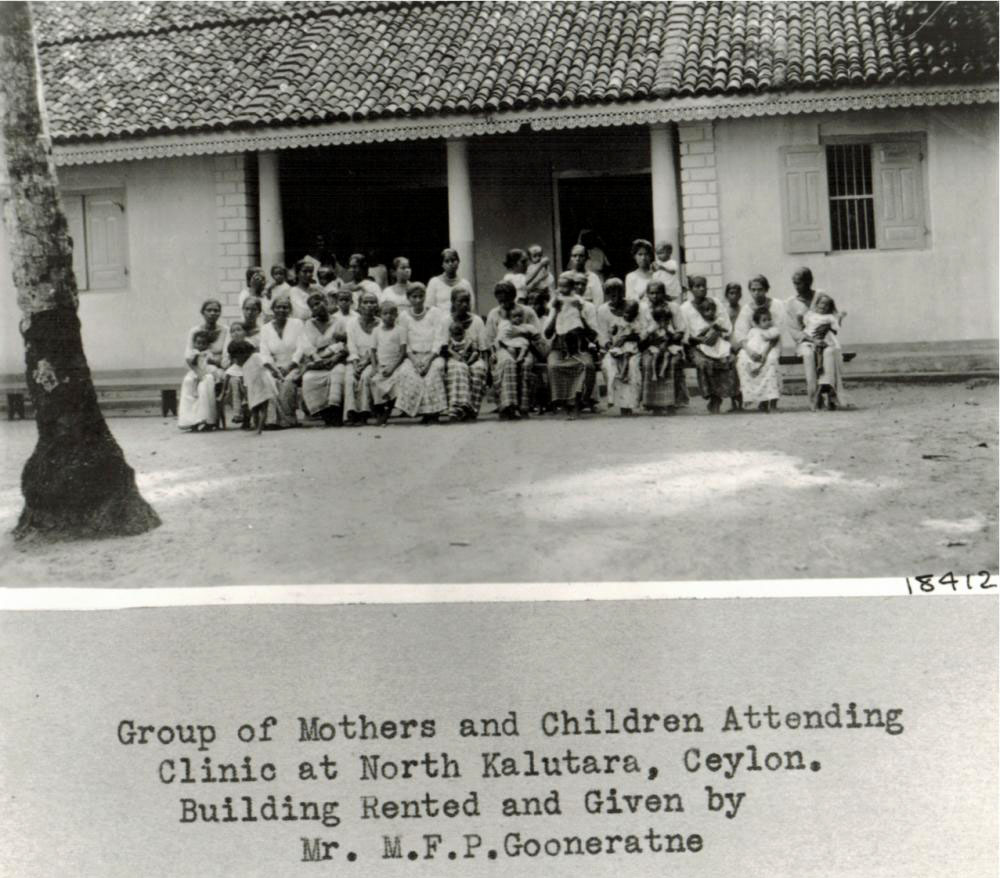
In the archival photograph from North Kalutara, mothers and children fill the veranda of a modest clinic. The building has shuttered windows, a tiled roof and no visible operating theatre. It looks like the end of a very small health system.
It was meant to be the beginning of one.
The first Health Unit in Asia opened at Kalutara, in what was then Ceylon, in 1926. Its staff did not try to turn a local clinic into a miniature specialist hospital. They gave preventive and maternal care a geographic address, found families before emergencies, and connected field workers to institutions able to do more.[1][2] Three decades later, newly independent Malaya pursued a different but comparable design: put a midwife's clinic—and often her home—inside the village, then build a referral ladder from that door to a health sub-centre, a doctor and a hospital.[3][4]
These histories are often compressed into one lesson: train more midwives. That is true but incomplete. A midwife alone cannot transfuse blood, perform emergency surgery, make a distant road passable or force an institution to learn from a preventable death. Sri Lanka and Malaysia mattered because each made the midwife the front door of a larger system, not a low-cost substitute left to manage every risk at the edge of it.[1][5]
The comparison is a systems test, not a country ranking
The long decline in reported maternal mortality was extraordinary in both places. Sri Lanka's historical series fell from 2,136 maternal deaths per 100,000 live births in 1930 to 486 in 1950 and 24 in 1996. In Peninsular Malaysia, the corresponding reported series fell from 1,085 in 1933 to 282 in 1957 and 18 in 1991.[1]
Those figures are numeric anchors, not a controlled experiment. Definitions, registration and case finding changed across the decades. The World Bank study behind the series cautions that Malaysian maternal deaths were underreported throughout the period and that actual ratios in the mid-1990s may have been roughly twice the official figures. It also cites a study that found 24 percent underreporting in Sri Lanka's Western Province in 1994–1995.[1] Modern World Health Organization guidance makes the same general boundary explicit: maternal-mortality measurement depends on finding pregnancy-associated deaths, certifying causes consistently and linking incomplete reporting systems.[7]
The trend is still too large and sustained to dismiss. But it cannot be assigned to midwifery alone. Malaria and hookworm control, antibiotics, sanitation, female education, fertility change, roads, nutrition, public finance and broader hospital capacity all moved risk. Sri Lanka and Malaysia also began from different positions: Sri Lanka had stronger female literacy and an older welfare infrastructure; Malaysia entered the post-independence period with higher income but a larger rural–urban divide.[1]
The useful comparison is therefore narrower. How did two systems make skilled care reachable before labor became a crisis—and make escalation possible when it did?
Sri Lanka gave maternal care a territory
Sri Lanka's field architecture preceded its most dramatic mortality decline. Formal midwifery training began in 1879, and an 1897 law required practitioners to follow a prescribed curriculum and enter a professional register. Until 1926, however, midwives worked only in hospitals. Kalutara changed the spatial logic. A health unit covered a defined population and brought public-health work—including maternal and child care—under a medical officer responsible for that territory.[1][2]
That boundary mattered. A public health midwife did not wait behind a clinic door for a woman to identify her own risk. She registered pregnancies, made home visits, provided antenatal and postnatal care, attended births in the earlier decades, and linked families to the local health unit. Training joined hospital practice to field experience: from 1936, the 18-month course placed trainees first at Colombo's De Soysa maternity hospital and then for six months at the Kalutara Health Unit.[1]
The birth setting changed as the network matured. In 1939, the recorded series shows 19 percent of all deliveries assisted in the home and another 8 percent occurring in government institutions. By 1950, those shares were 25 and 33 percent. By 1995, only 2 percent of recorded deliveries were assisted at home while 87 percent took place in government institutions.[1] The midwife did not disappear as childbirth moved. Her job shifted toward finding pregnancies, preparing women for institutional delivery, recognizing danger and maintaining continuity outside the ward.
The back end expanded too. Sri Lanka had 12 ambulances in 1948 and 67 by 1950, distributed across provincial, district and remote hospitals. Where official transport could not be summoned, field staff could hire private transport for an emergency referral and seek reimbursement. The vehicle might once have been a bullock cart or buggy; the principle was that the cost and improvisation of reaching care should not fall entirely on a laboring family.[1]
This is what the Kalutara photograph cannot show on its own. The clinic was valuable because it belonged to a chain: household, midwife, health unit, maternity home, district hospital, specialist service. The small building was not asked to contain every capability.
Malaysia built the ladder into the village
Malaysia's large rural build-out came later and more visibly. The Ministry of Health dates the core Rural Health Service to 1956, when maternal and child health became a central part of a three-tier program. A main health centre was designed to serve 50,000 people, linked to four sub-centres and 20 midwife clinics. The smallest facility was supposed to be close enough to make the service ordinary rather than exceptional.[3][4]
The clinic was also living infrastructure. A “midwife clinic cum quarters” placed a simple clinical room and staff accommodation in the village, with water, electricity and a bicycle, later often a motorcycle. Housing the midwife on site reduced absence and made help available beyond scheduled sessions. Pregnant women could be screened locally, then referred upward to a public-health nurse at the sub-centre or a doctor at the main centre.[4]
The plan was never completed as neatly as its ratios implied. Between 1956 and 1975, about 1,280 midwife clinics, 256 sub-centres and 65 main centres were built, alongside added hospital capacity. Yet by 1975 a typical three-tier complex served about 112,900 people rather than the intended 50,000, and an average rural midwife covered roughly 4,390 residents rather than 2,000.[1][4] The gap between plan and reality is important: this was a stretched public service, not a frictionless model village.
It still changed reach. Skilled attendance rose from about 30 percent of births in 1949 to more than 90 percent in 1995. During the concentrated rural expansion from 1957 to 1975, the reported maternal mortality ratio fell from 282 to 83.[1] Association is not proof of a single cause, but the sequence is consistent with a system extending competent first contact while also enlarging hospital backup.
Malaysia also treated trust as infrastructure. In 1960, unskilled attendants—mostly traditional birth attendants—handled about 60 percent of births. Free government midwifery threatened their income and could provoke resistance. Rather than pretend the existing care world could be erased overnight, officials classified traditional practices as harmful, beneficial or neutral; registered and supplied attendants; and encouraged them to retain valued non-clinical roles while government-trained midwives took over childbirth care. The transition was managed through reporting and partnership as well as professional authority.[1]
Proximity worked because escalation had somewhere to go
The shared mechanism was not “home birth is safe” or “facility birth is safe.” It was a managed transition between settings.
A trained worker close to home could identify pregnancy, notice anemia or hypertension, explain danger signs and make a referral before collapse. But referral only meant something if transport existed, the receiving facility accepted responsibility, blood and resuscitation were available, and someone could perform an intervention beyond the midwife's scope. The 1999 World Health Organization review of delivery-care models reached a deliberately bounded conclusion: professional attendance was associated with much lower maternal mortality when strong referral mechanisms existed, while brief training of a community attendant without that system had not shown the same results. It also warned that evidence was too thin to declare one organizational model universally best or most cost-effective.[5]
Sri Lanka and Malaysia built different versions of that connection. Sri Lanka's health units attached a named field workforce to territorial medical officers and a tiered institutional network. Malaysia's clinic quarters made the midwife physically present, while sub-centres, main centres and hospitals defined the next steps. In both places, care was largely free at the point of use; transport and communication were treated as clinical inputs rather than background development.[1][3][4]
The comparison also corrects a heroic reading of midwifery. The achievement was not that one exceptionally dedicated worker could overcome any shortage. It was that ordinary workers received training, salary, supplies, supervision, rules and an escalation path. Reliability came from making competence repeatable.
Counting a death became part of preventing the next one
The final link ran backward from the worst outcome. Both systems gradually made a maternal death something to find, investigate and feed back into management.
In Sri Lanka, local investigation procedures existed by the late 1950s; later reviews brought field and hospital accounts together, with mandatory notification and increasingly structured national oversight. In Malaysia, rural midwives checked female deaths reported through the civil-registration system, and state officials joined local investigations. A national confidential inquiry began in 1991.[1]
That first Malaysian inquiry did not merely publish a mortality ratio. It reviewed the care chain and judged 46 percent of the deaths to involve substandard care. Its findings drove changes including emergency “red alert” responses, stabilization before transfer, revised protocols and better feedback between hospitals and health centres.[1][6] Measurement had become a quality tool: the system was asking not only what killed her? but where did recognition, transport, treatment or communication fail?
This feedback loop complicates historical comparisons because better case finding can make a later system appear worse on paper. It also explains why the numbers became more useful. A falling ratio is reassuring; an investigated death can reveal which link still breaks.
A doorway, not a dead end
Neither history supplies a template that can be copied without politics, geography or money. Sri Lanka's compact island network, long civil-registration tradition and investment in free education are not interchangeable with Malaysia's federal structure, ethnic and regional inequalities, or post-independence construction drive. Both systems also carried exclusions and unevenness that national averages could hide.[1][4]
What travels is the distinction between presence and connection. Posting a midwife nearby improves distance. Giving her professional standing improves trust and consistency. Removing fees improves use. But maternal safety also depends on what happens when the local answer is not enough: a vehicle arrives, a facility receives, blood is available, a clinician can intervene, and the case returns as evidence rather than vanishing into a register.
That is why the North Kalutara clinic should not be read as a humble substitute for a hospital. It was a front door. Sri Lanka and Malaysia reduced risk when they kept building what stood behind it.
Sources
- Indra Pathmanathan et al., Investing in Maternal Health: Learning from Malaysia and Sri Lanka. World Bank, 2003 — comparative historical series, service expansion, midwifery, transport, referral, expenditure, mortality review, and data-quality limits.
- China Medical Board Centennial, “The Health Unit Program in Sri Lanka” — Kalutara's 1926 health-unit model and the Rockefeller Archive Center photograph used as the article image.
- Malaysia Ministry of Health, Family Health Development Division, “History” — official chronology of maternal-and-child health services, the 1956 three-tier rural system, and later reorganization.
- S. Sivasampu et al., “40 years of Alma Ata Malaysia: targeting equitable access through organisational and physical adaptations in the delivery of public sector primary care,” Primary Health Care Research & Development, 2020 — clinic-quarter design, staffing norms, referral structure, expansion shortfalls, and service reorganization.
- Marjorie A. Koblinsky, Oona Campbell, and Joana Heichelheim, “Organizing delivery care: what works for safe motherhood?” Bulletin of the World Health Organization 77(5), 1999 — comparative delivery-care models, referral requirements, and evidence boundaries.
- Malaysia Ministry of Health, Report on the Confidential Enquiries into Maternal Deaths in Malaysia 1991 — primary national review of causes, care quality, and remedial actions.
- World Health Organization, Maternal mortality measurement: guidance to improve national reporting, 2022 — standards for identification, certification, data linkage, interpretation, and reporting, including a Sri Lanka case study.