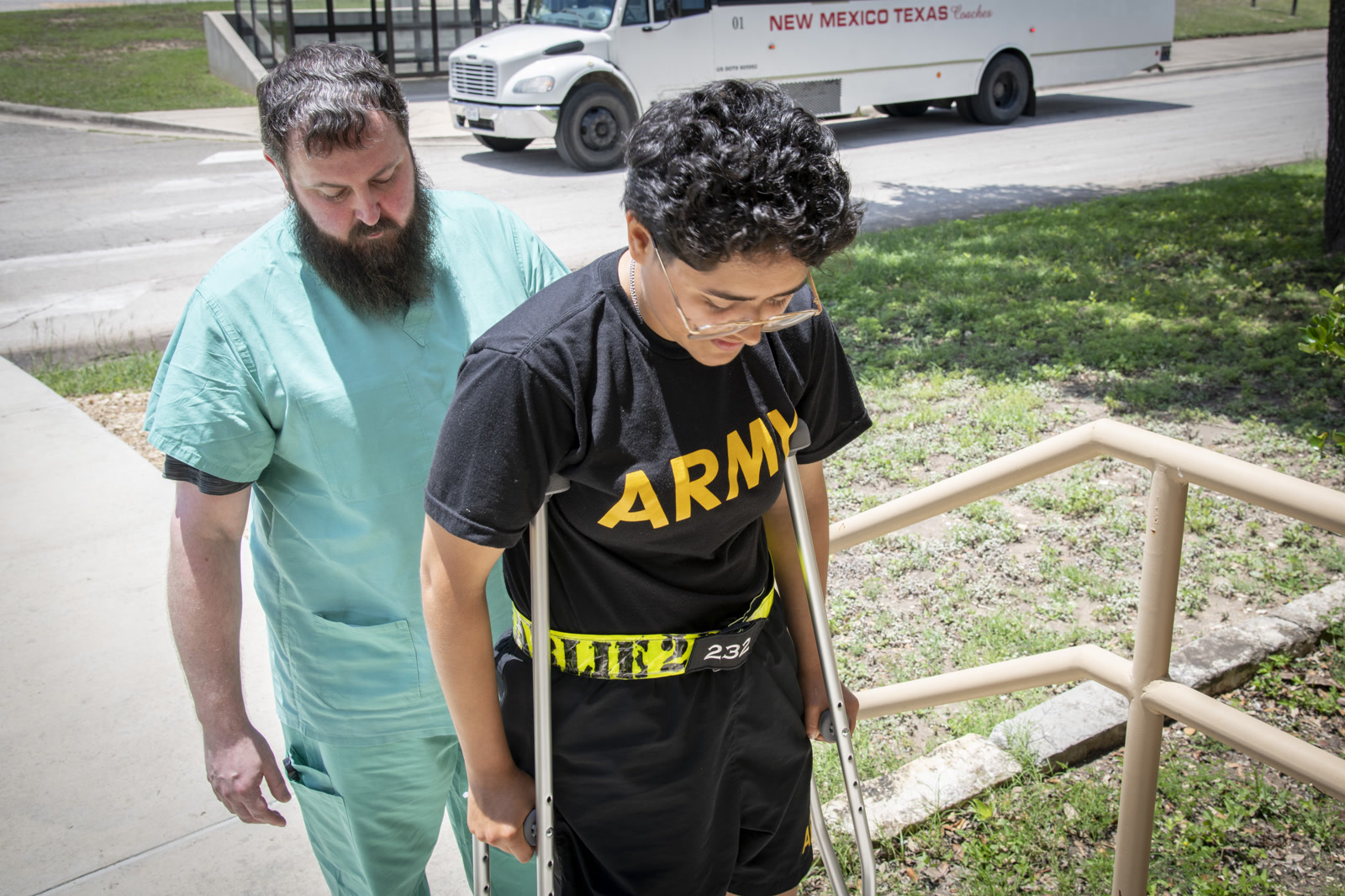


A pair of crutches is often remembered as an object and forgotten as an instruction. The important part is not simply that two metal supports have appeared. It is the loading rule that comes with them: keep all weight off the affected limb, touch down only for balance, bear part of the load, or bear as much as symptoms and the clinical plan allow. Those phrases are not interchangeable levels of bravery. They are different prescriptions for protecting tissue while keeping a person mobile.[4][5]
The three hospital videos below turn that prescription into movement. A 2016 George Eliot Hospital demonstration shows a non-weight-bearing pattern. A 2023 Gloucestershire Hospitals clip makes partial loading visible in only a few seconds. A 2019 Children's Hospital Colorado lesson moves the problem onto stairs.[1][2][3] Watched together, they expose the real work of crutch use: the loading rule must survive every transition—from standing to stepping, from level floor to chair, and from one stair tread to the next.
This is also the collection's boundary. A video cannot decide which loading status is safe for a particular fracture, operation, wound, or painful joint. It cannot fit the issued device, test balance, or clear someone for stairs. The prescriber or physiotherapist supplies those decisions; the videos help a viewer see what the resulting choreography is supposed to protect.[4][5][6]
Video 1: non-weight-bearing changes the definition of a step
George Eliot Hospital's physiotherapy video begins with the strictest rule in this collection: the affected limb does not become the next point of support.[1] Watch the relationship among the crutches, the suspended foot, and the sound leg. The crutches move to create a new base; body weight travels through the hands; the unaffected leg then advances into the space between or beyond them. The injured side stays out of the load path.
The distinction is sharper than “try not to lean on the sore foot.” MedlinePlus separates non-weight-bearing, touch-down, partial weight-bearing, and weight-bearing as tolerated because each permits a different relationship between the affected limb and the floor.[5] Under a non-weight-bearing instruction, an accidental habit of using the toes to catch balance is not a small stylistic variation: it changes the loading condition. The video is valuable because the empty space beneath the affected foot makes that condition visible.
It also shows why upper-body effort is not the whole skill. Moving the crutches too far ahead creates a long, unstable swing; placing them too narrowly shrinks the base of support. Looking only at the feet can pull posture forward and hide what is ahead. The useful rhythm is controlled rather than athletic: place the supports, confirm balance, move the body, then reset. AAOS advises a nearby helper while someone is first learning and emphasizes clear, well-lit routes without rugs, cords, spills, or clutter.[6] Technique lives inside an environment.
If a person cannot preserve the prescribed no-load pattern without repeated toe contact, unsafe hopping, severe fatigue, or loss of balance, the answer is not to quietly invent a partial-weight-bearing plan. It is to return to the clinical team. A different device, more practice, a changed route through the home, or a revised prescription may be needed. The invariant is the clinician-assigned load; the gait is built around it.
Video 2: partial weight-bearing is controlled contact, not a vague compromise
Gloucestershire Hospitals' short demonstration changes one variable.[2] The affected foot now contacts the floor, while the arms unload part of the step through forearm crutches. Watch the order: crutches move forward, the affected leg steps into their support, and the unaffected leg follows. The clip's brevity is useful because it isolates the moment that differs from the first video.
University Hospitals Sussex defines partial weight-bearing as allowing the affected leg to touch the ground during standing, walking, and rising from a chair without taking full body weight through it.[4] That definition makes the video easier to read. The crutches are not merely following the feet. They are accepting part of the load during the affected-side step, before the sound leg comes through.
The dangerous ambiguity lies in the word partial. Hospitals and clinical teams may express restrictions with a category, a proportion, a touch-only instruction, or a patient-specific limit. Pain is not always a reliable substitute for that instruction: anaesthesia, medication, nerve changes, or simple momentum can make an unsafe load feel temporarily possible. The written discharge plan and the treating team's demonstration therefore outrank a generic internet clip.[4][5]
Chair transfers reveal the same logic in a different form. The Sussex guide tells patients to hold both crutches in one hand, use the other hand on the chair, and establish balance before placing the arms into the crutches; sitting reverses that sequence after the backs of the legs have found the seat.[4] Pulling up on two freestanding crutches asks unstable objects to behave like a fixed rail. Reaching for the chair converts the transfer into a controlled handoff between stable supports. The loading prescription remains the same, but the support map changes.
This is why partial weight-bearing should look deliberate, not improvised. The viewer should be able to identify when the crutches are planted, when the affected foot accepts its permitted share, and when the unaffected leg advances. If those phases blur into a hurried limp, the person may still be moving, but the prescription is no longer legible in the movement.
Video 3: stairs turn the rule into an order
Children's Hospital Colorado moves from forearm crutches to underarm crutches and from level ground to a training staircase.[3] That device change matters: cuffs, handgrips, height checks, and pressure points are device-specific. Do not copy a fitting detail from one crutch type onto another. The value of placing this video third is the broader sequence it shares with the written guidance: the stronger leg leads upward; the crutches and affected side lead downward.[5][6]
The order follows the job gravity is doing. Going up, the stronger leg reaches the higher tread and produces the lift before the crutches and affected limb join it. Going down, the supports establish a base on the lower tread before the affected side descends; the stronger leg follows under control. The familiar memory aid—strong leg up first, affected side down first—is useful only if it remains attached to that mechanical explanation. A slogan without the support sequence is easy to recite and easy to perform badly.
Both MedlinePlus and AAOS advise help during early stair practice and describe using a handrail when available.[5][6] They also offer a seated, step-by-step alternative for someone who is not steady enough to manage the stairs upright. That is not failure. It is a route change that respects the same safety boundary. Stairs demand strength, balance, adequate tread space, a secure rail, and a plan for the second crutch; a video cannot inspect any of those conditions in a reader's home.
The change from UK-style forearm crutches in the first two clips to underarm crutches in the third is therefore a useful warning against treating “crutch technique” as one universal script. The load rule, placement order, and need for stable support can carry across devices. Exact fit and handling do not. Use the instructions for the device that was actually issued, and practise the real staircase with a clinician or capable helper before relying on memory alone.[5][6]
One prescription, translated three times
Together, the videos show why safe crutch use is a small system rather than a prop. First comes the clinical constraint: how much load may cross the affected limb. Next comes the gait that preserves it. Then each environment—chair, doorway, wet floor, curb, staircase—forces that gait to negotiate a new support surface. Daily checks on rubber tips, adjustment points, footwear, lighting, and clutter keep the system from failing for reasons that have nothing to do with the original injury.[5][6]
The upload dates also trace a quiet continuity: a December 2016 non-weight-bearing lesson, a March 2019 stair demonstration, and a January 2023 partial-weight-bearing clip all teach through visible sequence.[1][2][3] MedlinePlus's adult crutch guidance, reviewed in April 2025, adds the boundary those images cannot: the appropriate device and loading status depend on the person's pain, weakness, balance, injury, and recovery plan.[5]
That is the best way to use this collection. Do not ask only, “Can I get across the room?” Ask whether the prescribed load stayed intact, whether every support was stable before weight moved, and whether the next environment requires a different plan. Crutches work when the rule remains visible in the movement.
Sources
- George Eliot Hospital, “George Eliot Hospital Physiotherapy — Using crutches for a non weight bearing limb” (YouTube, uploaded December 28, 2016) — the embedded non-weight-bearing demonstration.
- Gloucestershire Hospitals NHS Foundation Trust, “Partial Weight Bearing on Crutches” (YouTube, uploaded January 24, 2023) — the embedded partial-loading demonstration.
- Children's Hospital Colorado, “How to Use Stairs With Crutches” (YouTube, uploaded March 13, 2019) — the embedded stair demonstration.
- University Hospitals Sussex NHS Foundation Trust, “How do I use my crutches (Partial Weight Bearing)?” (reviewed April 14, 2025; patient-guide PDF) — definitions and sequences for walking, chair transfers, and stairs.
- MedlinePlus Medical Encyclopedia, “Using crutches” (reviewed April 1, 2025) — loading categories, gait, transfers, stairs, device choice, and home-safety boundaries.
- American Academy of Orthopaedic Surgeons, “How To Use Crutches, Canes, and Walkers” — fitting, first-use support, stair sequence, and environmental safety guidance.
- Jason W. Edwards / Brooke Army Medical Center Public Affairs, “Service members training at physical therapy clinic” (DVIDS, May 17, 2023) — source page for the lead documentary photograph of supervised crutch stair training.