On the glass at Grosse Île, small engraved boats stand beside the work of naming the dead. Parks Canada identifies them as memorials to people whose names remain unknown. Even the gaps in the record have been given something a visitor can see.[1]
The island in the St. Lawrence served as a quarantine station for the port of Québec from 1832 to 1937. Its surviving buildings document the effort to control infectious disease at a major gateway to Canada. Its memorials ask a more intimate question: how should that effort be remembered by the families of people who died there?[2]
The ground beneath the story
In 1847, famine drove an exceptional movement of people across the Atlantic. Historian André Charbonneau’s account for Parks Canada places arrivals at Québec and Grosse Île above 100,000 that season, against a previous annual average of 25,000–30,000. Many passengers reached the river weakened by hunger and crowded ocean crossings; some were already sick with typhus.[3]
The station expanded during the emergency, yet facilities and exhausted staff struggled to meet demand. Ships waited offshore for inspection and medical attention. Charbonneau records 5,424 burials on the island that year, alongside deaths at sea and in Canadian cities. These figures describe distinct places in the catastrophe; the island’s burial count is not a total for everyone who died during the migration.[3]
The cemetery retains a physical record of that pressure. Parks Canada describes the change from individual burials to long trenches during the epidemic, their outlines still perceptible in the ground. The terrain itself interrupts any easy account of arrival and settlement. For thousands, this was where the journey ended.[4]
A cross with an argument
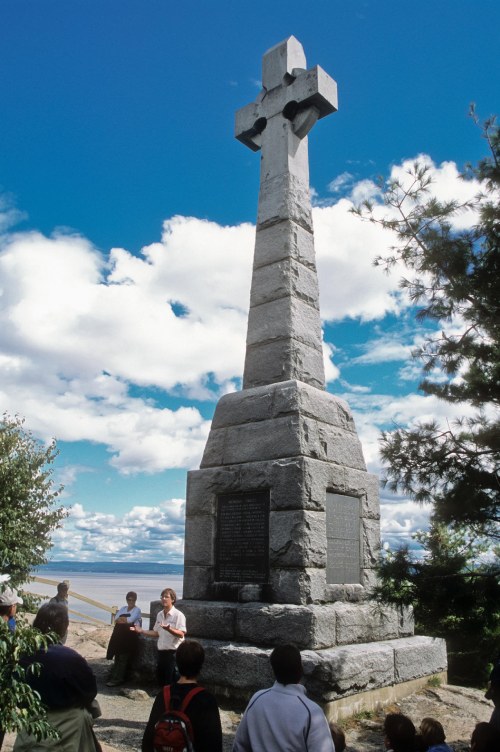
The Ancient Order of Hibernians erected the Celtic cross in 1909. High above the river, it made the Irish identity of the dead unmistakable. The monument also carried an interpretation of their deaths.[6]
Jacqueline Hyman and Joseph Lonergan’s account for the Quebec Anglophone Heritage Network distinguishes its inscriptions. The English and French texts commemorate the tragedy without assigning blame; the Irish text invokes oppressive laws and an artificially produced famine. The difference matters. Reading the monument in one language does not disclose everything it says in another.[6]
That inscription is evidence of the community’s historical judgment. It cannot, by itself, settle the causes of famine mortality or allocate responsibility for every death at the station. Its force lies in preserving a demand that the circumstances before embarkation remain part of the story. Disease arrived with people who had already endured hunger, displacement and a dangerous passage.[3][6]
The appeal, and the cost, of a larger story
There is a substantial history beyond the disaster. Medical superintendent Frederick Montizambert, who led the station from 1869 to 1899, reorganized facilities to separate sick passengers from healthy travellers and people under observation. Inspection, disinfection, vaccination and laboratory work became part of a more developed quarantine service.[5]
André Sévigny’s 1995 Parks Canada history makes the case for following that transformation. An account confined to the early epidemics would leave much of the institution’s subsequent work unexplained. The buildings and changing procedures give historians evidence of learning, investment and scientific change.[5]
Yet the same essay closes by describing a “happy ending.” That phrase shifts the scale of judgment from the person to the institution. A service can improve across decades; a family’s loss remains fixed. The memorials make that difference difficult to pass over.[5]
The choice of emphasis became a public dispute. Writing in the May/June 1996 issue of Irish America, Michael Quigley described Irish-Canadian opposition to a 1992 development proposal that foregrounded a broad immigration story. His account presents the campaign as a successful defence of ancestral graves against an overly celebratory national narrative. It is an advocate’s account, and should be read as such.[7]
Quigley reported that Heritage Minister Sheila Copps announced the name Grosse Île and the Irish Memorial on March 17, 1996, with renewed attention to the famine tragedy, graves and surviving hospital. His report documents what campaigners wanted recognition to protect.[7]
The two emphases can coexist. A convincing broader history would give the disaster and its victims substantial space while explaining later care and prevention. To judge whether an exhibition achieves that balance requires its actual displays, routes and interpretation; its title alone cannot establish whose experience receives attention. The official designation now explicitly includes immigration, the Irish tragedy and quarantine.[2]
Giving absence a place
In August 1998, Parks Canada inaugurated a further memorial near the cemetery, created by artist Lucienne Cornet and the architecture firm Émile Gilbert et associés. Its passages lead visitors through an enclosed, darkened space toward light and engraved names. The design gives remembrance a bodily sequence: approach, passage, encounter.[4]
The accompanying register includes immigrants, employees and sailors. Parks Canada records 7,553 people buried on the island across its history, of whom 1,545 remain unidentified; an equal number of boats are engraved for them. These are whole-site figures, distinct from the 1847 burial count. The agency also cautions that its list records the deceased, rather than everyone who passed through quarantine.[1]
That boundary gives the memorial its honesty. A missing name cannot be supplied by sentiment, and a list of deaths cannot tell the whole history of care. But the boats keep an incomplete archive from making unidentified people invisible. Alongside the buildings, graves and cross, they let medical progress remain a history of people—some able to continue their journeys, others still being remembered at the place where they stopped.[1][2]
Sources
- Parks Canada, “List of names on the Memorial” — the register’s scope, whole-island burial figures and engraved boats for unidentified people.
- Parks Canada, “Grosse Île and the Irish Memorial National Historic Site” — official commemorative mandate, station chronology and the 2006 photograph used here.
- André Charbonneau, “1847: A tragic year at Grosse Île,” Parks Canada, September 1995 — arrivals, conditions at the station and the scope of the death and burial counts.
- Parks Canada, “Online visit — western sector” — the cemetery’s trenches and the design, creators and inauguration of the 1998 memorial.
- André Sévigny, “The evolution of the historic role of Grosse Île,” Parks Canada, September 1995 — modernization under Montizambert and the essay’s interpretation of medical progress.
- Jacqueline Hyman and Joseph Lonergan, “Celtic Cross — 1909,” Quebec Anglophone Heritage Network / Irish Heritage Quebec — the monument’s community origins and differing inscriptions.
- Michael Quigley, “Canada Recognizes Irish Famine Memorial,” Irish America, May/June 1996, republished online in 2025 — a contemporary advocate’s account of the commemoration dispute and ministerial announcement.